
More project photos (3)
The problem
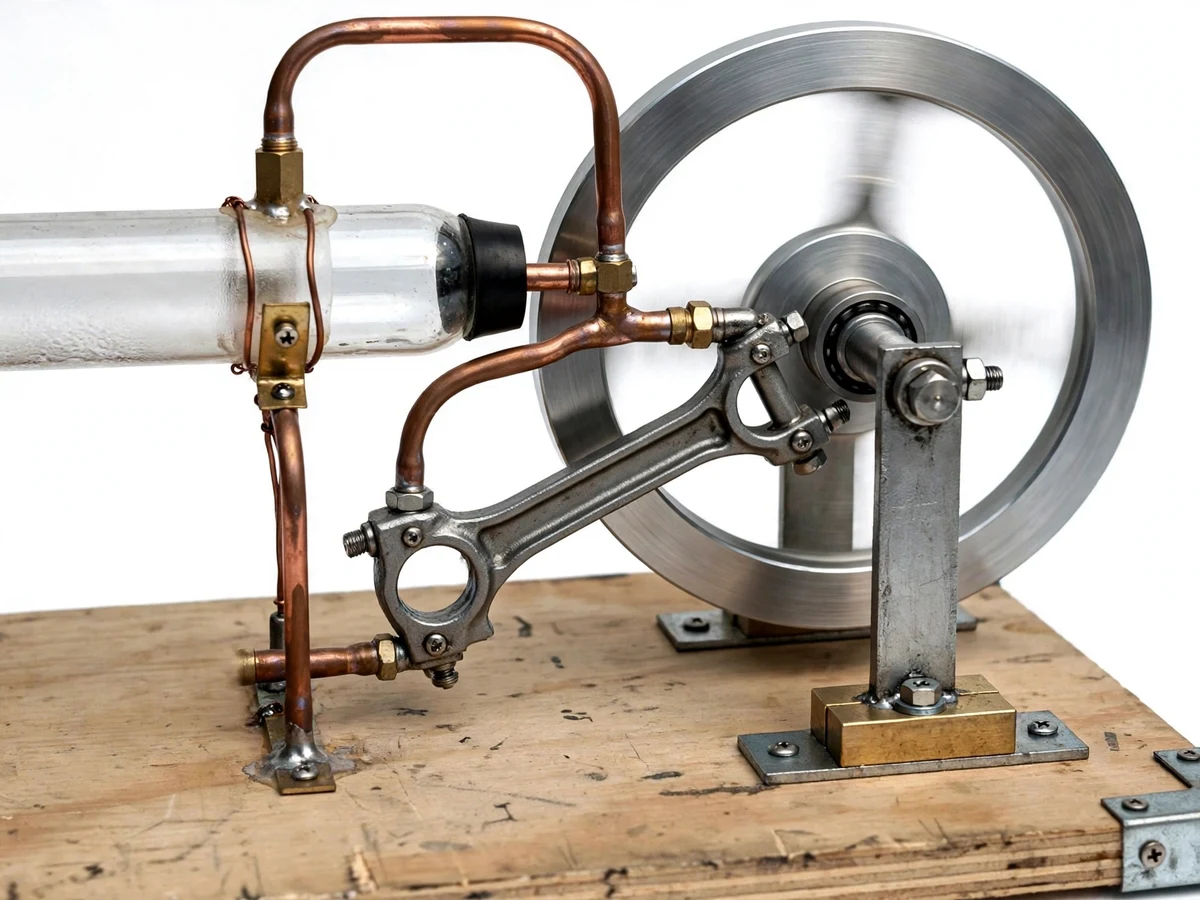
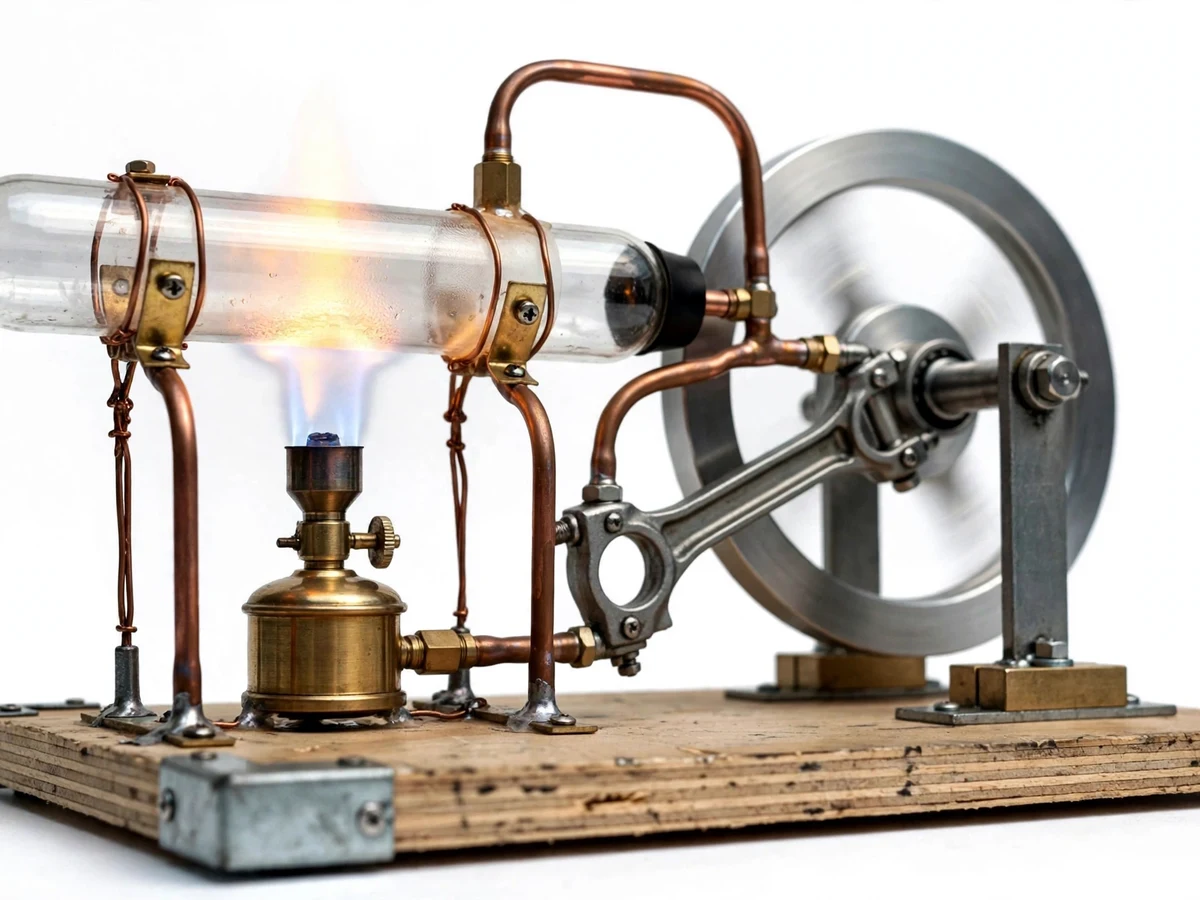
Most engines students meet are internal-combustion: fuel burns inside the cylinder. The Stirling engine is the elegant counter-example — an external-combustion engine where heat is applied from outside, the same working air is sealed inside forever, and power comes purely from shuttling that air between a hot end and a cold end. It was patented in 1816, predates the diesel, and today it appears in solar concentrators, cryocoolers and quiet auxiliary power — yet in college thermodynamics it usually stays a p-V diagram on paper. This project changes that: a running gamma-type Stirling model with a glass displacer cylinder, an alcohol burner, a power piston and a flywheel. The student fabricates the parts, sets the crank phase angle, adjusts the burner, and tunes the engine until it runs — the full cycle made visible in glass and motion.
Adjustable-flame spirit burner heating the closed end of the displacer cylinder.
Follow the working sequence
How it works
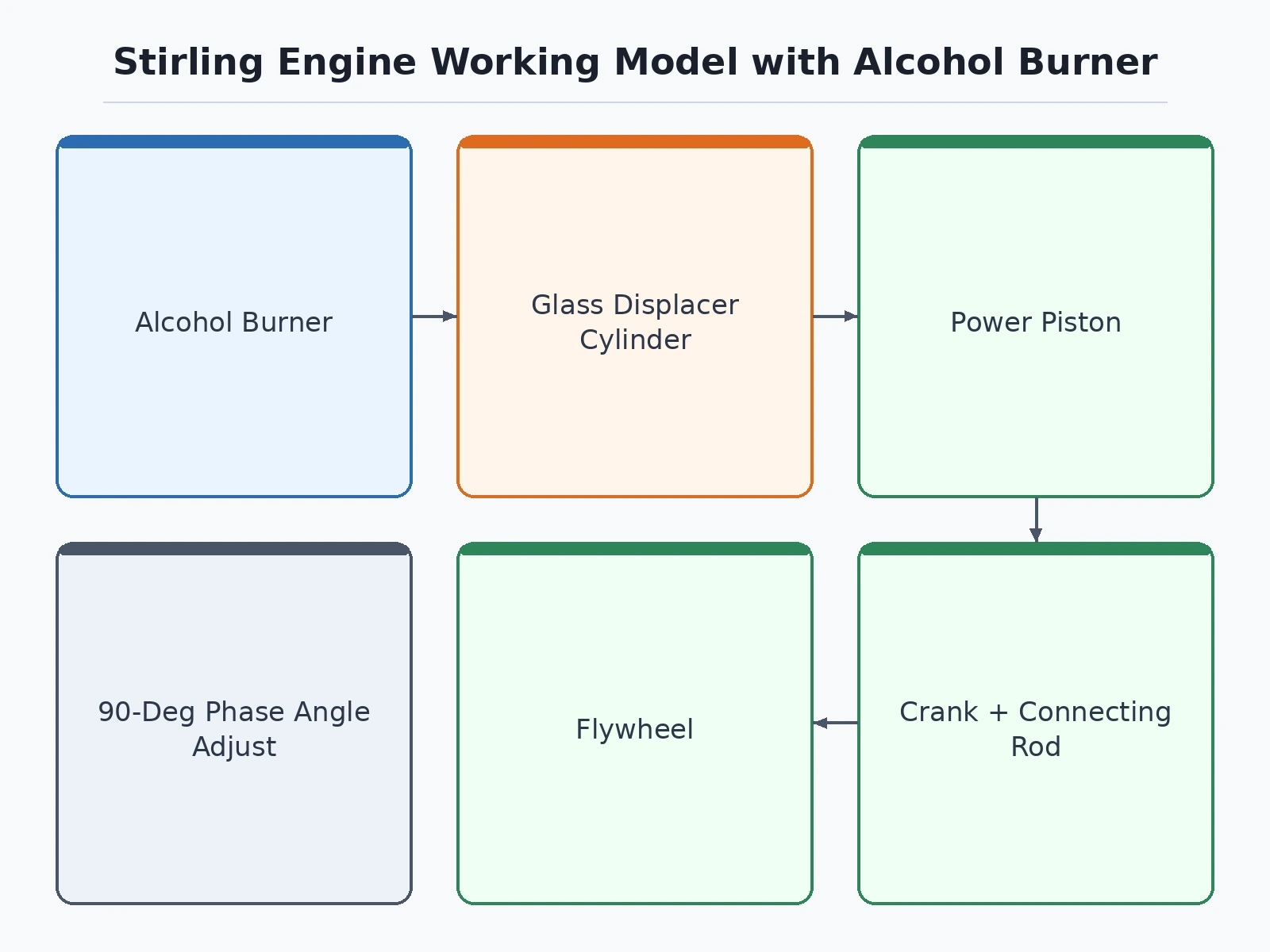
- The alcohol burner heats the closed end of the glass displacer cylinder, creating a hot zone; the far end stays near room temperature (cold zone).
- The displacer — a loose-fitting cylinder inside the glass tube — shuttles the trapped air between the hot and cold ends.
- When air is in the hot end it expands and pushes the power piston out; when moved to the cold end it contracts and the piston is drawn back.
- The crank ties displacer and piston to the same shaft with a ~90-degree phase angle, so the cycle sequences itself: expand, transfer, contract, transfer.
- The flywheel stores energy through the cycle and carries the mechanism over the dead spots.
- The student adjusts burner height, phase angle and displacer clearance until the engine runs steadily.
- Speed is observed by counting flywheel revolutions over a timed interval — the measured output of the student's own tuning.
Tech stack:
- Glass test-tube displacer cylinder
- Alcohol spirit burner
- Machined/fitted displacer and power piston
- Steel flywheel with crank and connecting rod
- Plywood base with L-bracket mounts
- Copper/steel tubing and fasteners
- Hand tools: files, drill, measuring instruments
| Parameter | Value |
|---|---|
| Engine type | Gamma-type Stirling (separate displacer and power cylinders) |
| Heat source | Alcohol spirit burner, adjustable flame |
| Displacer cylinder | Glass test tube, design approx. 25 mm ID |
| Phase angle | Adjustable, design target ~90 degrees |
| Output | Rotary motion at flywheel; speed measured by student (design target tens of rpm after tuning) |
| Working fluid | Air, sealed in the engine |
| Construction | Plywood base, steel flywheel, hand-fitted piston/displacer |
| Measured values | RPM and run duration are measured by the student during tuning — not pre-claimed |
Project features
- [Working gamma-type engine] Displacer and power piston in separate cylinders — the classic configuration for teaching the Stirling cycle.
- [Glass displacer cylinder] The hot end is a glass test-tube cylinder so the displacer motion and heat flow are visible during operation.
- [Alcohol burner heat source] A spirit burner provides the hot end; flame height is adjustable to control heat input.
- [Flywheel and crank drive] A flywheel smooths the power pulses and a crank with connecting rod converts the piston motion to rotation.
- [Adjustable phase angle] The crank pin positions allow setting the ~90-degree displacer-to-piston phase that the Stirling cycle needs, and the student tunes it.
- [Low-friction construction] Displacer clearance and lightweight piston minimize friction — the key to a model that actually runs.
- [Tuning procedure] A documented tuning sequence (displacer clearance, phase angle, burner position, flywheel balance) gets the engine from assembly to running.
What is included
- Working Stirling engine model (glass cylinder, displacer, piston, flywheel, crank, burner)
- Fabrication and assembly documentation with part drawings
- Tuning procedure (phase angle, clearance, burner position)
- Project report PDF (Stirling cycle theory, fabrication methodology, tuning log template)
- PPT presentation for final review
- Viva Q&A preparation document (Stirling cycle, isothermal vs adiabatic, phase angle reasoning)
- Setup and demonstration guide
Limitations & prerequisites
- This is a demonstration model, not a power source — useful shaft output is tiny and not characterized as a power rating.
- RPM and continuous run time depend on the student's own tuning and ambient conditions; no speed is claimed before measurement.
- The glass cylinder is fragile and the burner is an open flame — the model runs only under supervision with standard lab fire precautions.
- The model uses air at atmospheric pressure; pressurized or regenerator-equipped variants are possible extensions, not part of the base build.
- Heat input is manual (burner flame height), so efficiency comparisons are qualitative.
Frequently Asked Questions
What type of Stirling engine is this?
A gamma-type: the displacer and the power piston sit in separate cylinders. It is the most common teaching configuration because each part of the cycle is visible and adjustable.
Why is the phase angle 90 degrees?
The displacer must move the air to the hot end before the piston's power stroke and to the cold end before the return — a quarter-cycle (90°) lead makes that sequence happen. The crank allows the student to set and adjust it.
Will it definitely run?
It runs when built and tuned to the documented procedure — displacer clearance, phase angle, flywheel balance and burner position all matter. The tuning guide walks through each, which is itself the learning.
Is it safe with the open flame?
The alcohol burner is a standard lab heat source; the model is operated under supervision on a clear bench with the usual fire precautions, same as any chemistry-lab burner.
What are the main limitations?
Tiny useful power, fragile glass, supervised operation only, and no claimed RPM or efficiency figures — performance comes from the student's own tuning and measurement.
Is this project suitable for a final-year project?
Yes — for Mechanical programs. It demonstrates the Stirling cycle, fabrication, mechanism timing and experimental tuning, all strong viva material. Suitable for B.E./B.Tech final-year projects in Mechanical engineering.
Components & software requirements
- Glass test-tube displacer cylinder
- Alcohol spirit burner
- Machined/fitted displacer and power piston
- Steel flywheel with crank and connecting rod
- Plywood base with L-bracket mounts
- Copper/steel tubing and fasteners
- Hand tools: files, drill, measuring instruments
Delivery information
Built-to-order project. Delivery timeline is shared after order confirmation based on current queue.
Support terms
Complete documentation, setup guide, and viva preparation included. Support for setup and explanation provided.
Download free synopsis (PDF)
Enter your name and WhatsApp number — the synopsis PDF downloads immediately. We may send occasional project updates on WhatsApp; no spam.