
More project photos (2)
The problem
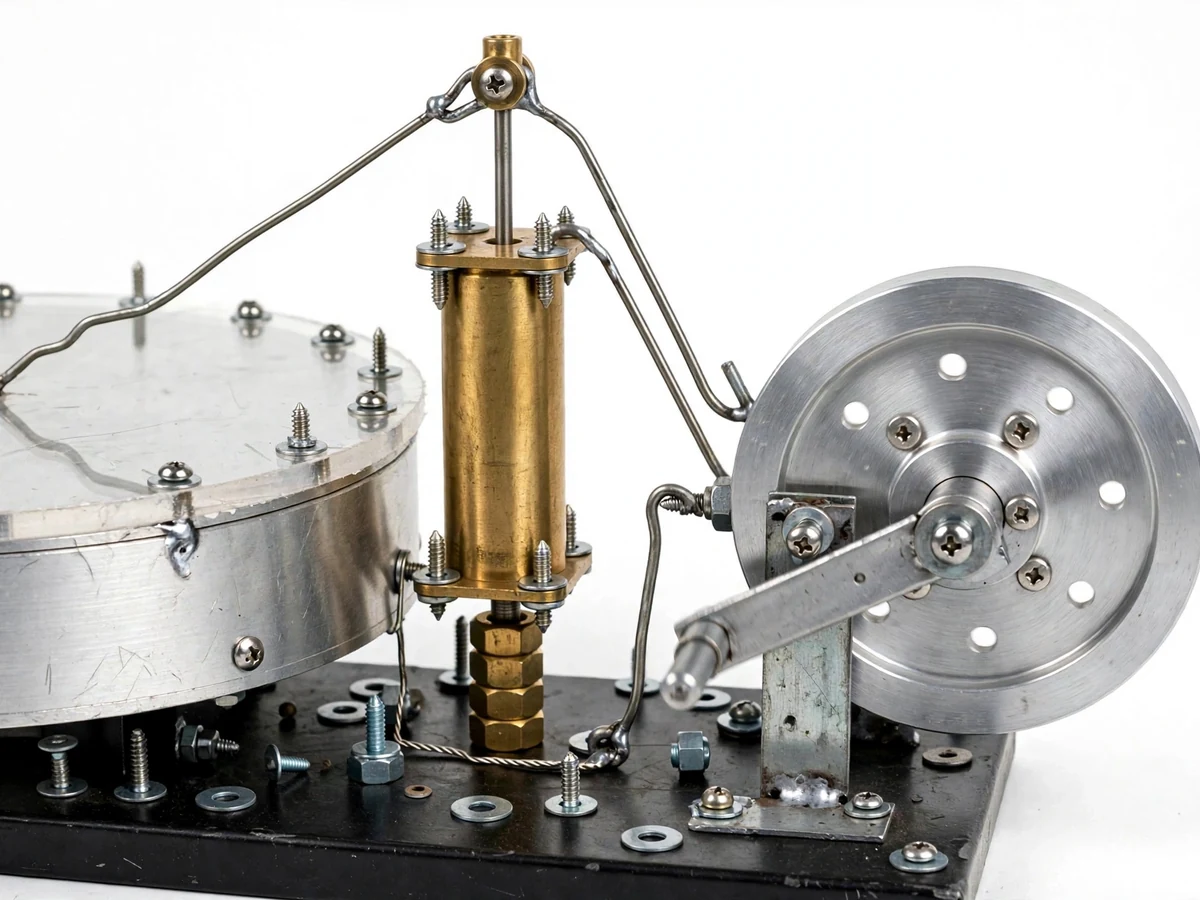
Heat engines are usually associated with flames, boilers and hundreds of degrees — but the Stirling cycle has a quieter cousin. A low-temperature-differential (LTD) Stirling engine runs on a temperature difference of only a few degrees Celsius: published demonstrators are documented running on differentials of about 7–10 °C, even from a mug of hot water or a warm hand. That makes the LTD engine a perfect desktop demonstrator of thermodynamics: no combustion, no pressure vessel, no electricity — just air being shuttled between a warm plate and a cool one, and a flywheel that keeps turning while the difference persists. This project builds that demonstrator in gamma configuration — the large displacer cylinder and the small power piston in separate cylinders, coupled through one crankshaft — from acrylic, brass and steel parts cut and fitted with ordinary workshop tools, following the published hardware-store LTD build methodology.
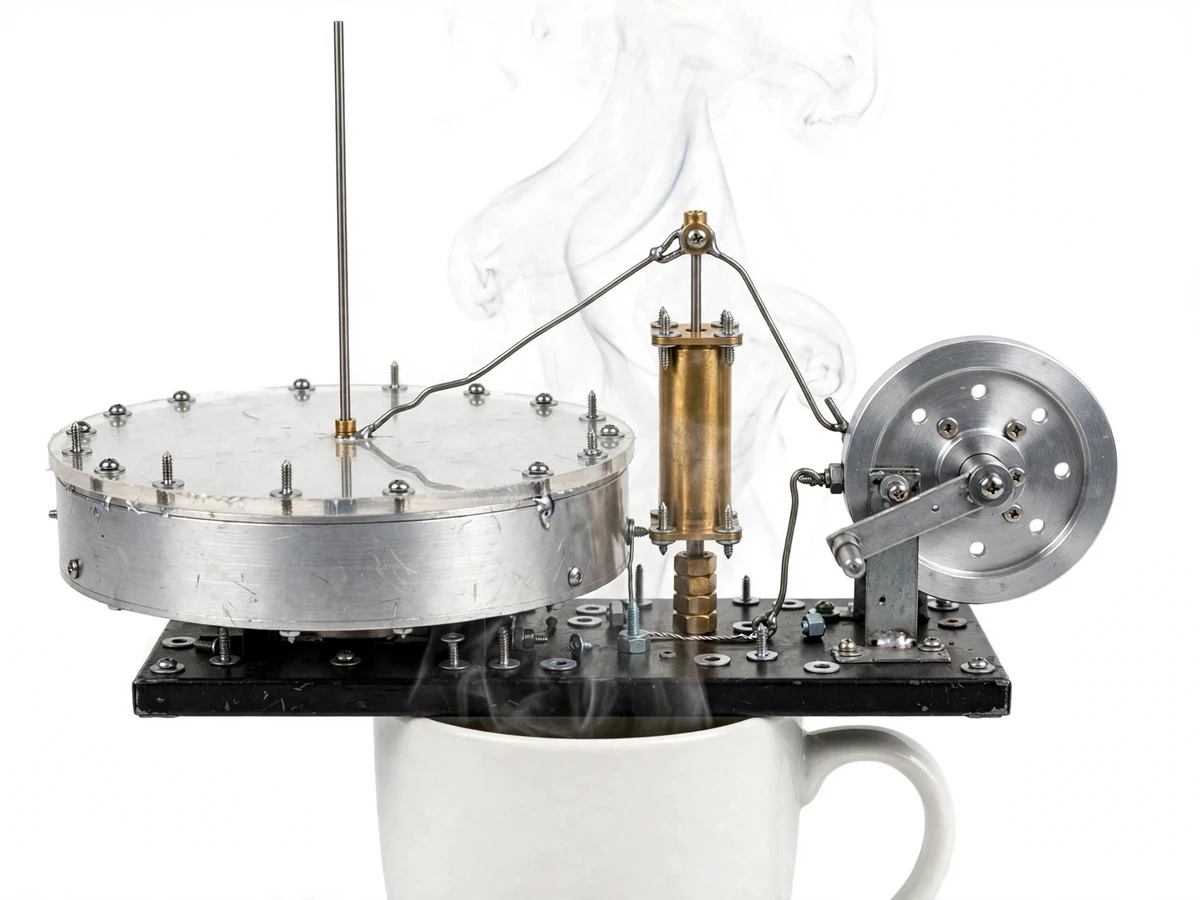
A mug of about 90 C water sits under the aluminium bottom plate. The temperature difference is the engine's only fuel.
Follow the working sequence
How it works
- The engine is placed so its aluminium bottom plate sits over a mug of hot water at approximately 90 °C (recommended heat source), while the acrylic top plate stays near room temperature — this temperature difference is the engine's only fuel. Allow approximately 30–60 s of preheat (expected) for the bottom plate to warm through.
- Give the flywheel a gentle flick by hand to start — LTD models rarely self-start, and this is documented behaviour, not a defect. The flywheel's inertia carries the mechanism through the points of the cycle where the gas produces no useful force.
- Expansion stroke: with the displacer rising, the trapped air is shoved down against the heated bottom plate. The air warms and expands, pushing the small power piston outward — this is the working stroke that feeds energy into the crankshaft.
- Transfer: the crank, with the displacer leading the power piston by approximately 90° (design target), now drives the displacer downward, shifting the same trapped air up to the cool top plate region. The air cools and its pressure falls.
- Compression stroke: with gas pressure low, the flywheel's momentum drives the power piston back inward, re-compressing the cooled air — this costs less work than the expansion stroke returned, so every revolution adds net work to the flywheel.
- The cycle repeats as long as the temperature difference persists; as the water cools toward room temperature the engine slows and stops, which itself demonstrates that a heat engine needs a ΔT, not heat alone.
Tech stack:
- Aluminium sheet and acrylic sheet fabrication
- Brass cylinder boring and honing
- Graphite piston fitting (oil-free, low-friction)
- Steel-wire crank linkages
- Flywheel machining and balancing
- Stirling thermodynamic cycle theory
- LTD engine tuning (clearance, phase angle)
- Drill-press and hand-tool fitting
| Parameter | Value |
|---|---|
| Overall footprint | Approximately 220 × 160 × 140 mm (design target) |
| Displacer chamber | Approximately 200 mm diameter × 70 mm tall (design target) |
| Displacer disc | Thin acrylic, approximately 3 mm thick (design target) |
| Power cylinder | Brass, approximately 16 mm bore (design target) |
| Power piston | Graphite, close fit, no seals (design) |
| Working fluid | Air at atmospheric pressure (design) |
| Phase angle | Displacer leads power piston by approximately 90° (design target) |
| Flywheel | Aluminium, approximately 100 mm diameter (design target) |
| Recommended heat source | Mug of hot water, approximately 90 °C |
| Minimum ΔT | Approximately 10 °C across the displacer chamber (design target, per published LTD demonstrators) |
| Preheat time | Approximately 30–60 s on hot water (expected) |
| Start procedure | Gentle flywheel flick by hand (expected behaviour) |
| Engine mass | Approximately 500 g (design target) |
| Rotation speed | Slow, unhurried rotation — not rated; buyer measures with a stopwatch (no RPM claimed) |
| Power output | Not rated — thermodynamics demonstrator, not a generator (explicit) |
Project features
- [Large transparent displacer chamber] A wide, shallow displacer cylinder — approximately 200 mm diameter — with a clear acrylic top plate, so the thin displacer disc shuttling air between the hot bottom plate and the cool top plate is visible while the engine runs.
- [Gamma layout with separate power cylinder] Displacer and power piston sit in separate cylinders on one crankshaft, the defining gamma arrangement — mechanically simpler to build than beta, since the power piston never shares its bore with the displacer and no hot sliding seals are needed.
- [Low-friction brass power cylinder] A close-fitting graphite piston runs in a honed brass bore with no oil and no rings; at low ΔT the pressure force on the piston is tiny, so this near-frictionless fit is what makes the whole engine possible.
- [Crank and flywheel drive] Steel-wire linkages connect the displacer rod and power piston to a crank with the displacer leading by approximately 90° (design target), and an aluminium flywheel carries the rotation through the cycle's weak points.
- [Runs on a cup of hot water] The signature LTD behaviour: no flame, no burner, no electricity — set over a mug of approximately 90 °C water, it preheats in about 30–60 s and keeps turning while the temperature difference persists.
- [Tunable at build time] Displacer clearance, linkage lengths and crank phase angle are adjustable in the build, so the student can experiment with what makes an LTD engine start and keep running (configurable at build).
- [Future scope — not built] A micro-generator or tachometer output is deliberately not included; it is listed as future scope in the report, not part of the delivered build.
What is included
- Working LTD Stirling engine model, assembled and tuned
- Dimensioned 2D drawings of the displacer chamber, crank layout and flywheel
- Complete material list with hardware-store sourcing notes
- Assembly and tuning guide (displacer clearance setting, phase-angle adjustment, friction debugging)
- Theory notes: Stirling cycle derivation, gamma layout, regenerator concept, why LTD works
- Project report PDF (background, methodology, cycle analysis, results discussion)
- PPT presentation for final review
- Viva Q&A preparation document (thermodynamics, Stirling cycle, gamma vs alpha vs beta, LTD operation)
Limitations & prerequisites
- This is a thermodynamics demonstrator, not a power generator — its mechanical output is tiny and deliberately unrated; no load-driving or electricity-generation claim is made.
- It does not self-start: a gentle flick of the flywheel is needed after preheat, which is normal documented LTD behaviour, not a defect.
- It runs only while a sufficient temperature difference exists — as the water cools toward room temperature, the engine slows and stops.
- At low ΔT the pressure force on the power piston is very small, so the build is sensitive to friction and alignment — dusty, bent or overtightened linkages will stall it.
- No flame or burner may be used — direct heat warps the acrylic top plate; hot water is the only intended heat source.
- The model has no regenerator (Stirling's original "economiser"): the thin displacer and narrow gaps provide only simple heat transfer, so efficiency is far below industrial Stirling engines — stated plainly.
Frequently Asked Questions
Is this project suitable for a final-year project?
Yes — for Mechanical Engineering programs. It demonstrates the Stirling thermodynamic cycle in working hardware: heat transfer, gas laws, the four cycle processes, gamma-layout kinematics, crank-phase tuning and low-friction precision fitting. The transparent chamber makes the cycle visible, so the student can explain every process live during the viva.
How can a cup of hot water power an engine?
A heat engine needs a temperature DIFFERENCE, not high temperature. The hot water warms the bottom plate while the acrylic top stays near room temperature; the displacer keeps shuttling air between the two, and the pressure swing drives the piston. Published LTD demonstrators run on differentials as low as about 7–10 °C, so a hot mug is ample.
What is gamma configuration, and why this layout?
Gamma means the displacer and the power piston live in separate cylinders on one crankshaft — unlike beta, where they share a bore. It is mechanically simpler to build: the power piston never shares its bore with the displacer, so a cheap brass tube with a close-fitting piston works without hot seals. The trade-off is extra dead volume and a lower compression ratio, acceptable in a demonstrator.
What did Robert Stirling patent in 1816?
In 1816 the Scottish clergyman Robert Stirling patented a closed-cycle hot-air engine — the device we now call the Stirling engine. The patent's distinctive feature was an "economiser", later called the regenerator: a mesh that stores heat from the working air on one part of the cycle and returns it on the next. This desktop LTD model omits the regenerator, stated honestly in the limitations.
Can it generate electricity or drive a load?
No. This build is a thermodynamics demonstrator, deliberately unrated — its mechanical output is tiny, and no generator or gearbox is included. It demonstrates the cycle, the kinematics and precision low-friction fitting. Adding a micro-generator to light an LED is listed as future scope in the report, not part of the delivered build.
Components & software requirements
- Aluminium sheet and acrylic sheet fabrication
- Brass cylinder boring and honing
- Graphite piston fitting (oil-free, low-friction)
- Steel-wire crank linkages
- Flywheel machining and balancing
- Stirling thermodynamic cycle theory
- LTD engine tuning (clearance, phase angle)
- Drill-press and hand-tool fitting
Delivery information
Built-to-order project. Delivery timeline is shared after order confirmation based on current queue.
Support terms
Complete documentation, setup guide, and viva preparation included. Support for setup and explanation provided.
Download free synopsis (PDF)
Enter your name and WhatsApp number — the synopsis PDF downloads immediately. We may send occasional project updates on WhatsApp; no spam.