
More project photos (3)
The problem
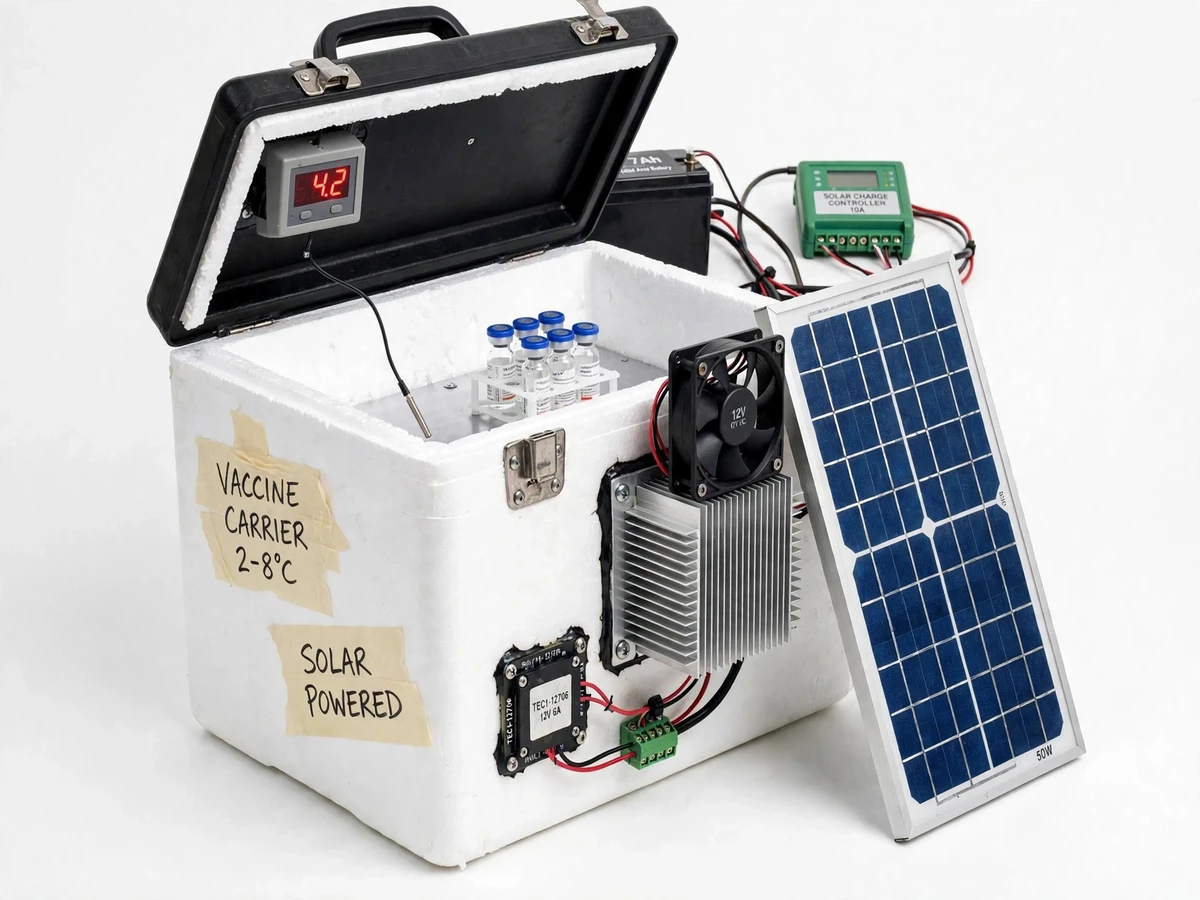
The Solar-Powered Thermoelectric Vaccine Carrier Box is a portable, actively-cooled cold-chain container that keeps vaccines and medicines inside the 2–8°C band without grid electricity. It serves rural immunisation camps and last-mile health workers, where vaccines spoil when the cold chain breaks between the health centre and the village.
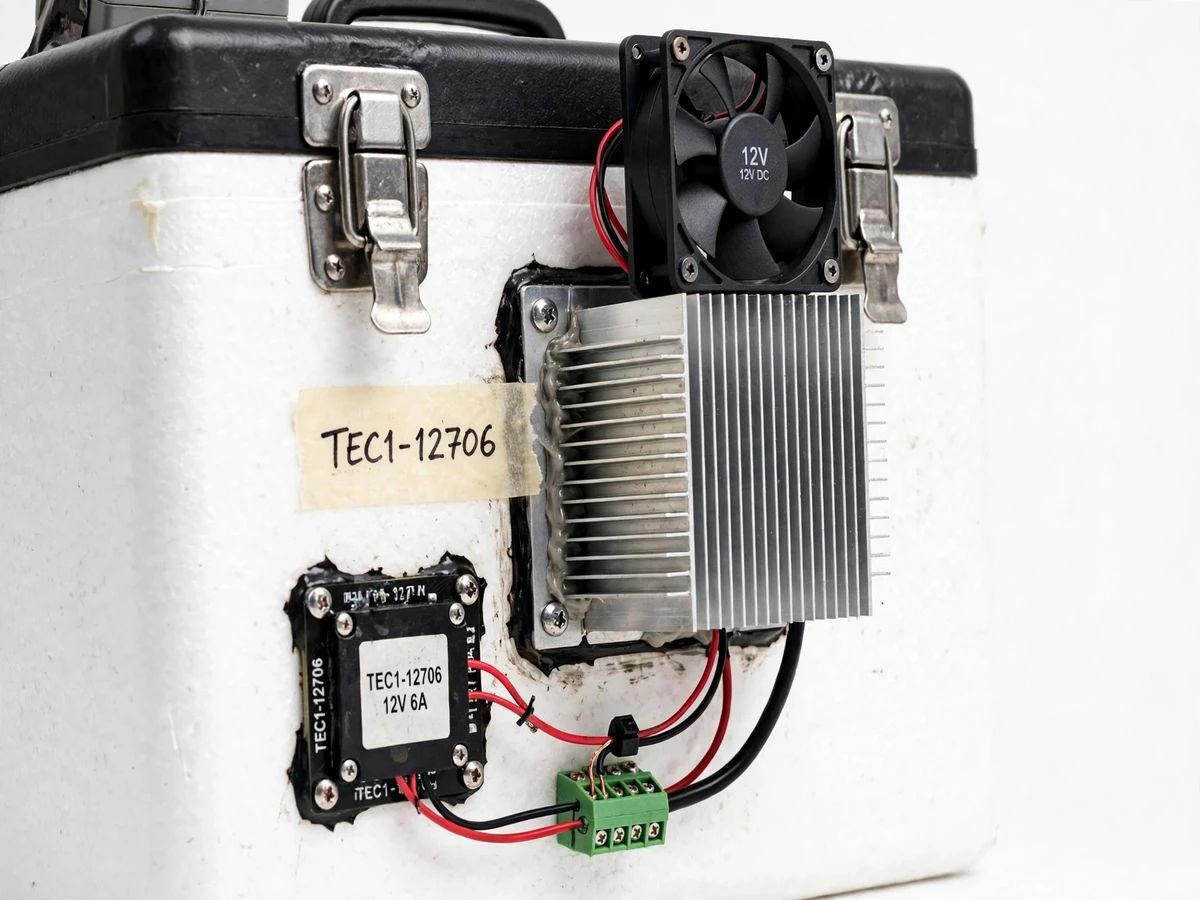
Unlike a passive ice box, which warms as its ice melts, this box pumps heat out continuously with a TEC1-12706 Peltier module set into the insulated wall, backed by a fan-cooled hot-side heatsink. A 50W solar panel charges a 12V battery through a charge controller, and a W1209-class digital temperature controller with probe and display cycles the module around the setpoint. The engineering is thermal-mechanical: sizing insulation against heat leak, designing the heatsink to reject both pumped heat and the module's own dissipation, and balancing the solar budget against cooling load. Holding 2–8°C is a design target; actual performance depends on ambient temperature, sun hours and lid openings.
Converts sunlight to DC power for the cooling load.
Follow the working sequence
How it works
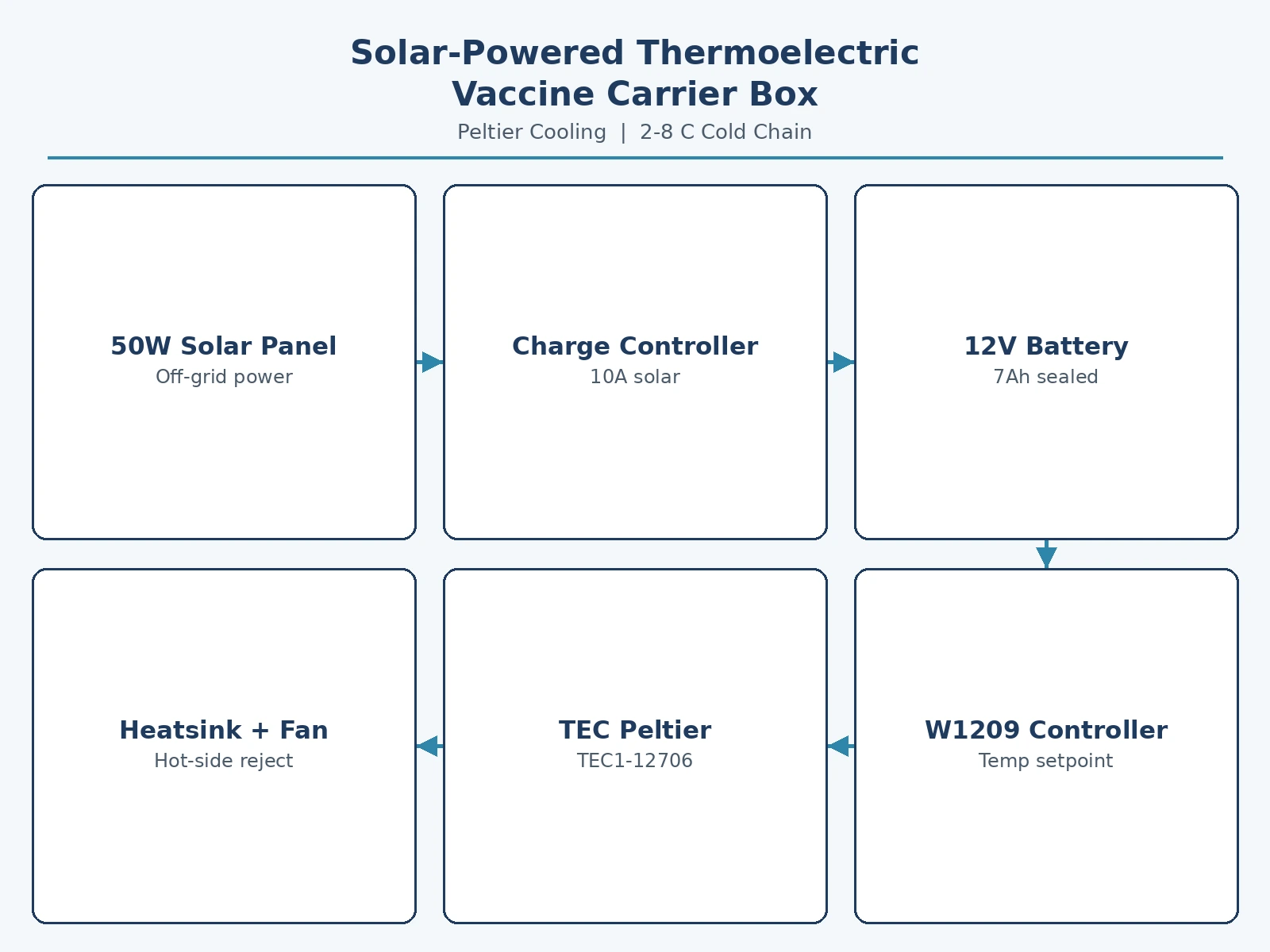
Sunlight hits the 50W panel as the charge controller tops up the 12V battery and powers the load. The W1209 controller reads the probe temperature and compares it with the setpoint; when the interior drifts above it, the controller's relay energises the TEC1-12706 module and the hot-side fan. Inside the module, DC current flowing through 127 bismuth-telluride thermocouple pairs pumps heat from the cold face to the hot face by the Peltier effect — one side of the slab drops below ambient while the other runs hotter than ambient. The cold face draws heat from the interior through the cold-side spreader, while the hot face dumps its heat into the finned heatsink, where the fan blows it away. When the probe reads the setpoint minus hysteresis, the relay drops out and cooling stops, and the 40mm polystyrene walls slow heat leaking back in. The cycle repeats through the day, and the solar-charged battery carries the system between sun and shade.
- The 50W solar panel charges the 12V 7Ah battery through the 10A charge controller, which also feeds the cooling load directly while the sun is up.
- The W1209 controller continuously compares the interior probe temperature against the setpoint (4°C nominal, set inside the 2–8°C band) with an adjustable hysteresis of about ±1°C.
- When the probe reads above setpoint plus hysteresis, the controller's relay switches on the TEC1-12706 Peltier module and the 12V hot-side fan.
- DC current through the module's 127 thermocouple pairs (datasheet values: Imax 6A, Vmax 15.4V, Qmax 50–60W) pumps heat from the cold face to the hot face by the Peltier effect.
- The cold face absorbs interior heat through the aluminium cold-side spreader, while the hot face rejects heat into the finned heatsink, which the fan cools with forced air.
- When the probe falls to setpoint minus hysteresis, the relay drops out, cooling stops, and the 40mm insulation walls slow heat leaking back into the box.
- The controller display shows live interior temperature at all times, so the health worker can verify the 2–8°C band without opening the lid.
Tech stack:
- TEC1-12706 thermoelectric module
- W1209-class digital temperature controller
- 50W polycrystalline solar panel
- 10A solar charge controller
- 12V 7Ah sealed lead-acid battery
- Aluminium heatsink · 12V DC fan
- PUF/polystyrene insulation panels
- Sheet metal · latches · handle hardware
| Parameter | Value |
|---|---|
| Interior volume | Approximately 20 L (design target) |
| Target interior band | 2–8°C (design target, not a measured claim) |
| Peltier module | TEC1-12706: 127 couples, Imax 6A (datasheet value), Vmax 15.4V (datasheet value), Qmax 50–60W (datasheet value) |
| Temperature controller | W1209 class, 12V, relay rated 10A (typical module specification); hysteresis range 0.1–15°C (datasheet range), used at ±1°C (design target) |
| Solar panel | 50W polycrystalline (panel nameplate rating) |
| Battery | 12V 7Ah sealed lead-acid, 84Wh nominal (nameplate value) |
| Charge controller | 10A PWM solar charge controller (nameplate value) |
| Insulation | 40mm polystyrene panels (design value); conductivity ≈ 0.033 W/m·K (typical published value) |
| Hot-side fan | 12V DC, approximately 0.25A draw (typical) |
| Daily solar yield | Approximately 250Wh on a 5-peak-sun-hour day (typical, location-dependent) |
Project features
The headline capabilities are active 2–8°C cooling with no compressor and no grid power, fully solar-driven energy autonomy through a 50W panel and a 12V battery with a charge controller, and precise setpoint control via a digital temperature controller with a probe and display. Around these, the build adds the thermal-mechanical detailing that makes it a genuine Mechanical project: a finned hot-side heatsink with a 12V fan sized to reject both the pumped heat and the module's own electrical dissipation — the doubled load that students most often undersize — plus a cold-side spreader fin that evens out interior temperatures so vials near the cold face never freeze while far corners stay cool. A rugged latching insulated enclosure with a carry handle is sized for health-worker field use, and the report carries the full solar energy balance, insulation sizing calculations and battery autonomy figures, so every design decision is defended from datasheets rather than claimed results.
- [Active thermoelectric cooling] A TEC1-12706 Peltier module (127 couples; datasheet values: Imax 6A, Vmax 15.4V, Qmax 50–60W) mounted through the insulated wall pumps heat from the interior to the hot-side heatsink whenever the controller calls for cooling.
- [Fan-cooled hot-side heat rejection] A finned aluminium heatsink with a 12V DC fan rejects the pumped heat plus the module's own electrical input — the build's single most important sizing decision, since an undersized hot side collapses the cold-side temperature difference.
- [Digital temperature control] A W1209-class 12V controller with an NTC probe and LED display cycles the module around the setpoint with adjustable hysteresis (used at ±1°C, design target), preventing freeze damage to vaccines.
- [Solar autonomy package] A 50W solar panel, 10A solar charge controller and 12V 7Ah sealed battery run the box off-grid; a typical 5-peak-sun-hour day yields roughly 250Wh (typical), covering daytime cooling load.
- [Insulated field enclosure] PUF/polystyrene-panel enclosure (40mm wall, design value) with a gasketed lid, metal latches and a carry handle; lid-opening frequency is treated as a design input in the thermal sizing.
- [Cold-side spreader fin] An aluminium spreader inside the box evens out interior temperature so vials near the cold face do not freeze while far corners stay cool.
- [Energy balance documentation] The report carries the full solar-energy budget — panel yield versus Peltier duty cycle, fan and controller draw, and battery autonomy hours — so the sizing logic is viva-ready.
- [Serviceable wiring] Terminal-block wiring, a fused battery line and accessible controller settings so the box can be repaired in the field.
What is included
- Fully assembled and wired carrier box with Peltier module, heatsink, fan, controller and probe
- 50W solar panel, 10A charge controller and 12V 7Ah battery with fused wiring
- Insulation sizing calculations and solar energy-balance worksheet
- Project report PDF (thermal design, build, testing procedure, results table)
- PPT presentation for final review
- Viva Q&A preparation document (Peltier effect, heatsink sizing, hysteresis control, solar sizing)
Limitations & prerequisites
- The 2–8°C band is a design target, not a measured claim — actual performance varies with ambient temperature (the design struggles above ~42°C ambient), sun hours and lid-opening frequency.
- Thermoelectric efficiency is low (COP approximately 0.3–0.5 at the operating point, typical); the box draws far more power than a compressor fridge of the same size, so it suits small volumes only.
- The 7Ah battery covers roughly 1–1.5 hours of full-load Peltier operation on its own (design target); overnight or monsoon-day operation needs a larger battery, documented as an optional upgrade.
- Solar charging stops in poor light — on cloudy days the battery may not fully recharge, and the box behaves as a well-insulated passive carrier until the sun returns.
- Frequent lid opening floods the interior with warm humid air; the report states the pull-down penalty and recommends batch handling of vials.
- Condensation forms on the cold-side spreader in humid climates; vials must travel in sealed racks and the interior wiped down after use.
- This is a student-built prototype, not a WHO PQS-certified cold-chain device — suitable for field trials and demonstrations, not for regulated vaccine logistics without certification.
- No data logging or cloud alerts are included (a separate IoT monitoring build in the catalogue covers that); temperature is verified visually on the controller display.
Frequently Asked Questions
How does the Peltier module actually cool the box?
When DC current flows through the module's 127 bismuth-telluride thermocouple pairs, the Peltier effect moves heat from one ceramic face to the other — the cold face absorbs heat from the box interior while the hot face runs hotter than ambient and dumps that heat into the heatsink. There is no compressor, no refrigerant and no moving part inside the module itself. Reversing the polarity reverses the faces, which is why the cold side is thermally isolated inside the insulated wall while the hot side stays exposed to the fan-cooled heatsink.
How is this different from the IoT cold-chain monitor already in the catalogue?
That project is a monitoring node — an ESP32 with temperature sensors that watches an existing fridge or passive box and sends cloud alerts when the temperature drifts. This project does the opposite job: it actively cools the box itself with solar-powered thermoelectric refrigeration, where the insulation sizing, hot-side heat rejection and solar energy balance are the engineering content. It is a thermal-mechanical build, not an IoT sensing build; the two can be combined later as future scope.
Can the box hold 2–8°C overnight or on cloudy days?
Only within the battery's limits — the supplied 12V 7Ah battery carries roughly 1–1.5 hours of full-load Peltier operation on its own, so all-night operation needs either a larger battery or a duty-cycled control strategy, both documented as optional upgrades. In full sun the 50W panel runs the cooling load and charges the battery at the same time, and the 40mm insulation slows the warm-up whenever the module is off. The energy-balance worksheet in the report sizes the exact battery needed for the buyer's required autonomy.
Why is the hot-side heatsink so large — what happens if it is undersized?
The heatsink must reject the heat pumped out of the box PLUS the module's own electrical dissipation, roughly doubling the thermal load on the hot side — this is the single most common undersizing mistake in student Peltier builds. If the heatsink is too small, the hot face runs hotter, the module's achievable temperature difference collapses, and the cold face never gets cold. The build sizes the finned heatsink and fan for this doubled load with margin, and the report walks through the calculation for the viva.
Is this project suitable for a final-year project?
Yes — for Mechanical, and for Electrical students leaning into thermal-electrical design. It covers insulation sizing, Peltier thermoelectric theory, heat-rejection design, solar energy balance and hysteresis control, each fully defensible in the viva with calculations and datasheets rather than claimed results. The clear differentiation from a passive ice box and from IoT monitoring builds gives the report an original, verifiable engineering story.
Components & software requirements
- TEC1-12706 thermoelectric module
- W1209-class digital temperature controller
- 50W polycrystalline solar panel
- 10A solar charge controller
- 12V 7Ah sealed lead-acid battery
- Aluminium heatsink · 12V DC fan
- PUF/polystyrene insulation panels
- Sheet metal · latches · handle hardware
Delivery information
Built-to-order project. Delivery timeline is shared after order confirmation based on current queue.
Support terms
Complete documentation, setup guide, and viva preparation included. Support for setup and explanation provided.
Download free synopsis (PDF)
Enter your name and WhatsApp number — the synopsis PDF downloads immediately. We may send occasional project updates on WhatsApp; no spam.