
More project photos (2)
The problem
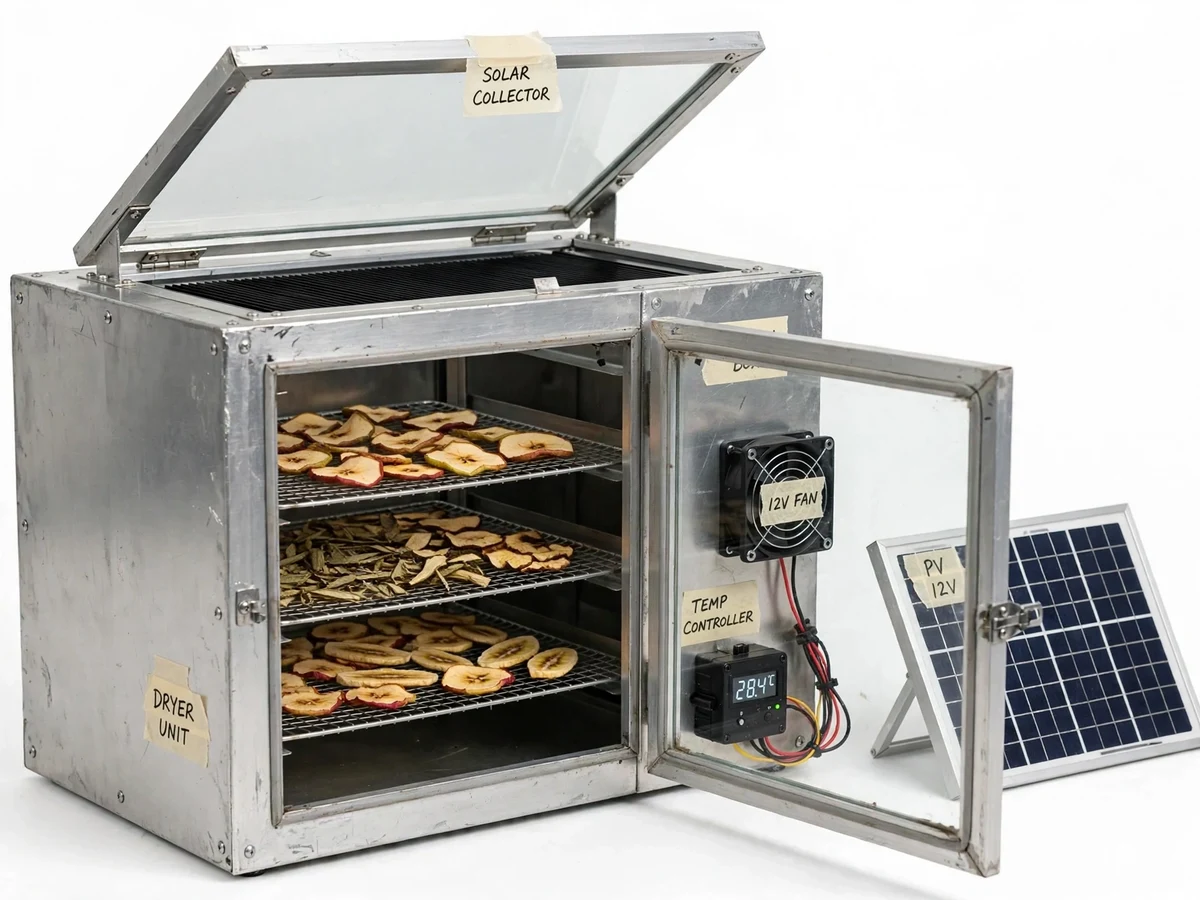
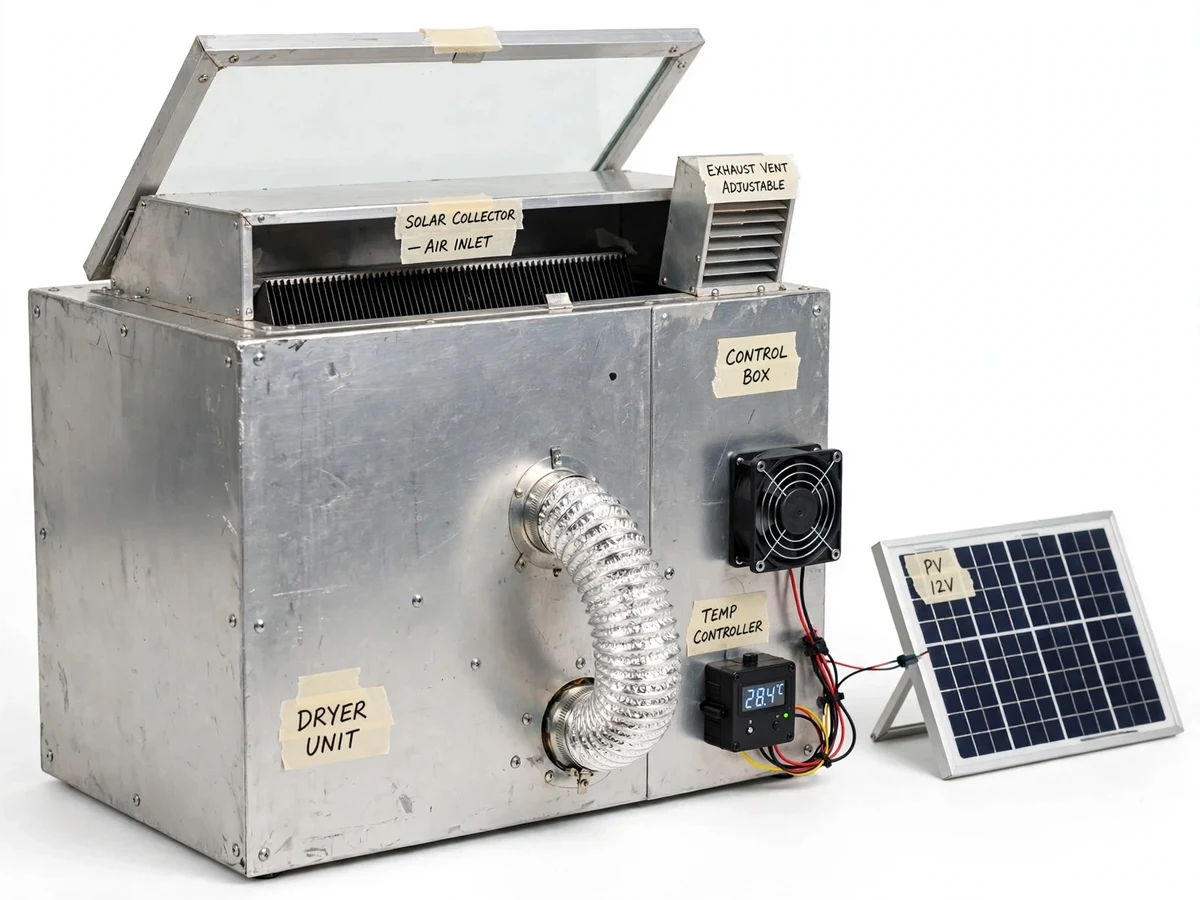
Open sun drying is still how much farm produce is dried in India, and it has well-known problems: dust and insects settle on the food, a sudden shower ruins a day's work, and uneven drying leaves some pieces over-dried while others stay moist enough to spoil. Electric and LPG dryers solve this but cost money to run every single day. A solar dryer sits in the middle — free heat from the sun, but enclosed and controlled so the produce is protected and dries evenly. This project builds exactly that: a flat-plate solar air collector feeds hot air into an insulated drying cabinet, a small DC fan (powered by a solar-charged battery) forces that air up through stacked trays of sliced produce, and a digital thermostat with a backup heater holds the chamber at a settable temperature when the sun dips. The student fabricates the cabinet and collector from sheet metal, sizes the airflow path, wires the control circuit and runs drying trials to compare performance — a complete mechanical design-and-build exercise with a working prototype at the end.
Flat-plate collector: sunlight through glazing strikes the black absorber plate, heating the duct air.
Follow the working sequence
How it works
- Sunlight passes through the collector glazing and strikes the black absorber plate, heating the air trapped inside the collector duct.
- The solar panel charges the 12 V battery through the charge controller; the battery runs the DC fan and the temperature controller.
- The fan pushes the heated collector air into the base of the drying cabinet, where it rises evenly through the four wire-mesh trays loaded with sliced produce.
- Hot moving air picks up moisture from the produce surfaces and carries it upward; the humid air leaves through the adjustable top vent.
- The thermostat sensor in the chamber compares air temperature with the operator's setpoint. If the chamber is cooler than the setpoint (cloud, morning, evening), the relay switches the backup heater on; once the temperature climbs past the setpoint plus hysteresis, the heater switches off.
- The controller's display shows live chamber temperature throughout, and the operator adjusts the setpoint and vent opening to suit the produce being dried.
Tech stack:
- Sheet-metal fabrication (GI/MS cabinet, collector body)
- Flat-plate solar air collector (black absorber, single glazing)
- 20 W solar PV panel with charge controller
- 12 V · 7 Ah battery
- 12 V DC axial fan
- Digital thermostat module (XH-W3001-type, 12 V)
- Nichrome heater coil with relay switching
- SS wire-mesh drying trays
| Parameter | Value |
|---|---|
| Cabinet (outer) | Approximately 600 × 450 × 900 mm (design target) |
| Collector aperture | Approximately 1.0 × 0.6 m (design target) |
| Drying trays | 4, removable SS wire-mesh |
| Chamber temperature | Settable 30–70 °C; 40–60 °C typical for fruits and vegetables (design target) |
| Controller | 12 V digital thermostat, ±1 °C display resolution (datasheet), approximately 2 °C hysteresis (typical) |
| Fan | 12 V DC axial, approximately 0.2–0.3 A (component-dependent) |
| Solar panel | 20 W, 12 V nominal (design choice) |
| Battery | 12 V, 7 Ah lead-acid (design choice) |
| Backup heater | 200 W nichrome coil, relay-switched, mains-powered (design choice) |
| Operation | Off-grid in sunshine; heater needs mains supply |
Project features
- [Flat-plate solar air collector] A black-painted absorber plate under single glazing heats incoming air with sunlight alone — the project's main heat source, built from sheet metal and sized to the cabinet.
- [Forced-convection DC fan] A 12 V DC axial fan pushes collector air up through the trays at a steady rate; powered by the solar-charged battery so airflow continues without mains supply.
- [Digital temperature controller] A 12 V digital thermostat module with a chamber temperature sensor and a settable range; the live temperature shows on its built-in display.
- [Backup nichrome heater] A relay-switched nichrome heater coil engages automatically when chamber temperature falls below the setpoint, so drying continues through cloudy spells and low-sun hours.
- [Multi-tray drying cabinet] An insulated sheet-metal cabinet with a front glass door holds four removable wire-mesh trays, so produce loads in layers with air flowing through every layer.
- [PV charging and battery] A 20 W solar panel with a charge controller charges a 12 V battery that runs the fan and controller — the dryer operates fully off-grid in sunshine.
- [Adjustable exhaust vent] A sliding top vent lets the operator balance temperature against moisture removal — opened wider for wet produce, closed down to hold heat.
What is included
- Working solar produce dryer prototype (cabinet, collector, fan, controller, heater, panel, battery, wiring)
- Complete wiring and control circuit documentation
- Sheet-metal fabrication drawings with dimensions
- Drying-test procedure to run on your own build (temperature logging, moisture-loss weighing)
- Project report PDF (background, design calculations, methodology, test results format)
- PPT presentation for final review
- Viva Q&A preparation document (solar thermal, heat transfer, airflow, temperature control)
Limitations & prerequisites
- Drying performance is weather-dependent: chamber temperature and airflow rate vary with solar intensity, so drying time changes day to day.
- Night operation is limited to battery capacity; the fan and controller draw down the 12 V battery, so overnight drying needs a larger battery (listed as customization).
- The 200 W backup heater requires a mains connection — the "fully solar" claim applies to fan and control only, not the heater.
- This is a food-drying prototype, not a certified food-processing appliance; it makes no food-safety or commercial-grade claims.
- Temperature uniformity across trays depends on loading: overcrowded trays block airflow and dry unevenly.
- Drying times are not stated as specifications — they depend on produce type, slice thickness, ambient humidity and sunshine, and are established by the buyer's own drying trials.
- The cabinet is a student-fabricated sheet-metal build, not an industrial powder-coated unit; finish quality reflects workshop fabrication.
Frequently Asked Questions
Is this project suitable for a final-year project?
Yes — for Mechanical Engineering students. It demonstrates solar thermal energy, forced-convection heat and mass transfer, sheet-metal fabrication, airflow design and closed-loop temperature control, all in one working prototype with measurable test data for the viva.
How is the temperature actually controlled?
A digital thermostat module reads a sensor inside the chamber and compares it with your setpoint. When the chamber is cooler than the setpoint, its relay output switches the backup nichrome heater on; when the temperature rises past the setpoint plus the module's hysteresis band, the heater switches off. The solar collector and fan do the main heating work whenever the sun is up.
What produce can I dry in it?
Fruits (banana, mango, apple slices), vegetables (onion, potato, tomato) and spices (turmeric, chilli) — anything sliced thin enough for air to reach all surfaces. The 40–60 °C range suits most of these; the operator adjusts the setpoint for the specific produce.
Does it work without sunlight?
The collector needs sun to be the primary heat source, but the system keeps working in reduced sun: the fan and controller run off the charged battery, and the thermostat switches the backup heater on whenever chamber temperature drops below setpoint. Full night operation would need a bigger battery and heater run-time, which is a listed customization.
Can this project be customized?
Yes — collector size, tray count and cabinet dimensions can be resized; a larger battery extends night operation; an Arduino/ESP32 with data logging or a mobile dashboard can replace the basic thermostat for an IoT-flavoured variant; and a double-glazed collector improves winter performance. Suitable for B.E./B.Tech final-year projects in Mechanical Engineering.
Components & software requirements
- Sheet-metal fabrication (GI/MS cabinet, collector body)
- Flat-plate solar air collector (black absorber, single glazing)
- 20 W solar PV panel with charge controller
- 12 V · 7 Ah battery
- 12 V DC axial fan
- Digital thermostat module (XH-W3001-type, 12 V)
- Nichrome heater coil with relay switching
- SS wire-mesh drying trays
Delivery information
Built-to-order project. Delivery timeline is shared after order confirmation based on current queue.
Support terms
Complete documentation, setup guide, and viva preparation included. Support for setup and explanation provided.
Download free synopsis (PDF)
Enter your name and email — the synopsis PDF downloads immediately. We may send occasional project updates; no spam, unsubscribe anytime.