
More project photos (2)
The problem
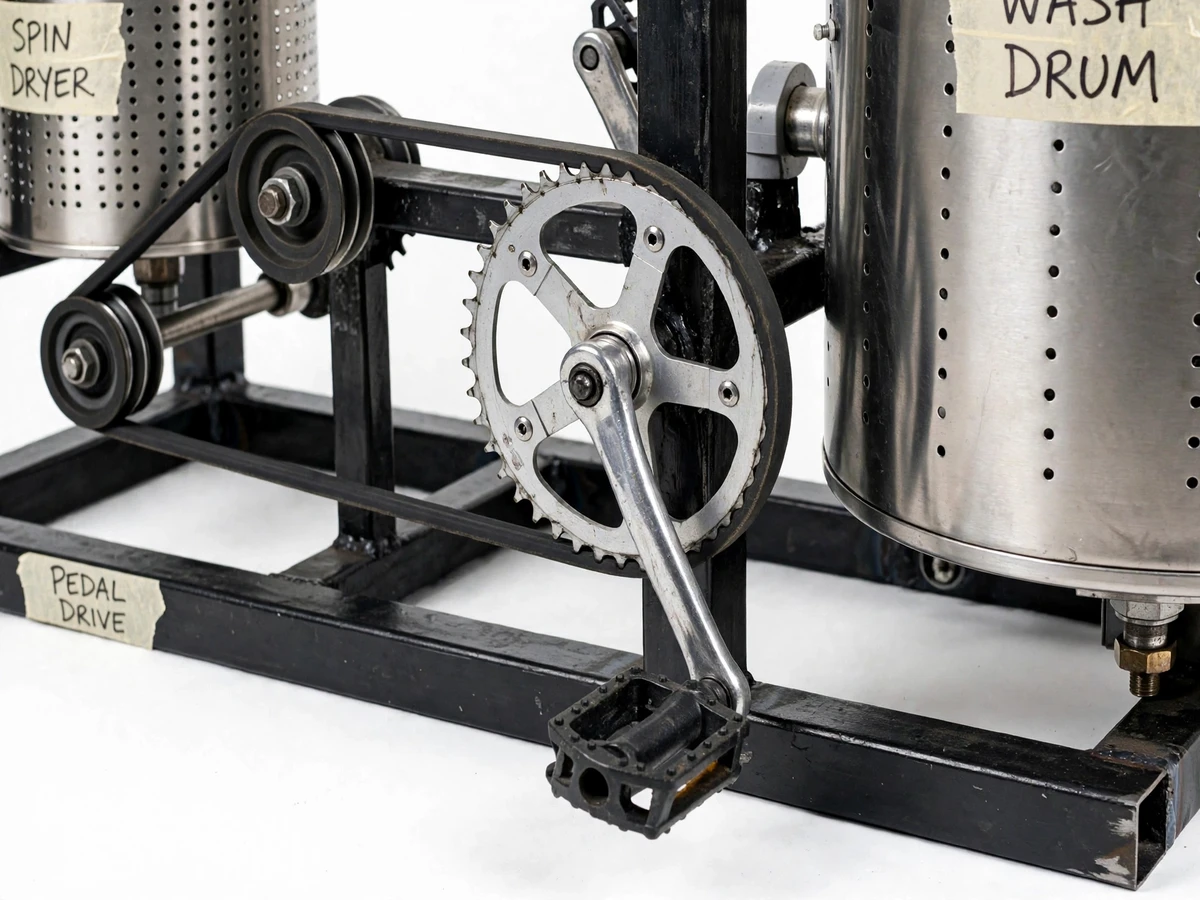
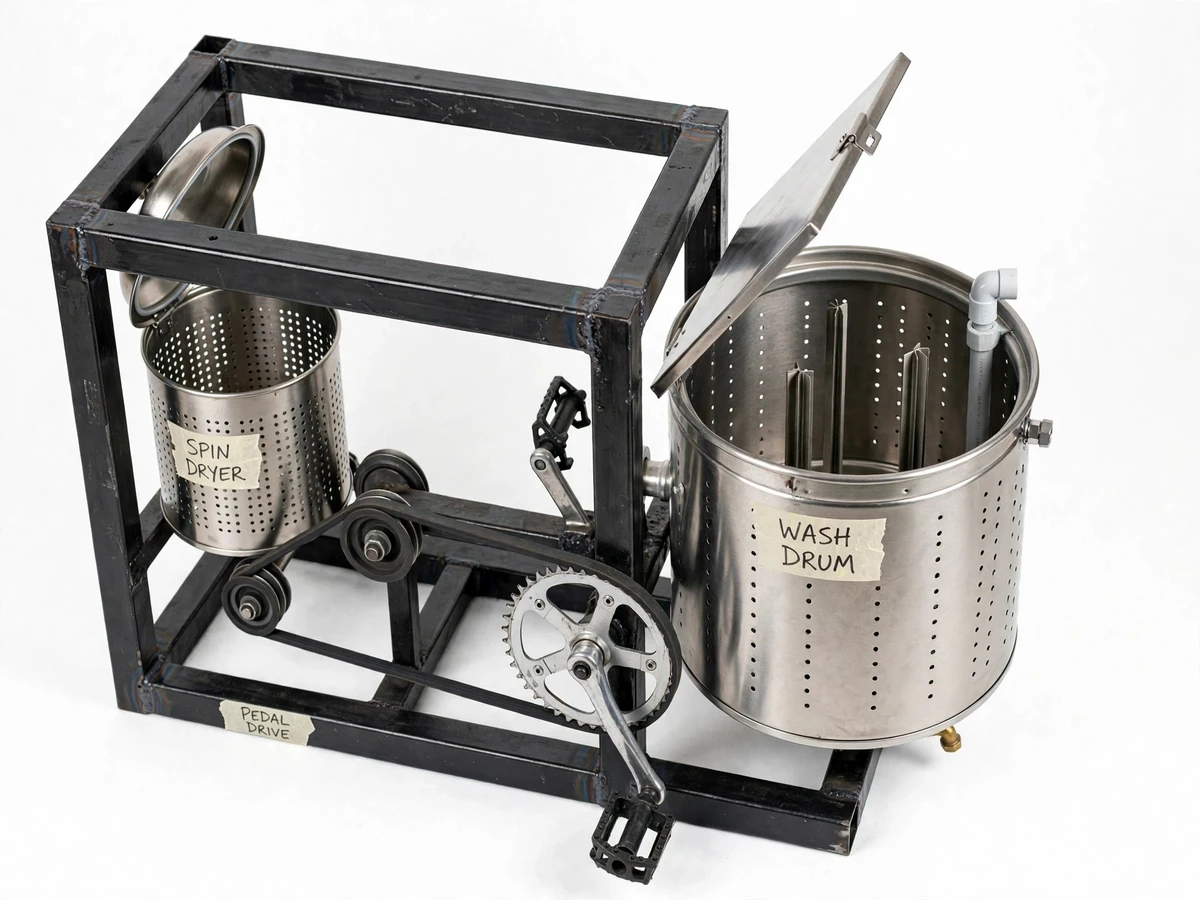
In villages, hostels and homes facing power cuts or no electricity at all, washing clothes by hand is slow, physically draining and inconsistent — yet electric washing machines are expensive and grid-dependent. A pedal-powered washer answers a genuine need: human effort the operator already expends, converted through simple machine elements into washing and spin-drying. This project delivers exactly that as a working prototype: a welded MS-steel frame carrying a bicycle pedal crank, a roller-chain primary drive to a countershaft, and a two-position V-belt drive feeding two drums — a large perforated stainless-steel wash drum with three vertical agitator fins, and a smaller perforated spin-dryer basket that runs at a stepped-up speed. Water is filled and drained manually through a PVC inlet and brass tap. Because every number that matters — pedal cadence, drum speeds, load capacity, washing time — is measured by the student on their own build with a tachometer and a stopwatch, the report contains honestly stated data, and the viva discussion is grounded in real machine-design and power-transmission decisions the student made or verified.
Pedals at a comfortable 40-60 rpm, as with a bicycle.
Follow the working sequence
How it works
- The operator sits at the pedal crank and pedals at a comfortable cadence of approximately 40–60 rpm, as with a bicycle.
- The 44T chainring drives the 16T countershaft sprocket through the roller chain, multiplying the cadence roughly 2.75 times at the countershaft (design target).
- With the V-belt set on the large pulley step (wash mode), the belt reduces this back down to the wash drum, turning the agitator at approximately 30–50 rpm (design target).
- The wash drum is filled with water and detergent through the inlet pipe; the three agitator fins churn the clothes through the water for the timed wash cycle.
- The operator opens the brass drain tap to empty the wash water, transfers the clothes to the spin basket, and shifts the belt to the small pulley step (spin mode).
- Pedalling now spins the perforated basket at approximately 600–800 rpm (design target), and centrifugal force throws the rinse water out through the perforations into the collection tray.
- The student measures cadence, both drum speeds and cycle time with the test sheet, and records the measured figures in the report.
Tech stack:
- MS square-tube fabrication & arc welding
- Bicycle chain drive · chainring & sprocket
- V-belt drive · stepped pulleys
- Pillow-block bearings (UCP-class)
- Stainless-steel sheet metal work · perforation
- Agitator washing action design
- Centrifugal spin-dry extraction
- Gear-ratio & human-power torque calculations
| Parameter | Value |
|---|---|
| Pedal input cadence | Approximately 40–60 rpm (comfortable pedalling, design input) |
| Chain drive ratio | 44T chainring : 16T sprocket, approximately 2.75:1 (design target) |
| Wash drum | Approximately 450 mm dia x 450 mm, perforated stainless steel (design target) |
| Agitator speed (wash mode) | Approximately 30–50 rpm (design target) |
| Spin basket speed (spin mode) | Approximately 600–800 rpm (design target) |
| Wash load capacity | Approximately 3 kg dry clothes per load (design target) |
| Spin load capacity | Approximately 2 kg per load (design target) |
| Frame | MS square tube 25 x 25 x 2 mm; footprint approximately 1.1 m x 0.55 m (design target) |
| Belt | A-section V-belt on 2-step pulleys (wash/spin selection) |
| Bearings | Pillow-block ball bearings, 20 mm bore (datasheet: UCP204 class) |
| Drain / inlet | 15 mm brass bib tap; PVC inlet approximately 25 mm dia |
| Overall size | Approximately 1.1 m x 0.55 m x 0.9 m (design target) |
| Test instruments | Digital tachometer and stopwatch (buyer-run procedure) |
Project features
- [Pedal chain drive] A bicycle crank with a 44T chainring drives a 16T countershaft sprocket through a standard roller chain, giving an approximately 2.75:1 step-up (design target) with pillow-block bearings supporting the shaft.
- [Agitator wash drum] A perforated stainless-steel drum, approximately 450 mm diameter, with three vertical agitator fins that lift and drop the clothes through the wash water at approximately 30–50 rpm in wash mode (design target).
- [Spin-dryer drum] A separate smaller perforated basket on the same frame, belt-driven at a stepped-up ratio to approximately 600–800 rpm (design target), throwing water out through the perforations by centrifugal action.
- [Two-position wash/spin selector] The V-belt moves manually between two stepped pulleys, switching the countershaft between the low-ratio wash drive and the high-ratio spin drive — a working lesson in ratio selection.
- [Welded MS frame] A bolted-and-welded 25 mm square-tube mild-steel frame (footprint approximately 1.1 m x 0.55 m) carries the drums, bearings and pedal bracket, with anti-vibration pads under the legs; a PVC inlet pipe fills the drum and a 15 mm brass drain tap empties it.
- [Buyer-run performance test procedure] A step-by-step test sheet guides the student to measure pedal cadence, wash-drum and spin rpm with a tachometer, time a full wash-plus-spin cycle, and grade wash quality — so every reported figure is the student's own measured result.
- Optional add-ons (quoted separately): a tachometer/digital rpm readout wired to the countershaft; a footrest-and-seat extension for longer wash sessions; a foldable weather cover for outdoor use.
- Future scope (not built): reverse-agitation via a reversible freewheel clutch; a larger 5 kg-load drum family with a re-rated frame; coupling the pedal shaft to a small generator for a phone-charging side output.
What is included
- Fabricated pedal-powered washing machine prototype (frame, drive train, wash drum with agitator, spin-dryer drum, plumbing fittings)
- 2D fabrication drawings with dimensions, cutting list and weld notes
- Bill of materials with standard part sizes and approximate sourcing guidance
- Buyer-run performance test procedure sheet (rpm, cycle time, wash-quality grading)
- Project report PDF (background, machine-element design calculations, fabrication process, test results template)
- PPT presentation for final review
- Viva Q&A preparation document (power transmission, gear ratios, welding, machine design)
Limitations & prerequisites
- Drum speeds and cycle times are design targets — actual figures depend on the rider's pedalling and are measured by the student, not claimed as guaranteed performance.
- Approximately 3 kg wash load per cycle; heavier loads raise pedal effort steeply and may stall a casual pedaller.
- Wash and spin modes switch by manually moving the belt between pulley steps — there is no automatic gearbox.
- The spin basket at approximately 600–800 rpm produces noticeable vibration; the machine needs level ground and the anti-vibration pads provided.
- Water is filled and drained manually; there is no plumbing automation or water-level control.
- Steel construction needs anti-rust upkeep (paint touch-ups) in humid or outdoor use.
- It is a working prototype for demonstration and academic study, not a substitute for an electric machine for heavy or daily household loads.
Frequently Asked Questions
How fast does it wash and spin?
The design targets are approximately 30–50 rpm at the agitator in wash mode and approximately 600–800 rpm at the spin basket in spin mode, from a comfortable pedalling cadence of about 40–60 rpm. These are not claimed as measured results — the buyer measures both with a tachometer on their own build following the supplied test procedure and reports their own figures.
Does it really use no electricity at all?
Yes. Washing and spin-drying are 100% human-powered through the pedal crank, chain and belt drive. Water is poured in and drained out manually, so there is no pump or electrical component anywhere in the machine.
How do you switch between washing and spin-drying?
By hand: the V-belt is moved between the two steps of the stepped pulley set — the large step gives the low-speed high-torque wash drive, the small step gives the high-speed spin drive. The test sheet shows the shift procedure.
What load can it handle per cycle?
The design target is approximately 3 kg of dry clothes per wash load and approximately 2 kg per spin load. Overloading raises pedal effort sharply, which is itself a useful demonstration of the torque–speed trade-off for the viva.
What will I calculate and learn from this project?
Human power and torque estimation, chain and belt drive ratio selection, bearing selection, shaft sizing, weld and frame design, agitator geometry, centrifugal extraction basics — plus fabrication skills and test-based reporting. The report's design-calculation chapter walks through each one.
Is this project suitable for a final-year project?
Yes — for Mechanical Engineering and related programs. It is a complete machine-design build: power transmission, fabrication, assembly and performance testing, with every key number measured by the student on their own prototype.
Components & software requirements
- MS square-tube fabrication & arc welding
- Bicycle chain drive · chainring & sprocket
- V-belt drive · stepped pulleys
- Pillow-block bearings (UCP-class)
- Stainless-steel sheet metal work · perforation
- Agitator washing action design
- Centrifugal spin-dry extraction
- Gear-ratio & human-power torque calculations
Delivery information
Built-to-order project. Delivery timeline is shared after order confirmation based on current queue.
Support terms
Complete documentation, setup guide, and viva preparation included. Support for setup and explanation provided.
Download free synopsis (PDF)
Enter your name and email — the synopsis PDF downloads immediately. We may send occasional project updates; no spam, unsubscribe anytime.