
More project photos (2)
The problem
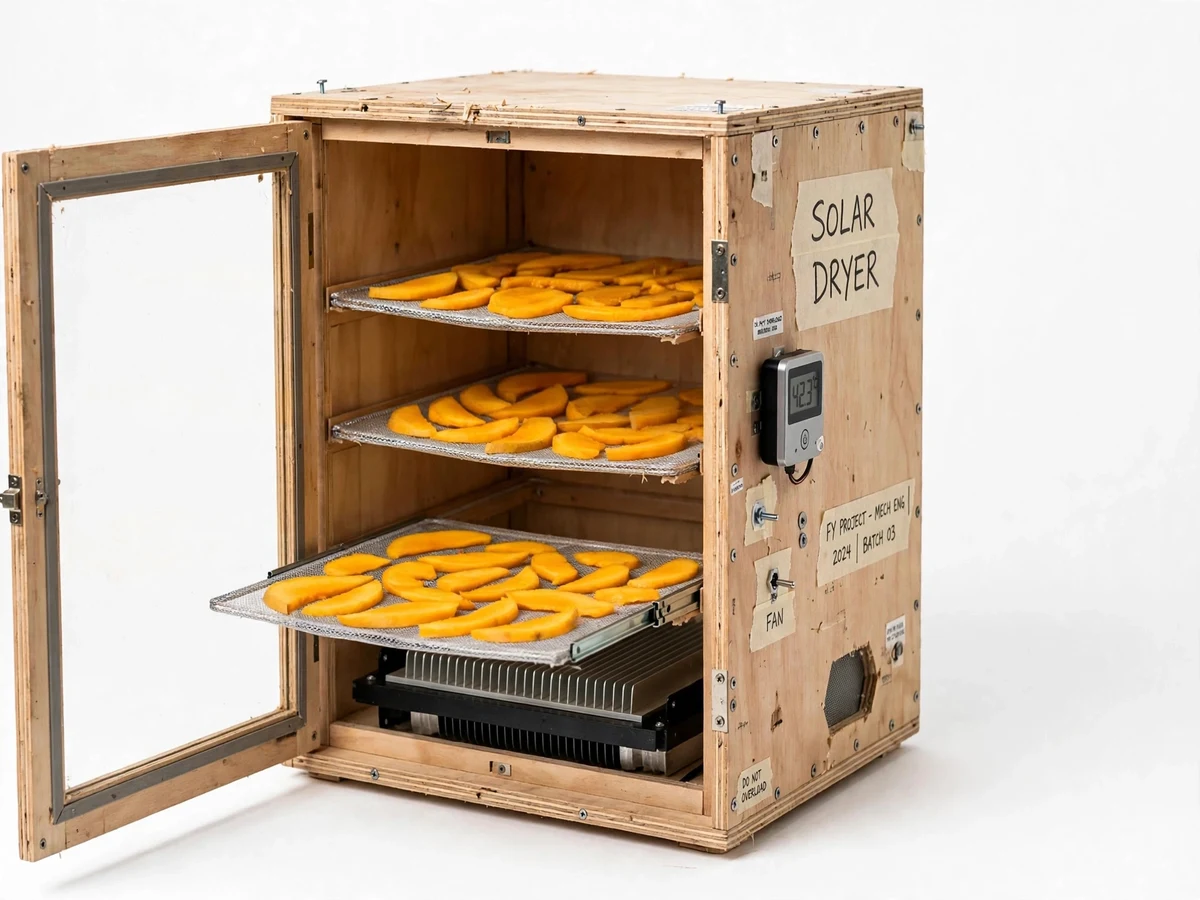
A significant fraction of harvested fruit and vegetables in India is lost between the farm and the market, and a major reason is drying: open sun drying — produce spread on the ground — is slow, invites dust, insects and animals, and one rain shower ruins the batch. Solar cabinet dryers solve the problem with simple physics: a black absorber plate converts sunlight to heat, the glazed cabinet traps it like a greenhouse, and warm air rising through stacked mesh trays carries moisture away from the produce. This project builds a working cabinet dryer as a student prototype — wooden cabinet with a glass door, three removable mesh trays, a finned black absorber collector at the base, a digital temperature display, and a fan for forced-convection mode — and pairs it with a real drying experiment: the student measures moisture loss over time for a produce batch and plots the drying curve.
How it works
- The student prepares a produce batch (e.g. mango or banana slices of uniform thickness) and records the initial weight on the weighing sheet.
- The trays are loaded in a single layer inside the cabinet, the door is closed, and the dryer is placed facing the sun with the collector exposed.
- Sunlight heats the black absorber; the glazed cabinet traps the heat, and warm air rises naturally through the mesh trays, carrying moisture out through the top vent.
- Every hour the student records chamber temperature, ambient temperature and the batch weight using the procedure's schedule.
- Moisture content is computed on wet and dry basis from the weight data, and the drying curve (moisture vs time) is plotted — optionally repeated in fan-assisted mode for comparison.
- The curves and efficiency discussion form the results chapter of the report, all from the student's own measurements.
Tech stack:
- Wooden drying cabinet with glazed glass door (fabricated)
- Black finned absorber collector plate
- Food-grade mesh drying trays (3)
- Digital temperature probe with display
- DC exhaust fan with solar/battery power option
- Drying-experiment procedure manual
- Moisture-content calculation and weighing templates
- Report, PPT and viva Q&A documents
| Parameter | Value |
|---|---|
| Cabinet | Approximately 600 x 450 x 450 mm wooden (design) |
| Trays | 3 mesh trays, approximately 400 x 350 mm each (design) |
| Batch capacity | Approximately 2–3 kg fresh produce per batch (design) |
| Chamber temperature | Approximately 50–65 °C in good sun (expected, location/season dependent) |
| Drying time | Approximately 6–10 h of sunshine for mango slices (expected, weather dependent) |
| Collector | Black finned absorber, approximately 400 x 350 mm (design) |
| Venting | Top vent plus adjustable side vents (design) |
| Fan | 12 V DC, approximately 0.15 A (design) |
Project features
- [Glazed drying cabinet] A wooden cabinet with a glass front door traps solar heat in the greenhouse effect while letting the student watch the produce; the door opens for loading and tray access.
- [Black absorber collector] A finned black absorber plate at the cabinet base converts incoming sunlight to heat; fins increase the heat-transfer area to the drying air.
- [Three removable mesh trays] Stainless/food-grade mesh trays hold sliced produce in a single layer so warm air passes through every slice, not just around the batch.
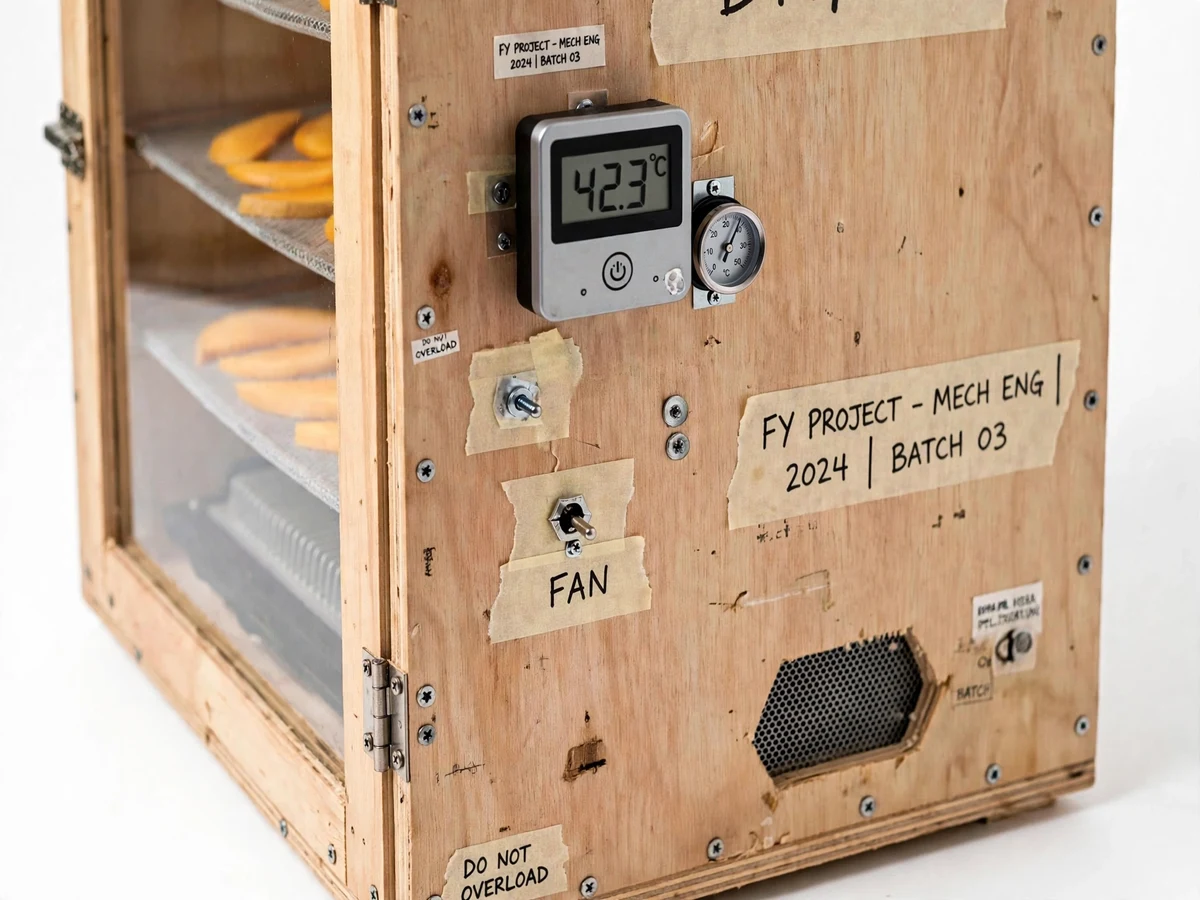
- [Temperature display and monitoring] A digital temperature probe shows the chamber temperature live; the experiment procedure uses it for hourly readings.
- [Fan-assisted forced convection mode] A small DC fan (solar-powered option) forces air through the collector and trays, so the student can compare natural vs forced convection drying rates.
- [Drying-experiment procedure] A documented procedure covers sample preparation, weighing schedule, moisture-content calculation and drying-curve plotting — the student produces real measured data.
- [Moisture-content calculation templates] Weighing sheets and the dry-basis/wet-basis moisture formulas are supplied so every number in the report is computed, not guessed.
What is included
- Working solar cabinet dryer (cabinet, collector, trays, display, fan)
- Drying-experiment procedure manual with weighing schedules
- Moisture-content calculation templates (wet-basis and dry-basis)
- Fabrication drawings and bill of materials
- Project report PDF (solar thermal principles, experiment design, results procedure)
- PPT presentation for final review
- Viva Q&A preparation document (greenhouse effect, drying kinetics, collector efficiency)
Limitations & prerequisites
- Drying rate depends entirely on sunshine — cloudy days slow the process and the procedure says how to handle interrupted runs honestly.
- The expected chamber temperatures and drying times are typical ranges, not guarantees; the student's own measurements are the report's data.
- Batch capacity is a few kilograms — this is a lab demonstrator, not a farm-scale dryer.
- The wood cabinet must be kept dry when not in use; prolonged rain exposure warps it.
- Only non-toxic, food-safe materials touch the produce; the manual lists what to clean between batches.
- Night-time drying is not possible without the optional backup heater, which is listed as future scope.
Frequently Asked Questions
Why is this better than just drying in the open sun?
The glazed cabinet reaches 50–65 °C while keeping dust, insects, animals and sudden rain off the produce — faster, cleaner and far less risky than open drying. The experiment procedure lets the student measure the difference.
What does the fan add?
Forced convection moves more air across the slices, which speeds moisture removal. The manual includes a natural-vs-forced comparison run, which makes a strong results chapter.
How is moisture content calculated?
By weighing: moisture on wet basis = (wet weight − dry weight) / wet weight. The templates walk through it with the student's own hourly weights.
What produce can be dried?
The manual is written around mango/banana slices, but the same procedure works for chillies, herbs and leafy vegetables — the student picks one commodity for the experiment.
Does it work without electricity?
Yes — in natural-convection mode the dryer needs no power at all. The fan and display are the only electrical parts, and both can run from a small solar panel.
Is this project suitable for a final-year project?
Yes — for Mechanical and Agricultural Engineering programs. It combines heat-transfer design, fabrication and a real experiment with measured results. Suitable for B.E./B.Tech final-year projects in Mechanical and Agricultural Engineering.
Components & software requirements
- Wooden drying cabinet with glazed glass door (fabricated)
- Black finned absorber collector plate
- Food-grade mesh drying trays (3)
- Digital temperature probe with display
- DC exhaust fan with solar/battery power option
- Drying-experiment procedure manual
- Moisture-content calculation and weighing templates
- Report, PPT and viva Q&A documents
Delivery information
Built-to-order project. Delivery timeline is shared after order confirmation based on current queue.
Support terms
Complete documentation, setup guide, and viva preparation included. Support for setup and explanation provided.