
More project photos (2)
The problem
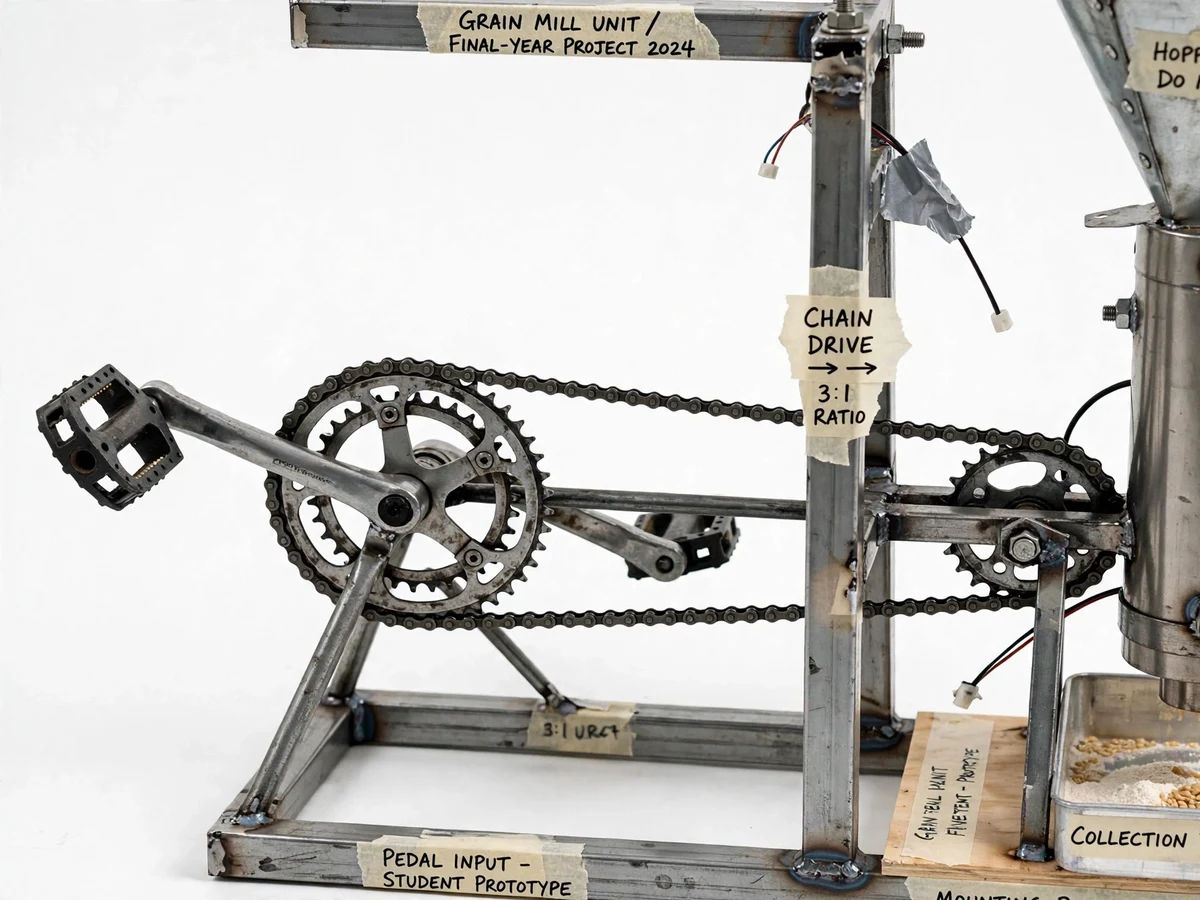
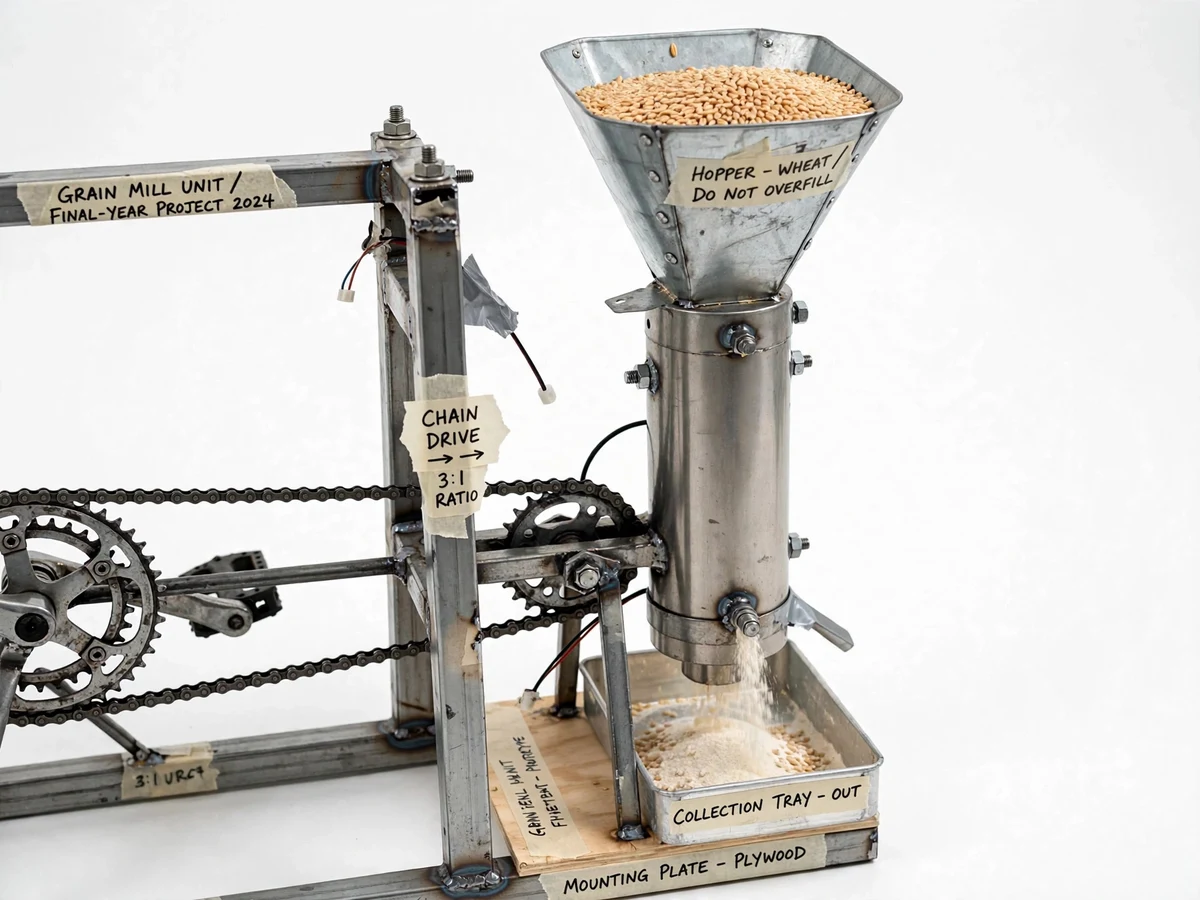
In villages with unreliable power, grinding grain still means carrying it to a diesel or electric mill — or grinding by hand. A pedal-powered mill converts the most available energy source, human muscle, into rotary grinding power through a familiar bicycle drivetrain. This project builds one: a standard bicycle chainring and pedals drive a chain to a countershaft, a V-belt steps the speed up to the grinding burrs, and an adjustable burr gap controls flour fineness. The whole machine is fabricated from angle iron, bicycle parts and a cast burr-plate pair, so every element — chain reduction, belt slip, burr clearance — is visible and measurable. The report includes power and speed calculations: what a human can sustain (approximately 75–100 W), how the reductions trade speed for torque, and what throughput the student can verify by timing a weighed batch of wheat.
How it works
- Wheat is poured into the hopper; the burr gap is set for the desired fineness.
- The operator sits and pedals at a steady cadence (approximately 40–60 rpm design target).
- The chainring drives the chain to the countershaft; the V-belt steps speed up to the grinding shaft.
- Grain falls from the hopper into the burr throat and is sheared between the rotating burr plates.
- Ground flour drops into the collection tray below the housing.
- A weighed batch is timed to compute throughput; burr gap is adjusted and the test repeated for fine versus coarse settings.
Tech stack:
- Bicycle chainring, crank and pedals
- Cast grinding burr plates
- V-belt and pulley step-up drive
- Countershaft with bearings
- Sheet-metal grain hopper
- Welded angle-iron frame
- Burr-gap adjustment screw
- Collection tray
| Parameter | Value |
|---|---|
| Pedal cadence | Approximately 40–60 rpm (expected human pace) |
| Burr speed | Approximately 200–300 rpm at the grinding shaft (design target) |
| Human power input | Approximately 75–100 W sustained (published ergonomic value) |
| Throughput | Approximately 3–5 kg of wheat per hour (expected, burr-gap dependent) |
| Burr gap | Adjustable, set by screw (design target) |
| Drive | Bicycle chain + V-belt, two-stage (design target) |
| Frame | Welded mild-steel angle iron (expected) |
| Overall size | Approximately 1200 × 600 × 1000 mm (expected) |
Project features
- [Bicycle pedal drivetrain] A standard chainring, crank and pedals convert leg power into rotary motion through a bicycle chain.
- [Chain-and-belt speed step-up] Chain drive to a countershaft, then a V-belt to the grinding shaft, sized to reach burr speed from a comfortable pedalling cadence.
- [Adjustable burr gap] An axial screw sets the clearance between the burr plates, selecting fine or coarse flour; the setting procedure is documented.
- [Gravity grain hopper] A sheet-metal hopper meters wheat into the burr throat at a rate matched to the grinding capacity.
- [Flour collection tray] A tray under the burr housing catches the ground flour for weighing and fineness checks.
- [Rigid fabricated frame] Welded angle-iron frame with a bicycle-saddle seating position sized for sustained pedalling.
- [Throughput test procedure] The report defines a weighed-batch test so the student can report real grinding rates.
What is included
- Fully assembled pedal-powered grain mill
- Burr-gap setting and maintenance procedure
- Throughput test procedure with log sheet
- Drivetrain sizing calculations (chain ratio, belt ratio, power)
- Project report PDF (background, human-power context, design, calculations, test procedure)
- PPT presentation for final review
- Viva Q&A preparation document (belt and chain drives, grinding mechanics, ergonomics)
Limitations & prerequisites
- Throughput of roughly 3–5 kg per hour is a household/village scale — it cannot match an electric mill's rate, and the report states this plainly.
- Flour fineness depends on burr condition and gap setting; very fine atta needs careful adjustment and slower feeding.
- Only dry grain is in scope; wet or oily seeds clog the burrs and are excluded.
- Sustained output depends on the operator's fitness; the test procedure uses a rested operator and timed batches.
- Burr plates wear and need periodic dressing; the maintenance section covers this.
- The mill is a demonstration prototype, not a certified food-processing machine.
Frequently Asked Questions
How much flour can it grind per hour?
The expected rate is approximately 3–5 kg of wheat per hour at a steady pedalling pace, verified by the weighed-batch test in the report. Coarser settings grind faster than fine ones.
Why both chain and belt drive?
The chain handles the high-torque first stage from the pedals; the belt provides the final speed step-up to the burrs with some slip protection if the burrs jam — a deliberate safety choice.
How is flour fineness adjusted?
An axial screw moves one burr plate relative to the other, changing the gap. The setting procedure in the documentation walks through it with a feeler gauge.
What grain can it grind?
Dry wheat, maize and similar dry grains. Wet grain or oily seeds (like mustard) clog the burrs and are outside the project's scope.
Does it need any electricity?
None at all — that is the point of the project. Human power is the only input, which is also the core of its viva story.
Is this project suitable for a final-year project?
Yes — for Mechanical Engineering. It combines power transmission design, fabrication, ergonomics and a socially relevant application in one demonstrable machine. Suitable for B.E./B.Tech final-year projects in Mechanical Engineering.
Components & software requirements
- Bicycle chainring, crank and pedals
- Cast grinding burr plates
- V-belt and pulley step-up drive
- Countershaft with bearings
- Sheet-metal grain hopper
- Welded angle-iron frame
- Burr-gap adjustment screw
- Collection tray
Delivery information
Built-to-order project. Delivery timeline is shared after order confirmation based on current queue.
Support terms
Complete documentation, setup guide, and viva preparation included. Support for setup and explanation provided.