
More project photos (2)
The problem
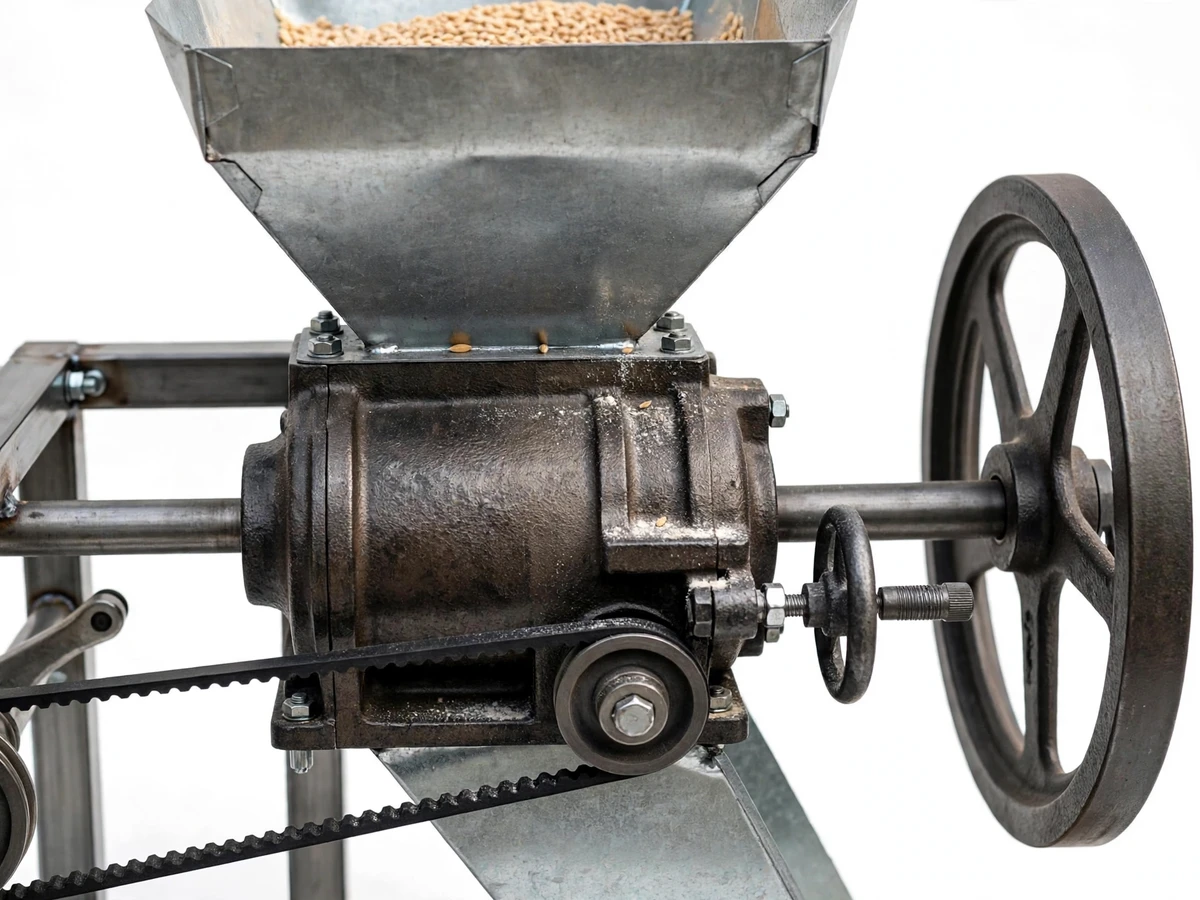
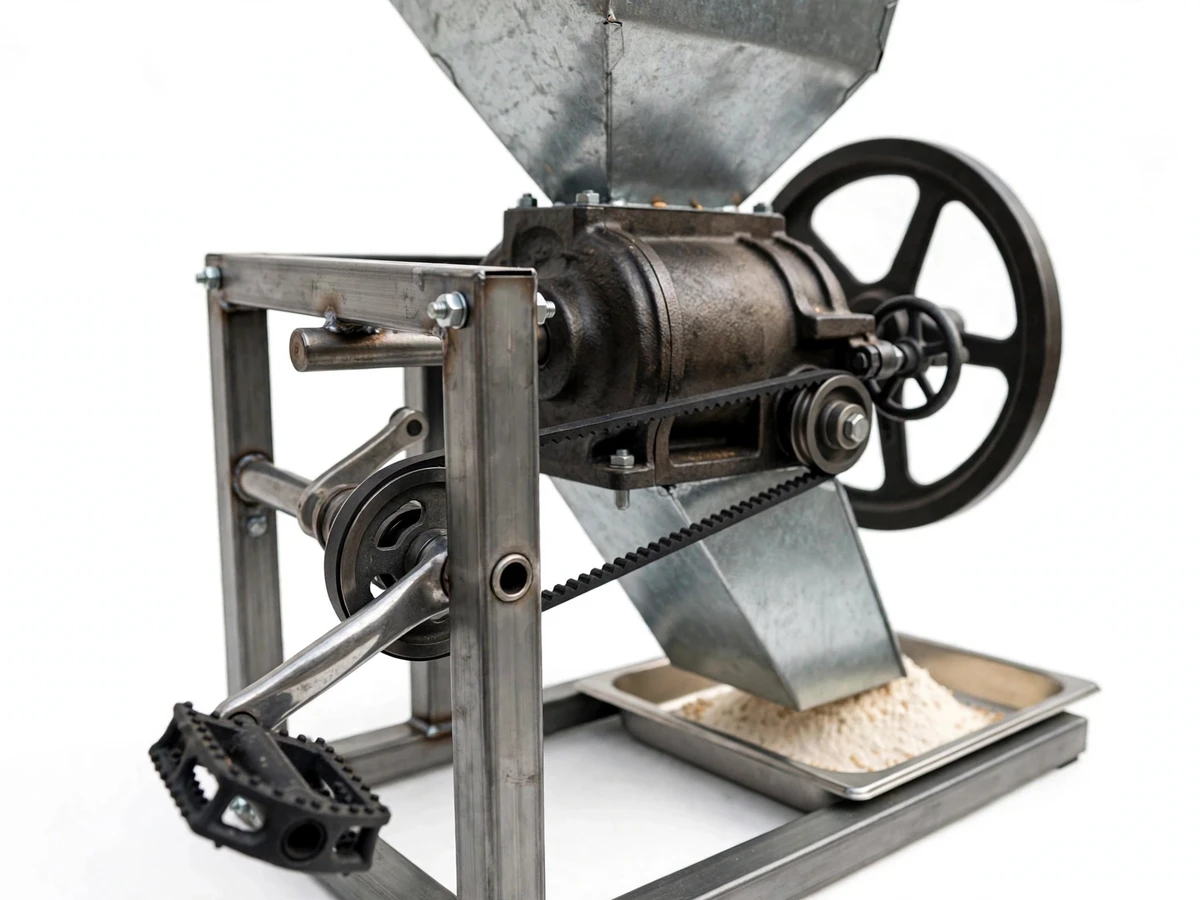
A Pedal-Powered Flour Mill with Belt Drive and Adjustable Grinding Plates is a human-powered grain mill that turns pedal motion into rotary grinding force without any motor or mains electricity. In villages, small farms and off-grid homes, grinding grain often means travelling to a diesel or electric mill, paying for every batch, or doing slow and tiring hand grinding at home. This mill answers that problem by letting one operator pedal a bicycle-style crank that drives a belt to a grinding-plate shaft, so dry grain poured into a hopper is crushed between two plates and collected as flour from an output chute. A flywheel fitted to the drive stores energy between pedal strokes and releases it steadily, which smooths the uneven push of pedalling into steadier rotation instead of surging and stalling. A handwheel adjuster moves one plate closer to or farther from the other, so the same machine gives coarse meal or finer flour.
How it works
Working the mill is one continuous chain from pedal to flour. The operator sits at the crank and pedals at a comfortable steady pace, and a belt carries that rotation to the grinding-plate shaft, with a flywheel on the shaft storing energy between strokes so the plates turn evenly. Dry grain poured into the hopper drops by gravity into the narrow gap between the two plates, where the rotating plate shears and crushes it against the fixed plate. The handwheel gap setting decides the result: a wider gap leaves coarse meal, while a tighter gap grinds the grain longer and finer. Ground flour falls from the plates through an output chute into a collection tray, ready to sieve or use, and the operator simply keeps pedalling to keep the flow going.
- The operator sits at the pedals and starts cranking at a steady, comfortable pace, building flywheel speed before any grain is fed.
- The belt transfers crank rotation to the grinding-plate shaft, and the flywheel evens out the push-and-pause rhythm of pedalling into steadier shaft rotation.
- Dry, clean grain is poured into the hopper, from where it feeds by gravity into the throat between the two grinding plates.
- The rotating plate shears and crushes the grain against the fixed plate, breaking it down as it works its way outward across the plate faces.
- The operator sets the handwheel gap adjuster before or between batches: a wider gap for coarse meal, a tighter gap for finer flour.
- Ground flour drops from the plates into the output chute and falls into the collection tray below.
- The operator sieves the flour if a finer grade is wanted, returns any coarse remainder to the hopper for a second pass, and stops pedalling to finish.
Builder note: if the belt slips under load, re-tension it at the adjustable idler and check plate alignment, rather than pedalling harder, which only wears the belt and tires the operator. The flywheel smooths pedal torque because it stores kinetic energy while the pedal push is strong and gives that energy back while the pedal passes its dead spot, so the plates see steadier torque than the operator's feet produce.
Tech stack:
- Mild-steel square-tube frame with bolted joints
- Pedal crank with drive pulley and belt transmission
- Cast-iron grinding plates with handwheel gap adjuster
- Flywheel on the grinding-plate shaft
- Sheet-metal hopper and output chute
- Pillow-block bearings and belt tensioning idler
- Collection tray with optional sieve set
| Parameter | Value |
|---|---|
| Drive method | Pedal crank with belt drive and no motor |
| Grinding plates | 2 cast-iron plates (Design target) |
| Grinding plate diameter | Approximately 150 mm (Design target) |
| Flywheel diameter | Approximately 300 mm (Design target) |
| Throughput | Approximately 2 kg per hour (Expected design target) |
| Hopper capacity | Approximately 2 kg of dry grain (Design target) |
| Frame material | Mild-steel square tube with bolted joints |
| Overall footprint | Approximately 900 mm × 600 mm (Design target) |
| Machine weight | Approximately 35 kg (Design target) |
| Fineness control | Handwheel gap adjuster from coarse to fine (Design target) |
Project features
The mill's most useful capabilities are its adjustable grinding gap, its smoothed pedal drive, and its fully electricity-free operation, with an easily tensioned belt drive and a simple grain-to-flour path tying them together. The adjustable plate gap is the capability that matters most at the table: one handwheel setting gives coarse cracked grain for porridge-style cooking, while a tighter setting gives finer flour for flatbreads, all from the same pair of plates. The flywheel and belt drive form the second capability: the flywheel stores energy between pedal strokes so the plates keep turning evenly instead of surging and stalling, and the belt lets the builder trade pedal speed for grinding torque. The third capability is independence from any power supply: with no motor, wiring or fuel, the mill works wherever an operator can sit and pedal, and every moving part can be inspected, tensioned or replaced with basic workshop tools.
Base build (implemented):
- [Adjustable grinding plates] A handwheel adjuster moves one plate relative to the other, so the same pair of plates gives coarse meal at a wide gap and finer flour at a tight gap.
- [Flywheel-smoothed pedal drive] A flywheel on the grinding-plate shaft stores energy between pedal strokes, keeping plate rotation even instead of surging with every push of the pedals.
- [Belt drive transmission] A belt carries crank rotation to the grinding-plate shaft, giving a quiet drive that can be re-tensioned with basic tools and that slips rather than breaking parts under a sudden jam.
- [Gravity-feed hopper] Dry grain poured into the sheet-metal hopper feeds by gravity into the plate throat, so no feeder mechanism or power supply is needed to keep grain moving.
- [Belt tensioning idler] An adjustable idler pulley keeps the belt at working tension, so a slack belt can be re-tensioned with basic tools instead of being replaced at the first sign of slip.
- [Output chute and collection tray] Ground flour drops from the plates through a chute into a tray below, so collection is clean and the flour is ready to sieve or use.
Optional add-ons:
- [Detachable sieve set] A set of sieves in different mesh sizes grades the flour after grinding, separating fine flour from coarse remainder for a second pass.
- [Second-pass return scoop] A simple scoop and funnel help return coarse remainder to the hopper for regrinding, for users who want a finer grade without extra equipment.
What is included
- Complete pedal-powered flour mill prototype: frame, pedal crank, belt drive, flywheel, grinding plates, hopper, output chute and collection tray
- Handwheel gap adjuster and belt tensioning idler fitted on the prototype
- Project report PDF with belt-drive and flywheel sizing calculations, build steps and test notes
- PPT presentation for final review
- Demonstration notes and maintenance guide
- Optional detachable sieve set on request
Limitations & prerequisites
- Output depends on operator stamina and pace; long sessions need breaks, and throughput falls as the operator tires.
- Grain must be dry and clean; damp or dirty grain clogs the plates and gives uneven flour.
- Flour fineness varies with gap setting, grain type and moisture; this is not a commercial mill and cannot match the uniformity of packaged flour.
- The coarse-to-fine range is limited by one pair of plates; very fine flour may need a second pass or sieving.
- The mill grinds one batch at a time and needs the operator present throughout; there is no automatic feeding or shut-off.
- Belt tension and plate alignment need periodic checking; a slack belt slips and an uneven gap grinds unevenly.
- The belt run is exposed for tensioning and inspection, so hands and loose clothing must be kept clear of it during operation and the operator must stop pedalling before any adjustment.
Frequently Asked Questions
How does the mill work without electricity?
The operator pedals a bicycle-style crank, and a belt carries that rotation to a shaft fitted with a flywheel and a fixed grinding plate, while grain from the hopper falls between the plates and is crushed into flour that drops through an output chute into a collection tray. The gap adjuster sets fineness, the flywheel keeps rotation steady between pedal strokes, and the whole machine runs on human effort alone, so it works anywhere an operator can sit and pedal.
What grain can it grind, and what flour fineness can it give?
It is designed for dry, clean grains such as wheat, maize and millet, and the handwheel gap adjuster sets how fine the flour comes out, with a wider gap giving coarse meal and a tighter gap giving finer flour for flatbreads. Wet grain must be dried first, since damp grain clogs the plates, and very fine flour may need sieving or a second pass through the plates.
How much flour can one operator produce in an hour?
The design target is approximately 2 kg of flour per hour at a comfortable steady pedalling pace, but the real figure depends on the operator, the grain and the gap setting, so it should be read as a planning figure rather than a guaranteed output. Coarse meal comes faster than fine flour, and regular breaks matter, since output drops as the operator tires over a long session.
Is it safe to operate, and what must the operator watch?
Yes, for careful adult operation, because the frame keeps the operator clear of the grinding plates and the hopper throat is sized so fingers cannot reach the plates while grain is being fed. The belt run is exposed for tensioning and inspection, so hands and loose clothing must be kept clear of it while pedalling, and the operator must stop pedalling before adjusting the gap or clearing a blockage; children must be supervised around the machine at all times.
What maintenance does the mill need?
Routine care is simple and tool-light: brush flour dust from the plates and chute after use, check belt tension and bearing tightness regularly, wipe the frame dry, and keep the plates dry so the grinding faces do not rust between uses. A worn belt is replaced rather than patched, and plate alignment is checked whenever the gap is reset, so grinding stays even over time.
Is this project suitable for a final-year project?
Yes, for Mechanical Engineering final-year work, because it combines machine design, belt-drive calculations, flywheel sizing and a working prototype that can be tested for throughput and flour fineness against its own stated design targets, with clear scope for honest reporting of measured results. The report documents the design calculations, the build steps and the test observations, and the review presentation walks through the mechanism from pedal to flour.
Components & software requirements
- Mild-steel square-tube frame with bolted joints
- Pedal crank with drive pulley and belt transmission
- Cast-iron grinding plates with handwheel gap adjuster
- Flywheel on the grinding-plate shaft
- Sheet-metal hopper and output chute
- Pillow-block bearings and belt tensioning idler
- Collection tray with optional sieve set
Delivery information
Built-to-order project. Delivery timeline is shared after order confirmation based on current queue.
Support terms
Complete documentation, setup guide, and viva preparation included. Support for setup and explanation provided.
Download free synopsis (PDF)
Enter your name and WhatsApp number — the synopsis PDF downloads immediately. We may send occasional project updates on WhatsApp; no spam.