
More project photos (2)
The problem
Most homes buy packaged flour, yet it is often weeks old by the time it reaches the kitchen, and the buyer cannot choose how fine it is ground. Small neighbourhood mills solve the freshness problem but need a trip, a queue and a minimum quantity, so home grinding stays out of reach. A mini flour mill machine with adjustable grinding brings that milling step into the home: a compact electric mill that grinds wheat, rice, maize and pulses with a 0.5 HP single-phase induction motor, a stainless-steel hopper and adjustable grinding plates. A handwheel sets the gap between the plates, so the same machine gives fine flour for chapatis or coarser meal for rava, and a sieve keeps the output uniform. It runs from a 230 V home socket, fits on a kitchen counter, and is built from materials — a mild-steel frame, cast plates and a V-belt drive — so a student can fabricate, assemble and test every part.
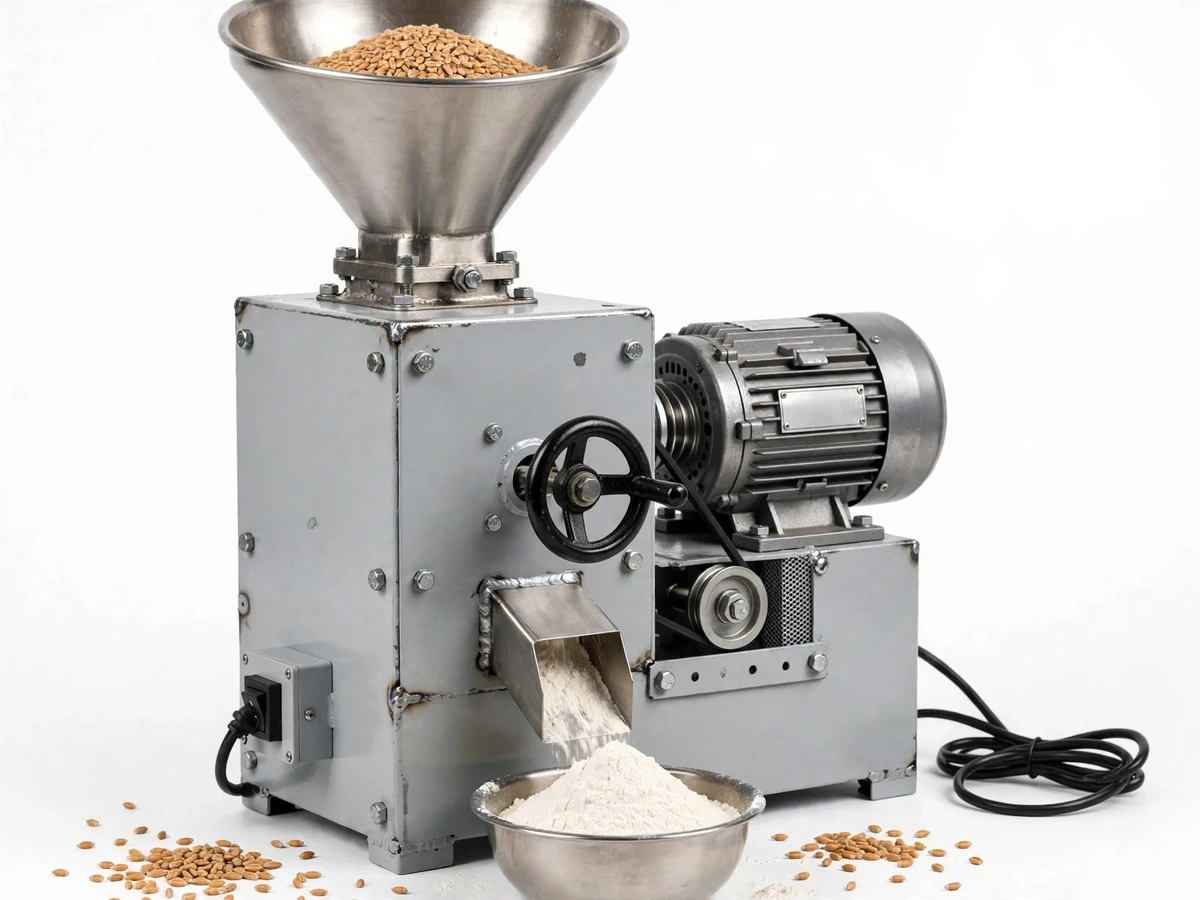
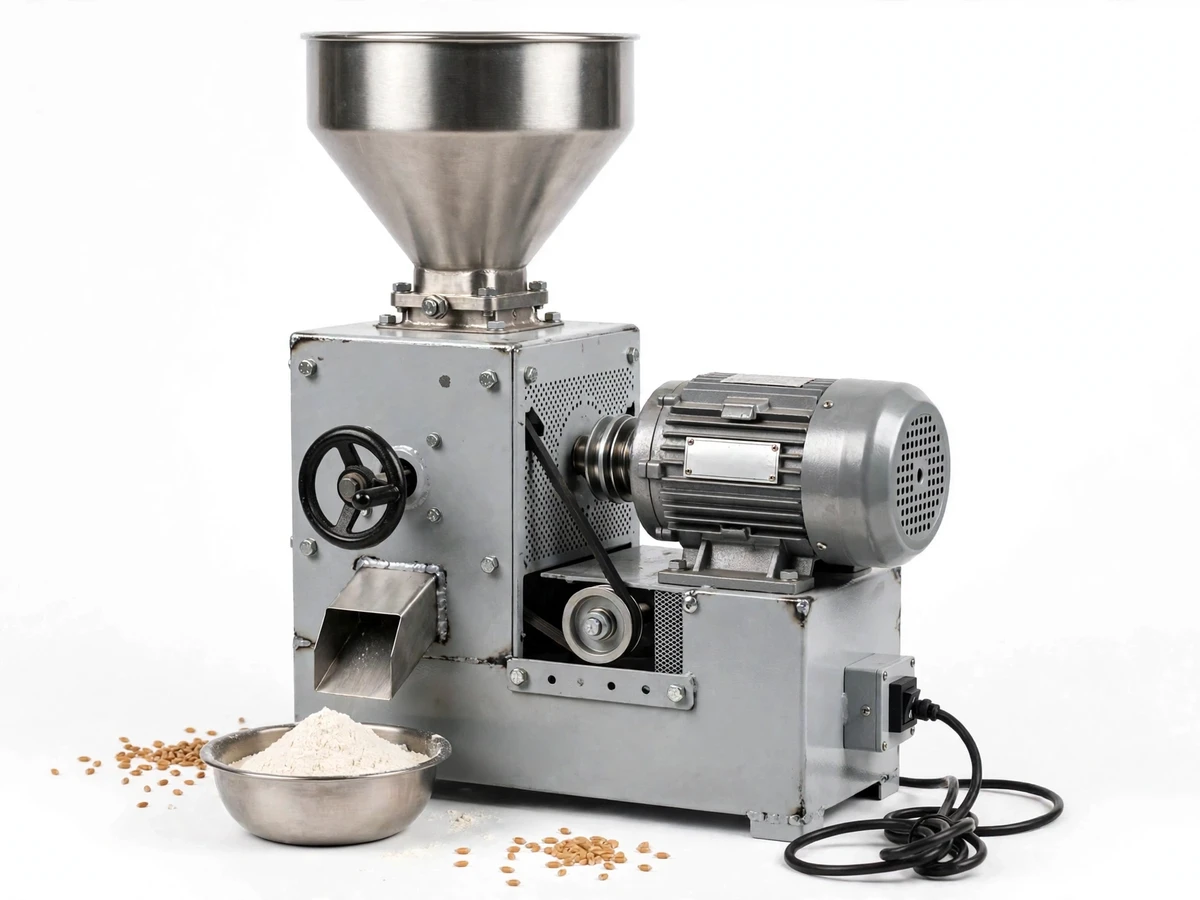
Stainless-steel hopper holds about 2 kg of grain and feeds it by gravity through a slide gate.
Follow the working sequence
How it works
The mini flour mill machine turns whole grain into flour in one continuous pass: grain falls from the hopper into the grinding chamber, the motor-driven rotating plate shears it against the fixed plate, and the ground flour leaves through the sieve and outlet chute into a bowl. Grinding works by shear and compression — grain trapped between the rotating and fixed plates is sheared as the plate gap narrows, so fineness follows the gap setting directly: a smaller gap means finer flour and a higher load on the motor, which is why the feed gate and the gap are adjusted together. The V-belt drive steps the motor speed down to the grinding shaft, the hopper keeps a steady supply of grain flowing by gravity, and the sieve stops oversize particles from reaching the bowl. The operator only loads grain, sets the gap with the handwheel, switches the motor on and collects the flour.
- Grain is poured into the stainless-steel hopper and the slide gate is opened to let it flow by gravity into the grinding chamber.
- The 0.5 HP single-phase induction motor (Approximate rating) is switched on and drives the grinding shaft through the V-belt and pulleys.
- The rotating grinding plate shears the grain against the fixed plate; the trapped grain is crushed by compression and shear between the two plates.
- Ground flour passes through the mesh sieve at the chamber outlet, which holds back oversize particles for re-grinding.
- The sieved flour drops through the outlet chute into a bowl placed beneath it.
- The operator turns the handwheel to widen or narrow the plate gap — a narrower gap gives finer flour, a wider gap gives coarser meal — and adjusts the feed gate to match.
- The machine is switched off, the chamber is brushed clean, and the sieve is checked before the next batch.
Tech stack:
- Single-phase induction motor, 0.5 HP (Approximate rating)
- Cast iron grinding plates (2 plates)
- Stainless-steel hopper with slide gate
- V-belt drive with pulleys
- Mild-steel fabricated frame
- Handwheel gap-adjustment mechanism
- Mesh sieve and flour outlet chute
- 230 V single-phase domestic supply
| Parameter | Value |
|---|---|
| Drive motor | 0.5 HP single-phase induction motor (Approximate rating) |
| Motor speed | 1440 rpm (Datasheet value, 4-pole, 50 Hz) |
| Grinding plates | 2 plates, cast iron, approximately 150 mm diameter (Design target) |
| Hopper capacity | Approximately 2 kg of grain (Design target) |
| Output | Approximately 3–5 kg of flour per hour (Expected, depends on grain and gap setting) |
| Power supply | 230 V, 50 Hz single-phase (Datasheet value) |
| Machine size | Approximately 600 mm x 400 mm x 700 mm (Design target) |
| Machine weight | Approximately 25 kg (Design target) |
| Flour fineness | Adjustable from fine to coarse by handwheel gap setting |
Project features
The strongest parts of this mini flour mill machine are its electric motor drive, its adjustable grinding plates, its gravity-fed hopper and its sieved flour outlet. The 0.5 HP single-phase induction motor drives the grinding plates through a V-belt, so the machine runs from an ordinary 230 V home socket with no manual effort and no pedalling. The handwheel on the front moves one grinding plate closer to or further from the other, which changes the flour from fine to coarse without changing any part. Grain flows from the stainless-steel hopper through a slide gate into the grinding chamber, and the sieve at the outlet keeps the flour uniform before it drops through the chute into a bowl. Together these four capabilities make a complete home milling machine: feed, grind, adjust and collect, all in one compact tabletop unit.
- [Electric motor drive] A 0.5 HP single-phase induction motor (Approximate rating) drives the grinding shaft through a V-belt and pulleys, so the machine runs from a standard 230 V home socket with no pedalling or manual effort.
- [Adjustable grinding plates] A handwheel moves one cast iron grinding plate towards or away from the fixed plate, changing the gap and therefore the flour fineness — fine for chapatis, coarser for rava — without swapping any part.
- [Stainless-steel hopper with feed control] A stainless-steel hopper holds the grain and feeds it by gravity into the grinding chamber, with a slide gate that regulates how fast grain enters so the plates are never choked.
- [Sieve and flour outlet] A mesh sieve at the chamber outlet keeps the output uniform, and a short chute delivers the flour straight into a bowl placed beneath it, with no extra handling.
- [Compact tabletop frame] A welded mild-steel frame carries the motor, grinding chamber and hopper as one rigid tabletop unit, sized for a kitchen counter or a small work table.
- [Simple switch control with belt guard] A single switch box starts and stops the motor, and a sheet-metal guard covers the belt and pulleys so the running drive is shielded during use.
- [Interchangeable sieve meshes (Optional customization)] Extra sieve meshes of different openings can be supplied on request for finer or coarser grades; this is an optional customization and is not part of the base build.
What is included
- Working electric mini flour mill prototype with motor, belt drive and grinding chamber
- Fabrication drawings for the frame, hopper and grinding chamber
- Component list with sizes, materials and bought-out parts
- Wiring and assembly documentation
- Project report PDF (background, design calculations, methodology, results)
- PPT presentation for final review
- Viva Q&A preparation document (grinding theory, belt drives, motor selection, fabrication)
Limitations & prerequisites
- Output of approximately 3–5 kg per hour is an expected value, not a measured claim — it depends on grain hardness, moisture and the gap setting.
- Friction between the plates warms the flour slightly, so long continuous runs should be broken into batches with cooling gaps.
- The machine is designed for dry grain only; wet grain, damp flour and oily seeds can clog the plates and the sieve.
- A single-phase motor and belt drive produce workshop-level noise and some vibration; this is a working prototype, not a silent appliance.
- Cast iron grinding plates wear with use and need periodic re-dressing or replacement; plate life depends on the grain ground and the hours run.
- Fine flour dust escapes at the outlet, so the machine needs brushing down and cleaning after each use.
- This is an academic prototype, not a food-certified commercial mill; grain-contact parts must be cleaned before first use and no commercial certification is claimed.
Frequently Asked Questions
Is this project suitable for a final-year project?
Yes — for Mechanical Engineering students, this project demonstrates machine design, electric drive selection, belt-drive transmission, grinding-plate geometry and workshop fabrication in one complete build. The report covers the design calculations for the motor, belt and plates, and the working prototype gives a clear live demonstration of grain going in and flour coming out. It also suits diploma mechanical programmes where a fabricated machine with a working demo is required.
What power supply does it need, and can it run at home?
Yes, it runs from an ordinary 230 V single-phase domestic socket, the same supply used by home appliances, because the 0.5 HP induction motor is a standard single-phase unit. No three-phase connection is needed. The motor draws approximately 2–3 A (Expected) at full load, so a normal 5 A household socket is sufficient. For workshop use, a separate MCB-protected circuit is recommended, and the switch box isolates the motor while the machine is cleaned.
How is the flour fineness adjusted?
The fineness is set with the handwheel on the front of the machine, which moves one grinding plate closer to or further from the fixed plate. Turning the handwheel narrows the gap for finer flour and widens it for coarser meal, with no part to change. The correct setting is found by grinding a small test batch and checking the flour before running the full quantity.
What grains can it grind?
Wheat, rice, maize, jowar, bajra and dry pulses are all suitable, since they are dry, hard grains that shear cleanly between the plates. Wet grain, damp flour and oily seeds such as groundnut or sesame are not recommended because they clog the plates and the sieve. Very hard items such as stones or metal must never be fed into the hopper.
What will I receive with the project?
You receive the working electric mini flour mill prototype with its motor, belt drive, hopper and outlet, plus fabrication drawings, a component list, wiring and assembly documentation, the project report PDF, a PPT presentation and a viva Q&A document. The prototype is built to order, so the drawings and report match the machine that is delivered. Spare sieve meshes and a second grinding-plate set can be quoted as optional extras.
Components & software requirements
- Single-phase induction motor, 0.5 HP (Approximate rating)
- Cast iron grinding plates (2 plates)
- Stainless-steel hopper with slide gate
- V-belt drive with pulleys
- Mild-steel fabricated frame
- Handwheel gap-adjustment mechanism
- Mesh sieve and flour outlet chute
- 230 V single-phase domestic supply
Delivery information
Built-to-order project. Delivery timeline is shared after order confirmation based on current queue.
Support terms
Complete documentation, setup guide, and viva preparation included. Support for setup and explanation provided.
Download free synopsis (PDF)
Enter your name and WhatsApp number — the synopsis PDF downloads immediately. We may send occasional project updates on WhatsApp; no spam.