
More project photos (2)
The problem
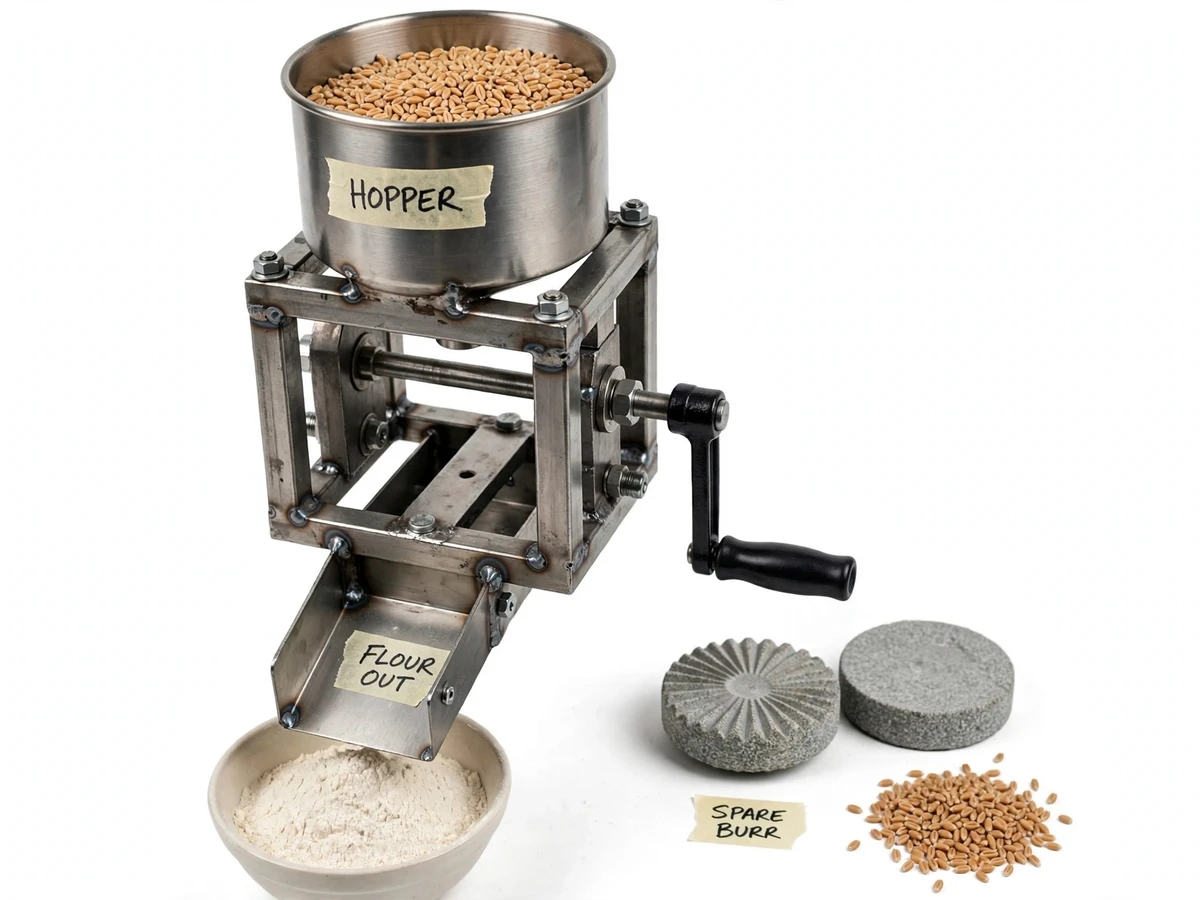
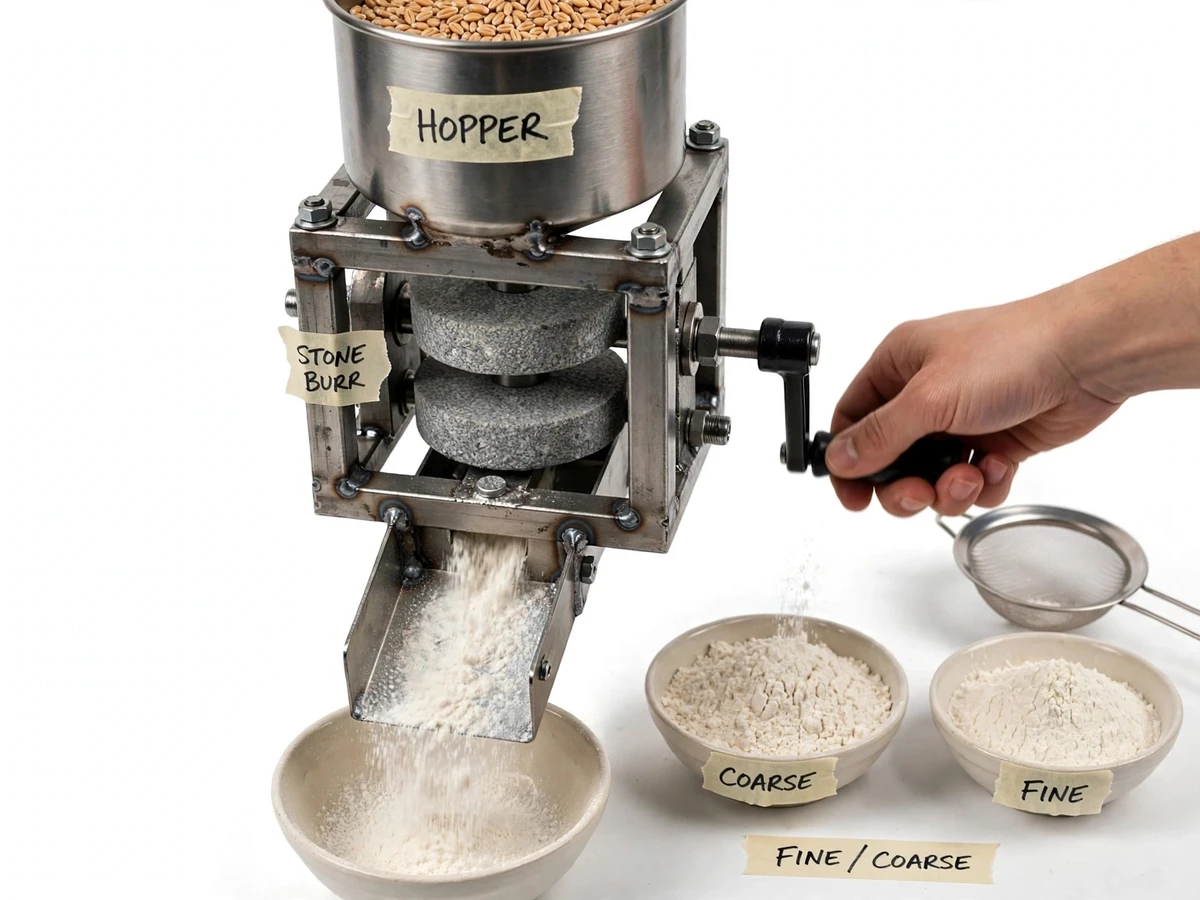
A hand-cranked stone grain grinder for home flour milling is a bench-scale machine that turns whole grain into flour by passing it between two granite stones. One stone stays fixed while the other is turned by a hand crank, and the narrow gap between the two stones shears and crushes each kernel until it becomes flour. The operator controls the result directly: a wider gap gives coarse meal for porridge and flatbreads that need texture, while a narrower gap gives finer flour for soft rotis and baking. Because the burrs are interchangeable, a worn or chipped stone can be swapped without rebuilding the machine, and a different groove pattern can be fitted for a different grain. The whole process runs without a motor, a power socket, or any electronic control, which keeps the build simple, repairable, and easy to demonstrate.
Many households buy packaged flour without knowing how long it has sat on a shelf, and small electric mills are expensive, noisy, and useless during a power cut. A hand-cranked stone mill answers a smaller, practical need: milling a fresh batch of flour at home, in the quantity needed for a day or two, from grain the household has chosen itself. The project also makes the milling mechanism visible and testable in a way a closed electric mill never does — the stones, the gap, the feed, and the outlet can all be inspected, adjusted, and explained. That visibility is what makes it a strong mechanical build: every part has a job that can be shown, measured, and defended.
Pours dry grain into the hopper and turns the crank.
Follow the working sequence
How it works
Grain enters the machine at the top and leaves as flour at the bottom, passing through four stages in a fixed order. First, dry grain poured into the hopper falls by gravity into the centre of the stone pair, where the rotating stone catches it and draws it outward between the two grinding faces. Next, the groove pattern cut into the stones shears each kernel again and again as it travels outward, breaking it into smaller and smaller particles — this shearing between two rough stone faces, rather than crushing by impact, is what gives stone-milled flour its characteristic texture. Then the gap between the stones decides the final particle size: grain cannot leave the stone pair until it is small enough to pass through that gap, so a narrow gap forces more shearing passes and finer flour. Finally, the milled flour falls through the outlet chute into a bowl, ready for sieving if a finer grade is wanted.
- Clean, dry grain is poured into the stainless steel hopper, and the operator checks that no stones, husk clumps, or damp grain are mixed in.
- The burr gap is set before milling starts: the builder note from the build is to begin with a gap roughly the thickness of a credit card for fine flour, then open it by quarter-turns of the adjuster for coarser meal, testing a small handful each time.
- The crank is turned at a steady, comfortable pace, and the rotating stone draws grain from the hopper centre outward between the two stone faces.
- Grooves on the stone faces shear each kernel repeatedly as it travels outward, reducing it to flour that is fine enough to pass through the set gap.
- Milled flour drops through the outlet chute into a bowl placed beneath it, while any coarse fraction can be returned to the hopper for a second pass.
- The operator sieves the flour if a finer grade is wanted, then brushes the stones and chute clean and leaves them dry before storage.
This project vs a commercial electric mill
| Feature | This stone grinder | Commercial electric mill |
|---|---|---|
| Power source | Hand crank, no electricity needed | Electric motor, needs a power socket |
| Flour fineness control | Mechanical burr-gap adjuster, set by hand | Dial or preset, set by the motor controller |
| Throughput | Approximately 300–500 g per hour (design target, dry wheat at a steady hand-cranking pace) | Several kg per hour (typical manufacturer rating) |
| Running cost | No electricity cost, only cleaning and occasional burr replacement | Electricity cost plus motor and blade servicing |
| Portability | Bench-scale unit, usable anywhere a table is available | Needs a socket, heavier, fixed in one place |
| Maintenance | Stones, bearings, and crank can be serviced with hand tools | Motor and electronics need specialist servicing |
| What you learn from it | The full milling mechanism is visible and adjustable | The mechanism is enclosed and hard to inspect |
Tech stack:
- Granite burr stones · interchangeable set
- Mild steel frame · bolted construction
- Stainless steel hopper
- Hand crank · gear reduction drive
- Ball bearings · shaft assembly
- Threaded burr-gap adjuster
- Stainless steel outlet chute
- Hand sieves · optional grading set
| Parameter | Value |
|---|---|
| Burr diameter | Approximately 150 mm (design target) |
| Burr set | 2 stones (count): one fixed stone and one rotating stone |
| Spare burr set | 1 additional pair (count) included with the base build |
| Hopper capacity | Approximately 1 kg (design target) |
| Overall height | Approximately 450 mm (design target) |
| Footprint | Approximately 300 mm × 300 mm (design target) |
| Weight | Approximately 8 kg (design target) |
| Crank length | Approximately 180 mm (design target) |
| Throughput | Approximately 300–500 g per hour (design target, dry wheat at a steady hand-cranking pace) |
| Grain types supported | 4 grain types (count): wheat, rice, jowar, bajra |
| Power requirement | 0 W (no electricity, hand-cranked only) |
| Flour fineness | Coarse to fine, set by the burr-gap adjuster |
Project features
The hand-cranked stone grain grinder is built around four capabilities that define how it works: interchangeable granite burrs that can be swapped for a different grain or groove pattern, an adjustable burr gap that sets flour fineness without changing any other part, a direct hand-crank drive that needs no electricity, and a simple gravity-fed flour path from hopper to outlet that keeps the grain moving with few moving parts. Together these give a machine that is easy to operate, easy to clean, and easy to explain part by part. The operator loads grain, sets the gap, turns the crank at a steady pace, and collects flour — and each of those actions maps to one visible mechanism, so the working of the machine can be followed from input to output without opening a black box.
- [Interchangeable granite burrs] A pair of granite stones forms the grinding faces, and the set can be removed and replaced with a spare pair carrying a different groove pattern, so one frame serves more than one grain and a damaged stone does not scrap the machine.
- [Adjustable burr-gap control] A threaded adjuster moves the rotating stone towards or away from the fixed stone, so flour fineness is set mechanically in small steps, from coarse meal to fine flour, without tools beyond the built-in handwheel.
- [Hand-crank drive with gear reduction] The crank turns the rotating stone through a simple gear reduction, so a comfortable cranking pace produces steady stone speed and the operator feels the load change when the gap is tightened or the hopper runs full.
- [Gravity hopper feed] A stainless steel hopper above the stones feeds grain downwards by gravity into the centre of the burrs, so no feeder motor or auger is needed and the feed rate follows naturally from the gap setting.
- [Food-contact flour path] Grain touches only the granite stones, the stainless hopper, and the outlet chute on its way to the bowl, which keeps the food-contact surfaces simple to inspect, brush clean, and dry after use.
- [Bench-scale bolted frame] The stones, shaft, bearings, and crank mount on a bolted mild steel frame that sits on a tabletop, so the machine can be assembled, dismantled for cleaning or burr changes, and transported without special handling.
- [Optional sieve set] A set of hand sieves for separating coarse bran from fine flour can be added on request, as an optional extra that is not part of the base build.
What is included
- Working hand-cranked stone grain grinder prototype with interchangeable burr set fitted
- Spare granite burr pair with a different groove pattern
- Hopper, outlet chute, and collection bowl
- Optional hand sieve set, if selected at order time
- Component list with stone, frame, bearing, and fastener details
- Assembly, burr-gap setup, and cleaning guide
- Project report PDF covering mechanism, design calculations, and test procedure
- Presentation slides for the final review
- Viva preparation notes on milling, burr geometry, and mechanical drives
Limitations & prerequisites
- Throughput is a design target of approximately 300–500 g per hour for dry wheat at a steady hand-cranking pace, so milling a large weekly batch takes longer than with an electric mill.
- Output fineness varies with grain moisture and crank speed: damp grain clogs the stones and uneven cranking gives uneven flour, so only fully dry grain and a steady pace give consistent results.
- The stones must be food-safe granite, cleaned and fully dried after every use; any other stone type, or a stone left damp, risks contamination and is not acceptable for food use.
- Milling is manual work: sustained cranking is tiring, and the machine is not suited to continuous all-day use or to commercial quantities.
- Oily seeds, wet grain, and spices are out of scope: oil clogs the stone grooves, wet grain pastes instead of milling, and strong flavours would carry into the next batch of flour.
- Flour from a single pass may need sieving for very fine baking grades, and a second pass is sometimes needed after the first milling.
Frequently Asked Questions
Is this project suitable for a final-year project?
Yes, it fits Mechanical Engineering programmes well, because it combines machine design, manufacturing, and testing in one visible build. It demonstrates shaft and bearing selection, frame design, gear reduction, and burr geometry, and the report documents the gap-setting procedure and a buyer-run milling test that the team can repeat during demonstration.
What grains can this grinder mill?
It mills dry wheat, rice, jowar, and bajra into flour, with fineness set by the burr gap. Each grain behaves differently — rice is harder and mills slower, while millets mill faster — so the operator tests a small handful first and adjusts the gap before milling a full batch. Oily seeds and wet grain are excluded because they clog the stones.
How is flour fineness adjusted?
Fineness is set by the threaded burr-gap adjuster, which moves the rotating stone closer to or further from the fixed stone. A narrower gap forces more shearing passes and gives finer flour, while a wider gap lets coarser meal through. The operator mills a small test handful, checks the result, and then adjusts by quarter-turns until the wanted grade is reached.
Does the grinder need electricity?
No, it runs entirely by hand crank, so it works anywhere a table is available, including during a power cut. The crank drives the rotating stone through a gear reduction that keeps the pace comfortable, so a steady hand-cranking rhythm is enough to mill a small batch without tiring quickly. The trade-off is throughput: hand milling is slower than an electric mill, so it suits fresh daily batches rather than large commercial quantities.
How is the grinder cleaned, and is the flour safe to eat?
Grain touches only food-safe granite stones, the stainless hopper, and the outlet chute, and the stones must be food-safe granite rather than any decorative stone. After each use the stones and chute are brushed clean, wiped, and left fully dry before storage, which prevents damp flour residue from spoiling. Only dry, clean grain should ever be milled.
Can the grinder be customised?
Yes, realistic changes include a different burr diameter, an extra burr pair with another groove pattern, a larger hopper, or a sturdier table clamp for the frame. A motor drive can be discussed as a separate modification, but it is not part of the base hand-cranked build. Any change is agreed before the build starts so the report and the delivered machine match.
Components & software requirements
- Granite burr stones · interchangeable set
- Mild steel frame · bolted construction
- Stainless steel hopper
- Hand crank · gear reduction drive
- Ball bearings · shaft assembly
- Threaded burr-gap adjuster
- Stainless steel outlet chute
- Hand sieves · optional grading set
Delivery information
Built-to-order project. Delivery timeline is shared after order confirmation based on current queue.
Support terms
Complete documentation, setup guide, and viva preparation included. Support for setup and explanation provided.
Download free synopsis (PDF)
Enter your name and WhatsApp number — the synopsis PDF downloads immediately. We may send occasional project updates on WhatsApp; no spam.