
More project photos (2)
The problem
Hand-kneading dough is slow, tiring work that rarely produces the same result twice. In homes, hostels and small bakeries, atta or bread dough is usually kneaded by hand on a flat surface, which takes 15 to 20 minutes of continuous effort for a single batch and leaves the dough's consistency dependent on the cook's strength and technique. Under-kneaded dough tears when rolled and bakes unevenly, while over-kneaded dough turns tough and loses its softness. Small bakeries face the same problem at larger scale: one worker can only knead so many batches a day, and every batch still varies with fatigue. The Automatic Dough Kneading Machine with Spiral Hook and Variable Speed Control removes this manual step entirely. Flour, water and other ingredients go into a stainless steel bowl, and a motor-driven spiral hook kneads the dough to a uniform consistency while the operator simply selects the speed and watches the process.
Hand kneading also brings hygiene and consistency problems that a machine avoids. Hands transfer heat and moisture unevenly into the dough, and every batch depends on who kneaded it. A small bakery or hostel kitchen that needs several batches a day cannot rely on one person's arms, and hiring extra help just for kneading is expensive. This project solves the problem with a compact, workshop-built machine: a fixed stainless steel bowl, a spiral hook driven by a geared motor, and a simple speed controller. It is sized for a college prototype and a small kitchen, not a commercial production line, and it teaches real machine-design thinking — torque, speed reduction, food-contact materials and fabrication — in a build the student can fully explain.
Loads ingredients into the bowl and selects a speed.
Follow the working sequence
How it works
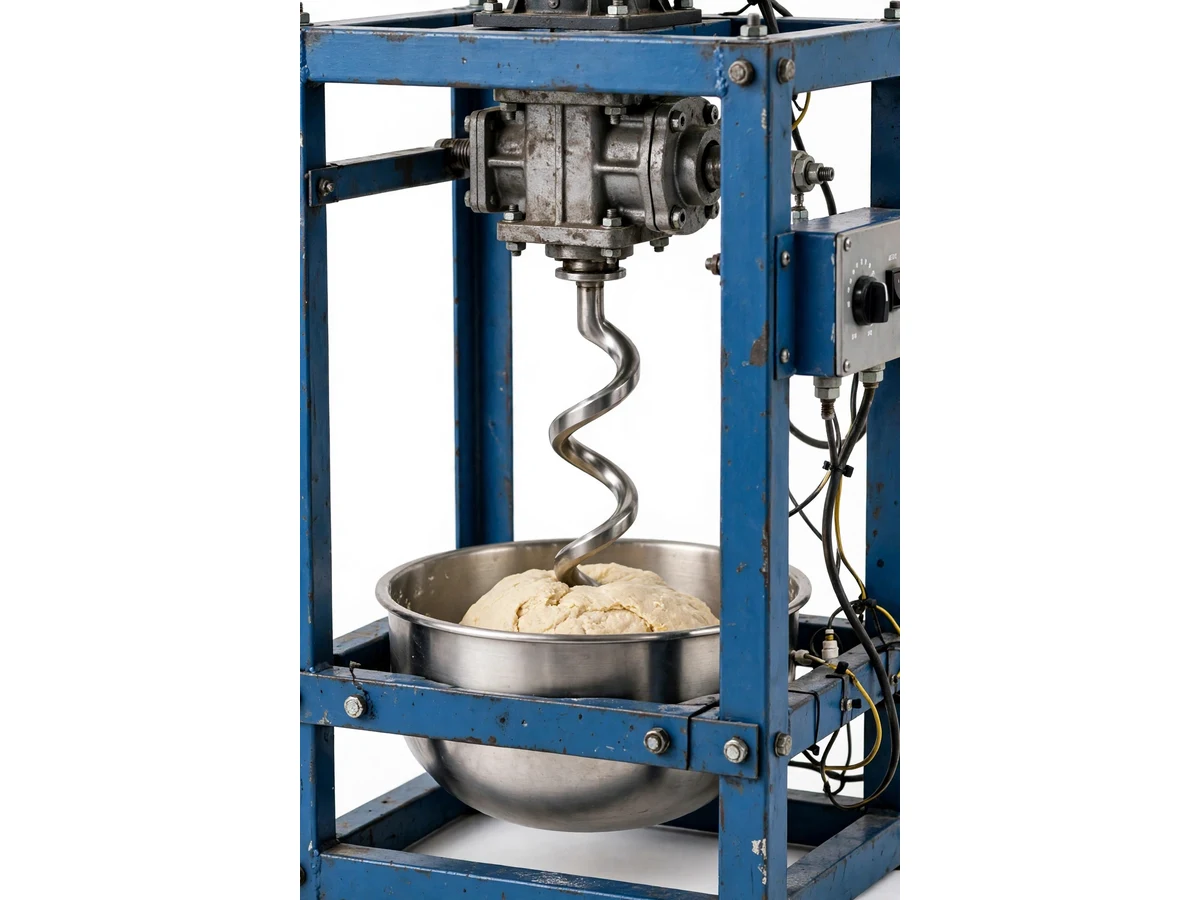
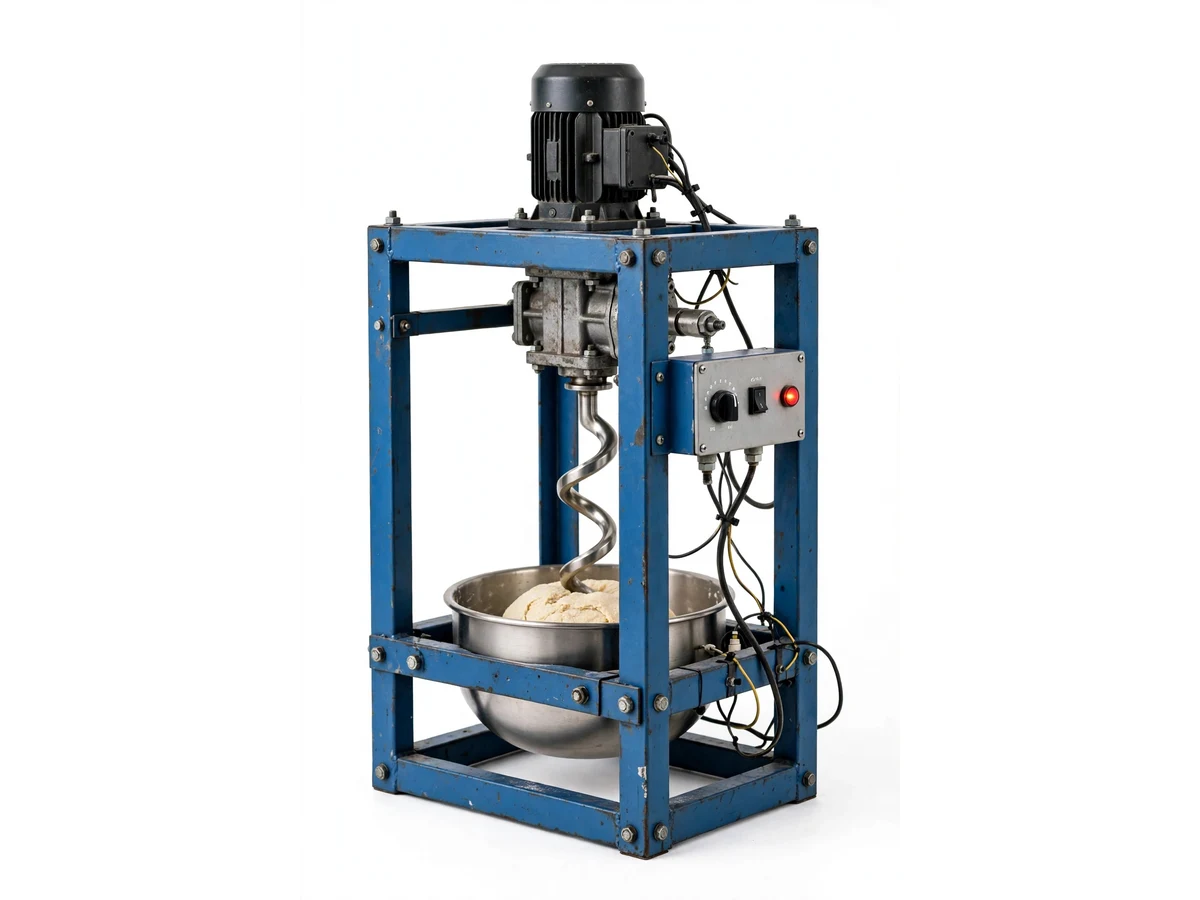
The machine kneads dough the way a skilled baker's hands do, but with a motor doing the work. A single-phase induction motor mounted on top of the frame drives a worm gearbox, which reduces the motor's speed and multiplies its torque so the hook turns slowly and powerfully instead of spinning fast and uselessly. The gearbox output shaft carries a stainless steel spiral hook that dips into a fixed stainless steel bowl. As the hook rotates, its helical shape lifts dough from the bottom of the bowl, stretches it upward and folds it back over itself, cycle after cycle. This stretching and folding action is what develops gluten evenly, giving the dough its smooth, elastic texture. A variable speed controller on the side panel lets the operator run the hook slowly while flour and water first combine, then faster once a rough dough forms, and finally at full speed for the finishing knead.
- Flour, water, salt and other ingredients are weighed and loaded into the stainless steel bowl, which sits in the frame beneath the hook.
- The operator switches the machine on and selects the slow speed, so the hook gently combines the dry and wet ingredients without throwing flour out of the bowl.
- Once a rough, shaggy dough forms, the operator moves to the medium speed; the spiral hook begins lifting, stretching and folding the mass.
- For the final knead, the operator selects the fast speed; the hook works the dough until it turns smooth and elastic and pulls cleanly away from the bowl wall.
- The operator switches the machine off, lifts the bowl out of the frame, and removes the finished dough for resting, rolling or baking.
- The bowl and hook are wiped or washed clean, ready for the next batch.
Builder note from the build: the hook tip clearance is the detail that decides whether the machine actually works. The hook tip is set approximately 8 mm to 10 mm above the bowl floor — set tighter, the hook drags on the steel and smears dough into a paste ring; set wider, a ring of dry flour survives unmixed at the bottom of the bowl. The clearance is fixed with shims under the gearbox mount during assembly, and it is the first thing checked after any reassembly.
Tech stack:
- Single-phase induction motor
- Worm gearbox drive
- SS304 spiral hook
- Stainless steel bowl fabrication
- Variable speed controller
- Mild steel frame fabrication
- Electrical panel wiring
- Food-grade surface finishing
| Parameter | Value |
|---|---|
| Drive motor | 0.5 HP single-phase induction motor (design target) |
| Gearbox | Worm gearbox, approximately 30:1 reduction ratio (design target) |
| Hook speed | Approximately 80 RPM to 160 RPM across 3 speed steps (design target) |
| Bowl | Stainless steel, approximately 10 L capacity (design target) |
| Batch size | Approximately 5 kg dough per batch (design target) |
| Hook | Food-grade SS304 spiral hook, 1 unit |
| Frame | Mild steel angle frame, bolted construction |
| Power supply | 230 V AC, single phase, 50 Hz (standard mains) |
| Controls | On/off switch, 3-step speed knob, indicator lamp, 1 panel |
| Overall size | Approximately 600 mm wide × 500 mm deep × 900 mm tall (design target) |
Project features
The machine's three strongest capabilities are its spiral hook kneading action, its variable speed control and its hands-free batch operation. The spiral hook is the heart of the machine: unlike a flat beater that cuts through dough or a paddle that merely stirs it, the helical hook lifts, stretches and folds the dough, developing gluten the way hand kneading does. Variable speed control gives the operator real command over the process, with a slow speed for combining dry and wet ingredients without throwing flour out of the bowl, a medium speed for forming the dough and a fast speed for the final elastic knead. Because the bowl is fixed and the hook does all the moving, a full batch kneads itself while the operator prepares other ingredients, turning a 15 to 20 minute manual chore into a supervised few minutes of machine time.
- [Spiral hook kneading] A food-grade stainless steel spiral hook rotates in a fixed bowl, lifting dough from the bottom, stretching it upward and folding it back over itself. This stretching-and-folding action develops gluten evenly instead of cutting or tearing the dough.
- [Variable speed control] A panel-mounted controller gives 3 speed steps: slow for combining flour and water without scattering, medium for forming the dough, and fast for the final elastic knead.
- [Fixed stainless steel bowl] The bowl is fabricated from food-grade stainless steel with a smooth, easy-to-clean interior, and it lifts out of the frame so the finished dough can be removed and the bowl washed.
- [Geared motor drive] A single-phase induction motor drives the hook through a worm gearbox, trading speed for torque so the hook turns slowly and powerfully through stiff dough instead of stalling.
- [Hands-free batch operation] Once the ingredients are loaded and the speed is selected, the machine kneads a full batch on its own while the operator prepares other ingredients or cleans up.
- [Simple panel controls] One on/off switch, one speed knob and one indicator lamp run the whole machine — no programming, no display menus, nothing to configure before use.
- [Sturdy bolted frame] A mild steel angle frame, bolted rather than welded at the key joints, carries the motor, gearbox and bowl rigidly and keeps vibration low during kneading.
Implemented features are listed above. Optional customizations (developed on request, not part of the base build): timer-based auto-stop, a rotating bowl drive, and a larger bowl size. Future scope (not included): a dough-consistency sensor and a flour-dispensing hopper.
What is included
- Working dough kneading machine prototype (motor, gearbox, spiral hook, bowl, frame, control panel)
- Fabrication drawings for the frame, hook and bowl mount
- Complete component list with specifications
- Wiring diagram for the motor, controller and panel
- Assembly and operating instructions
- Project report PDF (design calculations, fabrication process, working, limitations)
- PPT presentation for final review
- Viva Q&A preparation document (gearbox selection, torque, food-grade materials, speed control)
Limitations & prerequisites
- The prototype is a college-scale build, not a certified commercial food machine — it is not rated for continuous production-line use.
- Batch size is limited to approximately 5 kg of dough per batch (design target); larger batches need a bigger motor, gearbox and bowl.
- The machine has no timer or auto-stop in the base build — the operator judges when the dough is ready and switches it off.
- Dough consistency depends on the ingredient ratio the operator loads; the machine cannot correct a wrong flour-to-water ratio.
- Very stiff doughs (low hydration) load the motor heavily and should be kneaded at the slow speed only.
- The hook and bowl must be cleaned after every use; dried dough left on the hook is hard to remove and is a hygiene risk.
- Performance figures stated here are design targets, not measured test results — the report documents the actual behaviour observed during the build's trial runs.
Frequently Asked Questions
Is this project suitable for a final-year project?
Yes — for Mechanical Engineering and related programs, because it combines machine design, drive selection, fabrication and testing in one working prototype. It demonstrates motor-gearbox torque and speed calculations, worm-gear reduction, food-grade material selection and hands-on fabrication, and every part of the build can be explained in a viva from first principles.
Which motor and gearbox does it use?
A 0.5 HP single-phase induction motor (design target) driving the hook through a worm gearbox with an approximately 30:1 reduction ratio. The worm gearbox is chosen deliberately: it converts the motor's high speed into the slow, high-torque rotation a dough hook needs, and its compact right-angle layout keeps the machine's frame simple.
How is a spiral hook different from a paddle or beater?
A spiral hook kneads, while a paddle stirs and a beater cuts. The hook's helical shape lifts dough from the bottom of the bowl, stretches it and folds it over itself, which develops gluten evenly like hand kneading and gives the dough its smooth, elastic texture. A paddle would only push the dough around, and a flat beater would slice through it without building elasticity.
How much dough can it knead in one batch?
Approximately 5 kg of dough per batch (design target), in a stainless steel bowl of approximately 10 L capacity. That covers a hostel or small bakery batch comfortably, and the bowl lifts out of the frame so the finished dough is easy to remove. Larger batches would need a bigger motor, gearbox and bowl, which can be quoted as a customization.
Can the machine be customized?
Yes — realistic customizations include a timer-based auto-stop, a rotating bowl drive, a larger bowl, and a different speed range. The base build keeps controls deliberately simple (one switch, one speed knob, one lamp), so any added feature is quoted separately and does not change what the base project already does.
What are the main limitations?
The main limits are batch size (approximately 5 kg per batch, design target), no timer or auto-stop in the base build, and no correction for a wrong flour-to-water ratio — the operator must load the right recipe. It is also a college-scale prototype, not a certified commercial food machine, so it is not rated for continuous production-line use.
Components & software requirements
- Single-phase induction motor
- Worm gearbox drive
- SS304 spiral hook
- Stainless steel bowl fabrication
- Variable speed controller
- Mild steel frame fabrication
- Electrical panel wiring
- Food-grade surface finishing
Delivery information
Built-to-order project. Delivery timeline is shared after order confirmation based on current queue.
Support terms
Complete documentation, setup guide, and viva preparation included. Support for setup and explanation provided.
Download free synopsis (PDF)
Enter your name and WhatsApp number — the synopsis PDF downloads immediately. We may send occasional project updates on WhatsApp; no spam.