
More project photos (2)

The problem
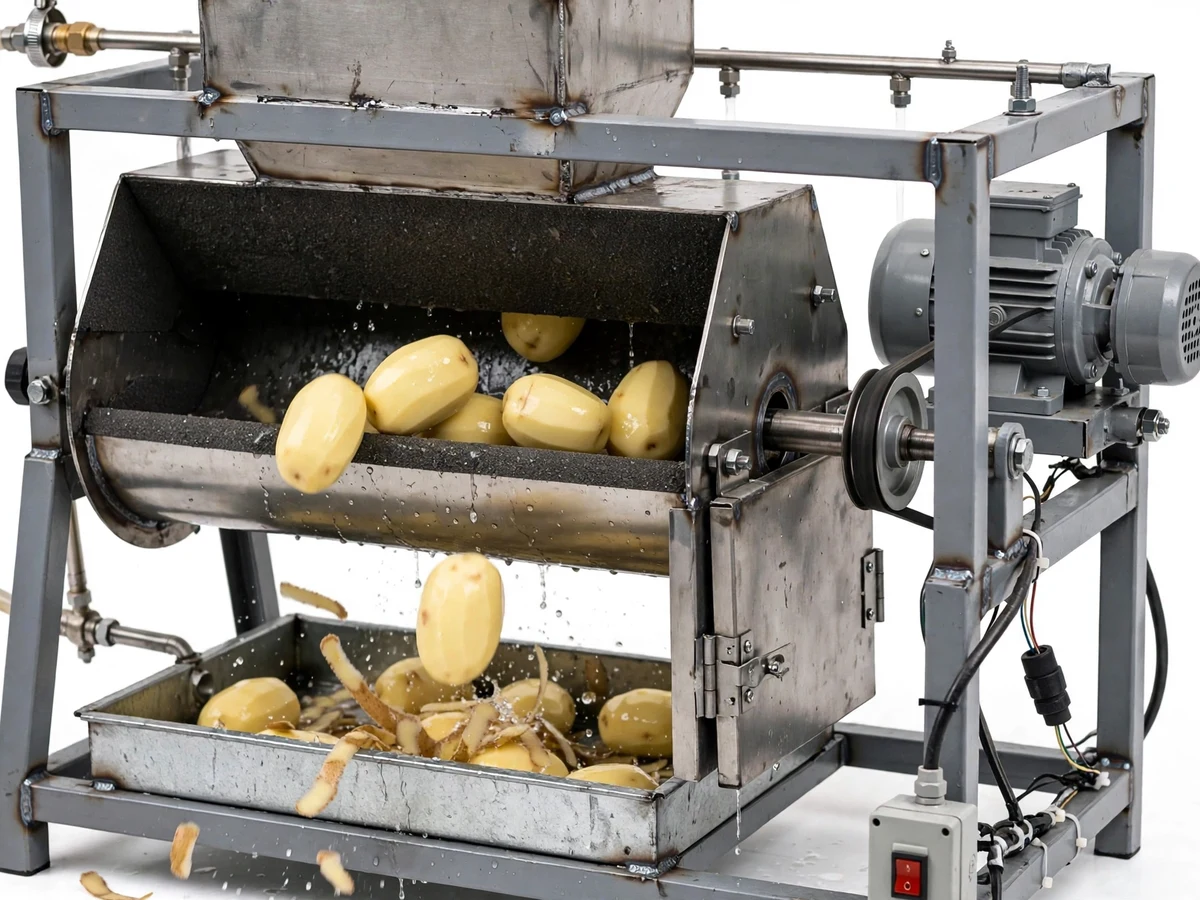
An automatic potato peeling machine is a batch food-processing machine that removes potato skin by abrasion instead of by hand knife work. Potatoes tumble inside a rotating drum whose inner wall is lined with abrasive carborundum; friction wears the skin away while a water spray flushes the loosened peel out through a drain. This project builds that machine as a compact prototype: a stainless-steel abrasive drum on a mild-steel frame, driven by a 0.5 HP single-phase motor through a belt and pulley, with a top loading hopper, a spray pipe, a side discharge gate and a drain tray. It suits kitchens and canteens that peel potatoes in batches every day, and it gives mechanical engineering students a complete fabrication project — drum design, drive sizing, frame welding, water handling and trial-based tuning — in one build.
This is a built-to-order hardware project: the prototype, fabrication drawings, wiring documentation and the complete viva kit (report, PPT, Q&A) are prepared fresh for you.
The Problem
Peeling potatoes by hand is slow, tiring and inconsistent wherever potatoes are prepared in quantity. In a hostel kitchen or small canteen, one worker with a knife or hand peeler works through sack after sack, and the result depends on that worker's speed and attention: some potatoes come out clean, others keep patches of skin, and tired hands slip. The work also ties up a person who could be cooking, and it scales badly: doubling the potatoes roughly doubles the peeling labour. The gap this project addresses is a small, affordable machine that takes over this repetitive job: a batch of potatoes goes into a drum, the drum's abrasive wall does the rubbing that a hand peeler does, water carries the peel away, and the batch comes out peeled through a discharge gate.
| Peeling by hand | Abrasive-drum machine (this project) | |
|---|---|---|
| Labour per batch | One worker peeling continuously | One person loads, switches on and collects |
| Batch size | One potato at a time | Approximately 5 kg per batch (design target) |
| Cycle time | Varies with the worker, potato by potato | Approximately 3–5 minutes per batch (design target) |
| Consistency | Depends on skill and fatigue | Same drum, speed and spray every batch |
| Peel removal | Knife or hand peeler, skin by skin | Abrasive wall plus water spray, whole batch at once |
| Suited to | A few potatoes at home | Hostel kitchens, canteens and food-processing demonstrations |
Washed potatoes are poured into the top hopper as one batch.
Follow the working sequence
How it works
The machine peels a batch of potatoes in one continuous motion from loading to collection, and the whole cycle is driven by a single rotating drum. Potatoes poured into the top hopper drop into the drum, whose abrasive inner wall is already turning at its slow working speed. As the drum rotates, the potatoes tumble over each other and rub against the grit lining; the friction wears the skin off a little at a time, while the water spray washes the loosened flakes off the wall and down to the drain tray. Because the drum turns slowly, the potatoes roll and fall inside it rather than being pinned to the wall, so every side of every potato meets the abrasive surface over the course of the cycle. When the batch looks clean, the operator stops the motor and opens the side discharge gate, and the peeled potatoes slide out into the collection tray, ready for washing and cooking.
- Potatoes are washed to remove loose soil, then poured into the top hopper in a single batch of approximately 5 kg (design target).
- The operator switches the motor on; the belt and pulley reduction turns the drum at approximately 80–100 rpm (design target).
- Inside the drum, the tumbling potatoes rub against the carborundum abrasive lining, and friction wears the skin away gradually.
- The spray pipe mists water into the drum throughout the cycle, flushing loosened skin off the grit and down to the drain tray.
- After approximately 3–5 minutes (design target, depending on potato size and skin thickness), the operator stops the motor.
- The side discharge gate is opened and the peeled potatoes slide out into the collection tray, while peel water drains away separately.
- The drum is rinsed, the tray is emptied, and the next batch is loaded; the abrasive lining is brushed clean between batches.
Builder note from the build: the spray nozzles are aimed at the drum wall, not directly at the potatoes, so loosened peel is washed off the grit before it can clog the abrasive — a clogged lining stops peeling even while the drum keeps turning. The first-principles rule behind the whole machine is that peeling happens only where skin meets grit under the potato's own weight plus tumble impact, so the drum must turn slowly enough for potatoes to roll and fall, not so fast that they ride round pinned to the wall; that is why the drum speed is held near approximately 80–100 rpm (design target) instead of motor speed.
Tech stack:
- Stainless steel abrasive drum (SS304)
- Single-phase induction motor
- Belt · pulley drive reduction
- Carborundum abrasive lining
- Mild steel fabricated frame
- Water spray pipe · nozzles · drain tray
- Switch box · overload protection
- Workshop fabrication · welding · fitting
| Parameter | Value |
|---|---|
| Motor | 0.5 HP (370 W) single-phase induction motor, 1435 rpm (datasheet value) |
| Drum speed | Approximately 80–100 rpm (design target) |
| Drum size | Approximately 300 mm diameter × 400 mm long (design target) |
| Drum material | Stainless steel SS304 (design selection) |
| Abrasive lining | Carborundum grit lining, grade component-dependent |
| Batch capacity | Approximately 5 kg per batch (design target) |
| Cycle time | Approximately 3–5 minutes per batch (design target, potato size dependent) |
| Power supply | 230 V AC single-phase (expected) |
| Frame | Mild-steel angle frame (design selection) |
| Water feed | Mains or hose feed to spray pipe (expected) |
| Discharge | Side gate to collection tray (design selection) |
| Overall size | Approximately 900 mm × 500 mm × 900 mm (design target) |
| Weight | Approximately 35–45 kg (design target) |
Requirements
- Workshop access for cutting, welding and fitting the frame and drum housing.
- 230 V AC single-phase supply with earthing, plus a water connection and a drain point for the spray and peel water.
- Standard hand tools, a welding set and a drill press for fabrication; no microcontroller, programming or internet connection is needed.
- Potatoes for trial batches, graded by size, to tune cycle time during testing.
Project features
The machine's capabilities centre on four things: an abrasive drum that peels by friction rather than cutting, a water spray that keeps the grit clear and carries peel away, a simple belt drive that turns a fast motor into a slow drum, and a batch layout that makes loading and unloading a one-person job. Together these give a prototype that a student can build with workshop processes, demonstrate with real potatoes in front of examiners, and explain from first principles — friction, tumbling, drive reduction and drainage — without hiding behind electronics the project does not need. All of it is workshop technology: steel, grit, belt and water, with no electronics to program or calibrate. Every feature below is part of the base build; optional additions and future scope are listed separately underneath, so nothing promised later is mistaken for something already built.
- [Abrasive drum peeling] The rotating drum's inner wall is lined with carborundum abrasive, so tumbling potatoes rub against grit instead of a blade. Skin wears away gradually, which suits the thin, uneven skin of a potato better than a fixed knife edge.
- [Water spray and drainage] A spray pipe with nozzles mists water into the drum during peeling, washing loosened skin off the abrasive surface and carrying it to the drain tray below. Clean grit keeps cutting, and peel does not cake onto the drum wall.
- [Belt-and-pulley drive] A 0.5 HP single-phase motor drives the drum through a belt and pulley reduction, turning fast motor speed into a slow drum speed of approximately 80–100 rpm (design target). The belt also slips rather than breaking parts if the drum jams.
- [Top loading hopper] Potatoes are poured in from the top hopper in one batch of approximately 5 kg (design target), with no need to feed them one by one. The hopper mouth is sized so a batch can be loaded in seconds.
- [Side discharge gate] A hinged gate on the drum housing opens to release the peeled batch into the collection tray, separating the finished potatoes from the peel water that drains away underneath.
- [Simple switch-box control] A single on-off switch box with overload protection starts and stops the motor, so operation needs no training beyond loading, switching on, and opening the gate at the end of the cycle.
- [Food-contact stainless steel] The drum and all parts that touch potatoes are stainless steel (SS304 grade, design selection), which resists corrosion from constant water contact and can be washed down after every batch.
Implemented: all seven features above. Optional customization (not in the base build): a cycle timer that stops the drum automatically, and a larger drum for bigger batches. Future scope (not included): a variable-speed drive for tuning drum speed to potato variety, and a conveyor feed for continuous rather than batch operation.
What is included
- Working abrasive-drum potato peeling prototype with motor, belt drive, spray pipe and drain tray
- Fabrication drawings and component list with materials and sizes
- Wiring diagram and operating instructions for the switch box and motor circuit
- Project report PDF (background, design calculations, fabrication method, trial procedure, results template)
- Abstract PDF for submission
- PPT presentation for final review
- Viva Q&A preparation document (abrasion mechanism, drive reduction, motor selection, limitations)
To request a quotation, message Projectech on WhatsApp with the project name, the scope you want (the base peeling machine, or the base machine plus a cycle timer), and your delivery date; Projectech replies with a quotation covering scope, price, and delivery timeline.
Limitations & prerequisites
- Eyes and deep spots on irregular potatoes may keep small patches of skin and need a quick hand finish after the cycle.
- Very small potatoes (under approximately 30 mm diameter, design note) can slip through gaps or peel unevenly, so batches should be size-graded before loading.
- Peel removal is uneven on badly misshapen tubers, since only the surface that contacts the grit gets peeled.
- The machine needs a continuous water supply and a drain during every cycle; it cannot run dry, and peel water must be disposed of, not reused.
- The carborundum lining wears with use and needs periodic inspection and replacement; the interval is component-dependent and is not claimed here.
- This is a batch machine, not a continuous line: each batch must be loaded, run and discharged separately, and throughput depends on potato size and skin thickness.
- The prototype is an academic and small-kitchen build, not a food-safety certified commercial machine, and it is not rated for industrial-scale production.
Timeline
- Week 1–2: design, drum and drive calculations, drawings and material purchase (expected).
- Week 3–4: frame fabrication, drum rolling and abrasive lining, housing and hopper (expected).
- Week 5: motor mounting, belt drive alignment, spray pipe and wiring (expected).
- Week 6: trial batches, cycle-time tuning and finishing, followed by documentation (expected).
- Total build time approximately 6 weeks (expected), depending on workshop availability.
Support
- Demonstration guidance for running trial batches in front of reviewers, including loading, timing and discharge steps.
- Documentation support for the report, abstract and presentation, with the trial-results template filled from the student's own trial runs.
- Guidance on replacing the abrasive lining and aligning the belt drive during routine maintenance.
Frequently Asked Questions
How does an abrasive drum peel potatoes without cutting them?
The drum wall is lined with carborundum grit, and as potatoes tumble inside, friction wears the thin skin away a little at a time instead of slicing it off, so the flesh underneath stays largely intact while the water spray carries the loosened skin away. Eyes and deep spots may still need a quick hand finish after the cycle.
What power supply does the machine need?
It runs on a standard 230 V AC single-phase supply, the same supply available in any home or hostel kitchen, driving a 0.5 HP induction motor through a belt and pulley reduction, with no three-phase connection or special wiring needed. The supply point must still be earthed, because the machine works with water.
Can it peel vegetables other than potatoes?
Yes, within limits: root vegetables with a similar thin skin, such as carrots and beetroots, can be peeled in the same drum, provided they are size-graded and the cycle time is adjusted for each vegetable to suit its skin thickness and size. Leafy vegetables, soft fruit and very small produce are not suitable, since they would bruise or slip through the drum gaps.
How much can it peel in one batch, and how long does a batch take?
One batch holds approximately 5 kg of potatoes (design target) and takes approximately 3–5 minutes (design target), depending on potato size and skin thickness, with larger or thicker-skinned potatoes needing the longer end of that range, and overloading the drum slowing peeling because the potatoes cannot tumble freely. Batches should therefore be size-graded and kept to the design-target load.
What maintenance does the machine need?
The abrasive lining must be brushed clean after every batch and inspected regularly, since peel packed into the grit stops it cutting and slows the whole cycle, and the belt tension and pulley alignment should also be checked periodically, with the drum rinsed and dried after use to protect the steel. The lining itself is replaced when peeling visibly slows.
Is this project suitable for a final-year project?
Yes — for Mechanical Engineering and related production and manufacturing programs, where it demonstrates drum and shaft design, belt-drive reduction, motor selection, fabrication processes and trial-based tuning in one build, with a working machine that can be demonstrated live with real potatoes. It also gives a clear viva story, from design calculations to trial results.
Components & software requirements
- Stainless steel abrasive drum (SS304)
- Single-phase induction motor
- Belt · pulley drive reduction
- Carborundum abrasive lining
- Mild steel fabricated frame
- Water spray pipe · nozzles · drain tray
- Switch box · overload protection
- Workshop fabrication · welding · fitting
Delivery information
Built-to-order project. Delivery timeline is shared after order confirmation based on current queue.
Support terms
Complete documentation, setup guide, and viva preparation included. Support for setup and explanation provided.
Download free synopsis (PDF)
Enter your name and WhatsApp number — the synopsis PDF downloads immediately. We may send occasional project updates on WhatsApp; no spam.