
More project photos (2)
The problem
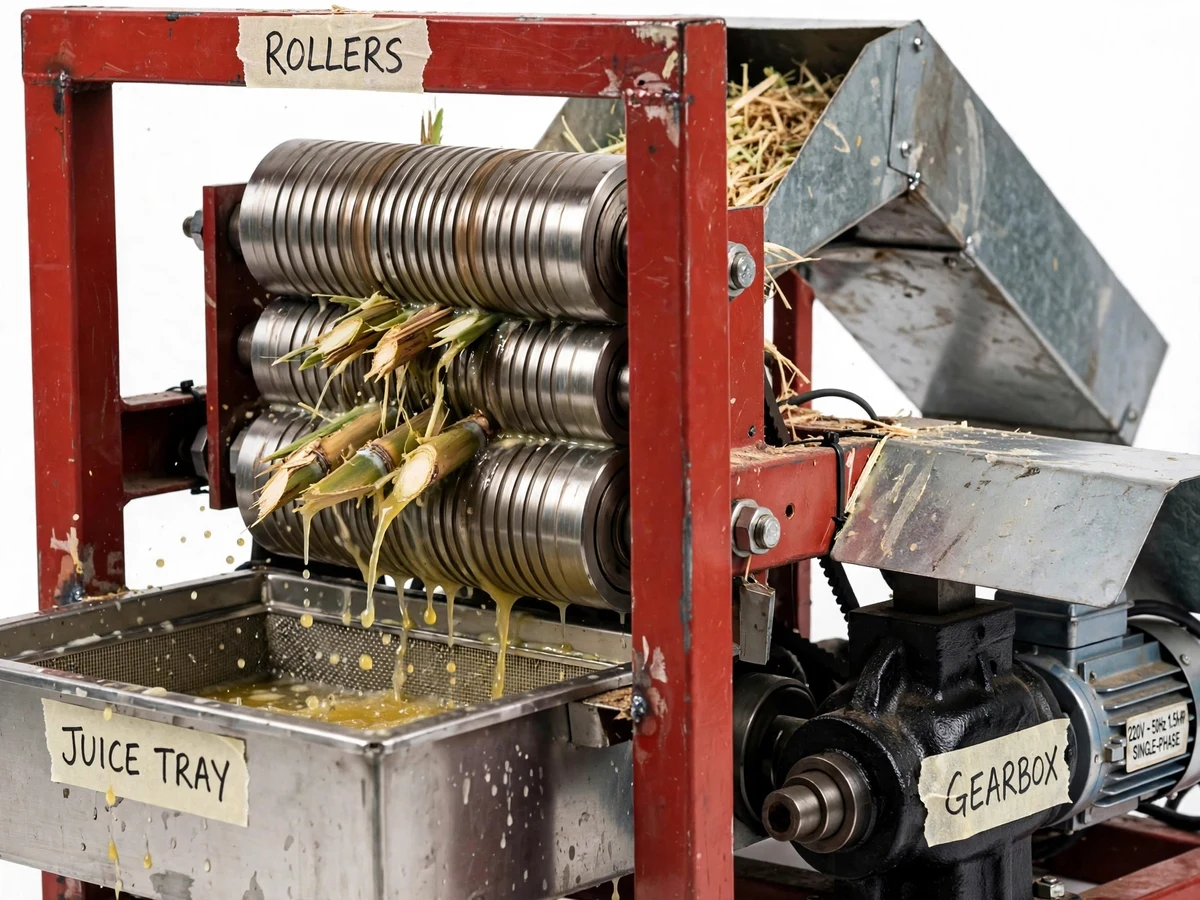
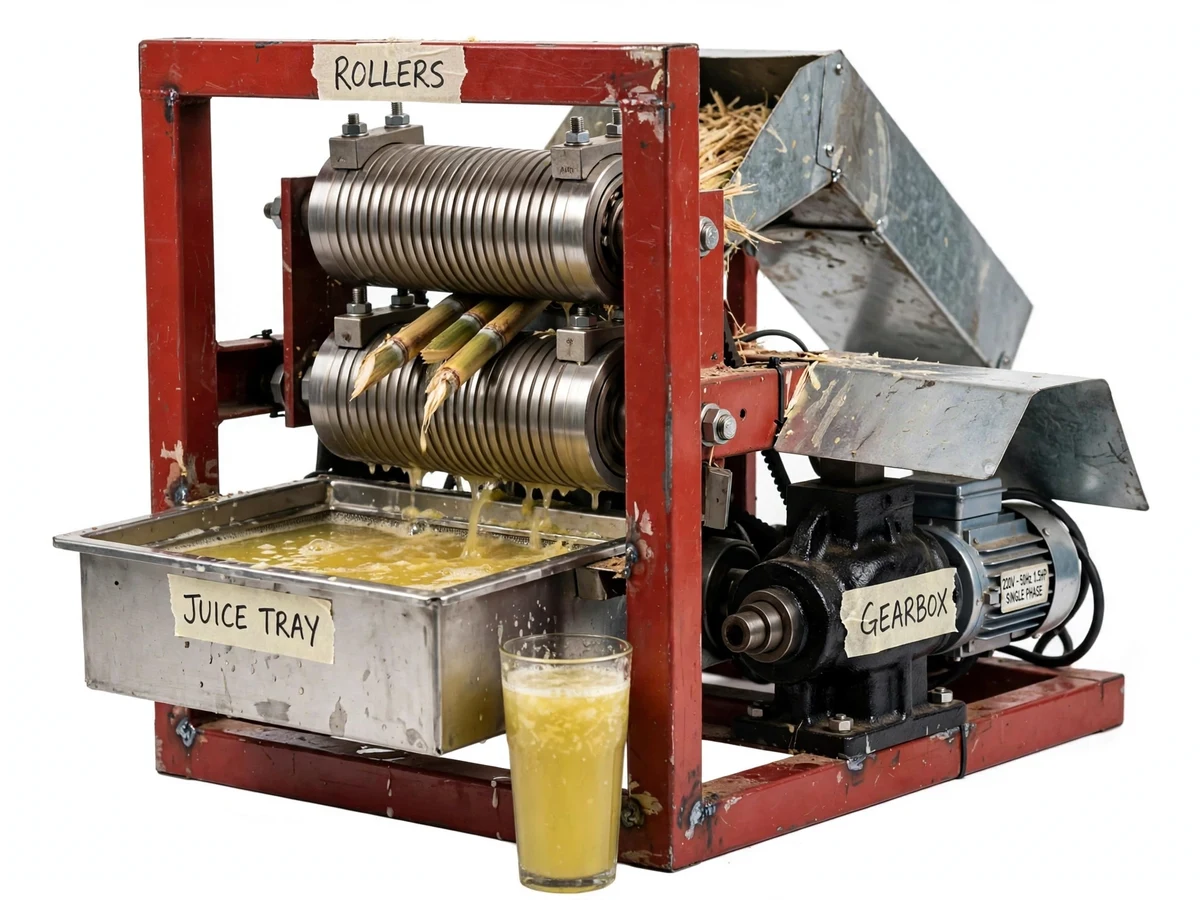
Fresh sugarcane juice is a staple street beverage across India, and the machines that press it are everywhere — yet their design is rarely studied as an engineering project. A cane extractor is a compact lesson in crushing mechanics: three rollers in a triangular arrangement grip the cane, the top roller adjustable for gap, and the slow, high-torque rotation squeezes juice from the fibre while the bagasse exits dry enough to burn as boiler fuel. This project builds that machine at vendor scale: three grooved MS rollers in a heavy frame, driven by a single-phase motor through a worm reduction gearbox for the slow, powerful crushing speed the process needs. A juice collection tray with strainer, a bagasse outlet chute and a full drive guard complete the build. The student runs extraction trials, measures juice yield per kilogram of cane at different roller gaps, and reports the yield study from their own data.
How it works
- Cleaned, trimmed cane billets are prepared and weighed for the test run.
- The roller gap is set with the adjusting screws to suit the cane thickness.
- The motor is started; the worm gearbox turns the three rollers at the slow crushing speed.
- Cane is fed into the roller nip by hand (with the feed pusher); the rollers grip, crush and convey it through.
- Juice flows into the strainer tray while bagasse exits through the rear chute for collection.
- Juice and bagasse are weighed per the test procedure, and yield per kg of cane is computed at each gap setting for the report.
Tech stack:
- Three grooved MS rollers with shafts
- Worm reduction gearbox
- 2 HP single-phase induction motor
- Fabricated heavy MS frame
- Adjustable top-roller bearing blocks
- Stainless juice tray with strainer mesh
- Bagasse outlet chute
- Sheet-metal safety guards
| Parameter | Value |
|---|---|
| Roller size | Approximately 150 mm dia × 200 mm long (design target) |
| Roller speed | Approximately 15–20 rpm (design target) |
| Motor | 2 HP single-phase induction motor (nameplate rating) |
| Gearbox | Worm reduction, approximately 30:1 (design target) |
| Juice yield | Approximately 55–65% of cane weight (design target, cane-dependent) |
| Throughput | Approximately 80–120 kg cane per hour (design target) |
| Overall size | Approximately 1100 × 700 × 1000 mm (design target) |
Project features
- [Three-roller crushing unit] Two bottom rollers and an adjustable top roller in triangular arrangement, grooved for cane grip — the standard extractor geometry.
- [Worm gearbox drive] A single-phase motor drives the rollers through a worm reduction gearbox, giving the slow, high-torque crushing speed the process needs.
- [Adjustable roller gap] The top roller bearing blocks slide on adjusting screws, so the crushing gap is set for cane thickness and for the yield study.
- [Juice tray with strainer] A stainless collection tray with a mesh strainer separates coarse fibre from the juice at the outlet.
- [Bagasse outlet chute] A rear chute guides the crushed bagasse clear of the machine for collection.
- [Yield test procedure] The manual gives the student a weighed-cane, timed-run procedure to measure juice yield per kg at each gap setting.
- [Full drive guard] Sheet-metal guards enclose the gearbox input, belt/chain drive and coupling; only the feed opening is accessible.
What is included
- Fully fabricated cane extractor machine with guards
- Juice tray with strainer and bagasse chute
- Roller-gap setting and machine operation manual
- Juice-yield test sheets (weighed-cane procedure)
- Dimensioned fabrication drawings
- Project report PDF (crushing theory, machine design, yield study format)
- PPT presentation for final review
- Viva Q&A preparation document (roller geometry, gearbox selection, yield factors, hygiene)
Limitations & prerequisites
- Juice yield and throughput are design targets verified by the student's own trials — no yield figures are claimed as measured before the build.
- Yield depends on cane variety, freshness and preparation; the manual specifies the cane prep the buyer must follow.
- Hand feeding needs care and the feed pusher; the manual lists the safe feeding procedure and what never to do near the nip.
- Rollers need cleaning after each run to prevent juice fermentation residue — the cleaning procedure is included.
- Food-contact parts are stainless tray and strainer only; rollers are MS as in commercial vendor machines, cleaned per procedure.
- Intended for cane; it is not designed for other crops or materials.
Frequently Asked Questions
Why three rollers instead of two?
The triangular three-roller arrangement crushes the cane twice in one pass (top-to-bottom roller nips on both sides), giving higher juice expression than a single nip — the standard geometry in commercial extractors.
Why is the roller speed so slow?
Crushing needs torque, not speed. The worm gearbox trades motor speed for the high torque that squeezes juice from the fibre, and slow rollers also give the juice time to drain into the tray.
How is juice yield measured?
Cane is weighed before the run, juice and bagasse are weighed after, and yield per kg is computed at each roller-gap setting. The test sheet walks the student through it.
What affects the yield?
Cane variety and freshness, roller gap setting, feed rate and roller condition. The yield study in the report compares gap settings on the student's own data.
Is this project suitable for a final-year project?
Yes — for Mechanical and Food Processing programs. It is a real working food machine with a design-plus-testing structure. Suitable for B.E./B.Tech final-year projects in Mechanical and Food Processing Engineering.
Components & software requirements
- Three grooved MS rollers with shafts
- Worm reduction gearbox
- 2 HP single-phase induction motor
- Fabricated heavy MS frame
- Adjustable top-roller bearing blocks
- Stainless juice tray with strainer mesh
- Bagasse outlet chute
- Sheet-metal safety guards
Delivery information
Built-to-order project. Delivery timeline is shared after order confirmation based on current queue.
Support terms
Complete documentation, setup guide, and viva preparation included. Support for setup and explanation provided.