
More project photos (3)
The problem
Cashew shelling is one of the most labour-intensive steps in cashew processing. In small units the work is still manual — a worker cracks each raw nut with a mallet or hand-lever cracker, a slow, skilled method protecting the delicate kernel inside. It also exposes the worker's skin to cashew nut shell liquid (CNSL), a caustic shell oil causing painful burns. Fixed-clearance motorized crackers raise the speed but create a new problem: raw nuts vary in size, so a gap for large nuts crushes small kernels, while a gap for small nuts fails to crack large ones.
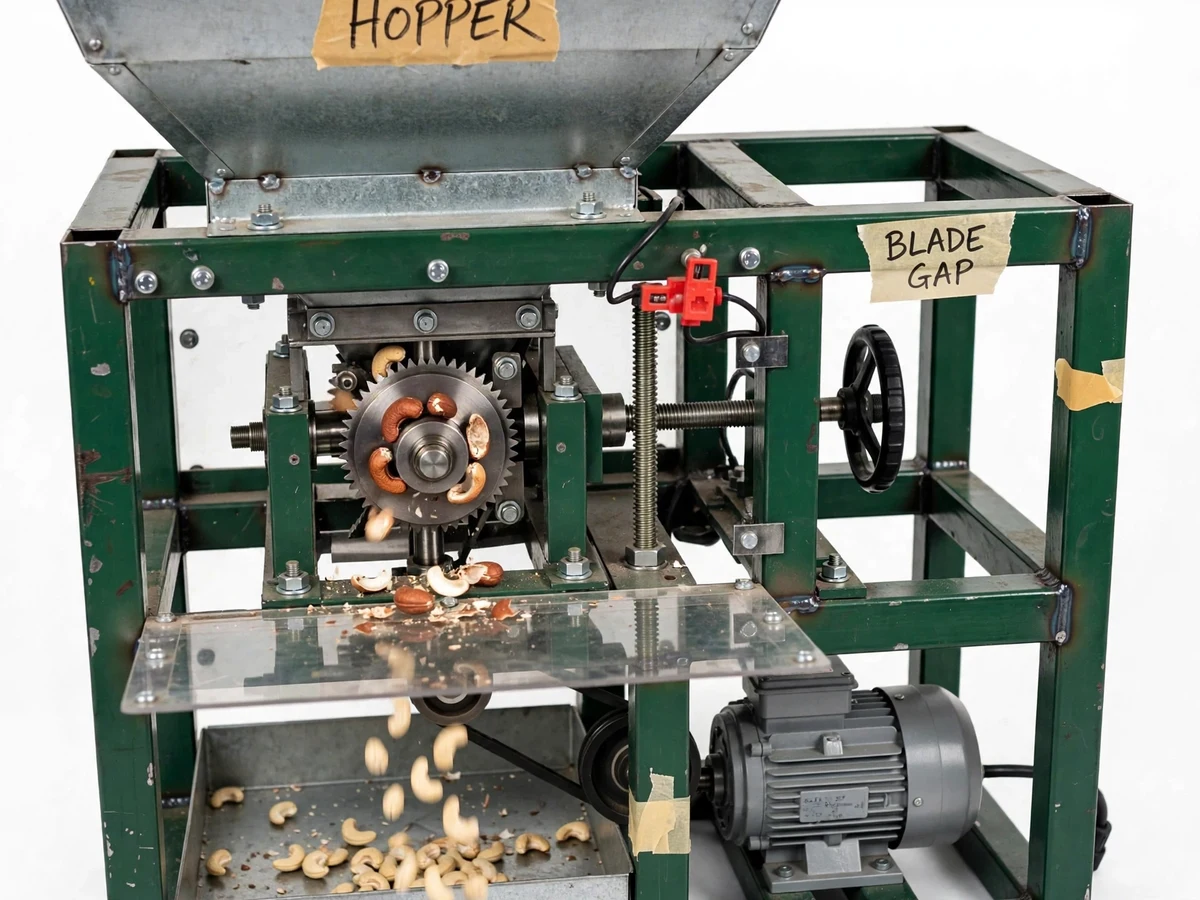
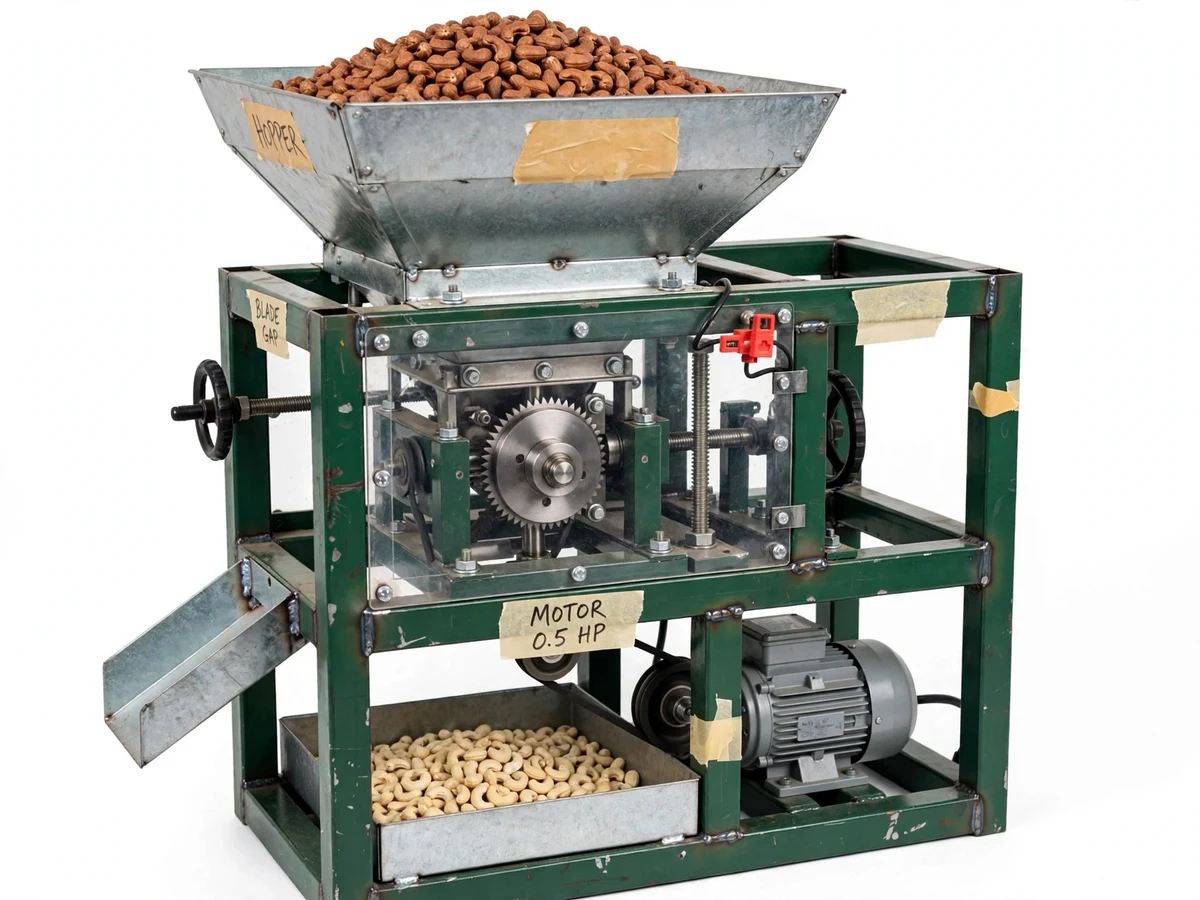
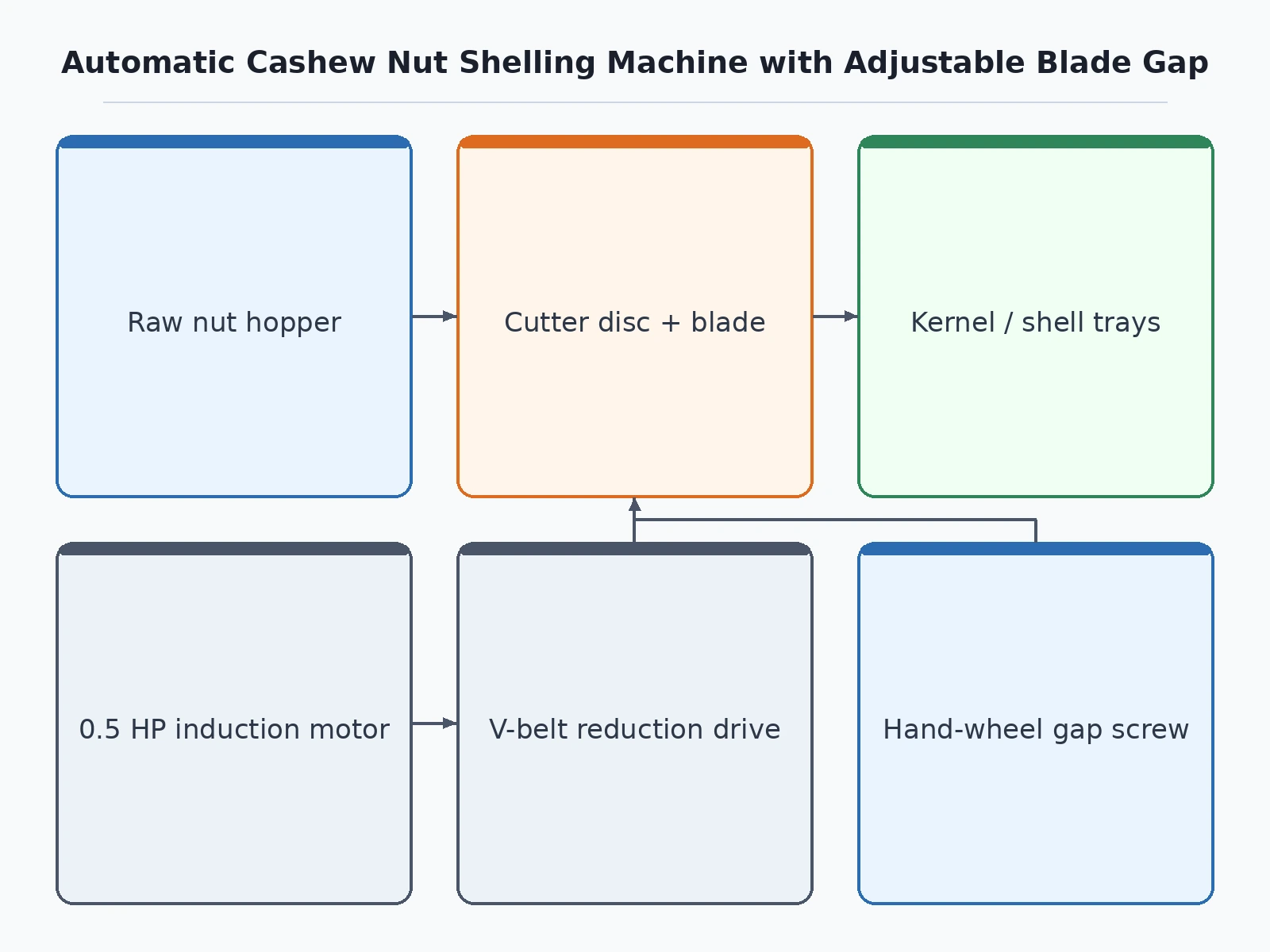
This project solves that trade-off mechanically: a lead-screw hand wheel moves the fixed blade relative to the rotating toothed cutter disc, so the working clearance matches the incoming nut grade — commercial grades W180, W240 and W320 run from large to small nuts. A 0.5 HP motor drives the cutter through a V-belt reduction, nuts meter from a top hopper, and kernels and shell fragments land in separate trays. The adjustment mechanism adds genuine design depth: screw-thread mechanics, belt-drive sizing and cutting geometry.
Sun-dried cashew nuts are poured into the top hopper, which meters them one at a time into the cutting chamber.
Follow the working sequence
How it works
- Raw, sun-dried cashew nuts are poured into the top hopper, which meters them one at a time into the cutting chamber.
- The operator sets the blade gap with the lead-screw hand wheel to match the incoming nut grade — a narrower gap for small grades such as W320, a wider one for large grades such as W180.
- The 0.5 HP motor spins the cutter disc through the V-belt reduction; the cutter runs at approximately 200-250 rpm (design target) after reduction.
- Each nut is caught between the rotating toothed disc and the fixed blade; the squeezing action cracks the brittle shell while the set gap prevents the kernel being fully crushed.
- The cracked mass drops onto the sieve tray — kernels fall through to the kernel tray while larger shell pieces slide off to the shell chute.
- The operator stops the machine with the push-button starter, collects the kernels and proceeds to manual shell separation and grading.
Tech stack:
- 0.5 HP single-phase induction motor, 1440 rpm
- V-belt and pulley reduction drive
- Mild steel 40 x 40 mm square-tube frame
- High-carbon steel toothed cutter disc and blade
- Lead screw with hand wheel (M16, 2 mm pitch)
- Plummer block bearings (UCP 204, typical selection)
- Polycarbonate safety guard with interlock switch
- Sheet-metal hopper and collection trays
| Parameter | Value |
|---|---|
| Drive motor | 0.5 HP single-phase induction motor, 1440 rpm (typical selection) |
| Blade gap | 0 to 15 mm, adjustable via lead screw and hand wheel (design) |
| Lead screw | M16, 2 mm pitch, with hand wheel (design selection) |
| Cutter speed | Approximately 200-250 rpm at the cutter shaft after belt reduction (design target) |
| Throughput | Approximately 20-25 kg of raw nuts per hour (design target, nut-size dependent) |
| Hopper capacity | Approximately 8-10 kg of raw nuts (design target) |
| Cutter disc | Toothed high-carbon steel disc, approximately 180 mm diameter (design) |
| Frame | 40 x 40 mm mild-steel square tube, welded |
| Machine footprint | Approximately 900 x 600 x 1100 mm (L x W x H, design) |
| Power supply | 230 V single-phase AC (standard) |
| Safety | Polycarbonate guard with interlock switch on the cutting chamber |
Project features
- [Adjustable blade gap] A lead-screw hand wheel moves the fixed blade toward or away from the rotating cutter disc, so the working clearance can be set to suit the nut grade being fed; a simple pointer and scale beside the screw helps the operator repeat a setting.
- [Motorized toothed cutter disc] A toothed high-carbon steel disc rotates inside the cutting chamber and drags each nut against the fixed blade; the squeezing action cracks the brittle shell while a correctly set gap stops the kernel being crushed.
- [Hopper feed] A sheet-metal hopper holds approximately 8-10 kg of raw nuts (design target) and meters them into the cutting chamber through a throat sized for single-nut entry.
- [Separate kernel and shell trays] Cracked material falls onto a sieve tray that sends kernels to one collection tray and larger shell fragments to a separate chute, ready for downstream hand-finishing and grading.
- [Safety guard with interlock] A transparent polycarbonate panel encloses the cutting chamber, and an interlock switch breaks the motor circuit the moment the panel is opened.
- [Fractional-HP belt drive] A 0.5 HP single-phase induction motor drives the cutter shaft through a V-belt and pulley reduction, delivering the high torque at low cutter speed that the cracking action needs.
- [Welded MS frame] The machine is built on a 40 x 40 mm mild-steel square-tube frame with anti-vibration mounting pads under the motor to keep the cutting gap steady during operation.
What is included
- Working fabricated prototype of the cashew nut shelling machine
- Adjustment and drive hardware as built (motor, V-belt, lead screw, guard)
- Wiring and connection documentation for the motor starter
- Component list with standard market specifications
- Blade-gap setting and calibration procedure for different nut grades
- Project report PDF (design calculations: belt drive, lead screw, shaft sizing)
- PPT presentation for final review
- Viva Q&A preparation document (cutting mechanics, drive design, nut grading)
Limitations & prerequisites
- Kernel breakage depends on nut moisture and a correctly set gap — a wrongly set gap cracks kernels, not just shells, so the operator must calibrate on each incoming grade.
- Some shell pieces stay stuck to kernels and need manual separation afterwards; the machine cracks shells, it does not fully peel them.
- Raw nuts vary in size even within one grade, so an occasional oversized nut can jam the chamber and must be cleared by hand with the power off.
- CNSL (cashew nut shell liquid) is a skin irritant — handling nuts and shells calls for gloves; the machine does not remove this exposure.
- Throughput is a design target of approximately 20-25 kg/h; the actual rate depends on nut size, gap setting and feed rate.
- This is a college prototype, not a food-processing-certified machine — it is not certified for commercial food handling.
- The machine runs on 230 V single-phase mains; a stable supply and proper earthing are required for the motor starter.
Frequently Asked Questions
What does the adjustable blade gap actually do?
The gap between the rotating toothed disc and the fixed blade is the distance the nut is squeezed through. A lead-screw hand wheel moves the blade so this clearance can be set between 0 and 15 mm, matching the size of the nut grade being fed — wide for large W180 nuts, narrow for small W320 nuts — so shells crack without crushing kernels.
How do the W180, W240 and W320 grades relate to the machine?
These are real commercial cashew grades: the number is the count of kernels per pound, so W180 kernels are larger than W320 kernels. Different grades need different blade gaps, which is exactly what the lead-screw adjustment provides; the report includes a calibration procedure for each grade.
What power supply does the machine need?
A standard 230 V single-phase AC supply with proper earthing is all it needs. The 0.5 HP induction motor starts through a push-button starter, and the interlock switch on the safety guard cuts power whenever the guard panel is opened.
Can the machine be made bigger or faster?
The base build is a prototype sized for college demonstration and small units. A larger hopper, a higher-capacity motor or a multi-chamber layout can be developed as customization, but higher speed raises kernel-breakage risk and needs re-engineering of the cutting geometry.
Is it safe to operate?
The cutting chamber is enclosed behind a transparent polycarbonate guard with an interlock switch that breaks the motor circuit when opened, and all moving parts outside the chamber are covered. Operators still wear gloves because CNSL in the shells is a skin irritant, and clearing jams is done only with the power off.
Is this project suitable for a final-year project?
Yes — for Mechanical and Manufacturing Engineering programs. It demonstrates machine design end to end: cutting mechanics, belt-drive selection, lead-screw adjustment, shaft and bearing sizing, sheet-metal fabrication, and a full design-calculation report for the viva, plus hands-on experience with fabrication tolerances and machine assembly.
Components & software requirements
- 0.5 HP single-phase induction motor, 1440 rpm
- V-belt and pulley reduction drive
- Mild steel 40 x 40 mm square-tube frame
- High-carbon steel toothed cutter disc and blade
- Lead screw with hand wheel (M16, 2 mm pitch)
- Plummer block bearings (UCP 204, typical selection)
- Polycarbonate safety guard with interlock switch
- Sheet-metal hopper and collection trays
Delivery information
Built-to-order project. Delivery timeline is shared after order confirmation based on current queue.
Support terms
Complete documentation, setup guide, and viva preparation included. Support for setup and explanation provided.
Download free synopsis (PDF)
Enter your name and email — the synopsis PDF downloads immediately. We may send occasional project updates; no spam, unsubscribe anytime.