
More project photos (2)
The problem
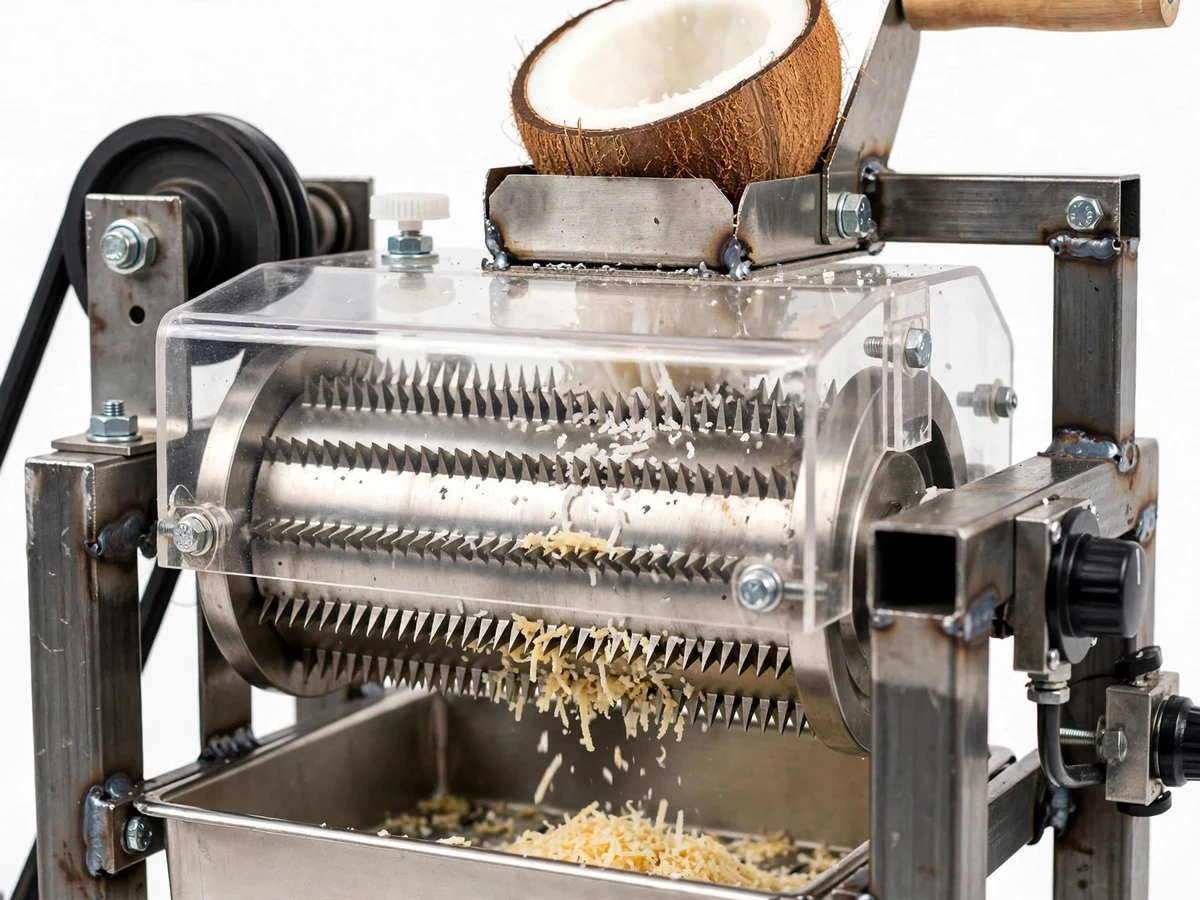
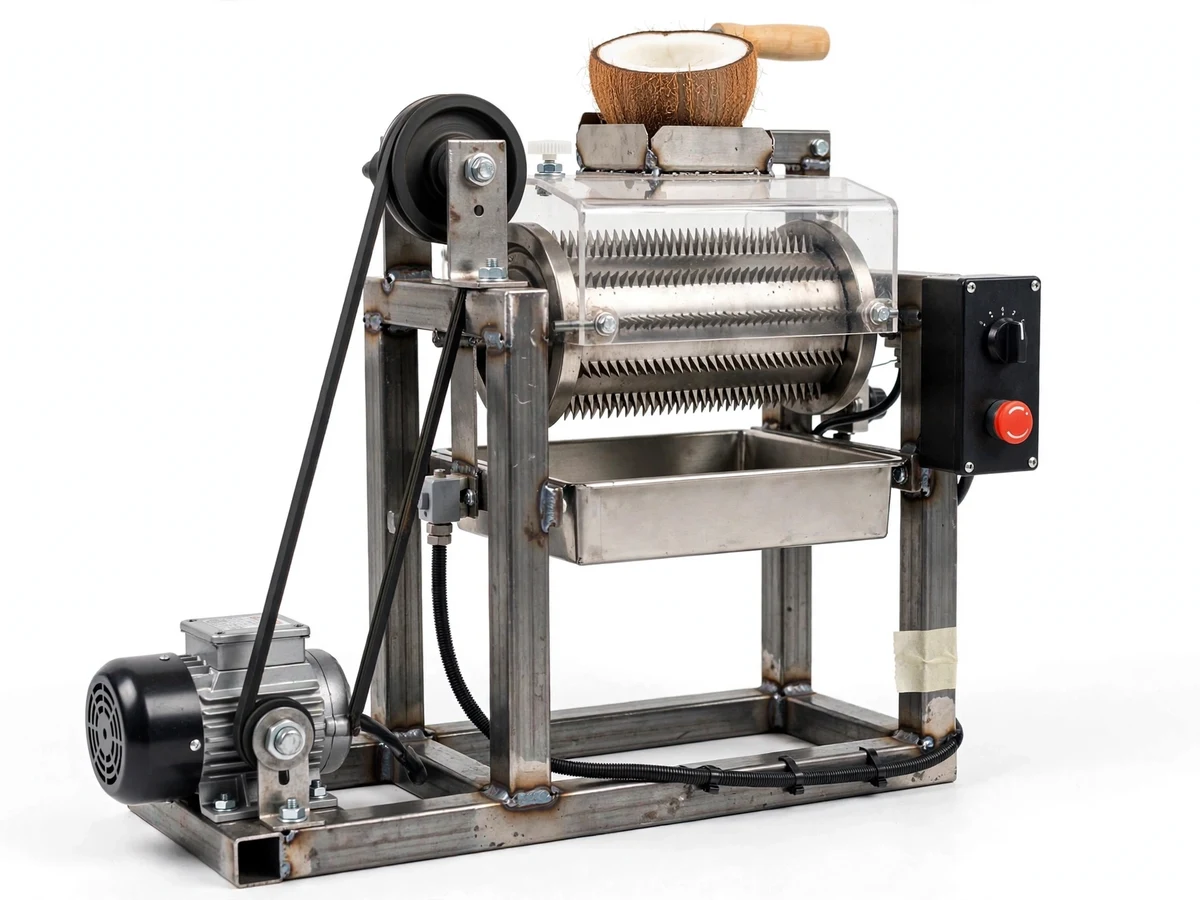
Grating a coconut by hand means scraping the flesh of a halved coconut against a fixed serrated blade for ten to fifteen minutes per nut. The work is slow and tiring on the wrist, the texture comes out uneven, and the real problem is safety: as the flesh thins near the shell, fingers get dangerously close to the teeth, and a slip means deep cuts. Households that cook with fresh coconut daily, temple kitchens and small food vendors grating dozens of nuts a day all pay for this drudgery in time and injury risk. Hand-crank tabletop graters exist, but they still demand constant effort and leave the blade exposed. This project replaces the manual scrape with an enclosed motorized machine: a toothed stainless-steel drum spins under a transparent guard, the coconut half sits in a pusher holder so fingers never reach the blade, and a guard interlock cuts power the moment the cover is opened. A speed knob lets the operator match drum speed to fresh or dry flesh, and the gratings fall into a removable tray.
Clamps each coconut half flesh-side-down, closes the guard, sets the speed and presses the coconut against the drum with the pusher handle.
Follow the working sequence
How it works
- The dehusked coconut is broken into halves by hand; one half is clamped flesh-side-down in the coconut holder. (Dehusking and shell-breaking are manual steps done before this machine's job begins.)
- The transparent guard is closed over the drum. Its interlock switch closes the motor circuit — with the guard open, the start button does nothing.
- The operator sets the drum speed with the panel knob: slower for soft fresh flesh, faster for firm dry flesh.
- Pressing start spins the toothed SS304 drum through the belt reduction at the selected speed.
- Using the pusher handle, the coconut half is pressed and gently rocked against the rotating teeth; the teeth shred the flesh and the gratings fall straight into the collection tray.
- When the flesh is scraped down to the shell, the operator stops the machine, empties the tray, and loads the next half.
Tech stack:
- Single-phase induction motor, 0.25 HP
- V-belt drive with pulley reduction
- SS304 stainless-steel grating drum
- Electronic rotary speed controller
- Guard-mounted limit-switch interlock
- Emergency-stop pushbutton
- Welded mild-steel square-tube frame
- SS304 collection tray
| Parameter | Value |
|---|---|
| Motor | Single-phase induction, 0.25 HP (approximately 186 W), 1440 RPM (datasheet) |
| Belt reduction | Approximately 3.6:1 (50 mm driver pulley, 180 mm driven pulley, design target) |
| Drum speed | Approximately 400 RPM at rated motor speed (design target, adjustable 30–100%) |
| Grating drum | SS304 stainless steel, approximately 150 mm diameter x 200 mm long (design target) |
| Tooth profile | Machined teeth, approximately 2 mm pitch (design target) |
| Machine footprint | Approximately 450 x 350 x 400 mm (design target) |
| Collection tray | SS304, approximately 250 x 200 x 80 mm (design target) |
| Interlock | Guard-open limit switch in series with the motor contactor (implemented) |
| Power supply | 230 V AC, 50 Hz, single phase (expected) |
| Grating throughput | Nuts-per-hour stated as design target only after buyer trials — no measured claim |
Project features
- [Toothed stainless-steel grating drum] The heart of the machine: an SS304 drum with a machined tooth profile that shreds coconut flesh into uniform gratings when a halved coconut is pressed against it.
- [Adjustable blade-speed knob] A panel rotary knob varies drum speed across roughly 30–100% of rated speed, so the operator can slow down for tender fresh flesh or speed up for dry, firm flesh.
- [Guard safety interlock] A limit switch on the transparent guard is wired in series with the motor circuit — the motor cannot start while the guard is open, and opening it mid-run cuts power immediately.
- [Coconut holder with pusher handle] The halved coconut clamps flesh-side-down in a sliding holder; the wooden pusher handle lets the operator apply even pressure without fingers anywhere near the rotating teeth.
- [Emergency-stop pushbutton] A red latching mushroom-head pushbutton on the control panel cuts motor power instantly and must be deliberately reset before the machine can restart.
- [Belt-drive power transmission] A V-belt with an approximately 3.6:1 reduction turns the 1440 RPM motor into a slow, high-torque drum — and if the drum jams on a hard shell fragment, the belt slips instead of breaking teeth.
- [Removable collection tray] An SS304 tray slides under the drum to catch the gratings, pulling out for clean transfer to a mixing bowl and easy washing.
- [Foot-pedal start (optional customization)] A hands-free foot switch can be added on request so the operator keeps both hands on the pusher — quoted separately, not part of the base build.
What is included
- Fully assembled and tested motorized coconut grating machine
- Fabrication drawings for the frame, grating drum, holder and guard
- Component list with sourcing details (motor, belt, pulleys, controller, switches, stainless parts)
- Wiring diagram for the motor, speed controller, interlock switch and emergency stop
- Operation and safety manual, including cleaning procedure for the SS304 drum
- Project report PDF (background, power-transmission calculations, material selection, safety design, methodology)
- PPT presentation for final review
- Viva Q&A preparation document (belt drives, SS304 food-contact suitability, motor types, machine safety)
Delivery timeline
- Typical build-and-test time is 15–20 working days from order confirmation; fabrication drawings, report, PPT and viva Q&A ship with the machine. Exact dates are confirmed in the quotation.
Support & explanation
- Build walkthrough call covering belt tensioning, pulley alignment and drum cleaning; viva preparation support on belt-drive calculations, stainless-steel material choice and machine-safety interlocking; 15 days of post-delivery query support.
Limitations & prerequisites
- This machine grates coconut flesh only — dehusking the nut and breaking the shell are manual steps done beforehand, not part of this build.
- Throughput in nuts-per-hour is deliberately not stated as a measured figure; it is quoted as a design target and confirmed during the buyer's trial runs, since coconut size, flesh condition and operator pace all affect it.
- The electronic speed controller holds limited torque at the lowest knob settings — very dry, hard flesh can stall the drum, so the belt is designed to slip rather than damage teeth.
- The interlock cuts power when the guard opens, but the drum coasts for a few seconds afterward (design target) — the operator must wait for a full stop before reaching in.
- The SS304 drum and tray must be washed and dried after each use; standing moisture at welds can stain, and the drum is hand-cleaned, not dishwasher-rated.
- This is a college prototype, not a food-safety-certified commercial machine — commercial kitchens need certified equipment, not this build.
Frequently Asked Questions
Is this a grating machine or a dehusking machine?
Grating only. It scrapes the flesh out of an already-dehusked, already-broken coconut half with a toothed drum. Dehusking (removing the outer husk) and shell-breaking are separate manual steps done before this machine is used.
How is the blade speed adjusted?
A rotary knob on the control panel drives an electronic speed controller, varying the drum across roughly 30–100% of its rated speed. Fresh, tender flesh grates cleanly at lower speeds; firm, dry flesh needs a higher speed.
What stops the machine if the guard is opened?
A limit switch on the guard sits in series with the motor circuit — opening the guard breaks the circuit and the motor loses power. The red emergency-stop button provides a second, latching cut-off on the panel.
What power supply does it need?
A standard 230 V AC, 50 Hz single-phase household socket (expected). No three-phase supply and no special wiring are required.
Can the machine be customized?
Yes. Realistic options include a larger drum, a VFD-based smooth speed drive, a foot-pedal start switch, or an all-stainless enclosed cabinet. Each is quoted separately against timeline and feasibility.
Is this project suitable for a final-year project?
Yes — for Mechanical Engineering, Electrical Engineering and diploma mechanical programs. It demonstrates belt-drive power transmission, SS304 food-contact material selection, single-phase motor control and machine-safety interlock design, with honest, labeled design-target calculations.
Components & software requirements
- Single-phase induction motor, 0.25 HP
- V-belt drive with pulley reduction
- SS304 stainless-steel grating drum
- Electronic rotary speed controller
- Guard-mounted limit-switch interlock
- Emergency-stop pushbutton
- Welded mild-steel square-tube frame
- SS304 collection tray
Delivery information
Built-to-order project. Delivery timeline is shared after order confirmation based on current queue.
Support terms
Complete documentation, setup guide, and viva preparation included. Support for setup and explanation provided.
Download free synopsis (PDF)
Enter your name and email — the synopsis PDF downloads immediately. We may send occasional project updates; no spam, unsubscribe anytime.