
More project photos (3)
The problem
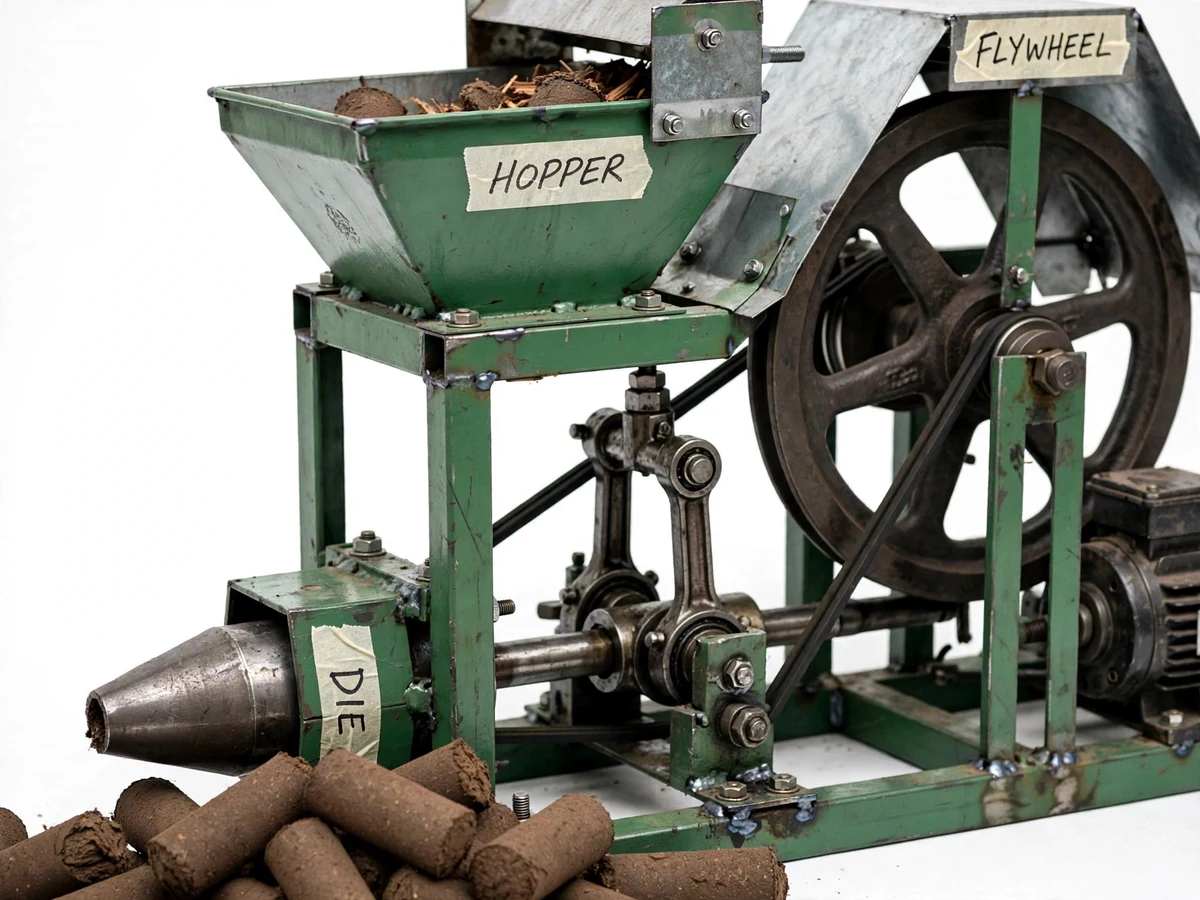
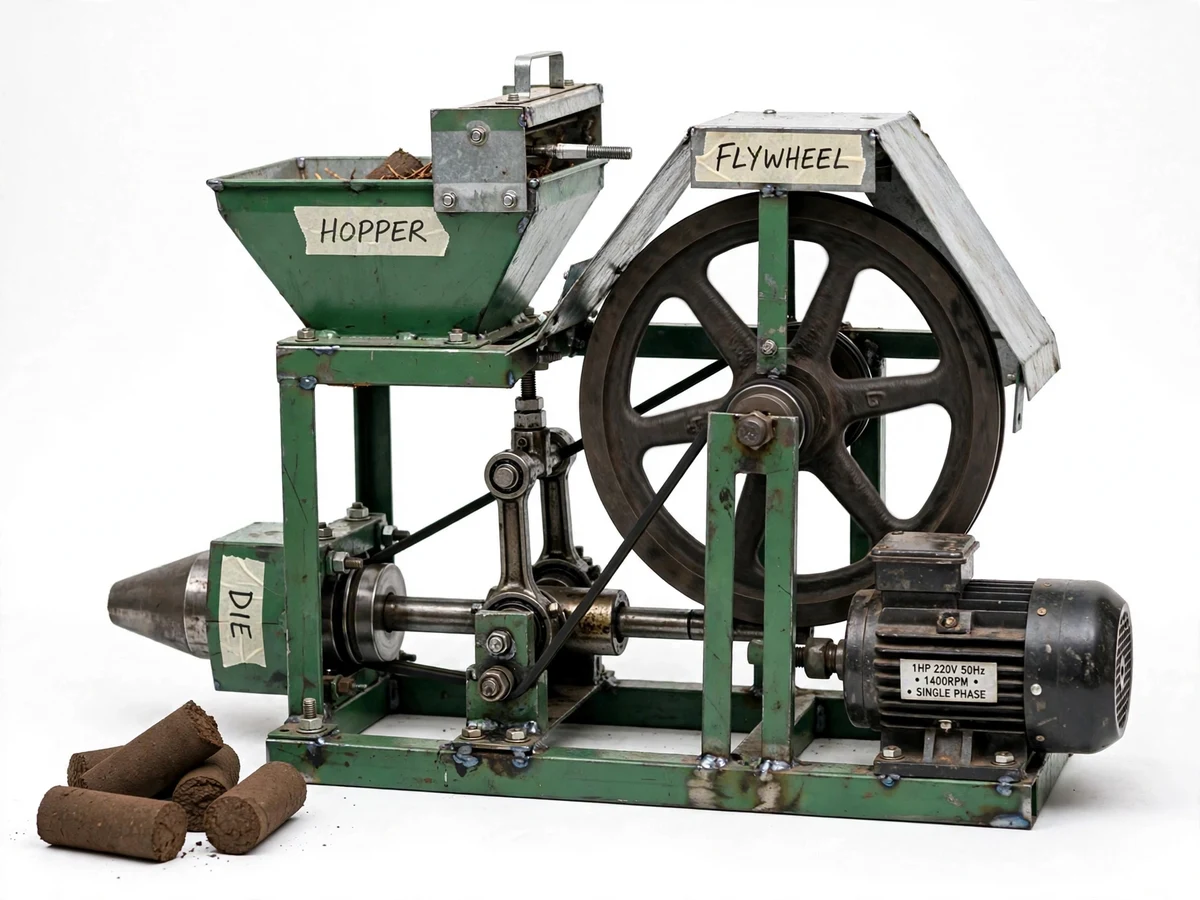
Across rural India, tonnes of sawdust, rice husk and crop shells are burnt in the open or left to rot, while the same villages buy firewood and LPG for cooking and heating. Briquetting solves both problems at once: compressing loose biomass into dense cylinders raises its bulk density several-fold, turning a waste-handling headache into a storable, transportable solid fuel. This project builds the machine that does it — a motorized piston-type briquetting press. A single-phase motor drives a heavy flywheel and crank-slider mechanism; each stroke rams a measured charge of feedstock through a tapered die, where pressure and friction heat bind it into a briquette that is ejected out the die mouth. The student varies feedstock type and moisture, then measures briquette density, compressive handling strength and burning time from their own samples, making the project a genuine manufacturing-plus-energy study rather than a static model.
Single-phase supply for the briquette press motor.
Follow the working sequence
How it works
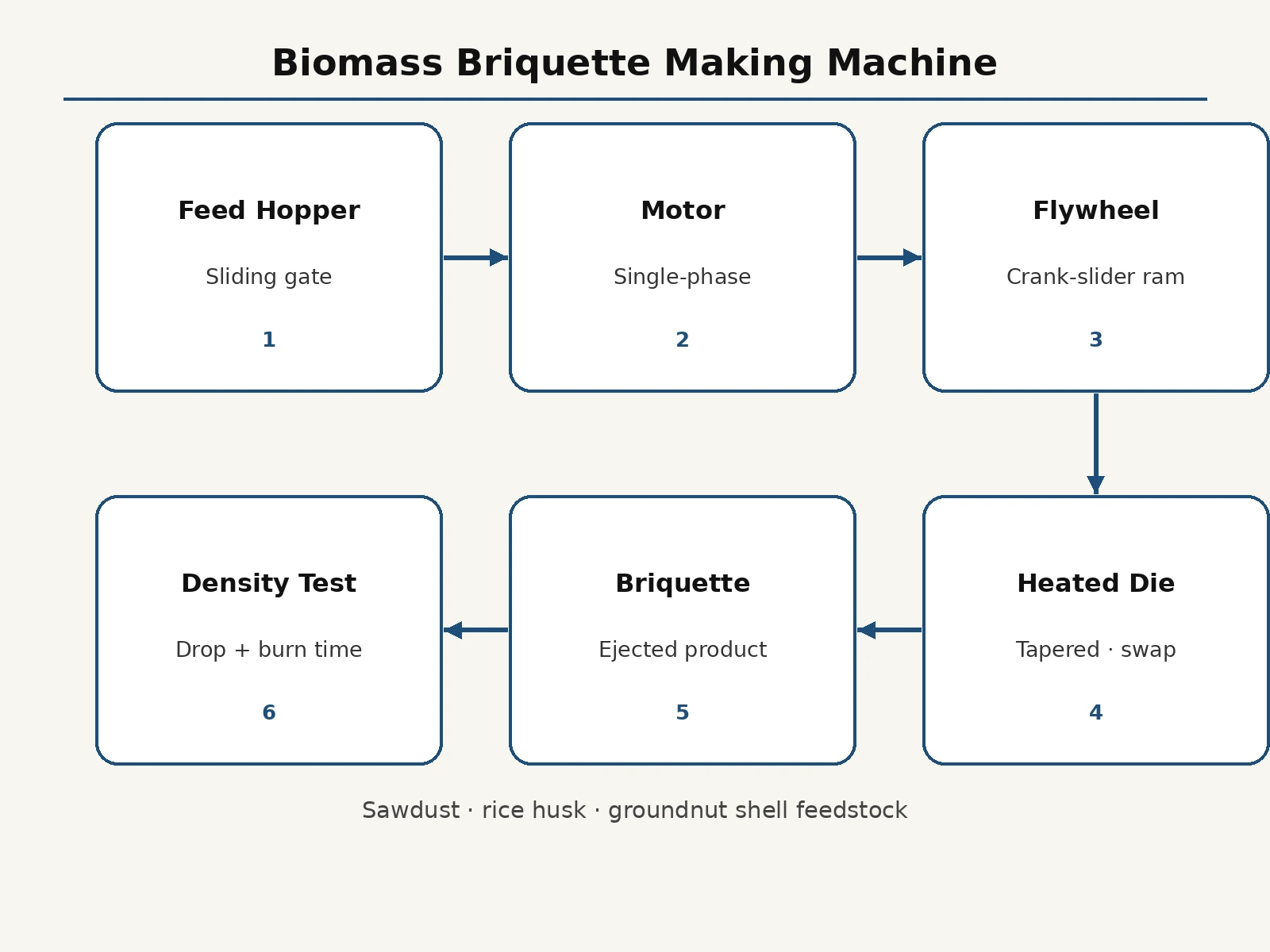
- Prepared feedstock (sawdust, husk or shells at the recommended moisture range) is loaded into the hopper.
- The sliding gate meters one charge into the compaction chamber ahead of the piston.
- The motor, through the belt drive and flywheel, drives the crank-slider; the piston rams the charge into the tapered die.
- Pressure and friction heat in the die bind the charge into a dense briquette, which is ejected out the die mouth as the next charge enters.
- Briquettes are collected, sun-dried, and the student runs the density, drop-test and burn-time procedure on samples.
- Results are compared across feedstock types and moisture levels and recorded in the report's test sheets.
Tech stack:
- Fabricated MS frame and crank-slider
- Flywheel (CI) with V-belt drive
- 2 HP single-phase induction motor
- Tapered briquetting die (interchangeable)
- Sheet-metal feed hopper with gate
- Plummer block bearings
- Sheet-metal safety guard
- Weighing scale and test procedure kit
| Parameter | Value |
|---|---|
| Briquette diameter | Approximately 50 mm (design target, die-dependent) |
| Briquette length | Approximately 80–120 mm per piece (expected) |
| Output rate | Approximately 40–60 kg per hour (design target, feedstock-dependent) |
| Motor | 2 HP single-phase induction motor (nameplate rating) |
| Flywheel | Cast iron, approximately 450 mm dia (design target) |
| Feedstock moisture | 8–12% recommended (procedure range) |
| Overall size | Approximately 1400 × 700 × 1100 mm (design target) |
Project features
- [Piston-type briquetting press] A crank-slider ram driven through a flywheel compacts each charge in a tapered die — the classic mechanical briquetting arrangement, fully visible in operation.
- [Flywheel energy storage] A heavy flywheel smooths the motor load across the high-force compaction stroke, demonstrating energy storage in a real machine.
- [Interchangeable die] The tapered die unbolts for cleaning and for trying different briquette diameters, with the die drawing included.
- [Feed hopper with charge control] A sheet-metal hopper with a sliding gate meters a repeatable charge per stroke, so briquette weight stays consistent.
- [Briquette test procedure] The manual gives the student a density, drop-test and burn-time procedure to run on their own briquettes and report.
- [Safety guard] A sheet-metal guard encloses the flywheel, belt and crank zone, with the die mouth left accessible for briquette collection.
- [Fabrication drawings] Dimensioned drawings of the frame, crank-slider, die and hopper are supplied for the report and viva.
What is included
- Fully fabricated briquetting machine with guard
- Interchangeable tapered die with drawing
- Feedstock preparation and machine operation manual
- Briquette density, drop-test and burn-time test sheets
- Dimensioned fabrication drawings
- Project report PDF (briquetting theory, machine design, test methodology)
- PPT presentation for final review
- Viva Q&A preparation document (densification, binders vs binderless, calorific value basics)
Limitations & prerequisites
- Briquette density and output rate are design targets verified by the student's own tests — no output figures are claimed as measured before the build.
- Results depend strongly on feedstock type, particle size and moisture; the manual gives the preparation procedure the buyer must follow.
- Binderless briquetting needs the right moisture and temperature window — out-of-range feedstock gives crumbly briquettes, discussed honestly in the report.
- The die wears with abrasive feedstocks (e.g. rice husk with silica) and is a replaceable wear part.
- Single die diameter per setup; changing briquette size needs a die swap, not an adjustment.
- Drying space and time for fresh briquettes are the buyer's arrangement.
Frequently Asked Questions
What holds the briquette together without glue?
Pressure and the friction heat in the tapered die soften the natural lignin in the biomass, which binds the particles as it cools — that is why the process is called binderless briquetting, and why feedstock moisture matters.
Which feedstocks work?
Sawdust, rice husk, groundnut shells, bagasse pith and similar dry agro-residues in the 8–12% moisture range. The test procedure has the student compare at least two feedstocks.
What tests does the student run?
Density (mass/volume of sample briquettes), a drop test for handling strength, and a timed burn comparison against firewood — all from the student's own machine output.
Is the machine safe to operate?
The flywheel, belt and crank are enclosed in a sheet-metal guard; only the hopper top and die mouth are accessible. The manual lists the lockout and clearing procedure for jams.
Is this project suitable for a final-year project?
Yes — for Mechanical and Energy programs. It combines machine design (crank-slider, flywheel) with renewable-energy fuel testing on real output. Suitable for B.E./B.Tech final-year projects in Mechanical and Energy Engineering.
Components & software requirements
- Fabricated MS frame and crank-slider
- Flywheel (CI) with V-belt drive
- 2 HP single-phase induction motor
- Tapered briquetting die (interchangeable)
- Sheet-metal feed hopper with gate
- Plummer block bearings
- Sheet-metal safety guard
- Weighing scale and test procedure kit
Delivery information
Built-to-order project. Delivery timeline is shared after order confirmation based on current queue.
Support terms
Complete documentation, setup guide, and viva preparation included. Support for setup and explanation provided.
Download free synopsis (PDF)
Enter your name and WhatsApp number — the synopsis PDF downloads immediately. We may send occasional project updates on WhatsApp; no spam.