
More project photos (2)
The problem
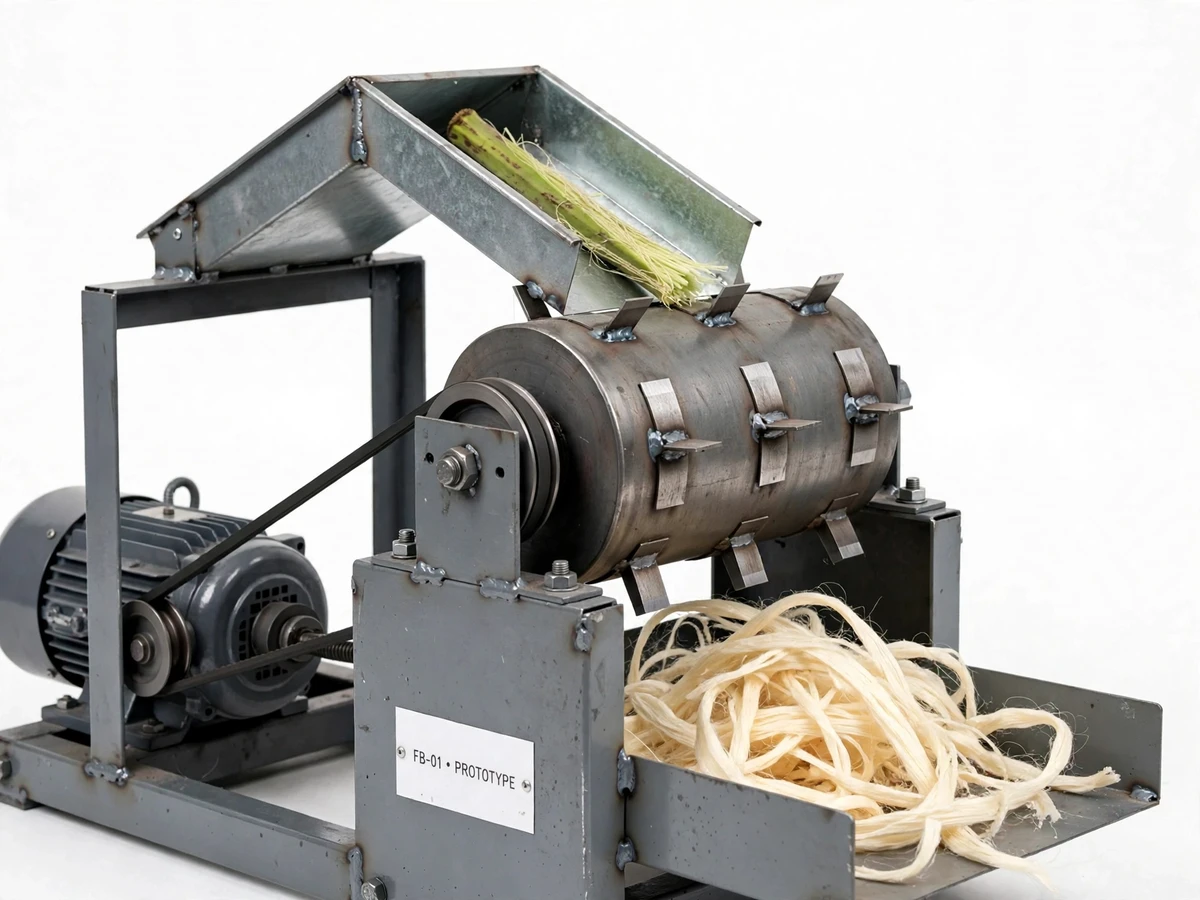
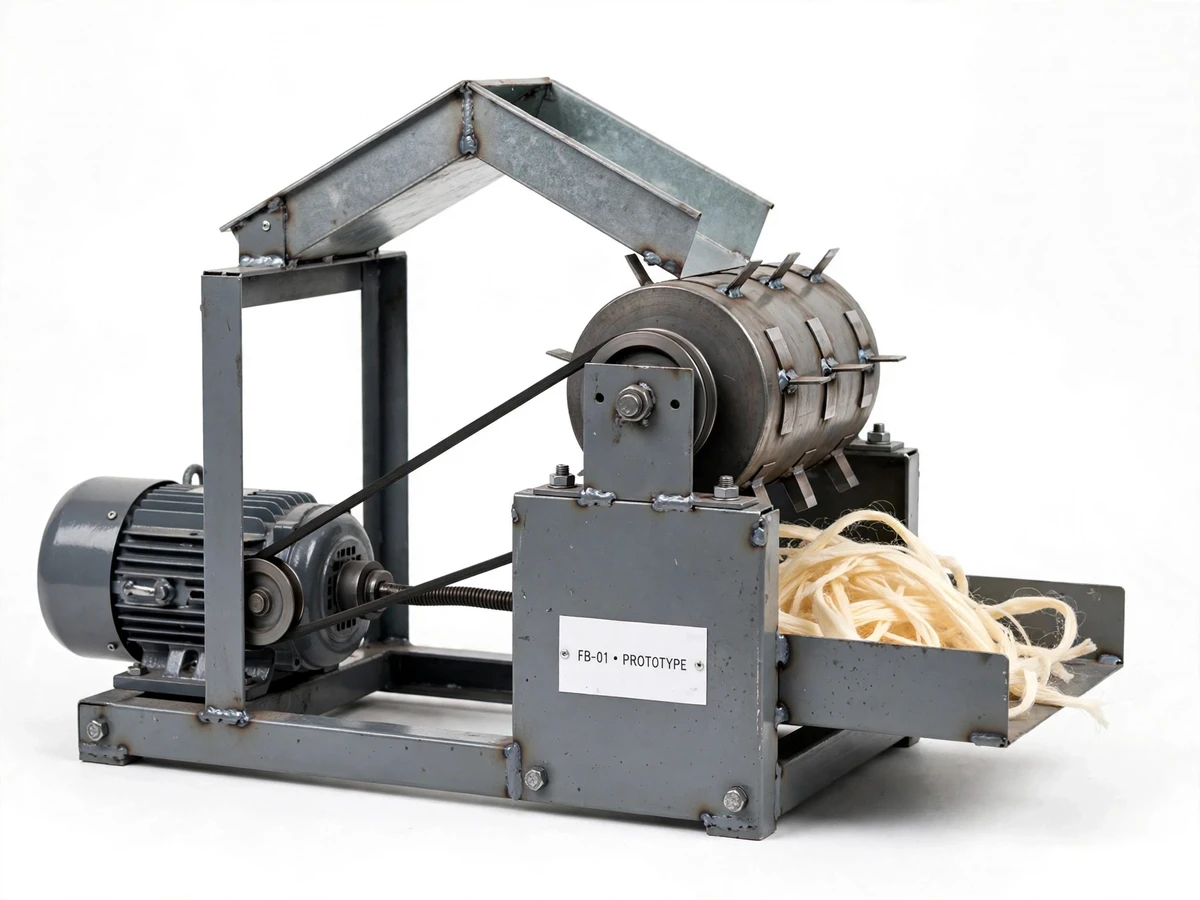
India is one of the world's largest banana producers, and every harvest leaves behind thousands of tonnes of pseudostems — the thick, fleshy trunks left behind after the fruit bunch is cut. These stems contain long, strong natural fibers, but in most regions they are chopped and left to rot or burned, because extracting fiber by hand is slow, laborious work: a worker scrapes each stem with a blunt knife or draws it across a fixed blade for hours to recover a small bundle of fiber. Machine extraction exists in industry, but commercial decorticators are sized and priced for factories, far beyond a student budget. This project fills that gap with a workshop-scale motorized decortication machine: a 1 hp single-phase motor drives a rotating drum fitted with blunt scraper blades through a belt-pulley reduction, so banana stem strips are mechanically beaten clean of pith and the fibers are recovered in minutes instead of hours. The build teaches machine design, fabrication, drive sizing and safety guarding in one tangible prototype.
1 hp single-phase 230 V induction motor with push-button starter and MCB overload protection.
Follow the working sequence
How it works
- Fresh banana pseudostems are cut into approximately 1 m lengths, the dry outer sheaths are stripped off, and the stems are split lengthwise into feedable strips.
- The motor is started and the belt drive spins the decorticator drum up to its operating speed (approximately 450 RPM, design target).
- A strip is fed through the feed chute onto the rotating drum using a push stick, pressing it lightly against the scraper blades.
- The blunt blades beat and scrape the strip against the drum surface, breaking the pulpy pith away from the long fiber bundles without cutting the fibers.
- Cleaned fibers exit at the discharge side and collect in the fiber tray, while pulp and juice fall into the separate waste bin below.
- Recovered fibers are rinsed in water, combed straight and sun-dried before grading and bundling; blade clearance is re-set between batches of different stem sizes.
Tech stack:
- 1 hp single-phase induction motor (230 V AC)
- V-belt and pulley reduction drive (approx. 3:1)
- Steel decorticator drum with blunt scraper blades
- Welded MS angle frame (40 × 40 × 5 mm)
- Sheet-steel feed chute and discharge tray
- Sheet-metal safety guards (belt + drum)
- Push-button ON/OFF starter with MCB
- Plummer-block bearings and mechanical fasteners
| Parameter | Value |
|---|---|
| Motor | 1 hp (0.75 kW), single-phase, 230 V AC (datasheet) |
| Drum speed | Approximately 450 RPM (design target) |
| Belt reduction ratio | Approximately 3:1 (design target) |
| Decorticator drum | Approximately 200 mm diameter × 400 mm long (approximate) |
| Scraper blades | 4–6 blunt blades, adjustable clearance (configurable) |
| Throughput | 8–12 kg of stem strips per hour (design target) |
| Fiber recovery | 2–4% of fresh stem weight (expected typical range) |
| Frame | Welded MS angle, approximately 40 × 40 × 5 mm |
| Overall size | Approximately 1.1 × 0.6 × 0.9 m (approximate) |
| Machine weight | Approximately 55–70 kg (expected) |
| Operating noise | Approximately 75–85 dBA at 1 m (expected) |
| Power supply | 230 V AC single phase, standard socket (datasheet) |
Project features
- [Rotating decorticator drum with blunt scraper blades] A steel drum fitted with 4–6 blunt scraper bars rotates at reduced drum speed; as stem strips pass over it, the blades break the pulpy pith away from the fiber bundles without cutting the fibers themselves.
- [Single-phase induction motor with belt-pulley drive] A 1 hp, 230 V single-phase motor drives the drum through a V-belt and pulley reduction of approximately 3:1, giving a drum speed suited to decortication while keeping torque high.
- [Rigid MS angle frame] The machine is built on a welded mild-steel angle frame that keeps the drum, motor and chute aligned under vibration; rubber anti-vibration pads sit under the feet.
- [Adjustable blade-to-drum clearance] The gap between the scraper blades and the drum surface can be set with shim adjustments at setup time, so stems of different thicknesses can be processed — a configurable setting, not a fixed one.
- [Sheet-metal safety guards] Guards cover the belt drive and the rotating drum ends so hands, clothing and hair cannot reach the moving parts during operation.
- [Feed chute and fiber collection tray] A shaped feed chute guides stem strips onto the drum at the correct angle, and a tray catches the extracted fibers while pulp and juice fall into a separate bin below.
- [Protected motor starter] A push-button ON/OFF station with an MCB protects the motor and operator against short circuits and overloads.
What is included
- Fabricated working prototype, built to order
- Fabrication drawings: frame, drum, blade layout, feed chute
- Bill of materials with component specifications
- Operating and maintenance manual
- Safety checklist and guard inspection notes
- Project report PDF (design calculations, fabrication steps, testing plan)
- PPT presentation for final review
- Viva Q&A preparation document (machine design, belt drives, bearings, fiber properties)
Limitations & prerequisites
- Throughput and fiber recovery figures are design targets, not measured results — actual output varies with stem freshness, moisture content and operator skill.
- The drum guard and belt guard must remain fitted during operation; the machine must never be run with guards removed.
- 230 V wiring and earthing must be done by a qualified electrician; the prototype is not an industrially certified machine.
- Blade edges wear with use and need periodic sharpening or replacement for clean fiber separation.
- Pulp and wastewater fall below the machine — the work area needs a bin or drain arrangement, and dried pulp dust should be cleaned to avoid slips.
- Long hair, loose clothing, scarves and gloves must be kept clear of the feed chute and rotating drum; feeding is done with a push stick, never bare hands.
Frequently Asked Questions
What does the machine actually do?
It extracts natural fiber from banana pseudostems by mechanical decortication. A motor-driven drum fitted with blunt scraper blades beats the pulpy pith away from stem strips, leaving long fiber strands that are washed, dried and graded — work that takes hours by hand is completed in minutes.
What motor and power supply does it need?
A standard 1 hp single-phase 230 V induction motor, which runs off an ordinary 230 V AC supply. No three-phase connection is needed — only proper earthing, fitted by a qualified electrician.
Is it safe to demonstrate in college?
Yes, with discipline: the belt drive and drum ends are fully guarded, the starter carries MCB overload protection, and feeding uses a push stick. Demonstrations must be supervised, guards stay fitted, and loose clothing and hair rules are enforced.
Can the machine handle different stem sizes?
The blade-to-drum clearance is adjustable at setup, so stems of different thicknesses can be processed. Stem length and strip width are the practical limits — oversized pieces must be trimmed before feeding.
Can this be customized?
Realistic options include a smaller benchtop version, a variable-frequency drive for adjustable drum speed as an optional extra, a stainless-steel contact surface for wet-area use, and a larger drum for higher throughput. Customizations are quoted separately from the base build.
Is this project suitable for a final-year project?
Yes — for Mechanical Engineering and Production/Manufacturing programs. It demonstrates machine design, fabrication, belt-drive and bearing selection, safety guarding and process-machine testing — all strong viva material. Suitable for B.E./B.Tech final-year projects in Mechanical Engineering.
Components & software requirements
- 1 hp single-phase induction motor (230 V AC)
- V-belt and pulley reduction drive (approx. 3:1)
- Steel decorticator drum with blunt scraper blades
- Welded MS angle frame (40 × 40 × 5 mm)
- Sheet-steel feed chute and discharge tray
- Sheet-metal safety guards (belt + drum)
- Push-button ON/OFF starter with MCB
- Plummer-block bearings and mechanical fasteners
Delivery information
Built-to-order project. Delivery timeline is shared after order confirmation based on current queue.
Support terms
Complete documentation, setup guide, and viva preparation included. Support for setup and explanation provided.
Download free synopsis (PDF)
Enter your name and WhatsApp number — the synopsis PDF downloads immediately. We may send occasional project updates on WhatsApp; no spam.