
More project photos (3)
The problem
Every harvest leaves behind tonnes of loose crop residue — rice husk, straw, bagasse, groundnut shells — that is expensive to transport, awkward to store, and too often burned in the open field because there is no better option. At the same time, rural kitchens and small furnaces burn firewood that is getting harder to source. Briquetting solves both ends of this problem: compress loose biomass into dense, slow-burning pucks and it becomes a genuine fuel. Commercial briquetting machines are motorized, expensive, and out of reach for a village workshop, but a hand-operated lever press needs no electricity, costs a fraction to build, and demonstrates real machine design — force multiplication through linkages, a die that must survive repeated compaction, and a frame that takes the full reaction without flexing. This project designs and fabricates exactly such a press, then proves it with feedstock preparation trials and binder experiments whose results go straight into the report.
Prepares the feedstock, loads each 120 g charge into the die, pulls the lever and ejects the formed briquette.
Follow the working sequence
How it works
- Feedstock is dried, ground and sieved to particles under 6 mm and under 12% moisture (design targets); binder (cassava/corn-starch slurry or molasses) is mixed in at 5–10% by weight until a squeezed handful holds its shape.
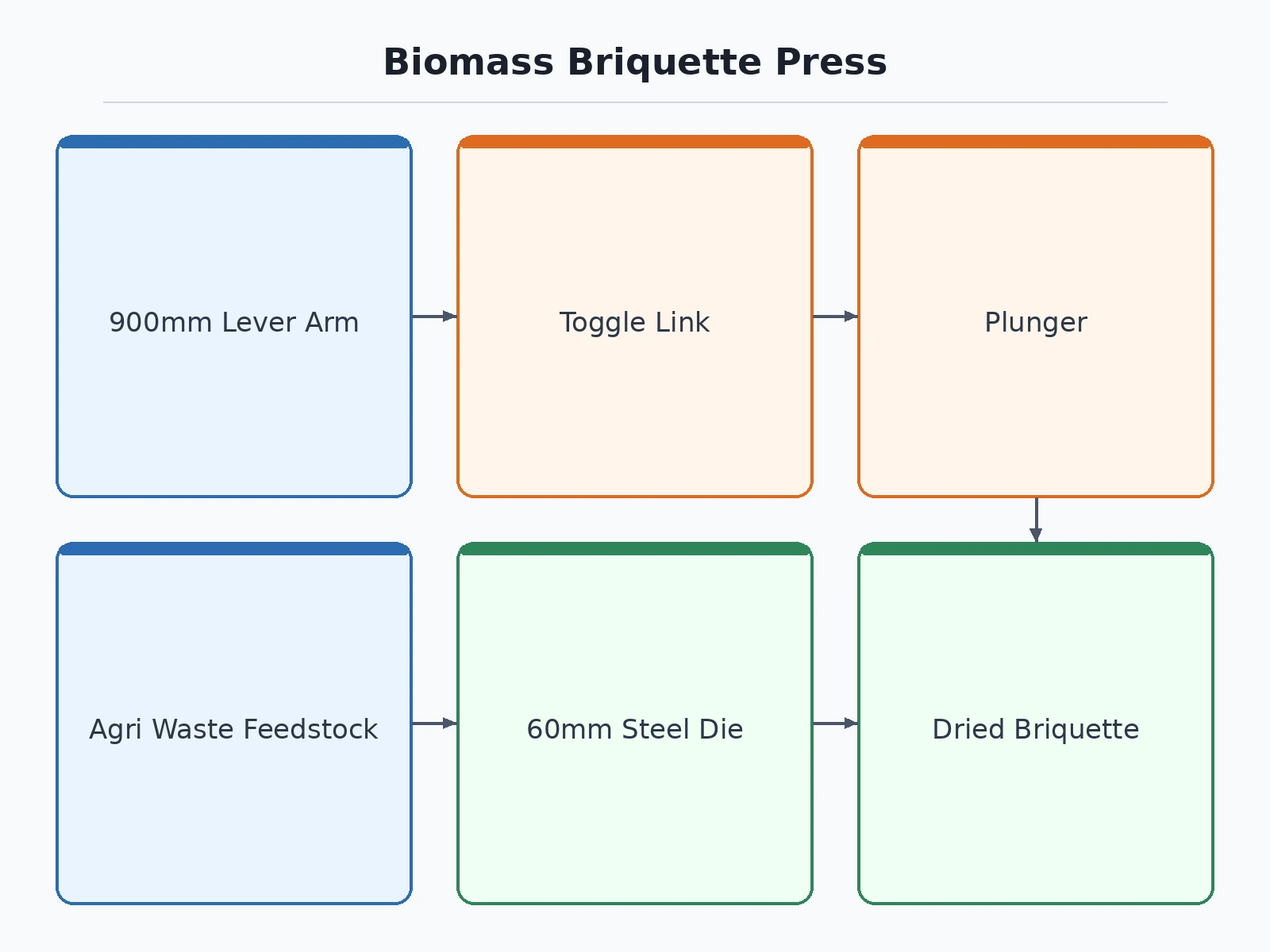
- The lever is raised to retract the plunger, and one charge of prepared mix (approximately 120 g, design target) is loaded into the 60 mm bore die.
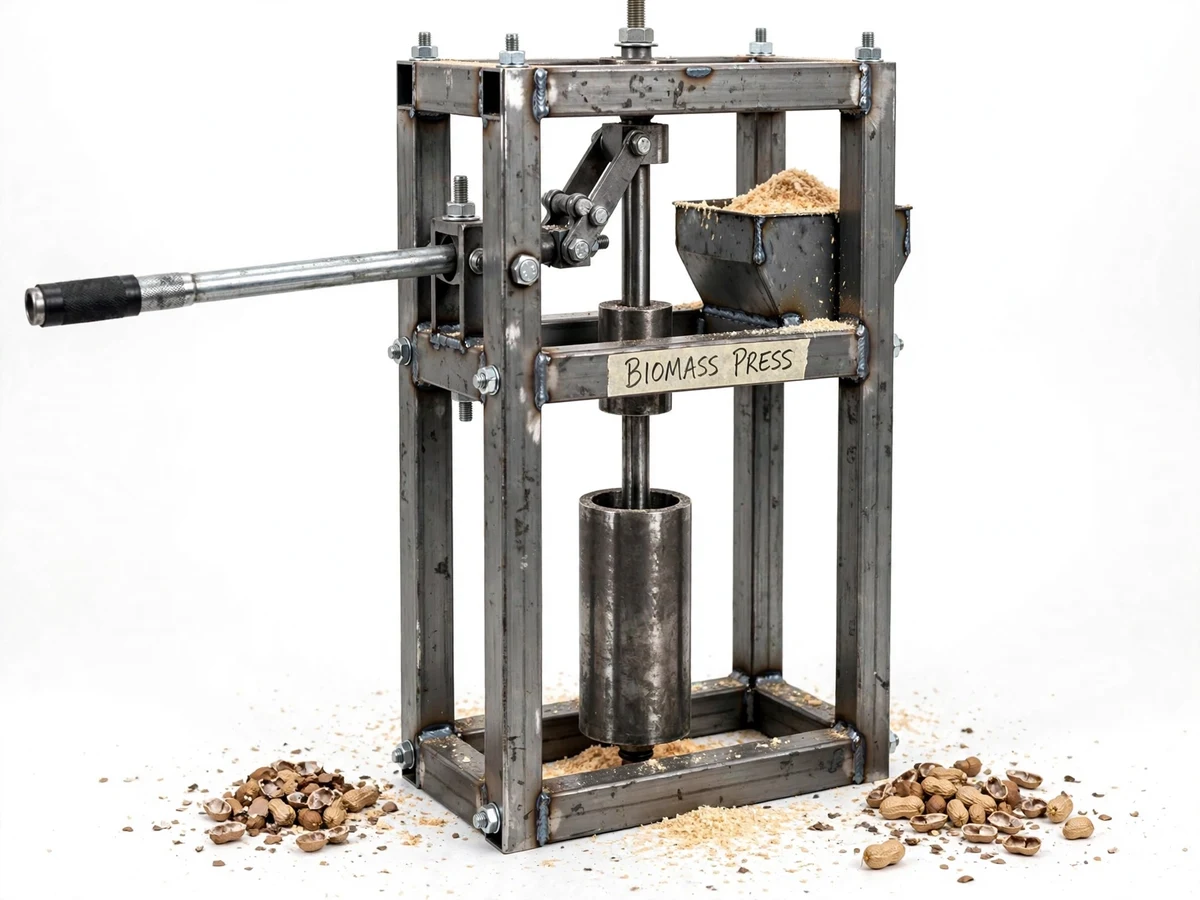
- The operator pulls the 900 mm lever down; the toggle link turns the swing into vertical ram travel, converting an expected 300–400 N of hand effort into roughly 2–2.4 kN of compaction force (design targets) that squeezes air and water out of the mix.
- The plunger dwells at the bottom of the stroke for a few seconds, the lever is raised, the sliding base plate is opened, and the formed briquette (approximately 60 mm diameter, 55–65 mm long, design targets) is ejected manually.
- Fresh briquettes rest on wire-mesh trays and sun-dry for 3–5 days (expected) until they feel rock-hard and no longer dent under thumb pressure.
- Dried briquettes (expected bulk density 0.9–1.1 g/cm³, design target) are stored dry and burned in chulhas, furnaces or boilers as a direct substitute for firewood or coal in heating duty.
Tech stack:
- 40 × 40 × 3 mm MS square tube (frame)
- EN8 / MS round bar · 20 mm pivot pin
- Heavy-wall MS pipe · 60 mm bore die · ground plunger
- Arc welding · M12 bolts, nuts, washers
- Cassava/corn starch · molasses (binders)
- Hacksaw · bench grinder · drill press (fabrication tools)
- Spring scale · vernier caliper (measurement tools)
- Wire-mesh trays (drying rack)
| Parameter | Value |
|---|---|
| Frame section | 40 × 40 × 3 mm MS square tube |
| Lever length | Approximately 900 mm |
| Mechanical advantage | Approximately 6 : 1 (design target) |
| Die bore diameter | 60 mm (design target) |
| Briquette size | Approximately 60 mm diameter × 55–65 mm long (design target) |
| Max press force | Approximately 2–2.4 kN (design target) |
| Hand effort required | 300–400 N (expected) |
| Charge per stroke | Approximately 120 g of prepared mix (design target) |
| Feedstock preparation | Under 6 mm particle size, under 12% moisture (design targets) |
| Binder proportion | 5–10% by weight (design target) |
| Cycle time | 45–60 s per briquette (expected) |
| Production rate | 60–80 briquettes per hour, single operator (expected) |
| Briquette bulk density | 0.9–1.1 g/cm³ (design target) |
| Sun-drying time | 3–5 days (expected) |
| Overall footprint | Approximately 1.1 × 0.6 × 1.3 m |
| Press weight | Approximately 28–32 kg (design target) |
Project features
- [Lever-driven plunger mechanism] A 900 mm lever arm pivoting on a 20 mm steel pin drives the plunger through a toggle link, multiplying an expected 300–400 N of hand effort into roughly 2–2.4 kN of compaction force (design target) — enough for one person to press dense briquettes with ordinary strength.
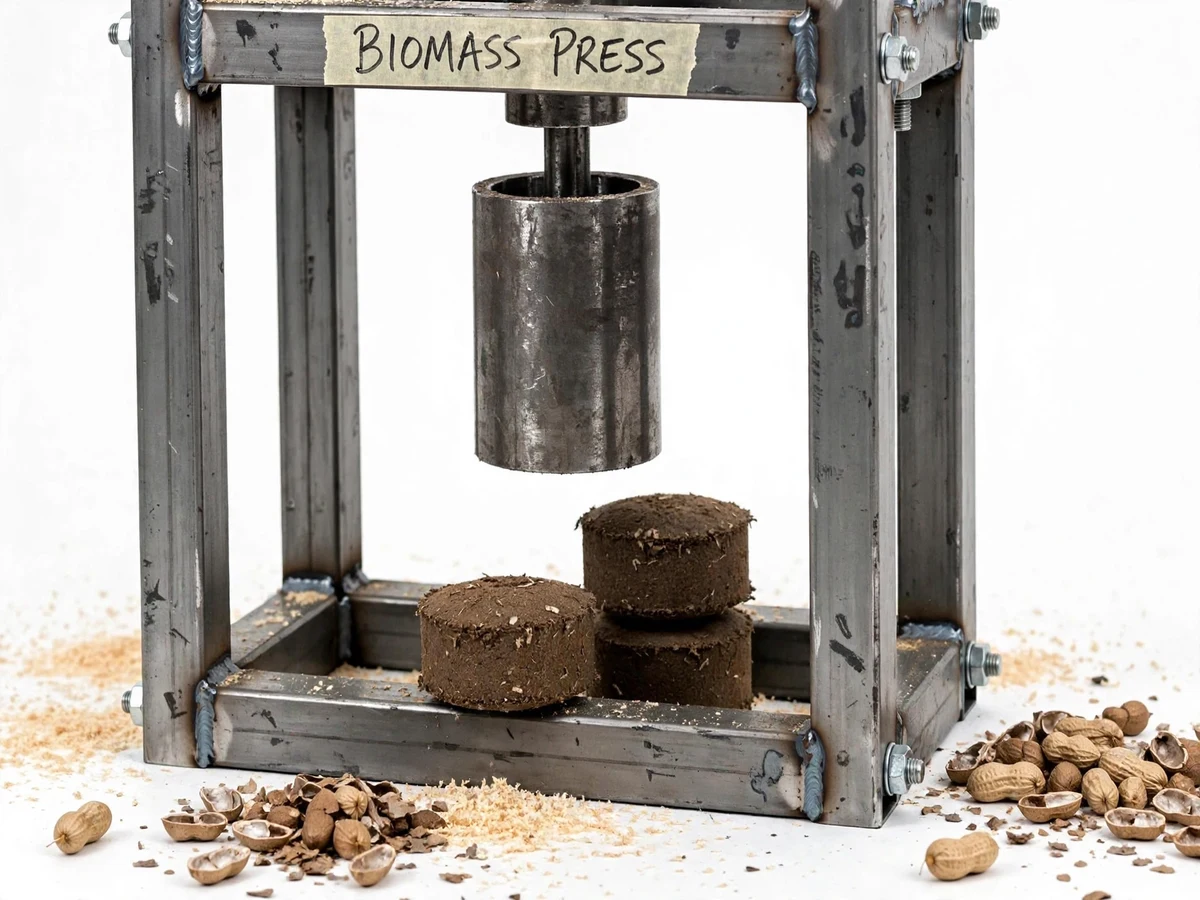
- [Cylindrical steel briquetting die] The 60 mm bore die (design target) is machined from heavy-wall MS pipe with a sliding base plate; feedstock is loaded, compressed by the plunger, and the formed briquette is ejected manually from the bottom after each stroke.
- [Welded MS square-tube frame] A rigid 40×40×3 mm mild-steel frame carries the full pressing reaction without flexing; joints are welded where stiffness matters and bolted with M12 fasteners where disassembly is needed.
- [Feedstock preparation procedure] A documented workflow for drying, grinding and sieving residue to under 6 mm particles and under 12% moisture (design targets), plus binder mixing at 5–10% starch or molasses by weight until the mix holds together when squeezed.
- [Binder trial protocol] Compares starch slurry against molasses at three concentrations each, recording briquette cohesion, drying time and density — real experimental data for the report, not assumed numbers.
- [Sun-drying rack design] Simple wire-mesh drying trays sized for a day's pressing output, so fresh briquettes cure in 3–5 days of sun exposure (expected) before storage.
- [Interchangeable die insert — optional] A second die insert (e.g. 40 mm bore) can be machined and swapped in to study how diameter changes briquette density; supplied only when ordered as the optional extra.
- [Motorized drive conversion — future scope] The pivot geometry is laid out so a screw-jack or hydraulic drive could replace the lever later; documented as future work and not part of this build.
What is included
- Complete manual lever-operated briquette press, fabricated and assembled
- Fabrication drawings: frame, lever linkage, die and plunger (fully dimensioned)
- Lever force and mechanical-advantage calculation sheet
- Feedstock preparation and binder-mixing procedure guide
- Binder trial protocol with observation datasheets
- Project report PDF (background, design, fabrication, trial results)
- PPT presentation for final review
- Viva Q&A preparation document (linkage mechanics, briquetting science, fuel properties)
Limitations & prerequisites
- Ejection is manual — the operator opens the base plate and pushes each briquette out by hand; there is no automated ejection.
- This is a press, not a carbonization kiln — it compacts raw biomass, so the briquettes burn like dense firewood and are not smokeless.
- One briquette per stroke from a single-cavity die; sustained output is 60–80 briquettes/hour (expected), which is village-scale, not industrial.
- Feedstock must be pre-dried below 12% moisture (design target); freshly harvested wet residue has to be sun-dried first or the briquette crumbles after drying.
- Briquette strength varies with feedstock and binder — 0.9–1.1 g/cm³ is a design target; the report records the actual measured figures from your trials.
- No calorific-value testing equipment is included — heating value is estimated from published tables for the feedstock, not measured on your briquettes.
Frequently Asked Questions
What agricultural waste can it press?
Sawdust, rice husk, groundnut shells, sugarcane bagasse, wheat straw and similar dry crop residue. The residue must be ground and sieved to under 6 mm particles and dried below 12% moisture (design targets) before pressing; long fibrous material like uncut straw has to be chopped first or it jams the die and the briquette falls apart after drying.
Why is a binder needed, and which ones work?
Loose dry biomass has almost no natural cohesion, so a binder glues the particles into a solid puck that survives handling and burning. Cassava or corn-starch slurry and molasses both work well; the trial protocol tests them at 5–10% by weight so the report shows which gives a harder briquette and shorter drying time for your feedstock.
What can the briquettes be used as fuel for?
Dried briquettes burn like dense firewood in chulhas, angithis, boilers and small furnaces — they suit cooking, space heating and water heating. They are raw-biomass briquettes, not charcoal, so they still produce smoke and are not meant for smokeless indoor cooking without ventilation.
Does it need electricity or any power source?
No. The press is entirely manual — a person pulls the lever, and the linkage multiplies that effort roughly sixfold into compaction force. That makes it usable in farms, villages and workshops without grid power, and it also keeps the fabrication cost far below motorized or hydraulic presses.
Is this project suitable for a final-year project?
Yes — for Mechanical, Production and related programs. It combines machine design (frame, linkage force analysis), manufacturing (welding, machining the die) and experimental work (binder trials, density and drying measurements), giving the student real fabrication experience plus measurable results to discuss in the viva.
Components & software requirements
- 40 × 40 × 3 mm MS square tube (frame)
- EN8 / MS round bar · 20 mm pivot pin
- Heavy-wall MS pipe · 60 mm bore die · ground plunger
- Arc welding · M12 bolts, nuts, washers
- Cassava/corn starch · molasses (binders)
- Hacksaw · bench grinder · drill press (fabrication tools)
- Spring scale · vernier caliper (measurement tools)
- Wire-mesh trays (drying rack)
Delivery information
Built-to-order project. Delivery timeline is shared after order confirmation based on current queue.
Support terms
Complete documentation, setup guide, and viva preparation included. Support for setup and explanation provided.
Download free synopsis (PDF)
Enter your name and email — the synopsis PDF downloads immediately. We may send occasional project updates; no spam, unsubscribe anytime.