
More project photos (2)
The problem
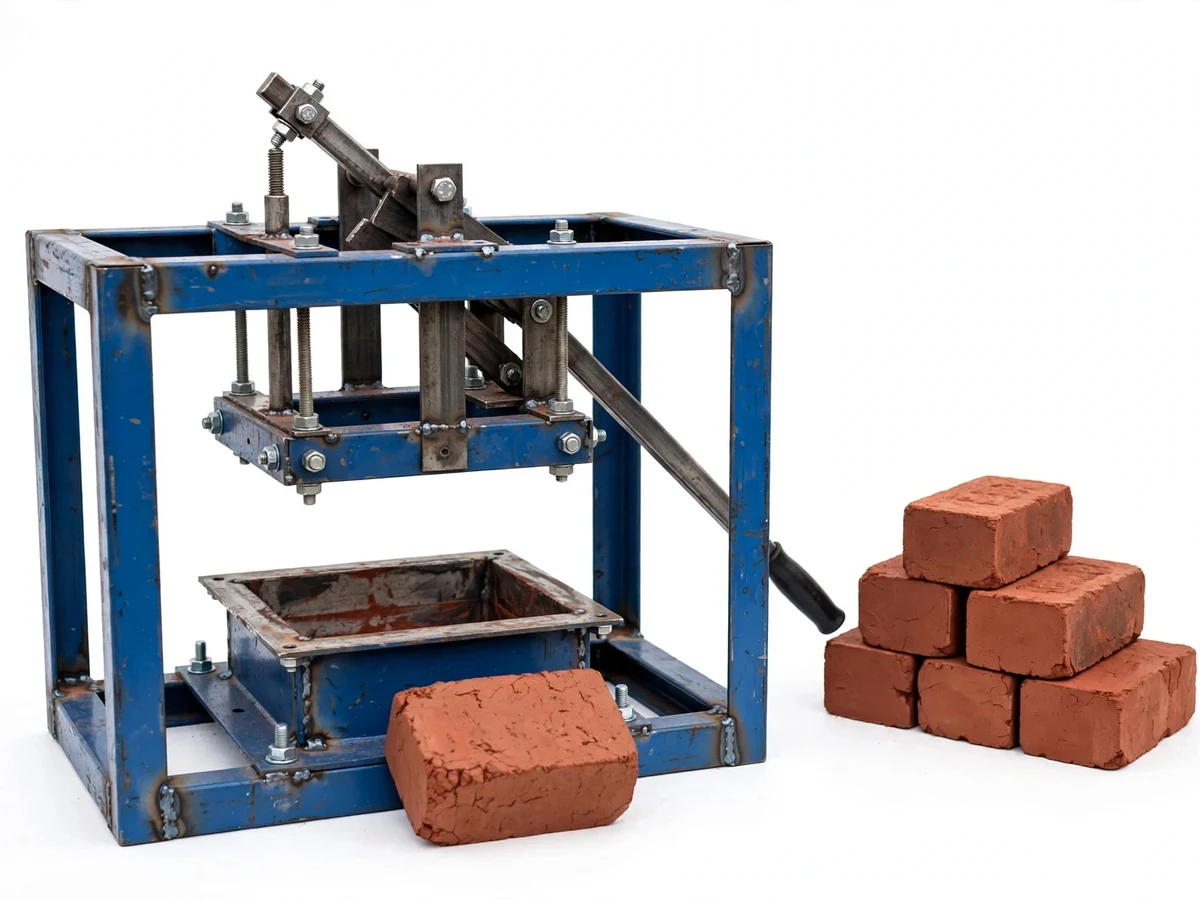
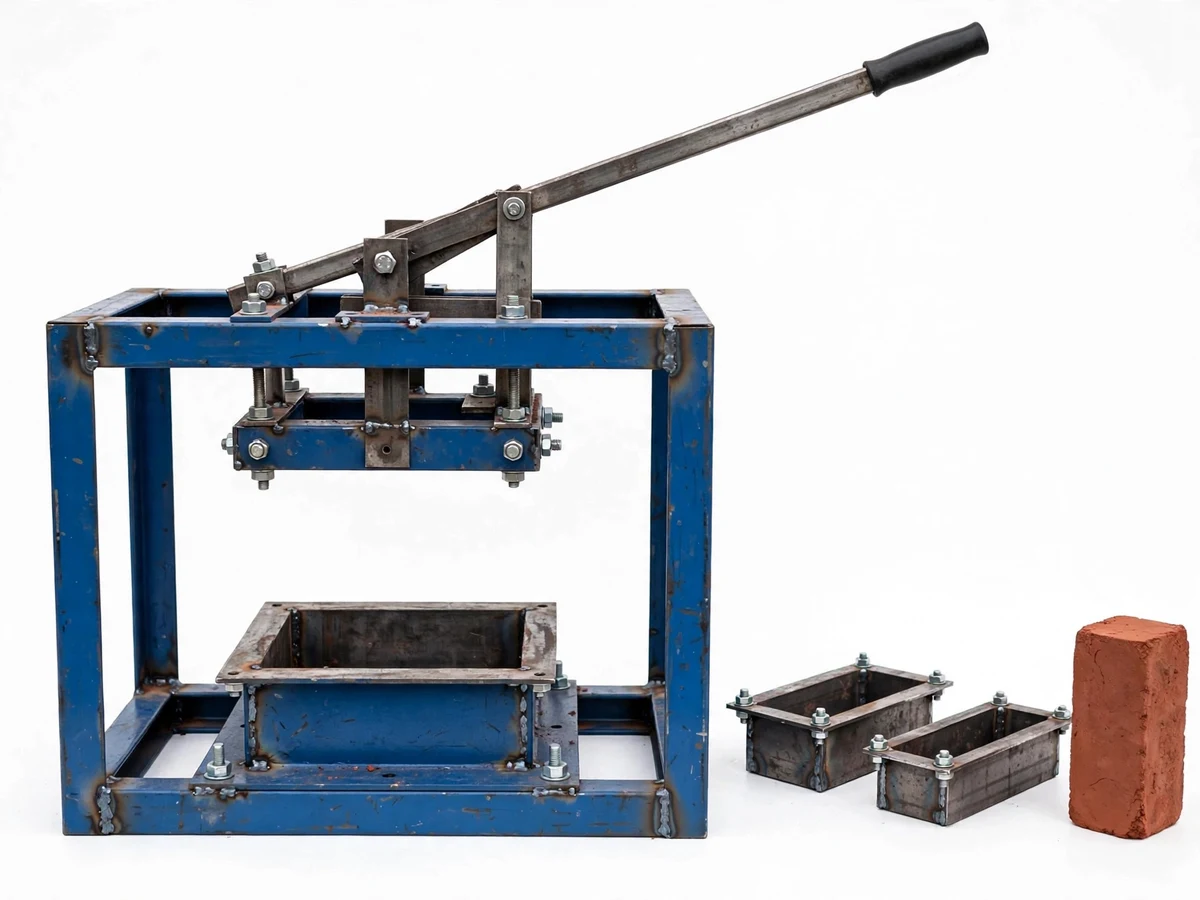
In rural and small-town construction, clay bricks are still the dominant building unit, yet production usually means buying from distant kilns or hand-moulding on the ground — a slow, labour-intensive process that yields inconsistent size and density. Table-top hand moulding is cheap but depends entirely on the operator's skill, while motorised presses need a grid connection and capital a village entrepreneur rarely has. The useful middle ground is a manually operated compression machine: a lever-multiplied press that compacts a measured charge of prepared clay into a mould box in one stroke, with no power supply. Interchangeable mould boxes let the same frame produce the standard nominal 190×90×90 mm brick as well as common alternate sizes. This project designs, fabricates and documents exactly that machine — an MS angle frame, a long lever arm driving a plunger plate through pinned linkages, a bolt-on mould box with an ejection provision, and a compaction-depth adjustment.
This is a built-to-order hardware project: the fabricated machine, fabrication drawings, operator manual and the complete viva kit (report, PPT, Q&A) are prepared fresh for you.
Problem it solves
Rural and small-scale brick makers face a labour-cost and consistency trap. Hand moulding needs an experienced worker for every brick: the mix is patted into a wooden mould by eye, so bricks vary in size and density, rejected bricks and mortar wastage rise, and daily output is capped by how long a person can sustain heavy manual work. Motorised brick presses solve the output problem but need three-phase power or a diesel engine, plus capital that is out of reach for a village entrepreneur, NGO livelihood project or student fabrication setup. The result is that small-scale production stays slow, inconsistent and labour-heavy, while the machines that could fix it are not viable where they are needed most. A manual lever-compression press breaks this trade-off: one operator, one lever stroke per brick, no electricity, and bricks of repeatable size because the mould — not the operator's eye — defines the geometry.
Fills the mould with prepared clay, pulls the lever for each pressing cycle, and swaps mould boxes with spanners.
Follow the working sequence
How it works
- The operator prepares the clay to the right consistency (sieved, mixed, moisture-checked per the operator manual) and fills the bolted-on mould box on the base plate with a measured charge.
- Pulling the long lever arm down drives the pinned linkages, which convert the pull into a downward stroke of the plunger plate into the mould box.
- The lever geometry multiplies the operator's effort: a long effort arm against a short load arm delivers the compaction force needed to press the clay charge in a single stroke.
- At the bottom of the stroke the lever position holds the compaction while the screw-type compaction-depth setting determines how far the plunger travels — set deeper for denser bricks, shallower for lighter ones.
- The lever is raised, lifting the plunger clear of the mould; the ejection provision (push plate/lifting pins) raises the pressed green brick out of the cavity without distorting it.
- The finished brick is set aside for drying and curing; to change brick size, the operator unbolts the mould box and fits another — the conversion takes minutes with ordinary spanners.
Tech stack:
- Mild-steel angle & plate fabrication (welded, painted)
- Lever & four-bar-style pinned linkage mechanism
- Plunger plate + screw-type compaction-depth setting
- Bolt-on interchangeable mould boxes
- Push-plate / lifting-pin ejection provision
- Clay preparation & pressing procedure (operator manual)
| Parameter | Value |
|---|---|
| Mould cavity (standard) | Nominal 190 × 90 × 90 mm (Indian standard size) |
| Alternate moulds | Configurable (e.g. 200 × 100 × 100 mm) |
| Operating effort | Single-operator lever pull (design target: full compaction in one stroke) |
| Mechanical advantage | Lever-ratio design (documented in the report) |
| Output per cycle | 1 brick per lever cycle |
| Output rate | Approximately 150–200 bricks per 8-hour day (design target for a trained operator; the buyer-run trial measures the actual rate) |
| Frame | Welded mild-steel angle, painted |
| Power requirement | None (fully manual) |
| Floor mounting | Base plate with anchor bolts |
Project features
- [Lever-compression mechanism] A long lever arm with rubberised grip drives a plunger plate through pinned linkages, multiplying single-operator effort into mould-compaction force in one pull — no motor, no electricity.
- [Interchangeable mould boxes] Mould boxes bolt onto the base plate with ordinary fasteners, so one frame accepts multiple brick sizes; the standard nominal 190×90×90 mm mould is supplied, with alternate sizes configurable.
- [Distortion-free ejection] A push-plate/lifting-pin ejection provision raises the pressed green brick out of the cavity without warping it, so the mould-defined geometry survives demoulding.
- [Adjustable compaction depth] A screw-type plunger-depth setting controls how far the plunger travels, letting the operator tune brick density and finish from a firm structural brick to a lighter one.
- [Welded MS frame] The machine is fabricated from mild-steel angle and plate, welded and painted, with a bolted-down base plate — rigid enough to absorb repeated pressing cycles.
- [Single-brick-per-cycle simplicity] One fill, one lever pull, one brick: the operating cycle is deliberately simple so an untrained worker can reach full speed quickly.
- [Documented fabrication procedure] Cut lists, weld sequence notes and assembly drawings are supplied, so the student can explain and defend every joint and dimension in the viva.
What is included
- Fabricated manual brick making machine (lever press + standard mould box)
- Interchangeable alternate-size mould box (as configured)
- Fabrication drawings (frame, plunger, linkages, mould boxes, cut list)
- Weld and assembly procedure notes
- Operator manual: clay preparation, filling, pressing, demoulding, mould changeover
- Buyer-run output trial sheet (bricks/day and dimension consistency, measured by the student)
- Project report PDF (mechanism design, fabrication, procedure, trial results)
- PPT presentation for final review
- Viva Q&A preparation document (lever ratios, linkage kinematics, mould tolerances, rural-production economics)
Limitations & prerequisites
- One brick per pressing cycle — output scales with the operator, not with the machine; the 150–200 bricks/day figure is a design target, and the actual rate is whatever the buyer measures in their trial.
- Clay must be prepared to the right consistency; too wet a mix sticks and distorts, too dry a mix crumbles — mix preparation skill is part of the process.
- Green bricks still need sun-drying and curing (and firing, if fired bricks are intended); the machine presses, it does not dry or fire.
- No measured compressive-strength figures are claimed — strength depends on the clay, the mix and the curing the buyer performs; the report documents a buyer-run procedure for checking it.
- Mould cavity tolerances hold the brick dimensions, but worn moulds drift over long production runs; the manual includes a mould-inspection routine.
- Fully manual operation means output drops with operator fatigue over a full day — the design is sized for one operator, not shift production.
- Alternate mould sizes beyond the supplied set are custom fabrication, quoted separately.
Timeline & delivery information
- Built-to-order: the machine is fabricated fresh on order. Typical fabrication lead time is 2–3 weeks after quotation acceptance, depending on mould configuration.
- Delivery covers the machine, mould boxes, drawings, operator manual, report, PPT and viva Q&A. Installation guidance and a remote walkthrough of the first pressing cycles are included.
Support & explanation
- The operator manual covers clay preparation, filling, pressing, demoulding and mould changeover step by step.
- A remote demonstration of the pressing cycle and ejection procedure is arranged after delivery.
- Report and PPT are explained section by section on a call, and the viva Q&A document is walked through so the student can defend the lever-ratio calculations, the linkage geometry and the fabrication decisions.
Frequently Asked Questions
How does the lever give enough force to press a brick?
The long lever arm is an effort multiplier: the operator pulls at a large radius while the load acts near the pivot, so the linkage delivers a much larger compaction force onto the plunger plate. The report shows the lever-ratio calculation and the pinned-joint sizing checks, which is a strong viva topic.
What brick sizes can it make?
The standard mould is the nominal 190×90×90 mm Indian standard size. Mould boxes are bolt-on and interchangeable, so the same frame can take alternate sizes (for example 200×100×100 mm) — extra moulds are configured at order time.
Does it need electricity?
No. The machine is fully manual — one operator, one lever. That is the point: it works in places with no grid connection and has no motor, wiring or fuel cost.
How many bricks can it make per day?
About 150–200 bricks in an 8-hour day is the design target for a trained operator doing one fill-press-eject cycle per brick. The report states this honestly as a target: the buyer-run trial sheet is for the student to measure and record their own rate.
Can the brick strength be guaranteed?
No — and any listing that promises a number without testing is guessing. Final strength depends on the buyer's clay, mix and curing/firing. The report documents a procedure to check compressive strength on the buyer's own samples rather than inventing a figure.
Is this project suitable for a final-year project?
Yes — for Mechanical Engineering. It covers mechanism design (lever ratios, linkage kinematics), fabrication (welding, tolerance thinking), and a complete rural-production case study with a buyer-run trial, all defensible in a viva. Suitable for B.E./B.Tech final-year projects in Mechanical Engineering.
Components & software requirements
- Mild-steel angle & plate fabrication (welded, painted)
- Lever & four-bar-style pinned linkage mechanism
- Plunger plate + screw-type compaction-depth setting
- Bolt-on interchangeable mould boxes
- Push-plate / lifting-pin ejection provision
- Clay preparation & pressing procedure (operator manual)
Delivery information
Built-to-order project. Delivery timeline is shared after order confirmation based on current queue.
Support terms
Complete documentation, setup guide, and viva preparation included. Support for setup and explanation provided.
Download free synopsis (PDF)
Enter your name and email — the synopsis PDF downloads immediately. We may send occasional project updates; no spam, unsubscribe anytime.