
More project photos (2)

The problem
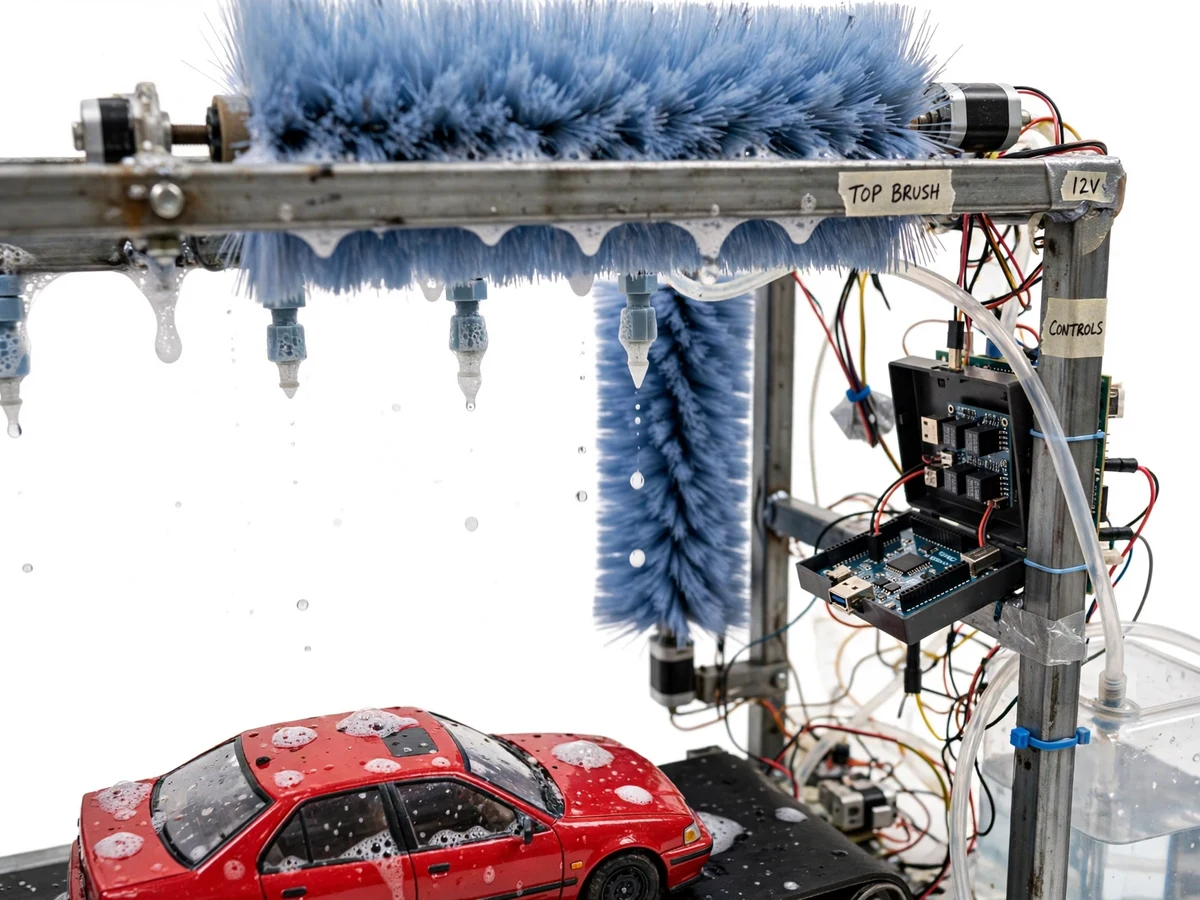
An automatic car washing machine using rotating brushes is a conveyor wash tunnel that cleans a whole car without hand scrubbing: the car rolls in on a belt conveyor, foam spray loosens road dirt, three rotating brush rollers scrub the roof, sides and lower panels, rinse jets wash the foam away, and underbody jets clean the chassis. This project builds that machine as a working scale-model prototype, with a mild-steel gantry carrying two vertical side brushes and one horizontal top brush, all driven by 12 V DC worm gear motors under Arduino control. Infrared sensors detect the car at the tunnel entry and trigger each stage in sequence, so the wash runs as one timed cycle from entry to exit. Used wash water drains to a settling tank and passes through a three-stage filter for reuse in the pre-rinse, cutting fresh-water use. This build is unambiguously a vehicle washer: it moves a car through a tunnel on a conveyor.
| Machine | What it washes | How it cleans | How the load moves |
|---|---|---|---|
| Automatic car washing machine (this project) | Whole cars | Rotating brushes, foam spray, rinse jets, underbody wash | Car moves on a conveyor through a brush gantry |
| Automatic vegetable washing machine | Vegetables in a tank | Air-bubble agitation, no brushes | Produce sits in a perforated basket |
| Solar panel cleaning robot | Flat solar panels | Dry rotating brush rollers, no water | Robot drives across the panel |
| Hand-cranked washing machine | Clothes in a drum | Hand-cranked agitator in soapy water | Drum stays fixed, user cranks by hand |
Builder note — brush and water choices from the actual build: soft flagged nylon was chosen over hard nylon because hard nylon (Mohs hardness approximately 3–4) can mark clear coat, while soft flagged nylon (Mohs approximately 2–3) sits below car paint hardness (approximately 3–5) and does not go mouldy when wet. The recycled-water loop is staged so filtered water feeds only the pre-rinse, never the final rinse, because the mesh, sand and charcoal stages remove grit and odour but not dissolved detergent, and a final rinse in recycled water would leave a soap film on the paint.
This is a built-to-order hardware project: the conveyor gantry, brush rollers, pump and filtration loop, control wiring and firmware are assembled fresh for you, with the report, PPT and viva Q&A prepared around the delivered build.
Related built-to-order projects on this site: Automatic Vegetable Washing Machine with Bubble Agitation (https://projectech.in/projects/automatic-vegetable-washing-machine-bubble-agitation/), Solar Panel Cleaning Robot using Brushes (https://projectech.in/projects/solar-panel-cleaning-robot-using-brushes/), Hand-Cranked Washing Machine for Hostels (https://projectech.in/projects/hand-cranked-washing-machine-hostels-drum-agitator/).
Detects the car at the tunnel
Follow the working sequence
How it works
The wash is one continuous sequence from entry to exit. The car is driven onto the belt conveyor at the tunnel entry, where an infrared sensor detects it and starts the conveyor, moving the car slowly through the gantry at a fixed speed. First, pre-rinse jets wet the body and loosen loose dust; then foam nozzles coat the car in detergent foam that softens road dirt. The three brush rollers — two vertical side brushes and one horizontal top brush — spin against the body while the car passes, scrubbing the roof, sides and lower panels, while underbody jets spray the chassis from below. A final rinse washes the foam and loosened dirt away, and a blower pushes air over the body to dry it. Used water drains through the floor grate into a settling tank, passes through the three-stage filter, and is pumped back only to the pre-rinse jets, while the final rinse always uses fresh water.
- The car is driven onto the belt conveyor at the tunnel entry; the entry infrared sensor detects it and starts the conveyor at the set speed.
- Pre-rinse jets spray the body with water — recycled filtered water at this stage — wetting the panels and loosening loose dust.
- Foam nozzles coat the car in detergent foam from the foam tank, and the foam dwells briefly to soften road dirt and insect residue.
- The three brush rollers spin up: the two vertical side brushes clean the doors and lower panels while the horizontal top brush covers the roof, bonnet and boot as the car passes through the gantry.
- Underbody jets under the conveyor spray the chassis and wheel arches, the area the brushes cannot reach.
- Fresh-water rinse jets wash the foam and loosened dirt off the body, and the blower pushes air over the panels to dry them.
- The car exits the tunnel, the exit sensor stops the conveyor and the cycle ends; used water drains to the settling tank and through the three-stage filter for the next pre-rinse.
Tech stack:
- Arduino Uno · ATmega328P controller
- 12 V DC worm gear motors · brush and conveyor drive
- Soft flagged nylon brush rollers
- 12 V DC diaphragm water pump
- Belt conveyor · roller drive
- Infrared proximity sensors · car detection
- Relay module · motor and pump switching
- Mild steel tube frame · sheet metal gantry
| Parameter | Value |
|---|---|
| Machine type | Conveyor car wash with rotating brushes (scale-model prototype) |
| Vehicle size | Scale-model car, approximately 1:10 to 1:12 (design target) |
| Brushes | 3 (2 vertical side + 1 horizontal top) |
| Brush speed | Approximately 60 RPM (design target; datasheet rated speed of the 5840-31ZY gear motor) |
| Brush motor | 12 V DC worm gear motor, 16 kg·cm rated torque (datasheet) |
| Bristle material | Soft flagged nylon, Mohs hardness approximately 2–3 (supplier data) |
| Conveyor | Belt conveyor, approximately 1.2 m long (design target) |
| Conveyor speed | Approximately 0.15 m/s (design target) |
| Water pump | 12 V DC diaphragm pump, max flow 4 L/min (datasheet, Hytek DP12.4 class) |
| Pump pressure | Max 2.4 bar / 35 psi (datasheet) |
| Water tanks | Approximately 20 L fresh + approximately 15 L recycled (design target) |
| Cycle time | Approximately 4–6 minutes per car (design target) |
| Controller | Arduino Uno (ATmega328P, 16 MHz clock, datasheet) |
| Power supply | 12 V DC, approximately 10 A (design target) |
| Frame | Mild steel tube, approximately 1.5 m × 0.8 m × 1.0 m (design target) |
| Water recycling | 3-stage filtration (mesh strainer, sand and gravel bed, activated charcoal) |
Project features
The strongest capabilities of this car washing machine are its three-brush gantry, its staged wash cycle, its water-recycling loop, and its sensor-driven sequencing. Two vertical side brushes clean the doors and lower panels while a horizontal top brush covers the roof, bonnet and boot, so every exterior surface meets a brush in a single pass. The wash runs as a fixed sequence — pre-rinse, foam, brush scrub, rinse, underbody wash and air dry — with each stage timed by the Arduino instead of left to the operator. Used water is collected, settled and filtered through three stages and reused for the pre-rinse, which cuts fresh-water consumption without risking a soapy final rinse. Infrared sensors at the tunnel entry detect the car, start the conveyor and hand control from stage to stage, so the whole cycle runs unattended once the car is positioned.
- [Three-brush gantry] Two vertical side brushes and one horizontal top brush cover the roof, sides and lower panels in a single conveyor pass, each driven by its own 12 V DC worm gear motor.
- [Staged wash cycle] Pre-rinse, foam spray, brush scrub, rinse, underbody wash and air dry run as a fixed Arduino-timed sequence, so every car gets the same wash every time.
- [Water recycling loop] Used wash water drains to a settling tank and passes through a mesh strainer, a sand and gravel bed and activated charcoal, then feeds only the pre-rinse stage.
- [Infrared car detection] IR sensors at the tunnel entry detect the car, start the conveyor and hand control from stage to stage, so the cycle runs unattended once the car is positioned.
- [Foam spray system] A 12 V DC diaphragm pump feeds foam nozzles that coat the body in detergent foam before the brushes, loosening road dirt without hand scrubbing.
- [Underbody wash jets] Nozzles under the conveyor spray the chassis and wheel arches, the area brushes cannot reach, during the rinse stage.
- [Adjustable brush and conveyor speed] Brush speed and conveyor speed are set in firmware, so the wash can be slowed for heavily soiled cars or sped up for a quick demonstration cycle.
What is included
- Working conveyor car wash prototype (gantry, 3 brush rollers, conveyor, pump, filtration loop, control box)
- Arduino firmware source code with commented stage timing and sensor logic
- Circuit and wiring documentation for motors, relays, sensors and pump
- Component list with datasheet references for the gear motors and pump
- Setup and calibration instructions (brush pressure, conveyor speed, stage timings)
- Project report PDF (background, mechanism, design calculations, results)
- PPT presentation for final review
- Viva Q&A preparation document (brushes, drives, water recycling, control logic)
Limitations & prerequisites
- The prototype washes a scale-model car (approximately 1:10 to 1:12), not a full-size vehicle — brush geometry, conveyor length and pump capacity are sized for the model.
- Wash quality is a design target checked by buyer-run trials; no cleaning-efficacy percentage is claimed, since dirt type, foam concentration and brush pressure all change results.
- Soft flagged nylon brushes suit painted model bodies; hard nylon or wire brushes must never be fitted, as they can mark the finish.
- Recycled water feeds only the pre-rinse; the final rinse always uses fresh water, so a mains or tank supply is needed at the demo site.
- The machine needs a level floor and a drain or collection tray — wash water must not be left to pool around the 12 V electrics.
- The prototype is an academic demonstration build, not a commercial car wash — it has no payment system, no vehicle-length sensing and no drying certification.
Frequently Asked Questions
Is this project suitable for a final-year project?
Yes — for Mechanical Engineering and allied programs. It demonstrates machine design, belt and gear drives, brush and fluid systems, sensor-based sequencing and water recycling in one working prototype, with enough measurable design work — brush speed, conveyor speed, stage timings and filtration staging — to fill a report and a viva. The build also covers fabrication drawings, motor selection from datasheets and a buyer-run wash trial, which give examiners concrete evidence to discuss.
How is this different from the vegetable washing machine and the solar panel cleaning robot on this site?
This machine washes whole vehicles on a conveyor; the vegetable washer cleans produce in a tank with air bubbles and no brushes, and the solar panel robot dry-brushes flat panels with no water and no conveyor. The three builds share the word washing but solve different problems with different mechanisms. The car washer is the only one of the three that moves a vehicle through a brush gantry, which is why its frame, drives and water loop are all sized around a car rather than produce or a panel.
Which motors drive the brushes and the conveyor?
Three 12 V DC worm gear motors drive the brush rollers and one drives the conveyor, all switched by a relay module under Arduino control. The specified brush motor is the 5840-31ZY class: 12 V, 60 RPM rated speed and 16 kg·cm rated torque from its supplier specification, with a 100:1 worm gearbox that holds the brush steady when power is cut.
Does the water recycling really save water?
Yes, within the prototype's limits: used wash water is settled and filtered through three stages and reused for the pre-rinse, which is the thirstiest stage, while the final rinse always uses fresh water. The saving is a design target, not a measured figure: the report includes a buyer-run procedure that measures fresh-water use per cycle with and without the loop, so the student reports their own number.
What power supply does it need, and can it run on a battery?
The machine runs on a 12 V DC supply rated at approximately 10 A, which covers the four gear motors, the diaphragm pump, the blower and the control electronics together. A 12 V battery of adequate capacity can power a short demonstration, but the mains adapter is recommended for repeated cycles because the pump and motors draw several amps under load.
Components & software requirements
- Arduino Uno · ATmega328P controller
- 12 V DC worm gear motors · brush and conveyor drive
- Soft flagged nylon brush rollers
- 12 V DC diaphragm water pump
- Belt conveyor · roller drive
- Infrared proximity sensors · car detection
- Relay module · motor and pump switching
- Mild steel tube frame · sheet metal gantry
Delivery information
Built-to-order project. Delivery timeline is shared after order confirmation based on current queue.
Support terms
Complete documentation, setup guide, and viva preparation included. Support for setup and explanation provided.
Download free synopsis (PDF)
Enter your name and WhatsApp number — the synopsis PDF downloads immediately. We may send occasional project updates on WhatsApp; no spam.