
More project photos (2)
The problem
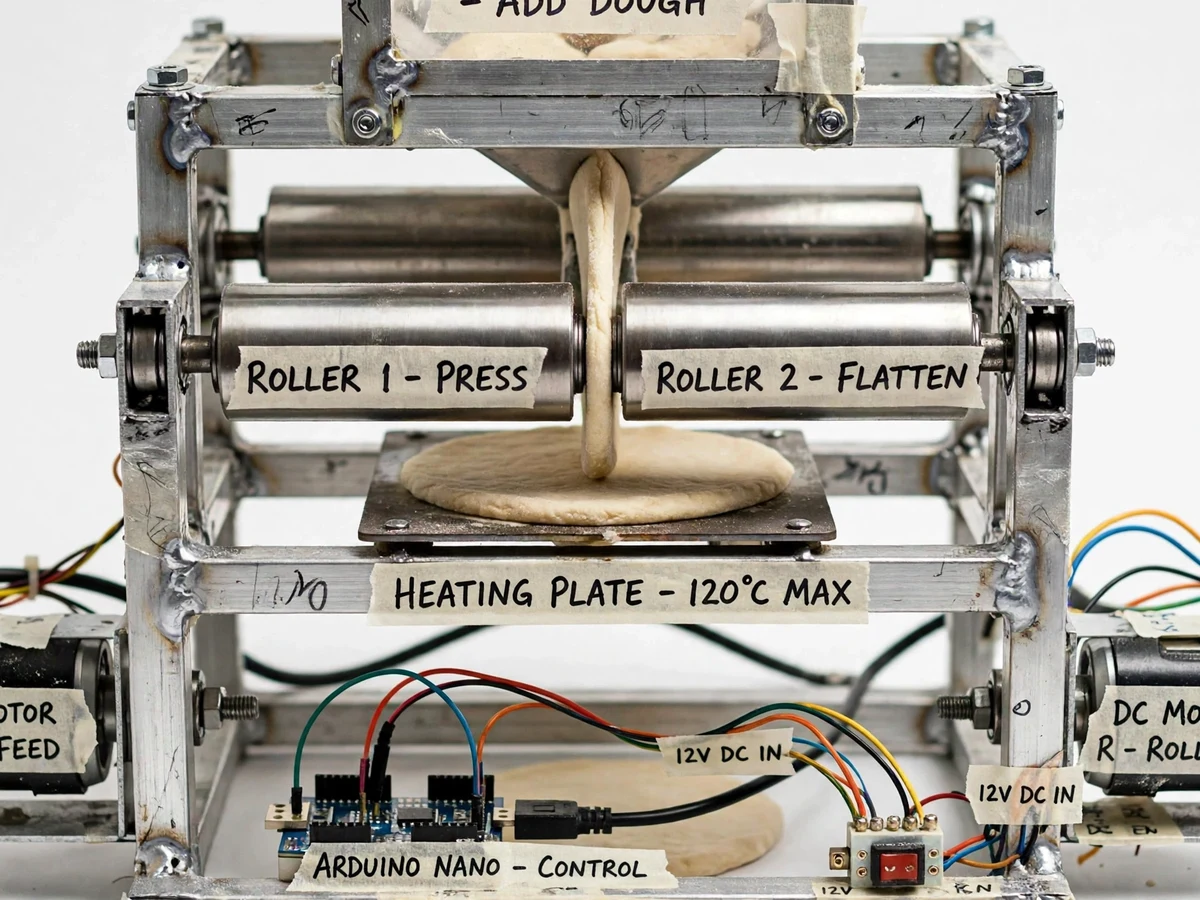
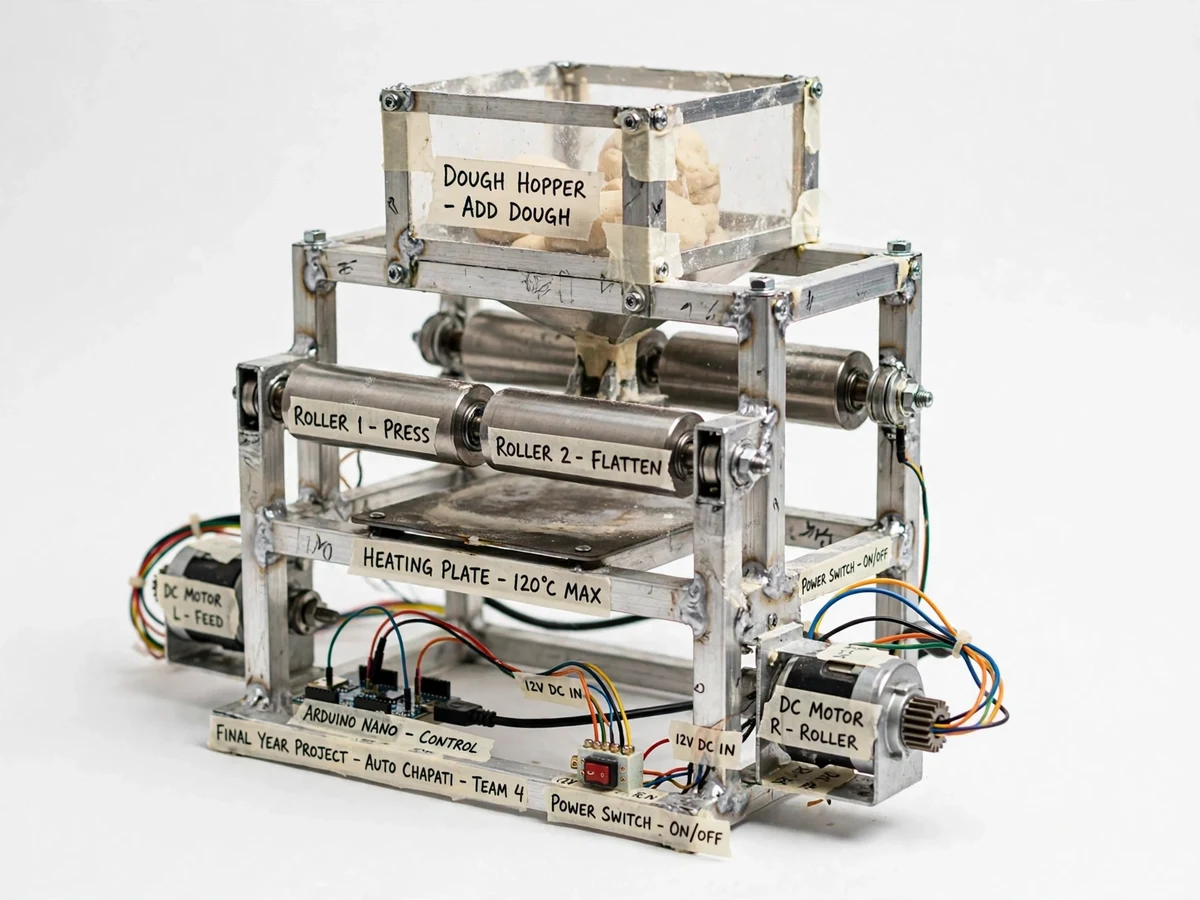
Rolling chapatis by hand is slow and inconsistent, while commercial automatic machines are sealed, expensive units that a student can neither open nor study. This project builds the complete working chain at tabletop scale: a dough hopper meters portions into the machine, two motor-driven stainless-steel rollers flatten them to an adjustable gap, and a heating plate with thermostatic control bakes each side while an Arduino Nano sequences the cycle. Because the machine is assembled from open parts — DC gear motors, a relay-switched heating element, a simple microcontroller — the student can trace every signal from button press to finished chapati, tune roller gap and bake time, and document genuine design trade-offs (torque versus speed, gap versus thickness, temperature versus browning) in the report.
How it works
- Dough portions are loaded into the hopper; on start, the feed mechanism drops one portion into the roller nip.
- The Arduino starts both DC gear motors, and the counter-rotating rollers draw the dough through the set gap, flattening it into a disc.
- The disc lands on the heating plate, which the thermostat holds at the set temperature (design target up to approximately 120 °C).
- A timed bake stage cooks one side while the controller monitors elapsed time.
- The plate's timed cycle completes, the operator flips the chapati (manual flip is part of the documented procedure), and the second side bakes.
- The cycle timer signals completion; the finished chapati is removed and the next portion feeds automatically.
Tech stack:
- Arduino Nano (ATmega328P) control
- 12 V DC gear motors with roller drive
- Stainless-steel rollers, adjustable gap mounts
- Thermostat-controlled heating plate
- Relay-switched heater circuit with thermal cutout
- Mild-steel frame, fabricated and welded
- 12 V DC + mains heater power supplies
- Embedded C firmware (Arduino IDE)
| Parameter | Value |
|---|---|
| Overall size | Approximately 450 × 350 × 400 mm (expected) |
| Roller diameter | Approximately 50 mm, stainless steel (design target) |
| Roller gap | Adjustable, approximately 1–8 mm (design target) |
| Heating plate | Approximately 200 × 200 mm; design target up to ~120 °C |
| Cycle time | Approximately 60–90 s per chapati (expected) |
| Motor supply | 12 V DC, gear motors (datasheet torque per selected unit) |
| Heater supply | 230 V AC mains, relay-switched with thermal cutout |
| Control | Arduino Nano, timed stages, adjustable in firmware |
Project features
- [Dough hopper with gravity feed] A transparent hopper meters dough portions into the roller nip on a timed cycle, so each chapati starts from a consistent portion without manual handling.
- [Twin-roller pressing stage] Two counter-rotating stainless-steel rollers, each driven by a DC gear motor, press the dough flat; the roller gap is mechanically adjustable to set finished thickness.
- [Temperature-controlled heating plate] A thermostat-switched heating plate bakes the flattened disc; the design target is a regulated plate temperature with a maximum of approximately 120 °C.
- [Arduino-timed bake cycle] The Arduino Nano sequences feed, roll, bake and eject with adjustable stage timers, and the timing values are exposed in firmware for tuning.
- [Adjustable roller gap] Slotted bearing mounts allow the gap to be set between roughly 1 mm and 8 mm, demonstrated during calibration with feeler gauges.
- [DC gear-motor drive train] Both rollers and the feed mechanism run from 12 V DC gear motors with enough torque margin for stiff dough, selected from a documented torque calculation.
- [Safety interlocks] A thermal cutout on the heater and a prominent emergency-stop switch are wired in hardware, independent of the microcontroller.
What is included
- Fully assembled and wired chapati-making machine prototype
- Arduino Nano with programmed cycle firmware
- Wiring diagram and electrical schematic
- Roller-gap calibration procedure with feeler-gauge method
- Project report PDF (background, mechanism design, torque and heater calculations, test procedure)
- PPT presentation for final review
- Viva Q&A preparation document (roller mechanics, heat transfer basics, motor selection)
Limitations & prerequisites
- The heating plate's design target is approximately 120 °C maximum, so the model demonstrates baking but does not fully puff chapatis the way a 200 °C+ tawa does — stated openly, not hidden.
- Dough consistency strongly affects results; the calibration guide defines the workable dough recipe used during development.
- Throughput is approximately one chapati per minute — a demonstration scale, not a commercial rate.
- Flipping the chapati between sides is manual in this build; an automatic flipper is listed as future scope.
- The machine is a laboratory prototype, not a food-grade certified appliance; it is intended for demonstration, not continuous food production.
- Roller gap must be re-checked after transport; the calibration procedure covers this.
Frequently Asked Questions
How does the dough get from the hopper to the rollers?
Gravity feed with a timed gate: the Arduino opens the feed gate for a calibrated interval, dropping one dough portion into the roller nip. Portion consistency depends on dough stiffness, so the report documents the dough recipe used for calibration.
What temperature does the heating plate reach?
The design target is a regulated plate temperature up to approximately 120 °C, held by a thermostat with a thermal cutout for safety. The limitations section is honest that this bakes rather than fully puffs the chapati.
Can the chapati thickness be changed?
Yes — the roller bearings sit in slotted mounts, so the gap is adjustable from roughly 1 mm to 8 mm, set with feeler gauges during calibration.
What motors drive the rollers?
12 V DC gear motors, one per roller, selected from a torque calculation included in the report (rolling resistance of dough at the set gap, with a stated safety margin).
Is the machine safe to operate?
The heater circuit has a hardware thermal cutout and an emergency-stop switch independent of the microcontroller; the 12 V control side is low voltage, and the operating procedure covers safe mains practice.
Is this project suitable for a final-year project?
Yes — for Mechanical Engineering and Mechatronics. It combines machine design, fabrication, motor selection, thermal control and embedded sequencing in one demonstrable build. Suitable for B.E./B.Tech final-year projects in Mechanical Engineering and Mechatronics.
Components & software requirements
- Arduino Nano (ATmega328P) control
- 12 V DC gear motors with roller drive
- Stainless-steel rollers, adjustable gap mounts
- Thermostat-controlled heating plate
- Relay-switched heater circuit with thermal cutout
- Mild-steel frame, fabricated and welded
- 12 V DC + mains heater power supplies
- Embedded C firmware (Arduino IDE)
Delivery information
Built-to-order project. Delivery timeline is shared after order confirmation based on current queue.
Support terms
Complete documentation, setup guide, and viva preparation included. Support for setup and explanation provided.