
More project photos (3)

The problem
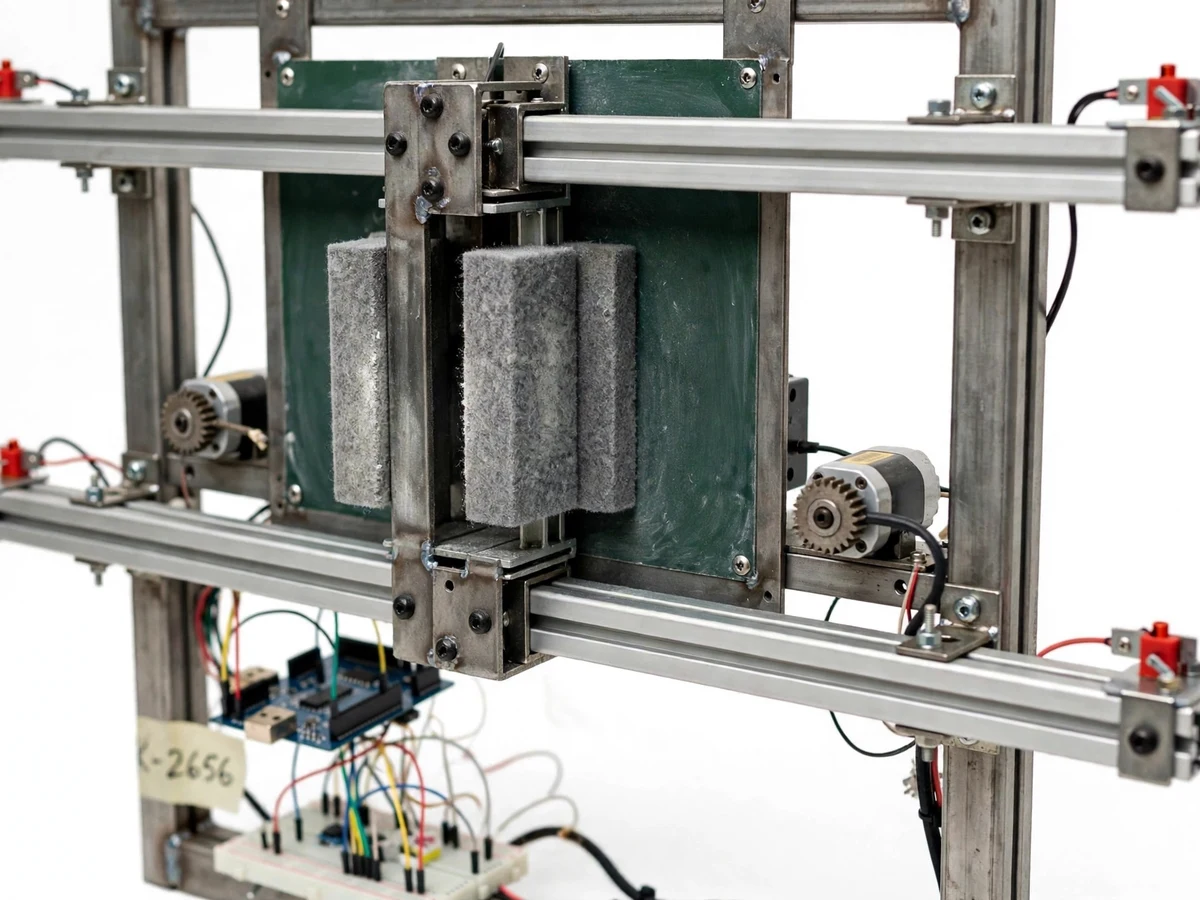
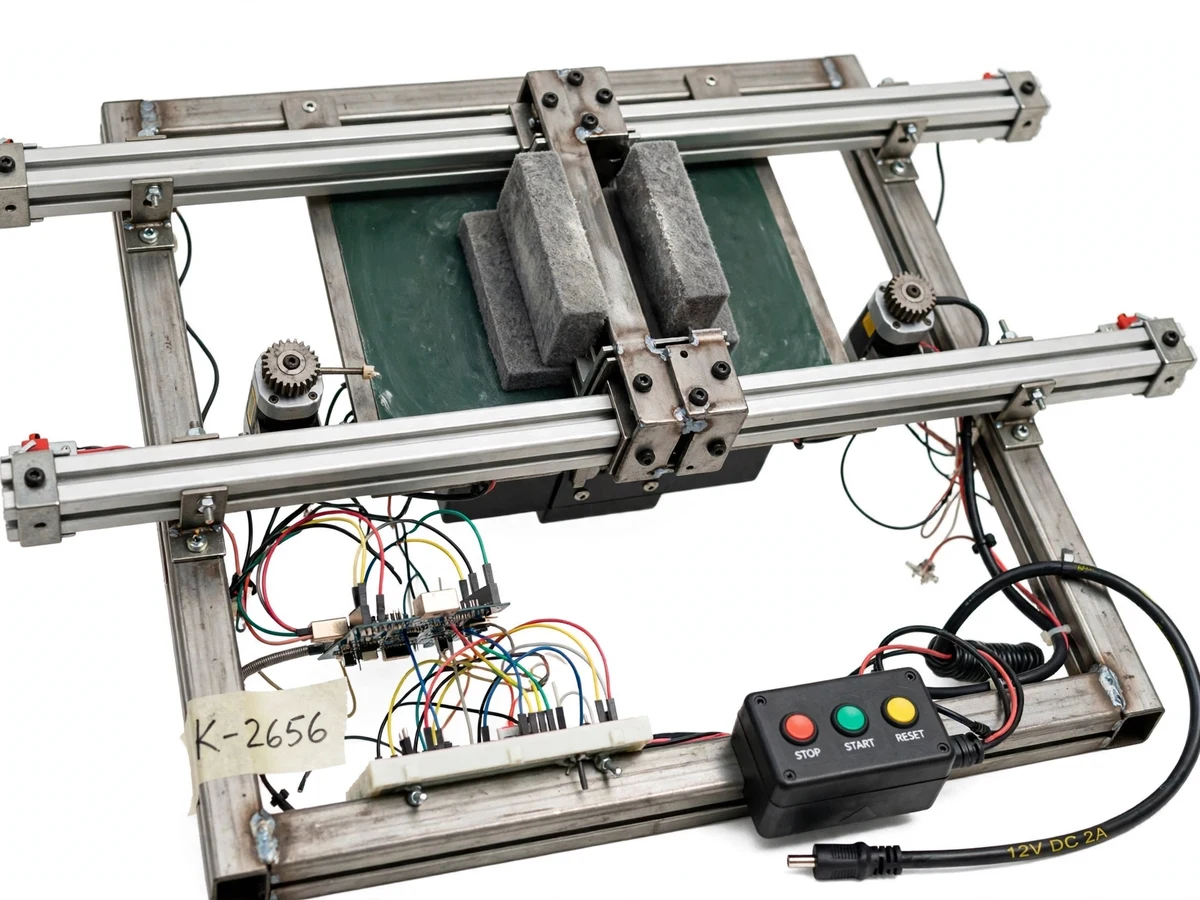
An automatic blackboard cleaning machine is an Arduino-controlled device that wipes a classroom blackboard without anyone holding a duster. Two parallel guide rails are fixed above and below the board, and a vertical carriage carrying felt duster pads travels along them, driven by DC gear motors under an Arduino Uno. The teacher presses a push button, the carriage sweeps from one end of the board to the other, and limit switches at both ends reverse the travel or stop the machine. The pads press lightly against the board and collect chalk dust as they pass, while a tray beneath the carriage catches falling dust. Manual wiping is repetitive, leaves chalk dust on hands and clothes, and often misses the top and corners of the board. This machine makes the task consistent and hands-free, and it gives the builder a compact example of guided motion, motor control and limit-switch feedback in one working prototype.
The teacher presses the start button to begin a cleaning pass across the board.
Follow the working sequence
How it works
The machine works as a short chain: a button press tells the Arduino Uno to start, the Arduino drives the DC gear motors, which move the carriage along the guide rails, the felt duster pads wipe the board as the carriage travels, and the limit switches at each end tell the Arduino when to reverse or stop. The carriage rides on two parallel rails fixed above and below the blackboard, keeping it square to the board through the sweep. When the carriage reaches a limit switch, the switch closes and the firmware either reverses the motor direction for a return pass or cuts power to stop. Builder note from the reference build: the two guide rails must be set parallel and level before fitting the carriage, because even a small misalignment makes the carriage bind mid-travel, and duster pressure is set by adjusting the pad mount so the felt stays in contact across the board without stalling the motors.
- The user presses the start push button, and the Arduino Uno reads the input and begins a cleaning cycle.
- The Arduino energizes the DC gear motors through the motor driver, and the carriage starts moving along the guide rails from its parked end.
- The felt duster pads mounted on the carriage press against the board and wipe away chalk dust as the carriage travels, with loose dust falling into the tray below.
- When the carriage reaches the far end, it presses the limit switch, and the Arduino reads the signal on a digital input.
- Depending on the selected mode, the firmware either reverses the motor direction for a return pass or stops the motors at the far end.
- In return-pass mode the carriage sweeps back to its parked end, presses the second limit switch, and the Arduino stops the motors and ends the cycle.
Tech stack:
- Arduino Uno (ATmega328P)
- Arduino IDE (C/C++ firmware)
- DC gear motors with L298N driver
- Limit switches
- Guide rails and carriage frame
- Felt duster pads
- 12 V DC power supply
- Push-button control panel
| Parameter | Value |
|---|---|
| Controller | Arduino Uno (ATmega328P, 16 MHz clock — datasheet value) |
| Drive motors | 2 × 12 V DC gear motors (design choice) |
| End detection | 2 limit switches, one at each end of the rails |
| Cleaning pass | Approximately 20–40 seconds per full pass (design target, board-width dependent) |
| Power supply | 12 V DC adapter, approximately 2 A (design target) |
| Duster | Replaceable felt pads on the carriage |
| Control modes | Push-button start, single-pass or return-pass, manual stop |
| Frame | Mild-steel or aluminium guide rails, length board-dependent |
| Board size | Sized to the buyer's blackboard; rail length and carriage width set at build time |
Project features
The machine's three strongest capabilities are its hands-free cleaning pass, its limit-switch end control, and its simple push-button operation. One button press starts a full sweep of the board, the felt duster pads wipe as the carriage travels, and the limit switches handle the ends without the user watching or intervening. A second strength is the guided carriage itself: two parallel rails keep the pads square to the board through the whole travel, so the wipe is even from one edge to the other instead of patchy. A third is the honest mechanical scope: DC gear motors, a motor driver and an Arduino Uno do all the work, so the whole system can be explained, repaired and demonstrated in a classroom without specialist tools. The remaining capabilities round out the build: replaceable felt pads, a choice of single-pass or return-pass cleaning, and a power supply sized for the motors.
- [One-button cleaning pass] Pressing the start button runs the carriage across the full width of the board, wiping as it travels, so the teacher does not need to reach the top or corners of the board by hand.
- [Limit-switch end control] A limit switch at each end of the rails detects when the carriage arrives and either reverses its travel or stops it, so the machine never runs off the rails or stalls against the frame.
- [Guided wiper carriage] Two parallel guide rails carry a vertical carriage fitted with felt duster pads, keeping the pads square to the board surface through the whole sweep for an even wipe.
- [DC gear-motor drive] DC gear motors drive the carriage through the motor driver, giving slow, steady travel with enough torque to move the pads against the board without slipping.
- [Replaceable felt duster pads] The cleaning surface is made from felt pads mounted on the carriage, which can be removed, washed or replaced when they load up with chalk dust.
- [Single-pass and return-pass modes] The firmware can run one sweep and stop, or sweep out and back, so the user can choose a quick wipe or a second pass on a heavily used board.
- [Push-button and manual stop controls] A start push button begins a cleaning cycle and a stop button halts the carriage at any point, giving the user direct control without touching the moving parts.
What is included
- Working prototype (carriage, guide rails, motors, limit switches, duster pads, control panel)
- Arduino firmware source code with mode selection (single-pass / return-pass)
- Circuit and wiring documentation
- Component list with part specifications
- Setup and rail-alignment instructions
- Project report PDF (background, mechanism, methodology, results)
- Project abstract PDF
- PPT presentation for final review
- Viva Q&A preparation document (motor control, limit switches, guided motion)
Limitations & prerequisites
- Cleaning quality depends on duster-pad condition — pads loaded with chalk dust must be washed or replaced, and very old, ingrained chalk marks may need a manual wipe.
- The machine is sized to one blackboard at build time; rail length and carriage width must be set for the buyer's board and are not adjustable afterwards without refabrication.
- Approximately 20–40 seconds per full pass is a design target, not a measured figure — actual pass time depends on board width and the gear motors fitted.
- The prototype is a classroom demonstration build, not a commercial cleaning appliance, and it has no dust extraction — loose chalk dust falls into the tray and must be emptied.
- The carriage must run on rails that are parallel and level; a misaligned rail can make the carriage bind mid-travel.
- The system cleans only flat blackboards (or whiteboards with a suitable pad); curved or damaged board surfaces are out of scope.
- Power is mains-adapter based (12 V DC), so the machine needs a nearby socket and is not battery-portable as shipped.
Frequently Asked Questions
Which controller is used and why?
The Arduino Uno (ATmega328P, 16 MHz clock per its datasheet) is the controller, because the task needs only a few digital inputs and motor-driver outputs. It reads the push buttons and the two limit switches, and it switches the motor driver to start, reverse or stop the carriage. The board is inexpensive, widely available, and familiar to most examiners, which keeps the build easy to explain and repair.
How does the machine know when to stop or reverse?
A limit switch is mounted at each end of the guide rails, and the carriage presses it when it arrives at that end. The Arduino reads the switch on a digital input and, depending on the selected mode, either reverses the motor direction for a return pass or cuts power to stop the carriage. Because the switches are physical, the machine cannot run off the rails even if the firmware timing is wrong.
What power supply does it need?
A 12 V DC mains adapter, approximately 2 A (design target), powers the gear motors through the motor driver, while the Arduino runs from its own regulated 5 V supply. The machine needs a nearby mains socket and is not battery-portable as shipped. A battery pack can be added as a customization, but it is not part of the base build and would shorten the available run time.
Can it fit blackboards of different sizes?
Yes, within limits, because the guide rails and carriage width are fabricated to the buyer's blackboard dimensions at build time. The buyer shares the board's width and height before the build, and the rails, carriage and duster pads are sized to match. Once built, the machine fits that board; moving it to a much larger or smaller board would need new rails and a resized carriage.
Can the cleaning speed or number of passes be changed?
Yes, both are set in the Arduino firmware, so they can be adjusted when the machine is built. Travel speed is changed by selecting a different gear-motor ratio or adjusting the driver output, and the number of passes is changed by selecting single-pass or return-pass mode. The mode is chosen on the control panel, and a firmware change can add further pass counts if the college asks for it.
Is this project suitable for a final-year project?
Yes — for Mechanical and Electrical Engineering programs, and for Electronics students interested in embedded control. It demonstrates guided mechanical motion, DC motor drive, limit-switch feedback and Arduino firmware in one working prototype, with clear scope for a report, a demonstration and viva questions on mechanism design and control logic.
Components & software requirements
- Arduino Uno (ATmega328P)
- Arduino IDE (C/C++ firmware)
- DC gear motors with L298N driver
- Limit switches
- Guide rails and carriage frame
- Felt duster pads
- 12 V DC power supply
- Push-button control panel
Delivery information
Built-to-order project. Delivery timeline is shared after order confirmation based on current queue.
Support terms
Complete documentation, setup guide, and viva preparation included. Support for setup and explanation provided.
Download free synopsis (PDF)
Enter your name and WhatsApp number — the synopsis PDF downloads immediately. We may send occasional project updates on WhatsApp; no spam.