
More project photos (3)

The problem
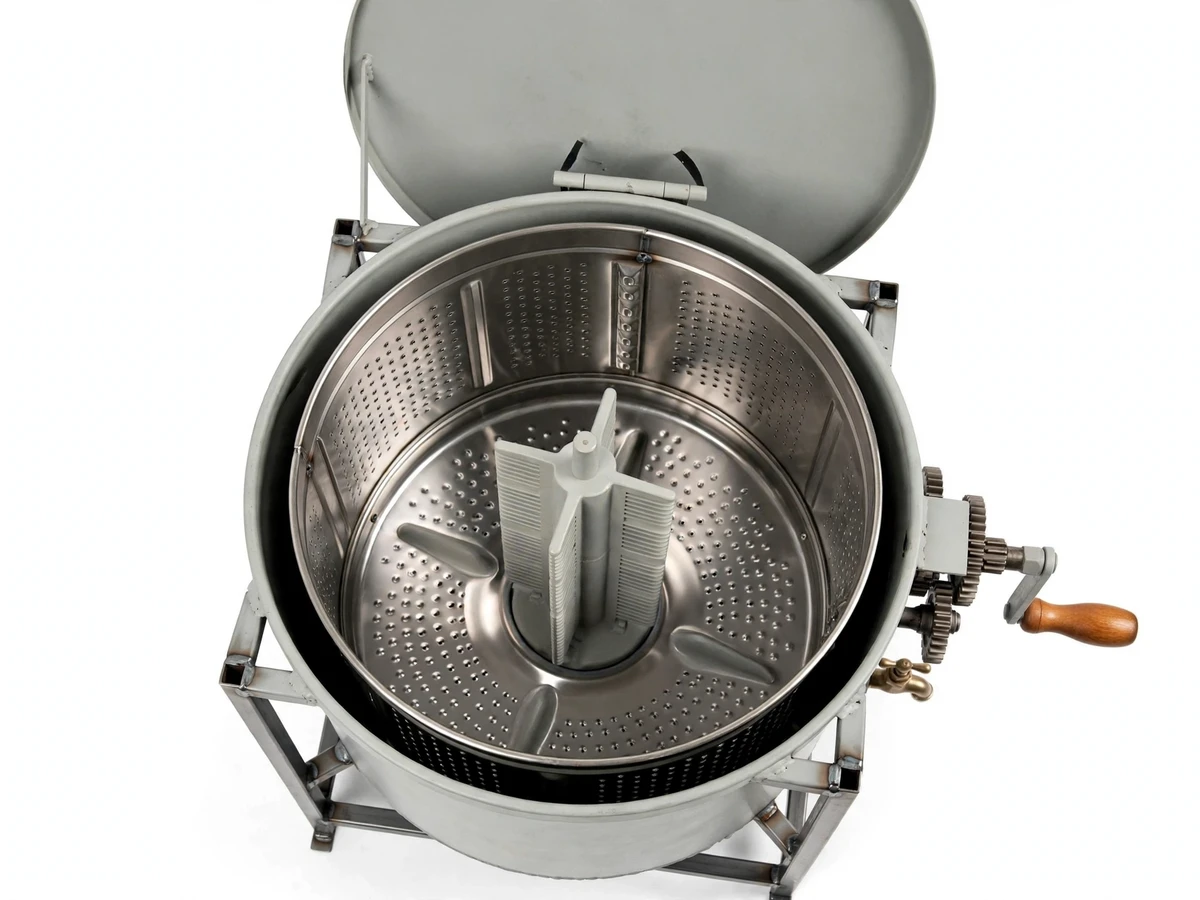
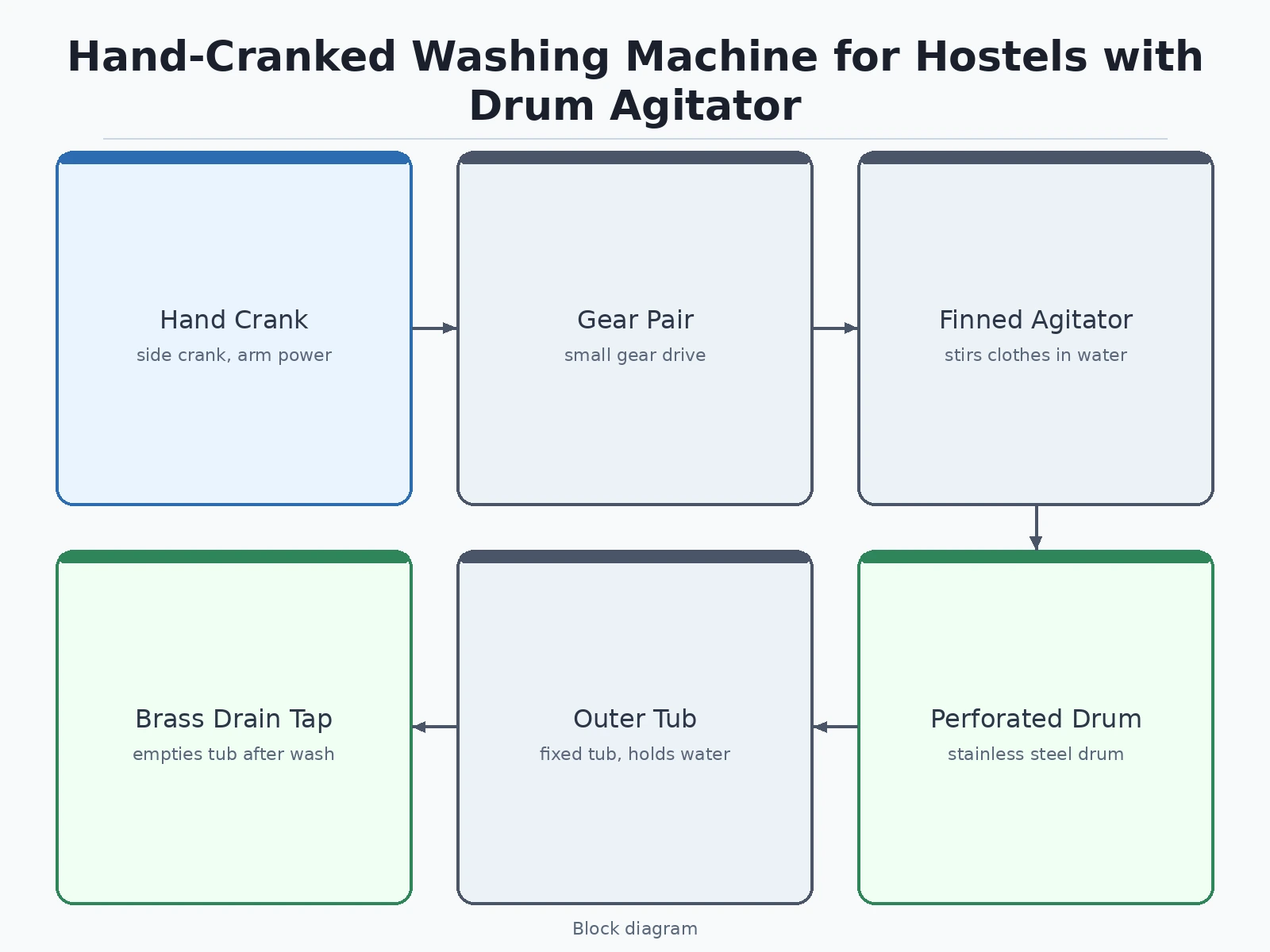
A hand-cranked washing machine for hostels is a manually powered laundry machine that washes clothes without electricity. This build places a perforated stainless steel drum inside a fixed outer tub, and a finned central agitator inside the drum stirs clothes through soapy water when the user turns a side crank. Hostel rooms rarely have space for a full-size electric washer, and shared laundry trips cost time and money, so a compact machine that runs on arm power fits rooms, balconies, and wash areas with no socket nearby. The user loads clothes and water, closes a hinged lid, and cranks at a comfortable pace while the agitator moves the load through the wash water. When washing ends, a brass drain tap at the base of the tub empties the water, and the damp clothes are lifted out for drying. The drum holds a design-target load of 3 kg of dry clothes, roughly one student's clothes for several days.
Loads up to 3 kg of dry clothes, water and detergent into the drum (design target).
Follow the working sequence
How it works
The wash follows a fixed five-stage routine: load, soak, crank, drain, and lift out. Loading puts dry clothes, water, and detergent into the perforated drum, and the hinged lid closes over the tub. Soaking lets the detergent water reach through the drum holes and loosen surface dirt before any cranking starts. Cranking then drives the agitator: three full turns of the crank become one full turn of the agitator shaft, trading speed for the torque needed to stir a full drum of wet clothes, and the fins push the load through the water in a slow rolling motion. Draining opens the brass tap so the dirty water runs out of the tub, and a rinse repeat of the same routine with clean water follows the same stages. Lifting out takes the damp clothes from the drum for line drying, since the base build has no spin-dry stage.
- The user opens the hinged lid and loads dry clothes into the perforated drum, up to a design-target load of 3 kg of dry clothes.
- Water and detergent are added to the outer tub until the load is covered, and the lid is closed over the drum.
- The load soaks in the detergent water so the water reaches through the drum holes and loosens surface dirt.
- The user turns the side crank at a comfortable pace, and the gear pair rotates the finned agitator so the fins push clothes through the water.
- After a design-target wash duration of 10–15 minutes of cranking, the user opens the brass drain tap and lets the dirty water run out of the tub.
- The user repeats the rinse with clean water, drains again, and lifts the damp clothes out of the drum for line drying.
How it compares
| Approach | Needs electricity | Effort per wash | Water handling | Hostel fit |
|---|---|---|---|---|
| This hand-cranked washing machine | No · hand power only | Moderate · steady cranking by hand | Drain tap empties the tub in place | Yes · one small floor patch · no socket or plumbing |
| Electric top-load washer | Yes · wall socket required | Low · motor does the washing | Pump drains the tub | Poor · needs socket · plumbing and floor space |
| Bucket hand washing | No · hand power only | High · scrubbing and wringing by hand | Bucket must be lifted and tipped | Yes · but slow and tiring for a full load |
| Shared laundry service | No · done off site | Low · clothes are dropped off | Handled off site | Varies · depends on cost and turnaround time |
Tech stack:
- Stainless steel · perforated wash drum
- Mild steel tube · welded frame and stand
- Spur gear pair · crank-to-agitator reduction drive
- Brass drain tap · tub emptying valve
- Polypropylene · finned agitator
- Wooden crank grip · free-spinning handle
- Sheet steel · outer tub and hinged lid
| Parameter | Value |
|---|---|
| Load capacity | 3 kg dry clothes (design target) |
| Wash drum | Perforated stainless steel · 360 mm diameter · 420 mm height (design target) |
| Agitator | 4 fins · 12 mm fin-to-drum clearance (design target) |
| Drive | Side hand crank · 3:1 gear reduction (design target) · 48-tooth / 16-tooth gear pair (design count) |
| Crank | 180 mm crank arm (design target) · wooden grip on a 10 mm steel pin (design target) · M8 bolt and locknut fixing (design detail) |
| Water per wash | 25 litres (design target) |
| Drain | 15 mm brass tap at the tub base (design target) |
| Frame | 25 mm square steel tube stand (design target) |
| Overall size | 520 mm wide × 520 mm deep × 850 mm tall (design target) |
| Wash duration | 10–15 minutes of cranking per wash (design target) |
| Power | None · hand-powered only (design) |
| Spin-dry stage | None in the base build (build scope) |
| Drum perforations | 6 mm diameter holes (design target) |
Project features
Hand-crank agitator drive, a perforated wash drum, a brass drain tap, and a hinged lid on a steel frame are the four capabilities that define this machine. The crank drive is the heart of the build: a side crank turns a small gear pair that rotates the central agitator, so arm power becomes steady stirring motion without any motor or socket. The perforated drum lets wash water flow freely around the clothes while keeping the load contained, and the drain tap empties the tub without tipping a heavy container of water. A hinged lid keeps splashes inside during cranking, and the welded steel frame holds the tub at a comfortable working height while keeping the machine steady on a hostel floor. Together these four parts make a wash that is simple to operate, simple to explain, and simple to maintain.
- [Hand-crank agitator drive] A side crank turns a gear pair that rotates the finned central agitator, so steady arm power stirs clothes through soapy water with no motor and no socket. Implemented in the base build.
- [Perforated wash drum] A stainless steel drum with small holes all around it lets wash water flow freely around the load while keeping clothes contained during cranking. Implemented in the base build.
- [Brass drain tap] A tap at the base of the outer tub empties wash water into a bucket or floor drain, so the tub never has to be lifted or tipped while full. Implemented in the base build.
- [Hinged lid with prop stay] A lid hinged to the tub rim closes over the drum during washing to hold splashes in, and a prop stay holds it open while clothes are loaded or lifted out. Implemented in the base build.
- [Welded steel frame and stand] A square-tube steel frame carries the tub at a comfortable cranking height and keeps the machine steady on flat hostel floors. Implemented in the base build.
- [Detachable agitator] The finned agitator lifts out of the drum on its shaft, so the drum and agitator can be rinsed and cleaned separately after a wash. Implemented in the base build.
- [Compact hostel footprint] The whole machine stands on one small floor patch beside a wash area, with no plumbing connection and no power connection to arrange. Implemented in the base build.
Optional on request: a longer drain hose fitted to the tap, and a second agitator fin set with wider fins for heavier fabrics. Future scope: a manual wringer attachment for pressing water out of washed clothes, and a lid latch for carrying the machine between rooms.
What is included
- Working hand-cranked washing machine prototype, with perforated drum, finned agitator, gear drive, drain tap, hinged lid, and steel frame
- Component list with fabrication notes, including the agitator clearance detail and the crank-handle fixing detail
- Demonstration photographs of the finished prototype, showing the full machine, the crank and gear side, and the drum interior
- Project report PDF (background, hostel laundry problem, mechanism design, fabrication steps, limitations)
- PPT presentation for final review
- Viva Q&A preparation document (gear reduction logic, agitator action, drum perforation purpose, drain design, manual-effort limits)
Limitations & prerequisites
- Washing is manual effort: a full design-target load of 3 kg needs steady cranking for a design-target wash duration of 10–15 minutes, so larger or heavier loads tire the user faster.
- Clothes come out damp, not spun dry: the base build has no spin-dry stage, so washed clothes need line drying time after every wash.
- Capacity is capped by the drum: loads above a design-target load of 3 kg of dry clothes cramp the agitator motion and wash unevenly, so oversized items like thick blankets need a different machine.
- Cleaning depends on the user: detergent dose, soak time, and cranking pace all change the result, and no wash-performance figure has been measured for this build, so no cleaning percentage is claimed.
- The machine needs a water source and a drain point nearby: water is poured in by hand and the tap drains into a bucket or floor drain, so rooms with no water access nearby are a poor fit.
- Steel parts need drying after use: the frame and tub must be wiped or left to air-dry, or damp storage will rust the uncoated steel over time.
- The prototype is an academic build, not a certified appliance: it carries no appliance safety certification, and the exposed gear pair must be kept clear of loose clothing and fingers during cranking.
Frequently Asked Questions
What does the machine wash, and how much at once?
The machine washes everyday hostel clothes such as shirts, trousers, and bed linen up to a design-target load of 3 kg of dry clothes, which covers roughly one student's clothes for several days. Heavier items like thick blankets sit outside that limit, because a crammed drum stops the agitator fins from moving the load freely, and the wash then turns uneven. Light and medium fabrics are the intended load for this build.
How does the crank drive the agitator?
Three full turns of the side crank become one full turn of the agitator shaft through a 3:1 gear reduction, trading speed for the torque needed to stir a full drum of wet clothes. The crank handle turns a small gear, that gear turns a larger gear on the agitator shaft, and the shaft carries the finned agitator around inside the drum. A builder detail worth noting: the wooden grip spins freely on a 10 mm steel pin and is fixed to the crank arm with an M8 bolt and locknut, so the hand stays comfortable while the arm turns. The agitator fins are set with a 12 mm clearance to the drum wall, which keeps clothes from jamming between the fin tips and the drum during a wash.
Does the machine need electricity or plumbing?
No, the machine needs neither electricity nor a plumbing connection, because every moving part is driven by the hand crank and water is poured in by hand. That is the point of the design for hostel rooms: the machine works beside a wash area with no socket nearby, and the only water handling is filling the tub and draining it through the tap. A bucket for the drained water and a line for drying are the only extras the user must arrange.
How is dirty water drained, and are clothes spin-dried?
Dirty water drains through the brass tap at the base of the outer tub into a bucket or floor drain, so the tub never has to be lifted or tipped while full. Clothes are not spin-dried by this build: after the final drain, the user lifts damp clothes out of the drum and hangs them for line drying. A manual wringer attachment is future scope, not part of the base build, so drying time after each wash must be planned for.
Is this project suitable for a final-year project?
Yes, Mechanical Engineering students can use this project because it covers mechanism design, gear reduction, fabrication, and ergonomics in one demonstrable prototype, with a working wash cycle that can be shown live. The gear ratio, agitator clearance, and crank effort are concrete design choices a student can explain and defend in a viva. The machine's limits, such as manual effort and damp output, are honest discussion points rather than hidden weaknesses.
Components & software requirements
- Stainless steel · perforated wash drum
- Mild steel tube · welded frame and stand
- Spur gear pair · crank-to-agitator reduction drive
- Brass drain tap · tub emptying valve
- Polypropylene · finned agitator
- Wooden crank grip · free-spinning handle
- Sheet steel · outer tub and hinged lid
Delivery information
Built-to-order project. Delivery timeline is shared after order confirmation based on current queue.
Support terms
Complete documentation, setup guide, and viva preparation included. Support for setup and explanation provided.
Download free synopsis (PDF)
Enter your name and WhatsApp number — the synopsis PDF downloads immediately. We may send occasional project updates on WhatsApp; no spam.