
More project photos (3)
The problem
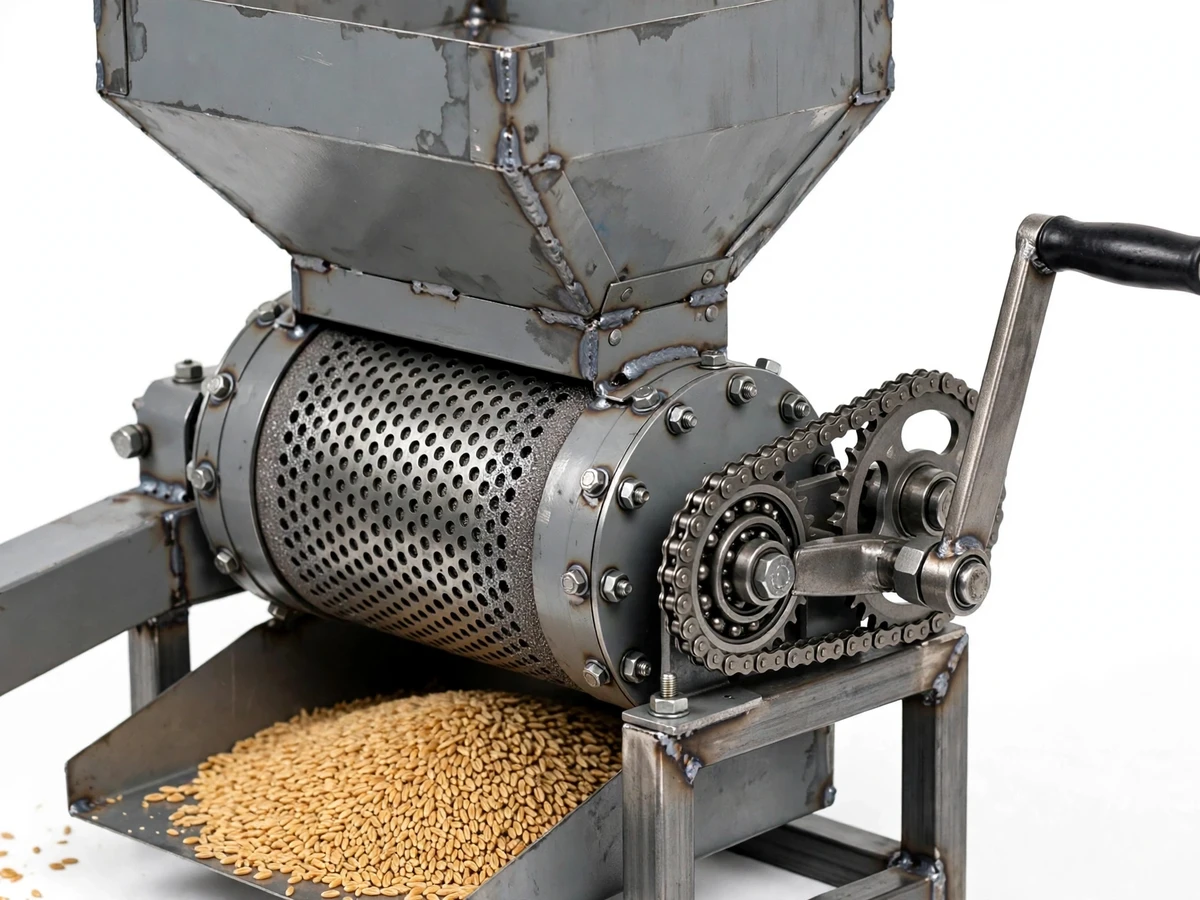
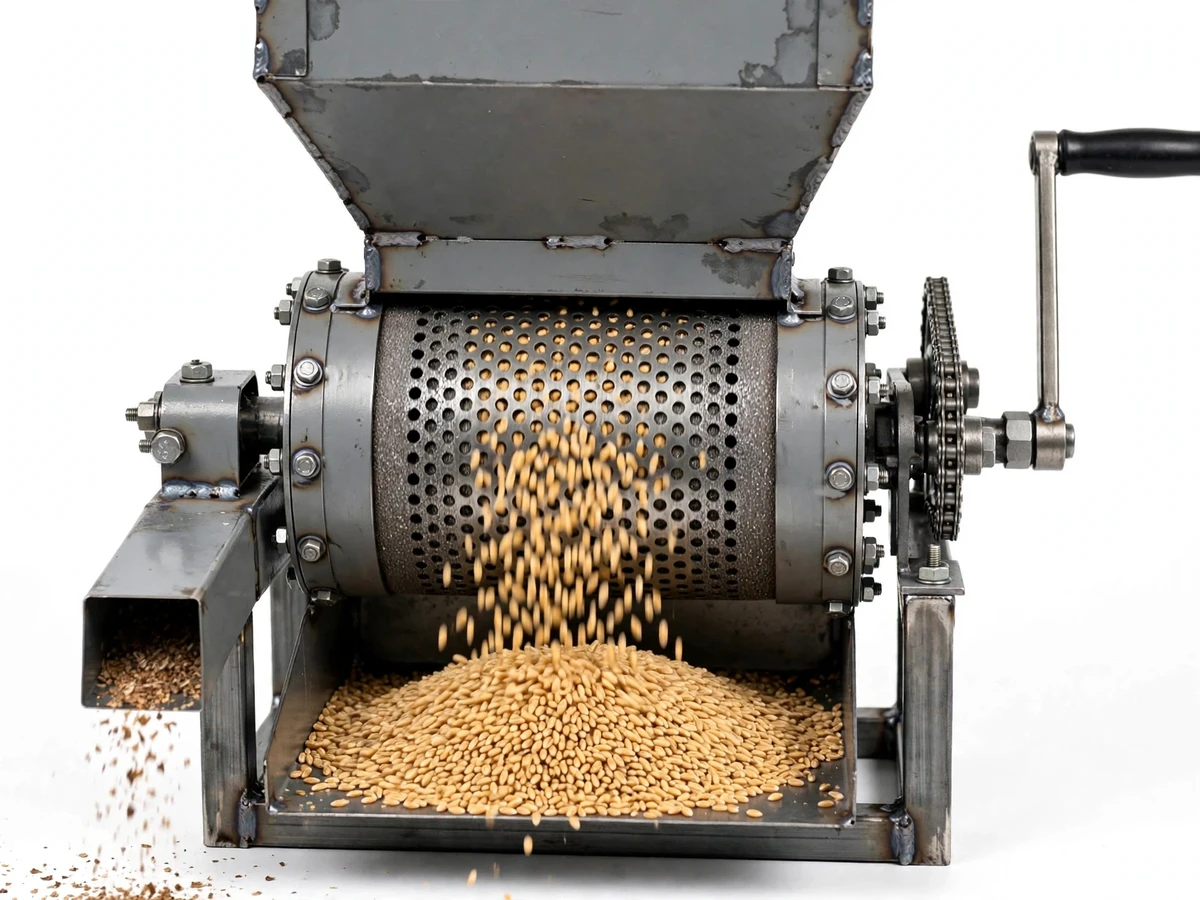
Small mills and farming households receive paddy and coarse grains carrying their bran layer, and polishing that grain by hand with a mortar or a flat stone is slow, uneven work that leaves broken kernels mixed with dust. The Hand-Cranked Grain Polisher Machine for Small Mills answers that gap with a hand-powered drum polisher that needs no electricity, no motor, and no fuel, so it can run in a courtyard or a small mill shed without a reliable power connection. Grain is poured into a top hopper and fed by gravity into a rotating abrasive drum, where friction against the drum surface and the perforated screen rubs the bran layer loose while the kernel itself stays intact. Polished grain leaves through one outlet and bran through a separate outlet, so the two streams do not need hand sorting afterwards. That separation turns a tiring chore into a repeatable bench process one operator can run and explain in a viva.
The operator sets clearance, fills the hopper and turns the crank.
Follow the working sequence
How it works
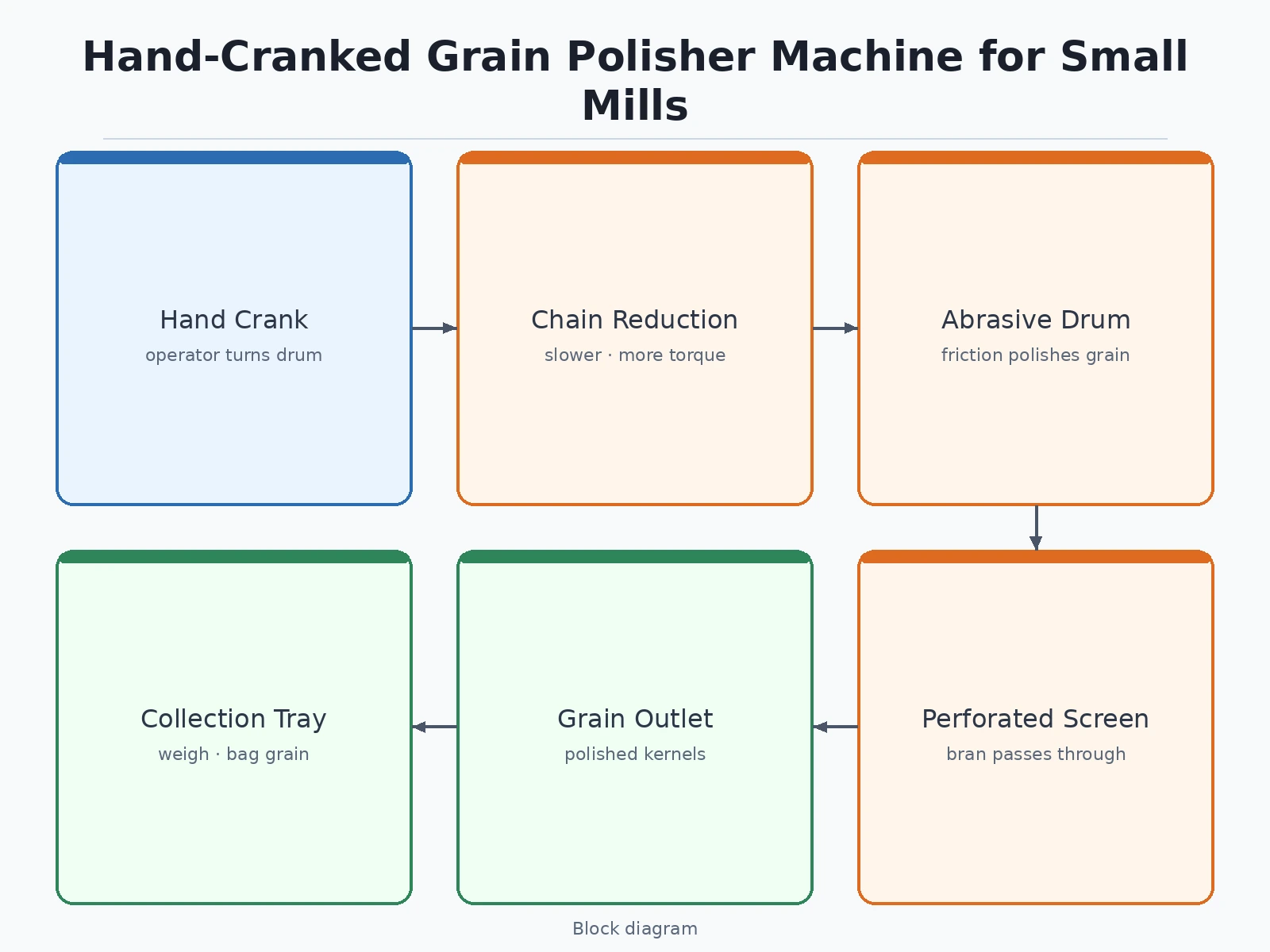
The Hand-Cranked Grain Polisher Machine for Small Mills works end to end as one visible loop: the operator pours grain into the hopper, turns the crank, and watches polishing, separation, and collection happen in sequence without any hidden stage. Turning the crank drives the drum through a chain reduction, so the drum turns slower than the crank but with more torque, and grain fed from the hopper tumbles against the abrasive drum surface and the perforated screen, which rubs the bran layer loose. Loosened bran passes through the screen perforations to its own outlet, while polished kernels travel on to the grain outlet and drop into the collection tray below. The operator controls the whole process by cranking speed and by feed rate, stopping to check polish quality, clear the screen, or adjust clearance before running the next batch.
- Check the drum clearance with a feeler gauge and set it just above the thickness of one kernel of the grain being polished, then close the hopper slide gate.
- Pour cleaned, dry grain into the top hopper and place the collection tray under the grain outlet and a container under the bran outlet.
- Open the slide gate a little to start a thin, steady feed, and begin turning the hand crank at a steady, comfortable pace.
- Grain enters the rotating drum and tumbles against the abrasive surface and the perforated screen, which rubs the bran layer loose from each kernel.
- Loosened bran falls through the screen perforations and out of the bran outlet, while polished kernels keep moving toward the grain outlet.
- Polished grain drops from the grain outlet into the collection tray, where the operator can see the finish and stop the feed at any time.
- Stop cranking, inspect a handful of polished grain for remaining bran and broken kernels, adjust the feed rate or clearance if needed, and repeat with the next batch.
Tech stack:
- Mild steel frame · welded fabrication
- Abrasive drum · perforated screen
- Hand crank · chain reduction drive
- Grain hopper · gravity feed
- Collection tray · bran separator
- Ball bearings · shaft mounting
- Painted steel finish · workshop prototype
- Feeler gauge setup · drum clearance check
| Parameter | Value |
|---|---|
| Polishing method | Friction against an abrasive drum and perforated screen (design target) |
| Drive | Hand crank with chain reduction · slower drum speed with higher torque (design target) |
| Crank speed | Approximately 60 rpm at the crank (design target, operator-dependent) |
| Drum clearance | Approximately 2–4 mm gap (design target, set above single-kernel thickness) |
| Grain handled | Paddy kernels approximately 6–10 mm long (variety-dependent) |
| Frame material | Mild steel · density 7.85 g/cm³ (standard datasheet value) |
| Feed | Gravity feed from a top hopper with a slide gate (design target) |
| Outputs | Polished grain outlet plus a separate bran outlet (design target) |
| Power | None · hand-powered only, no electricity or fuel (design target) |
| Throughput | Batch operation only · operator-dependent (design target, no measured throughput claimed) |
| Scale | Bench-scale machine for a small mill bench (design target) |
Project features
The Hand-Cranked Grain Polisher Machine for Small Mills is built around four working capabilities that a student can demonstrate one at a time: a rotating abrasive drum that polishes grain by friction, a hand crank with a chain reduction that keeps the drum turning steadily without a motor, separate outlets that keep polished grain and bran apart, and an adjustable drum clearance that lets the operator match the machine to the grain being polished. Around those four, the build adds a gravity-feed hopper that needs no feeder mechanism, a welded steel frame that holds the drum steady under cranking load, and a collection tray that catches the finished grain in one place. Together they make a complete small-mill process — feed, polish, separate, collect — with every stage visible and every part reachable for explanation, adjustment, and repair.
- [Abrasive polishing drum] A horizontal drum lined with an abrasive surface and a perforated screen tumbles grain against friction surfaces as it turns, rubbing the bran layer loose without grinding the kernel itself. Implemented in the base prototype.
- [Hand crank with chain reduction] A hand crank drives the drum through a chain and sprocket reduction, so the drum turns slower than the crank but with more torque, keeping the motion steady under a loaded drum. Implemented in the base prototype.
- [Separate grain and bran outlets] Polished kernels leave through the grain outlet into the collection tray while loosened bran passes through the screen perforations to its own outlet, so the two streams stay apart. Implemented in the base prototype.
- [Adjustable drum clearance] The gap between the drum and the screen can be set with a feeler gauge before a run, letting the operator match the machine to the grain being polished. Builder note from the actual build: a direct crank with no reduction feels heavy once the drum is loaded, and a clearance tighter than a single kernel thickness cracks kernels instead of polishing them, so the build keeps the reduction and sets clearance just above kernel thickness. Implemented in the base prototype.
- [Gravity-feed hopper] A sheet-metal hopper on top of the frame feeds grain into the drum by gravity alone, with a simple slide gate to start, slow, or stop the feed. Implemented in the base prototype.
- [Welded steel frame and bearings] A welded mild-steel frame carries the drum shaft on ball bearings, so the drum stays aligned and steady while the operator cranks. Implemented in the base prototype.
- [Collection tray] A tray under the grain outlet catches polished grain in one place for inspection, weighing, and bagging after each run. Implemented in the base prototype.
Optional on request (not in the base build): a motor drive in place of the hand crank, and interchangeable drums for different grain sizes. Future scope (not implemented): a sieve shaker for grading polished grain by size.
What is included
- Working prototype: welded steel frame, abrasive drum with perforated screen, hand crank with chain reduction, hopper, outlets, and collection tray, assembled and checked
- Fabrication drawings with the frame, drum, shaft, and hopper dimensions used in the build
- Component list with the exact parts used in the build
- Setup procedure: clearance setting with a feeler gauge, feed-rate adjustment, and screen cleaning
- Demonstration procedure: polishing a batch by hand, showing the separate grain and bran streams, and inspecting the finished grain
- Project report PDF (background, drum polishing principles, crank and chain drive, methodology, limitations)
- PPT presentation for final review
- Viva Q&A preparation document (friction polishing, chain reduction and torque, clearance and kernel breakage, bran separation)
Limitations & prerequisites
- Throughput is limited by hand power: this is a batch machine for small quantities, and polishing yield and polishing time are stated only as design targets, never as measured results, until the buyer runs timed batches on their own build.
- Polish quality depends on the operator: uneven cranking speed or too fast a feed leaves bran on some kernels, so the report must show the buyer's own inspection results rather than a claimed finish grade.
- One drum clearance suits one grain size at a time: switching between grains with very different kernel sizes needs the clearance to be reset and checked with a feeler gauge before the next run.
- Wet or uncleaned grain must not be fed: moisture clogs the screen perforations and stones or husk clumps can jam the drum, so grain must be cleaned and dried before polishing.
- The machine polishes only: it does not husk, grade, or sort grain by size, and any grading step is a separate process, not part of this build.
- The prototype is a bench demonstration: it is not a certified milling product, it carries no food-processing certification, and polished grain from a demonstration run is for inspection, not for sale as food.
Frequently Asked Questions
Is this project suitable for a final-year project?
Yes — this project fits Mechanical Engineering final-year work because it combines machine design, fabrication, transmission, and material handling in one build that a student can explain part by part in a viva, with the drum, crank, chain reduction, bearings, and frame each giving a separate design decision to defend. The polishing demonstration gives a visible result to show, and the report documents the student's own batch inspection.
How does hand cranking polish grain without a motor?
Turning the crank drives the drum through a chain reduction, so the operator's arm power becomes steady drum rotation with enough torque to turn a loaded drum, and grain inside tumbles against the abrasive surface and perforated screen, which rubs the bran layer loose kernel by kernel. No motor, electricity, or fuel is involved at any stage.
What grains can it polish, and what changes between grains?
The machine is set up for paddy and similar coarse grains whose kernels are in the same size range, and the main change between grains is the drum clearance, which the operator resets with a feeler gauge before running a trial batch. Grains much smaller or larger need a different drum or screen, which is a scope change, and a trial batch is checked for broken kernels before a full run.
Does it need electricity or fuel?
No — the machine is entirely hand-powered, which is the point of the design for small mills without a reliable power connection, and the crank, chain, drum, and gravity feed all work without any electrical supply, so the only running input is the operator's effort. That also means output depends directly on cranking pace, and throughput is stated only as a design target.
Can a motor be added later?
Yes, as a scope change, by replacing the hand crank with a motor and a suitable reduction, with guards added around the new drive, so the build, the safety guarding, and the demonstration story all change with it, and it is priced and built as an addition rather than included free. The report for a hand-cranked build must not claim motor performance.
What are the main limitations?
The main limitations are hand-powered throughput, operator-dependent polish quality, and one clearance setting per grain size at a time, plus the rule that wet or uncleaned grain clogs the screen and must not be fed, and the machine polishes only, without husking, grading, or sorting. The full limitations section states each limit plainly, and the report must carry the buyer's own batch results rather than claimed figures.
Components & software requirements
- Mild steel frame · welded fabrication
- Abrasive drum · perforated screen
- Hand crank · chain reduction drive
- Grain hopper · gravity feed
- Collection tray · bran separator
- Ball bearings · shaft mounting
- Painted steel finish · workshop prototype
- Feeler gauge setup · drum clearance check
Delivery information
Built-to-order project. Delivery timeline is shared after order confirmation based on current queue.
Support terms
Complete documentation, setup guide, and viva preparation included. Support for setup and explanation provided.
Download free synopsis (PDF)
Enter your name and WhatsApp number — the synopsis PDF downloads immediately. We may send occasional project updates on WhatsApp; no spam.