
More project photos (2)
The problem
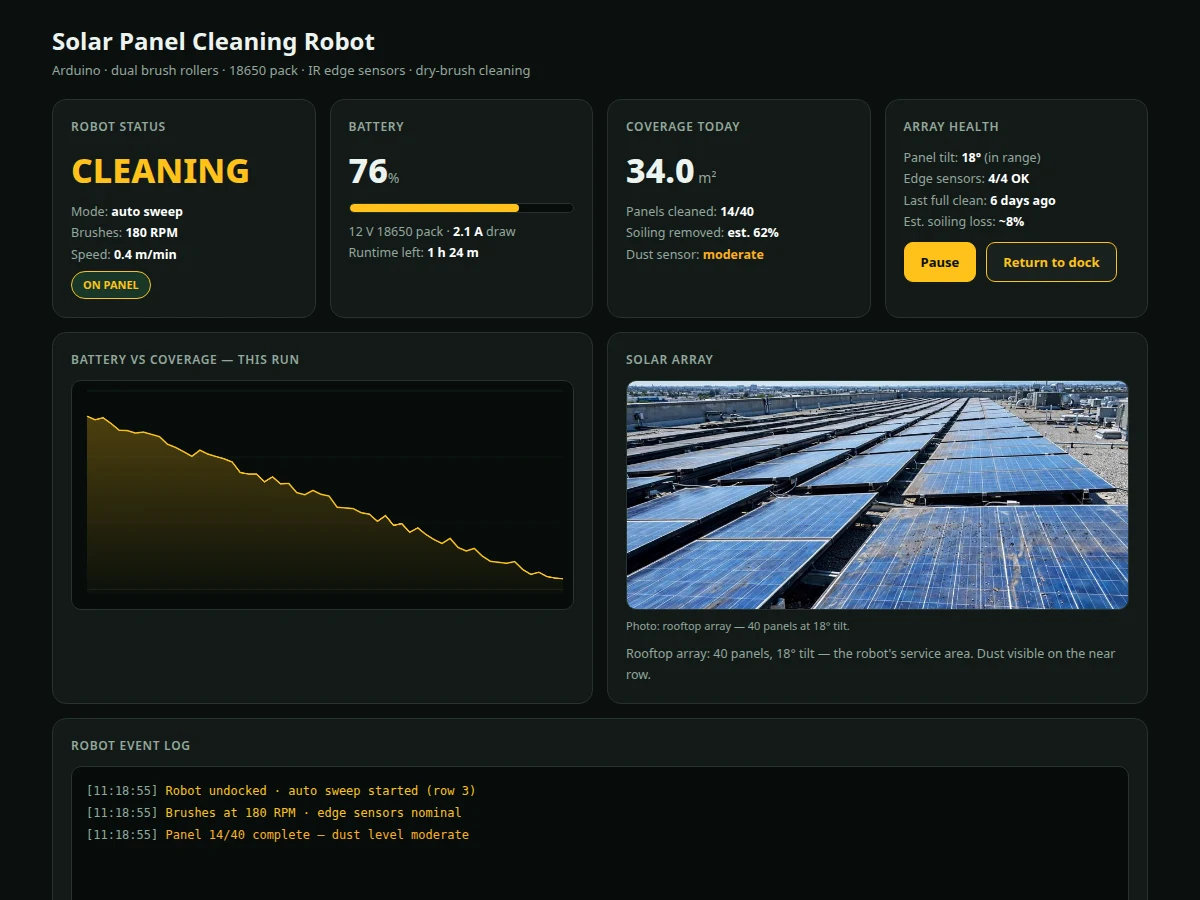
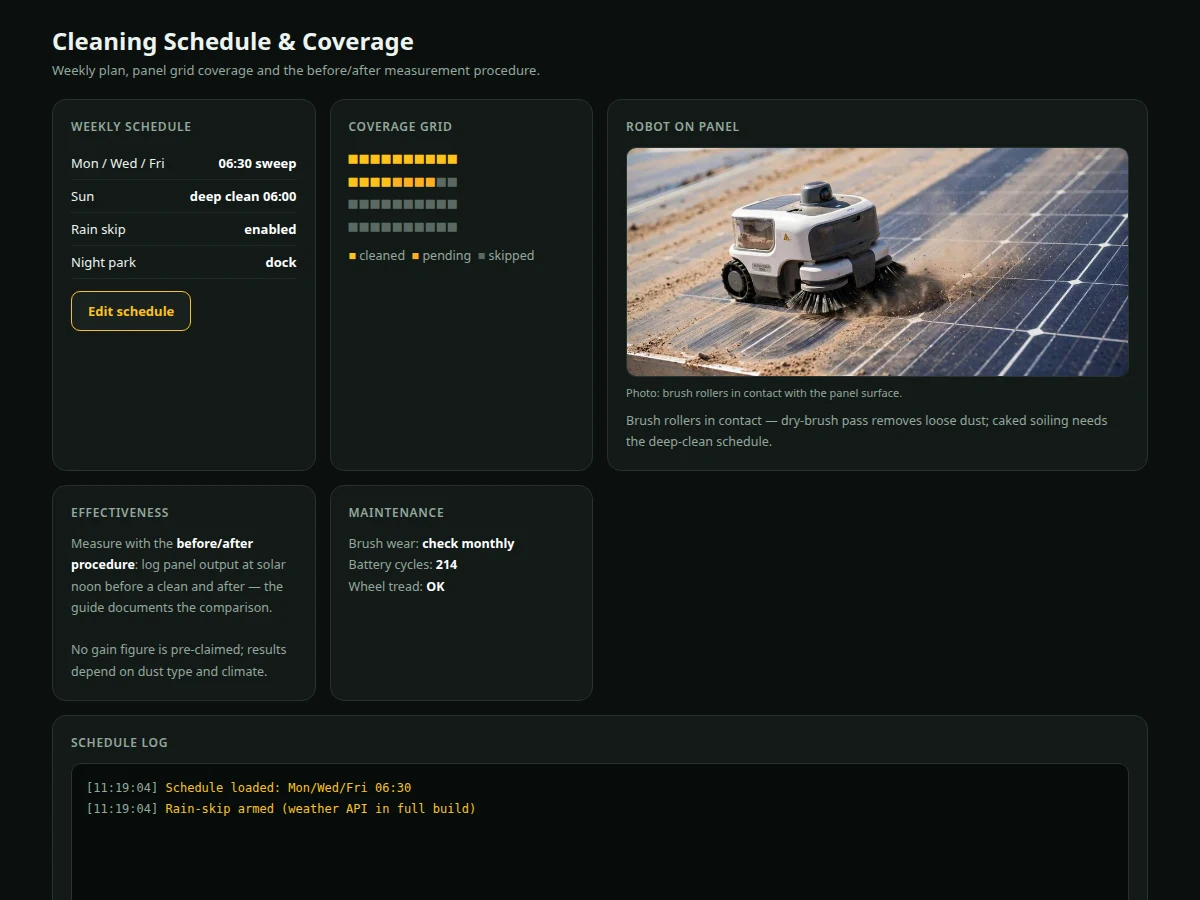
Dust is a quiet tax on solar power: in arid regions, soiling can shave a noticeable share off a rooftop array's output, and manual cleaning is labor nobody schedules. Water-based cleaning wastes water; a dry-brush robot that sweeps on a schedule is the low-maintenance answer — and a genuinely multidisciplinary student build. This robot is a four-wheeled chassis sized for standard ~1x2 m panels, carrying two counter-rotating brush rollers that sweep dust ahead of the drive wheels. An Arduino runs the show: timed sweep patterns (lawnmower passes along the panel), brush RPM control, and an IR edge-sensor array that stops and reverses the robot at panel edges and gaps. A 12 V pack of 18650 cells powers the drive and brushes with onboard voltage monitoring, and the robot returns to a dock at the array edge when the battery runs low or the schedule ends. The dashboard — the software half of this hybrid project — shows live status, battery with estimated runtime, cleaned area and panel count, a 40-panel coverage grid, the weekly schedule (with rain-skip) and the event log. Because dust type, humidity and panel tilt all change results, the report refuses to pre-claim a percentage gain; instead the measurement guide has the buyer log panel output before and after cleaning and compute their own number.
How it works
- On schedule (or manual start), the robot undocks and drives onto the first panel row at ~0.4 m/min with brushes spinning at ~180 RPM.
- The Arduino executes lawnmower passes: straight runs along the panel, 180° turns at row ends detected by the edge sensors.
- Each IR edge sensor watches for the panel edge or gap; any sensor losing the surface triggers a stop-and-reverse maneuver.
- Battery voltage is monitored continuously; at the low threshold the robot finishes its row and returns to the dock.
- Every pass, panel completion and sensor event is logged with timestamps to the dashboard's event log and coverage grid.
- The weekly schedule repeats the routine; rain-skip parks the robot until the next dry window.
- The buyer runs the before/after measurement procedure and records the verified cleaning gain in the report.
Tech stack:
- 4-wheel robot chassis with dual brush rollers (DC gear motors)
- Arduino Uno/Nano (drive firmware: patterns, edge logic, scheduling)
- 4x IR edge sensors, 12 V 18650 battery pack with BMS
- L298N / TB6612 motor drivers for drive and brushes
- Single-file HTML/CSS/JS dashboard (status, battery, coverage grid, schedule, log)
| Parameter | Value |
|---|---|
| Chassis | 4-wheel, sized for ~1 x 2 m standard panels |
| Brushes | Dual counter-rotating soft-bristle rollers, ~180 RPM |
| Drive speed | ~0.4 m/min sweep speed (design target) |
| Controller | Arduino (Uno/Nano), L298N/TB6612 drivers |
| Edge sensing | 4x downward IR sensors, stop-and-reverse at edges/gaps |
| Battery | 12 V 18650 pack with BMS; runtime design target ~2 h per charge |
| Panel tilt range | 10–30 degrees (documented operating envelope) |
| Scheduling | Weekly plan, rain-skip, dock parking |
| Cleaning gain | Measured by buyer via before/after procedure — never pre-claimed |
| Dashboard | Status, battery, coverage grid, schedule, event log |
Project features
- [Dual brush-roller cleaning head] Two counter-rotating soft-bristle rollers sweep loose dust ahead of the drive wheels; brush pressure is set by the suspension geometry.
- [Arduino sweep firmware] Lawnmower pass patterns along the panel, brush RPM control, turn-at-edge logic and dock-return behavior.
- [IR edge-sensor array] Four downward IR sensors detect panel edges and inter-panel gaps, stopping and reversing before a drop.
- [18650 battery system] 12 V pack with voltage monitoring, runtime estimation and low-battery dock return.
- [Weekly cleaning schedule] Configurable sweep days and times with rain-skip logic and night parking at the dock.
- [Robot dashboard] Live status, battery gauge, cleaned area and panel count, coverage grid, schedule editor and timestamped event log.
- [Before/after measurement procedure] Documented buyer-run method: log panel output at solar noon before and after a clean, then compute the gain yourself.
What is included
- Complete cleaning robot (chassis, brush rollers, drive, sensors, battery), assembled and tested
- Arduino firmware (sweep patterns, edge logic, battery management, scheduling)
- Robot dashboard web app (status, battery, coverage grid, schedule editor, log)
- Assembly manual and wiring diagram (motor drivers, sensor placement, battery pack)
- Before/after measurement guide (panel-output comparison procedure)
- Project report PDF (background, mechanical design, control logic, buyer-run effectiveness measurement)
- PPT presentation for final review
- Viva Q&A preparation document (DC motors, IR sensing, battery management, scheduling, soiling)
- Setup guide (panel compatibility check, dock placement, first sweep)
Limitations & prerequisites
- Dry brushing removes loose dust only — caked soiling, bird droppings and sticky residues need manual cleaning; the report documents this boundary plainly.
- No cleaning-gain percentage is pre-claimed: results depend on dust type, humidity, tilt and climate, so the buyer measures their own with the documented procedure.
- Operating envelope is 10–30° panel tilt on standard framed panels; flat roofs, steep arrays and frameless glass are outside it.
- The robot parks during rain — wet glass plus electronics is a combination the design avoids by policy, not by waterproofing.
- Brush bristles wear with use; the maintenance guide documents inspection and replacement intervals.
- Very dusty environments may need multiple passes or a deep-clean schedule; the dashboard's dust-level indicator guides the frequency.
Frequently Asked Questions
How does the robot clean?
Dual counter-rotating brush rollers sweep loose dust off the panel glass as the robot drives lawnmower passes at ~0.4 m/min; IR edge sensors keep it on the panel.
How much does panel output improve?
That is measured, not claimed: the guide has you log panel output at solar noon before and after a clean and compute your own gain — dust type and climate change the number too much to pre-print one.
What powers it, and for how long?
A 12 V 18650 pack with BMS; the design target is ~2 hours of sweeping per charge, with low-battery dock return handled by the firmware.
What if it reaches the panel edge?
Four downward IR sensors detect edges and gaps; the firmware stops and reverses before any drop. The 10–30° tilt envelope is part of the same safety design.
Does it work in rain?
No — rain-skip parks it at the dock. The build is not waterproofed; avoiding wet operation is a deliberate design rule.
Is this project suitable for a final-year project?
Yes — for Mechanical, Mechatronics and Electrical programs. It demonstrates mobile-robot kinematics, sensor-based edge safety, battery management, scheduling and honest effectiveness measurement, all strong viva material. Suitable for B.E./B.Tech final-year projects in Mechanical, Mechatronics and Electrical.
Components & software requirements
- 4-wheel robot chassis with dual brush rollers (DC gear motors)
- Arduino Uno/Nano (drive firmware: patterns, edge logic, scheduling)
- 4x IR edge sensors, 12 V 18650 battery pack with BMS
- L298N / TB6612 motor drivers for drive and brushes
- Single-file HTML/CSS/JS dashboard (status, battery, coverage grid, schedule, log)
Delivery information
Built-to-order project. Delivery timeline is shared after order confirmation based on current queue.
Support terms
Complete documentation, setup guide, and viva preparation included. Support for setup and explanation provided.