
More project photos (3)

The problem
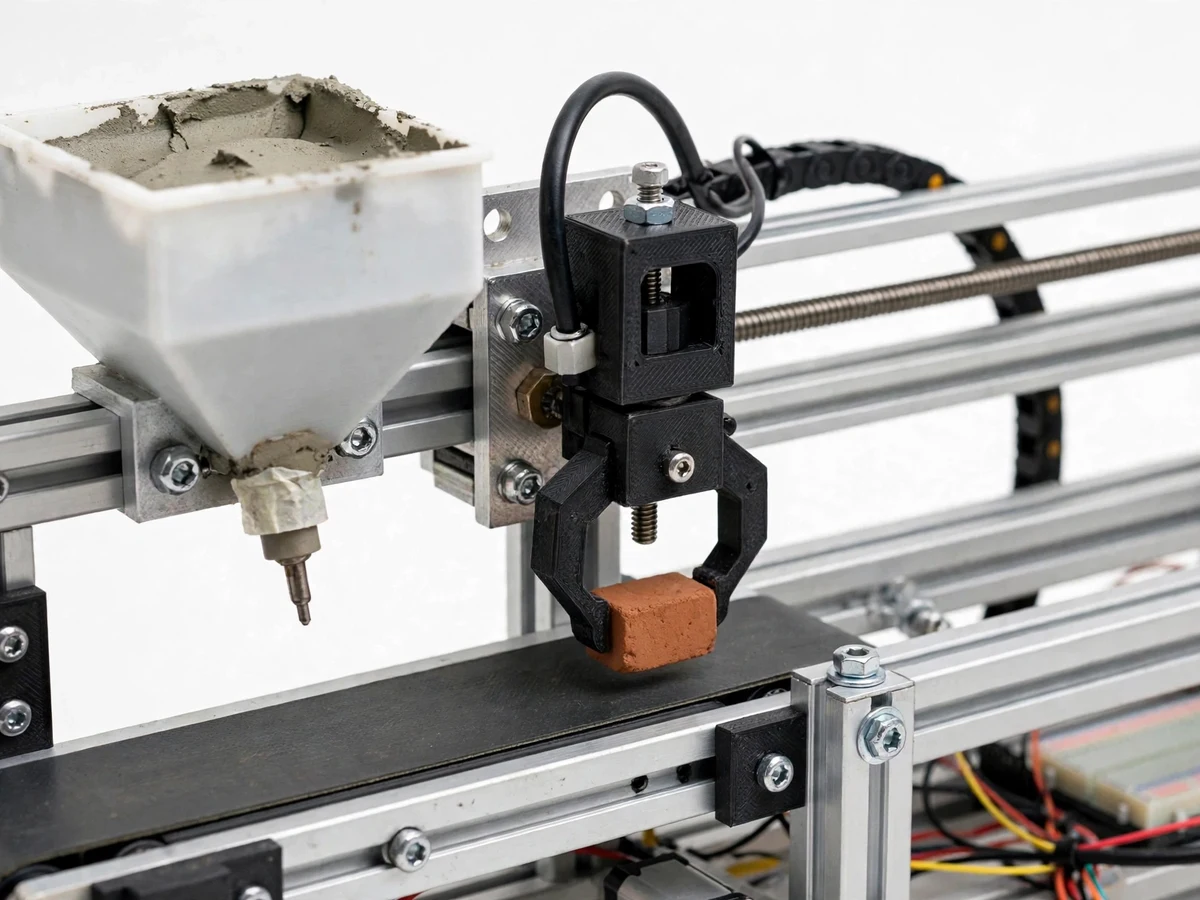
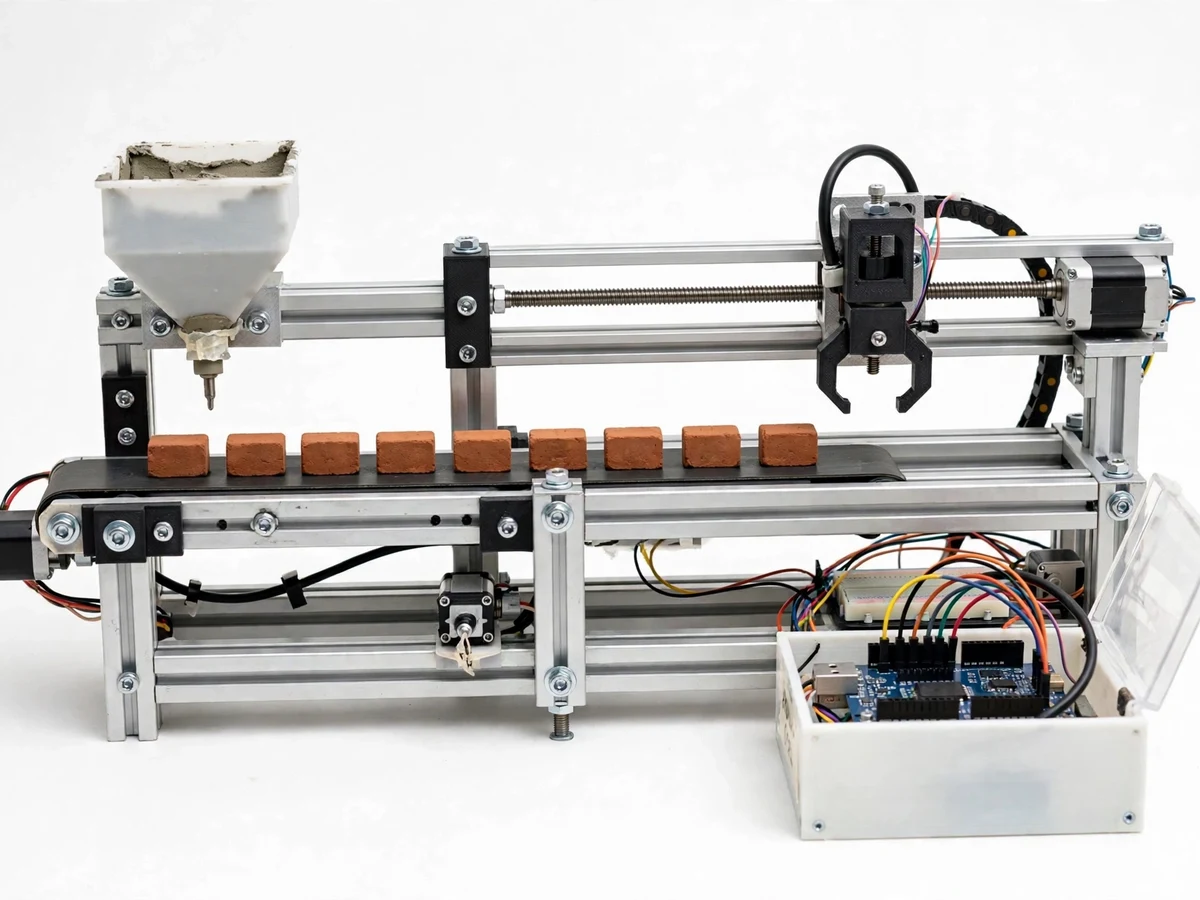
Bricklaying is repetitive, physically demanding work, and construction automation is moving it toward machines — but a real bricklaying robot is far beyond a student budget. The engineering, however, scales down beautifully: feeding, mortar application and precise placement are the same three operations at any size. This project builds a tabletop machine that performs all three. A belt conveyor brings miniature clay bricks one at a time to the pick station; a hopper with a controlled valve lays a bead of mortar simulant; and a gantry gripper on stepper-driven axes picks each brick and places it in a straight course on the laying bed. An Arduino sequences the whole cycle with limit-switch homing, demonstrating coordinated multi-axis automation on a genuine construction process.
Coordinates the conveyor, hopper valve and two-axis gantry with limit-switch homing.
Follow the working sequence
How it works
- At startup, the gantry homes both axes against their limit switches, establishing the machine coordinate reference.
- The conveyor indexes one miniature brick into the pick station, detected by an IR sensor.
- The hopper valve opens briefly, laying a bead of mortar simulant on the laying bed at the target position.
- The gantry moves to the pick position, the gripper closes on the brick, and the Z axis lifts it clear.
- The gantry traverses to the course position and lowers the brick onto the mortar bead; the gripper releases.
- The cycle repeats, placing brick after brick in a straight course; the LCD counts completed bricks.
- When the course length is reached, the machine parks the gantry and signals completion — the standard demo endpoint.
Tech stack:
- Arduino Uno (sequence controller)
- NEMA-17-class stepper motors + drivers
- Lead-screw X/Z gantry
- Servo gripper
- Belt conveyor + DC gear motor
- IR brick detection + limit switches
- Mortar hopper + solenoid valve
- 16x2 LCD status display
| Parameter | Value |
|---|---|
| Controller | Arduino Uno (ATmega328P) — datasheet |
| Axes | X + Z gantry on lead screws, stepper driven (prototype) |
| Brick size | Miniature clay bricks, approximately 60x30x20 mm (prototype) |
| Course length | Configurable; default 8 bricks (firmware) |
| Cycle time | Approximately 25–35 s per brick (expected) |
| Homing | Limit switches on both axes (implemented) |
| Mortar | Gravity hopper + solenoid valve, simulant bead (prototype) |
| Power | 12 V DC steppers/conveyor + 5 V logic (design) |
| Machine size | Approximately 80 cm tabletop (prototype) |
Project features
- [Three-stage masonry cycle] Conveyor feed, mortar dispensing and gantry placement sequenced automatically — the complete bricklaying process at model scale.
- [Stepper-driven gantry] X and Z axes on lead screws with stepper motors give repeatable pick-and-place positioning with limit-switch homing.
- [Mortar hopper with valve control] A gravity hopper dispenses a controlled bead of mortar simulant ahead of each brick, demonstrating the dispensing operation.
- [Gripper end-effector] A servo-actuated gripper picks bricks reliably from the conveyor and releases them precisely on the course.
- [Course programming] The firmware lays straight courses of configurable length; the pattern logic is extensible to staggered bonds in the report's future scope.
- [Limit-switch homing] Every axis homes to a known reference at startup, teaching the calibration discipline real automation needs.
- [Cycle counter and status display] An LCD shows bricks laid, current stage and fault states for the operator.
What is included
- Brick-laying machine (assembled: conveyor, hopper, gantry, gripper)
- Arduino control electronics (programmed)
- Complete sequencing firmware source code
- Wiring diagram and mechanical assembly guide
- Axis calibration and homing procedure
- Mortar-simulant mixing and loading guide
- Miniature brick set for demonstration
- Project report PDF (background, automation design, sequencing, results)
- PPT presentation for final review
- Viva Q&A preparation document (steppers, homing, sequencing)
Limitations & prerequisites
- This is a tabletop model using miniature bricks and mortar simulant — not a construction-site machine; the report states the scale gap plainly.
- Real mortar chemistry (setting time, workability) is out of scope; the simulant demonstrates the dispensing operation only.
- Placement accuracy is approximately ±2 mm (expected), fine for the model but not real masonry tolerances.
- The machine lays straight courses; staggered bonds and corners are discussed as future scope, not implemented.
- Mortar simulant needs fresh mixing per demo session; the guide covers the recipe and cleanup honestly.
- Cycle time of approximately 25–35 s per brick suits demonstration, not production rates.
Frequently Asked Questions
How does the machine know where to place each brick?
The gantry homes to limit switches at startup, establishing a fixed coordinate reference. The firmware then computes each course position from the brick dimensions — deterministic positioning, the same principle real automation uses.
What is the mortar made of?
A mortar simulant (a simple paste per the included recipe) that demonstrates the dispensing operation. Real mortar chemistry and setting behavior are out of scope and the report says so.
How does the gripper hold the bricks?
A servo-actuated two-finger gripper sized for the miniature bricks, with the closing force tuned to hold firmly without crushing the clay.
Can it lay patterns like a real wall?
The firmware lays straight courses of configurable length. Staggered (English/Flemish) bonds are worked out as future scope in the report — the pattern logic extends naturally.
What happens if a brick is missing on the conveyor?
The IR pick sensor detects the missing brick, the cycle pauses, and the LCD shows the fault state until the operator clears it — basic fault handling is implemented.
Is this project suitable for a final-year project?
Yes — for Mechanical, Electronics and Electrical programs. It demonstrates multi-axis automation, sequencing and process thinking on a real construction operation. Suitable for B.E./B.Tech final-year projects in Mechanical, Electronics and Electrical.
Components & software requirements
- Arduino Uno (sequence controller)
- NEMA-17-class stepper motors + drivers
- Lead-screw X/Z gantry
- Servo gripper
- Belt conveyor + DC gear motor
- IR brick detection + limit switches
- Mortar hopper + solenoid valve
- 16x2 LCD status display
Delivery information
Built-to-order project. Delivery timeline is shared after order confirmation based on current queue.
Support terms
Complete documentation, setup guide, and viva preparation included. Support for setup and explanation provided.
Download free synopsis (PDF)
Enter your name and WhatsApp number — the synopsis PDF downloads immediately. We may send occasional project updates on WhatsApp; no spam.