
More project photos (2)
The problem
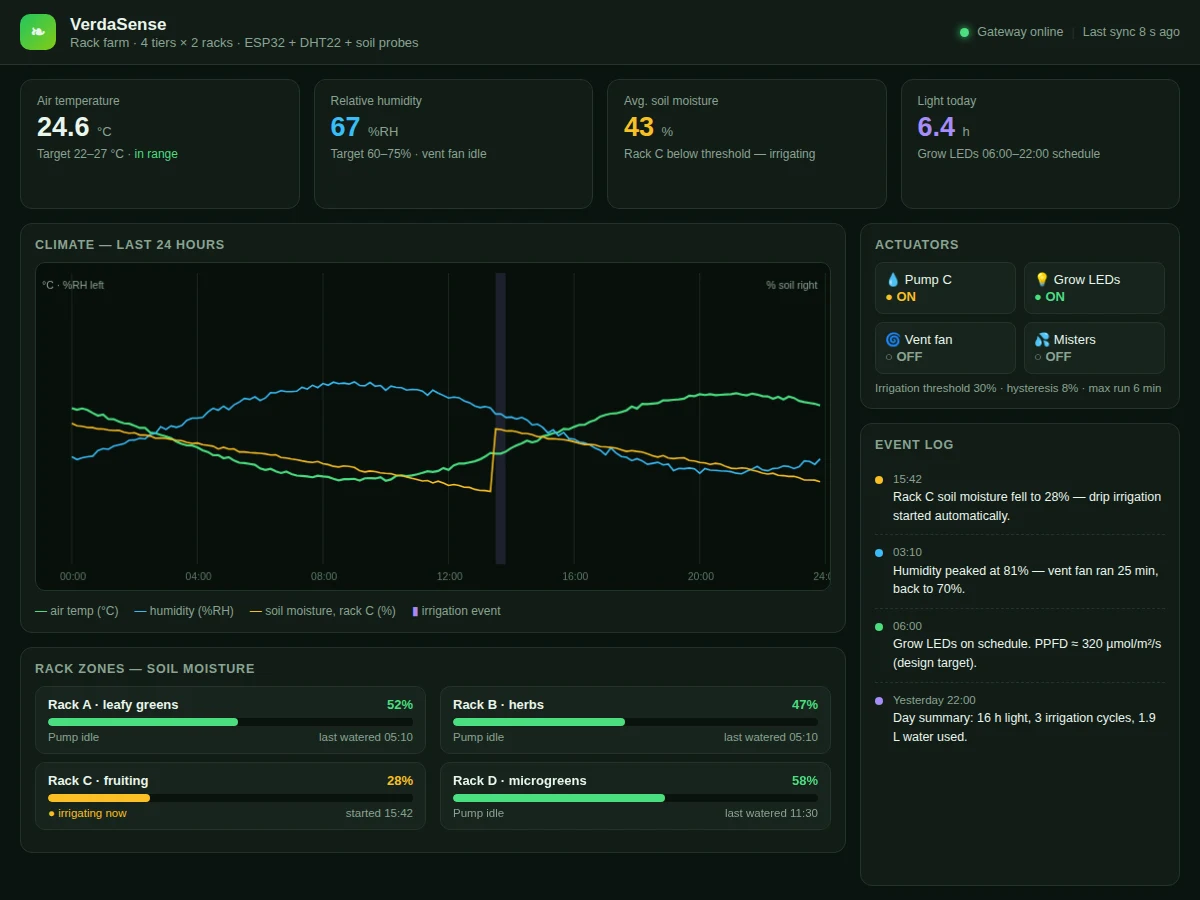
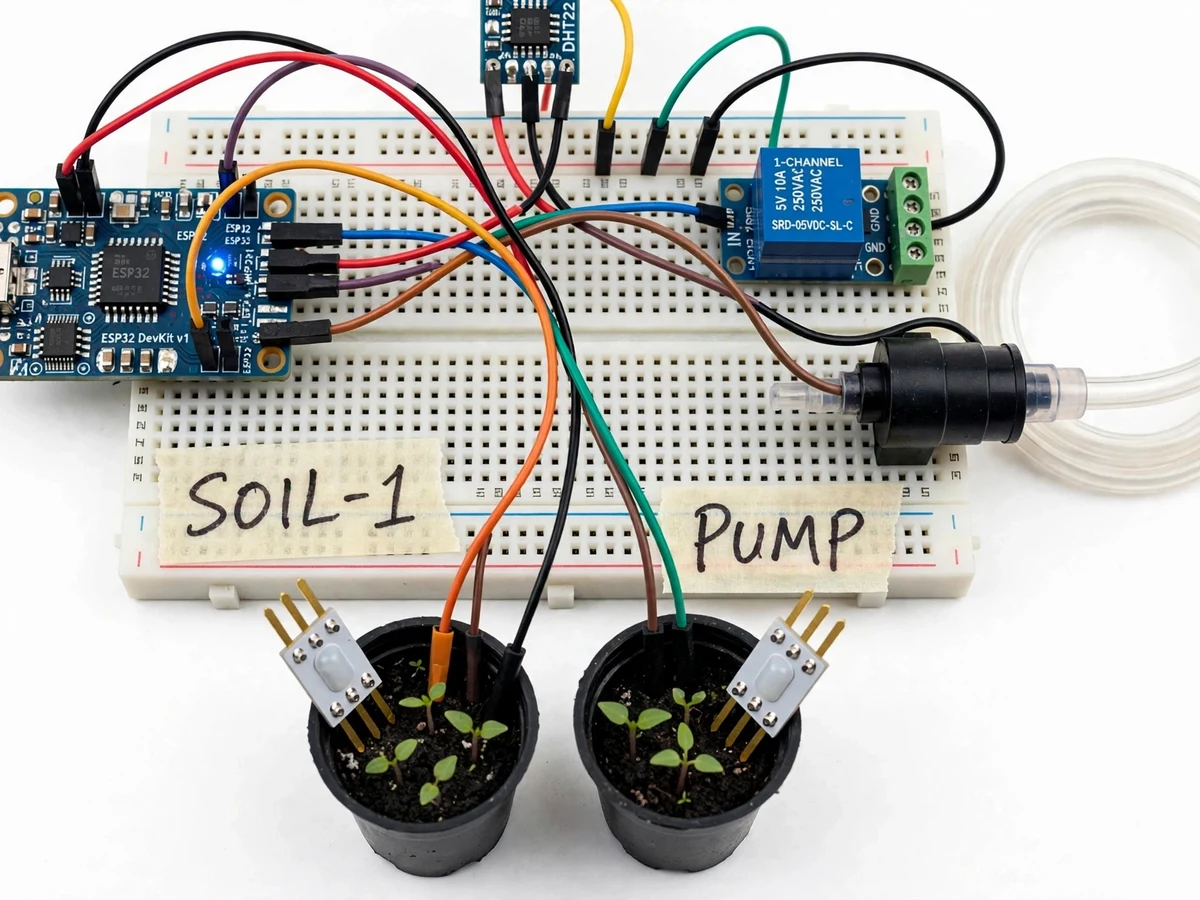
Vertical and indoor farms promise year-round growing, but small rack setups fail for boring reasons: one zone dries out while another stays soggy, humidity spikes invite fungus, and grow lights run on a plug-in timer nobody checks. The result is uneven crops and wasted water. This project gives a rack farm a nervous system. An ESP32 DevKit reads a DHT22 for air temperature and humidity and soil-moisture probes in each rack zone, then automates the responses: a mini pump waters any zone whose moisture falls below 30% (with 8% hysteresis and a 6-minute max run), a vent fan clears humidity peaks, grow LEDs follow a 06:00–22:00 schedule, and misters handle dry-air events. The VerdaSense dashboard shows the 24-hour climate curves, per-rack moisture bars, actuator states, and an event log — e.g. "Rack C soil moisture fell to 28% — drip irrigation started automatically" and "Humidity peaked at 81% — vent fan ran 25 min, back to 70%."
How it works
- The ESP32 polls the DHT22 (air temp/RH) and each zone's capacitive soil-moisture probe on a fixed schedule; readings are smoothed before decisions.
- When a zone's moisture falls below the 30% irrigation threshold, the ESP32 energises the pump relay for that zone; it stops at threshold + 8% hysteresis or after 6 minutes, whichever comes first.
- Grow LEDs switch on the 06:00–22:00 schedule via a relay; the dashboard shows scheduled light hours and the PPFD design target for the lighting plan.
- If humidity rises above the high band, the vent fan runs until humidity returns to the target band; misters engage on low-humidity events.
- All readings, actuator states and events stream to the dashboard: 24-hour climate curves, per-rack moisture bars, actuator panel and a timestamped event log.
- The demo app's event log narrates automation decisions (irrigation starts, fan runs, LED schedule) so the control logic is auditable.
Tech stack:
- ESP32 DevKit firmware
- DHT22 (temperature + humidity)
- Capacitive soil-moisture probes
- 5 V relay module + mini DC pump
- Grow LEDs (scheduled)
- Vent fan + misters
- Cloud dashboard (24-h curves, zones, events)
- MQTT/HTTP telemetry
| Parameter | Value |
|---|---|
| Controller | ESP32 DevKit v1 |
| Climate sensor | DHT22 (datasheet ±0.5°C, ±2–5% RH — indicative) |
| Soil sensing | Capacitive probes, one per rack zone (4 zones in demo) |
| Irrigation | Threshold 30%, hysteresis 8%, max run 6 min (configurable) |
| Grow lights | 06:00–22:00 schedule; PPFD 320 µmol/m²/s (design target) |
| Actuators | Pump, vent fan, grow LEDs, misters via relay |
| Dashboard | 24-h climate curves, zone moisture, actuators, event log |
| Water tracking | Day-summary irrigation cycles + litres (design behavior) |
Project features
- [Per-zone soil moisture] Capacitive probes in each rack zone; the dashboard tracks Rack A (leafy greens), B (herbs), C (fruiting) and D (microgreens) independently.
- [Automatic irrigation] Pump runs when a zone falls below the 30% threshold, with 8% hysteresis and a 6-minute maximum run to prevent flooding.
- [Climate sensing] DHT22 reports air temperature and humidity; targets 22–27°C and 60–75% RH are shown on the dashboard with in/out-of-range flags.
- [Grow-light scheduling] Grow LEDs follow a 06:00–22:00 schedule with a 320 µmol/m²/s PPFD design target for the lighting plan.
- [Vent fan & misters] The fan clears humidity peaks automatically; misters counter dry-air events — both visible as actuator states with event-log entries.
- [24-hour climate curves] Air temp, humidity and rack soil moisture plotted together with irrigation-event markers, so watering responses are visible in context.
- [Day summaries] The event log rolls up light hours, irrigation cycles and water used (demo: 16 h light, 3 cycles, 1.9 L).
What is included
- Complete ESP32 prototype (DHT22, soil probes, pump, relay, wiring diagram)
- Automation firmware (irrigation, fan, LED schedule, telemetry)
- Rack dashboard (climate curves, zone moisture, event log)
- Calibration guide (moisture threshold tuning per crop, PPFD notes)
- Project report PDF (background, controlled-environment theory, methodology)
- PPT presentation for final review
- Viva Q&A preparation document (DHT22, capacitive sensing, hysteresis, relays)
Limitations & prerequisites
- The DHT22 is an indicative sensor (±0.5°C / ±2–5% RH per datasheet); the build is a teaching automation rig, not a certified climate controller — stated as design targets, not measured claims.
- The dashboard figures (irrigation events, 1.9 L water, humidity responses) are illustrative simulation data from the demo app, not measurements from a built farm.
- Capacitive probe readings depend on soil mix and need per-crop threshold calibration; the 30% threshold is a starting point, not a universal value.
- The 320 µmol/m²/s PPFD is a design target for the lighting plan; actual PPFD depends on the LED hardware chosen and was not measured.
- The mini pump and relay suit a demo rack; a production farm needs rated pumps, contactors and electrical safety review.
Frequently Asked Questions
What does it automate?
Drip irrigation per rack zone (below 30% moisture), grow-LED scheduling (06:00–22:00), vent-fan runs on humidity peaks, and mister events on dry air — all with hysteresis so actuators don't chatter.
Why per-zone moisture instead of one sensor?
Different crops drink differently — leafy greens, herbs, fruiting plants and microgreens sit at different moisture levels in the demo, and watering the whole rack when only one zone is dry wastes water.
How is flooding prevented?
Each irrigation run stops at threshold + 8% hysteresis or after 6 minutes maximum, whichever comes first; the event log records every run.
What is PPFD and why 320?
Photosynthetic photon flux density — the light plants actually use. 320 µmol/m²/s is a typical design target for leafy greens; the actual figure depends on the LED hardware used.
Can it run without the internet?
Yes — the ESP32 runs all automation locally on its schedule and thresholds. The dashboard needs connectivity, but the farm keeps watering on its own.
Is this project suitable for a final-year project?
Yes — for IoT & Embedded, Electronics and Computer Science programs. It combines multi-sensor interfacing, closed-loop automation with hysteresis, and a real application (urban/vertical farming) in one build. Suitable for B.E./B.Tech final-year projects in IoT & Embedded Systems, Electronics and Computer Science.
Components & software requirements
- ESP32 DevKit firmware
- DHT22 (temperature + humidity)
- Capacitive soil-moisture probes
- 5 V relay module + mini DC pump
- Grow LEDs (scheduled)
- Vent fan + misters
- Cloud dashboard (24-h curves, zones, events)
- MQTT/HTTP telemetry
Delivery information
Built-to-order project. Delivery timeline is shared after order confirmation based on current queue.
Support terms
Complete documentation, setup guide, and viva preparation included. Support for setup and explanation provided.