
More project photos (5)
The problem
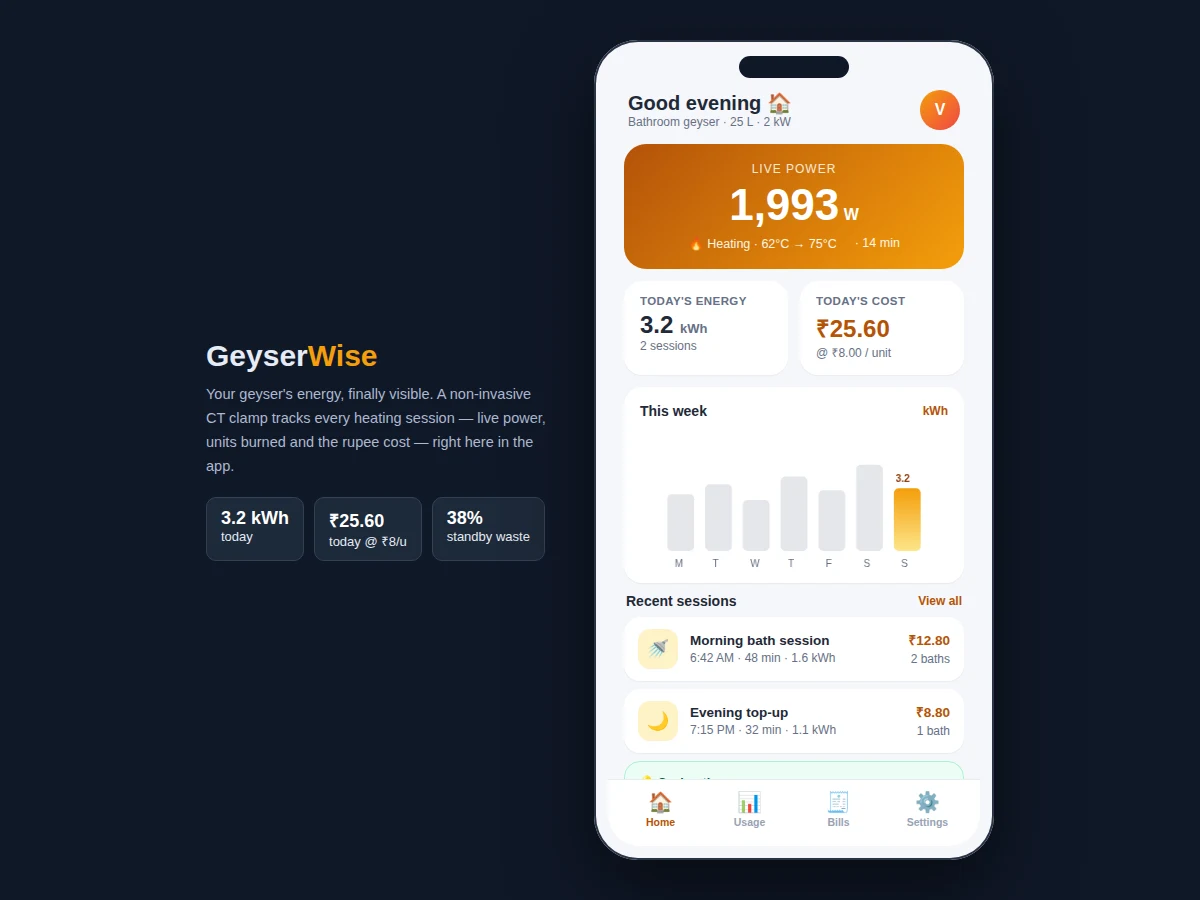
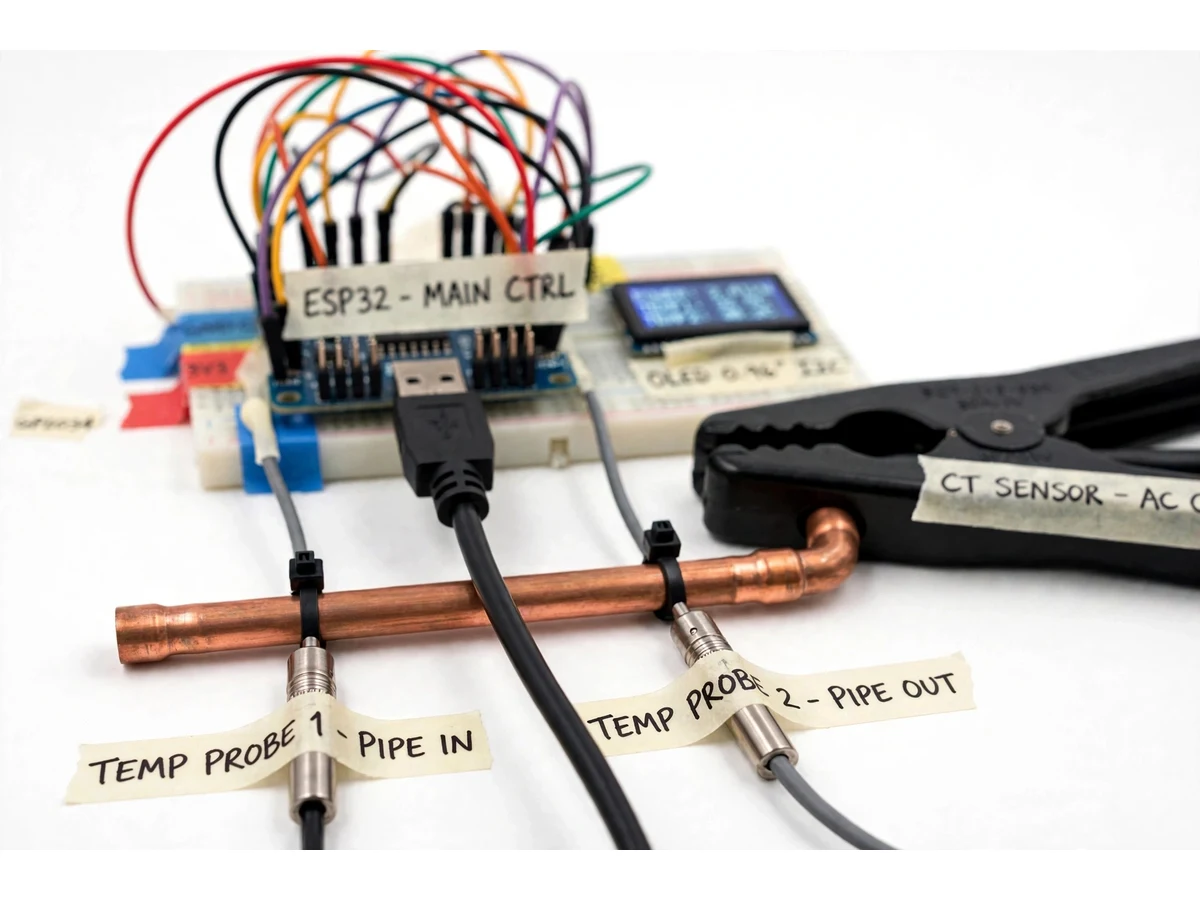
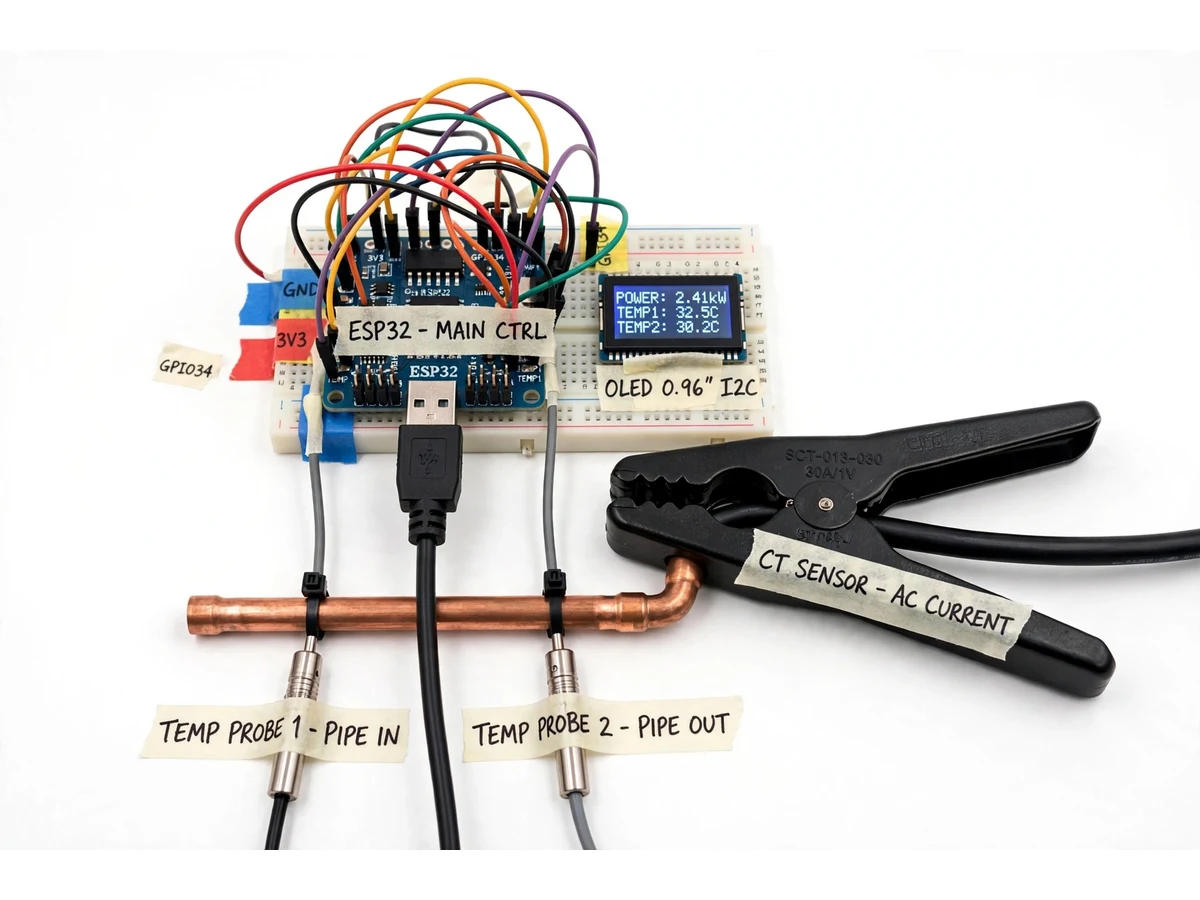
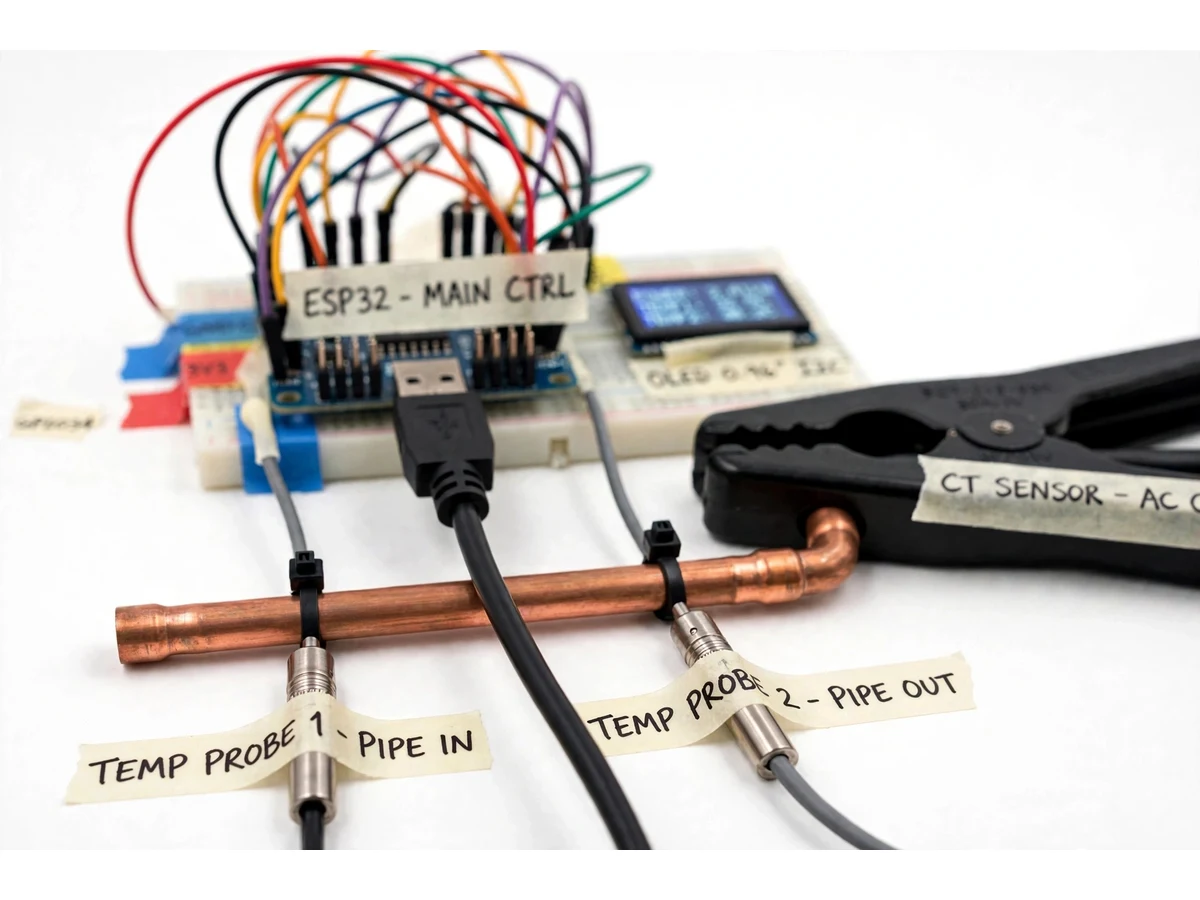
Electric geysers heat water brilliantly and waste energy quietly. The element cycles on a thermostat, and a geyser left switched on reheats the tank all day to cover standby losses — energy that buys nobody a hot bath. Because the consumption is invisible, families cannot answer the simplest questions: how many units did the geyser use today, what does one bath cost, would a timer actually save money? This project makes it visible without touching a single wire: a split-core CT clamp around the geyser's supply cable measures current non-invasively, DS18B20 sensors watch inlet and outlet water temperature, and an ESP32 detects heating sessions from the current signature, integrates power over time into kWh, and multiplies by the user's tariff for the rupee figure. A mobile-style app dashboard presents live power, today's energy and cost, a session log with per-session units, weekly bar charts and an estimated standby-loss share. The student gets both the sensing hardware and a genuinely working app demo.
How it works
- A split-core CT clamp is clipped around the geyser's supply cable and DS18B20 probes are strapped at the inlet and outlet — no mains wiring is disturbed.
- The ESP32 samples current, computes RMS power (using the configured mains voltage), and watches the current signature to mark session start/end.
- Energy per session is integrated (power × time) into kWh and converted to rupees at the configured tariff; standby reheat cycles are tagged separately.
- Every 30 seconds the node publishes live power, temperatures and session events over Wi-Fi (MQTT/HTTP) to the app backend.
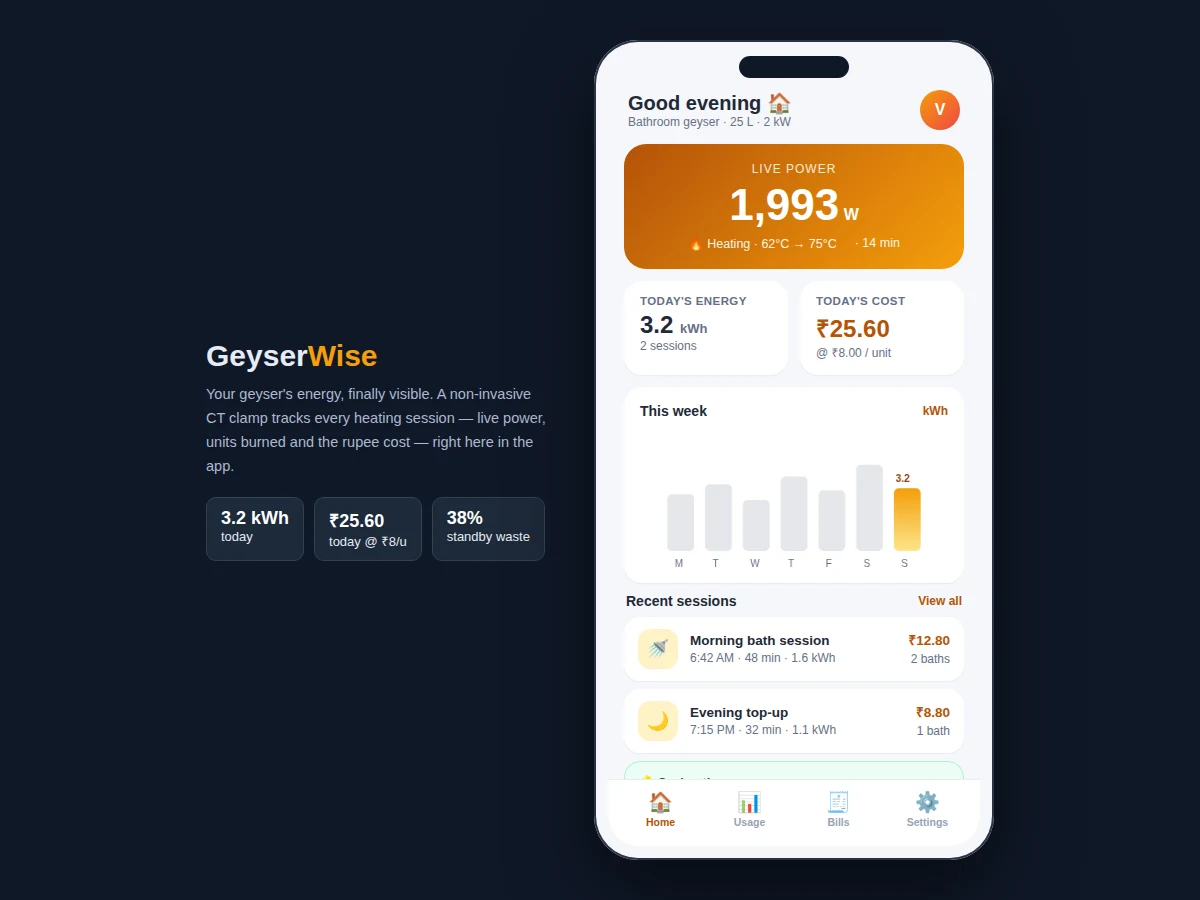
- The app dashboard renders the live power dial, today's units and cost, the session log, weekly consumption bars and the standby-loss share.
- The student commissions the unit with the included procedure: verify the power reading against the geyser's rating plate, run a known session, and document the measured energy in the report.
Tech stack:
- ESP32 (sensing + Wi-Fi telemetry)
- SCT-013 split-core current transformer
- DS18B20 waterproof temperature sensors
- MQTT/HTTP telemetry
- Mobile-style app dashboard (HTML/CSS/JS demo included)
- Arduino IDE (C/C++ firmware)
- 5 V USB power for the node
| Parameter | Value |
|---|---|
| Current sensing | SCT-013 CT clamp, non-invasive (datasheet) |
| Power computation | RMS current × configured mains voltage (design) |
| Energy resolution | Session-level kWh integration (design) |
| Telemetry interval | 30 seconds + session events (design) |
| Cost conversion | Configurable ₹/unit tariff |
| Temperature sensing | DS18B20 inlet/outlet, ±0.5 °C (datasheet) |
| App views | Live, sessions, weekly charts, settings |
| Power | 5 V USB adapter |
Project features
- [Non-invasive energy metering] A split-core CT clamp measures geyser current without cutting or stripping mains wiring — safe to fit and honest to demonstrate.
- [Session-aware analytics] Firmware detects heating sessions from the current signature and logs each with duration, energy and cost — not just a raw power number.
- [Rupee-cost conversion] Energy is converted to cost at a user-configurable tariff, so "3.2 units" becomes the number families actually care about.
- [Mobile-style app dashboard] A phone-friendly app UI shows live power, today's units/cost, session history and weekly charts — the included demo runs on realistic simulated data.
- [Standby-loss estimate] The app separates reheating cycles (thermostat top-ups with no water drawn) from real usage sessions, quantifying the waste of leaving the geyser on.
- [Temperature context] Inlet and outlet sensors show how hard the element works per session, supporting the efficiency discussion in the report.
- [Tariff and tank configurability] Tank capacity and electricity tariff are settings, so the numbers stay truthful for the student's own home.
What is included
- Assembled sensor node (ESP32 + CT interface + temperature probes)
- Split-core CT clamp and waterproof DS18B20 probes
- Firmware source with session detection and energy integration
- Working single-file app dashboard demo with simulated telemetry
- Installation and commissioning guide (non-invasive fitting)
- Project report PDF (theory, metering, analytics, app, results)
- PPT presentation and viva Q&A document
Limitations & prerequisites
- Energy is computed from current × an assumed mains voltage, not measured voltage — the report states this approximation and its error bounds honestly.
- Power factor is assumed near unity for a resistive element; the figure is approximate, not revenue-grade metering.
- The app demo ships with simulated telemetry; live data appears only after the hardware node is installed and connected.
- Standby-loss tagging is heuristic (reheat cycles with no draw inferred from timing), not a direct measurement of hot-water usage.
- Wi-Fi coverage is required at the geyser location.
- One node monitors one geyser; tariff changes must be updated manually in settings.
Frequently Asked Questions
How accurate is the energy measurement?
It is an honest approximation: true RMS current times a configured voltage, integrated over detected sessions. The report states the error sources (voltage assumption, CT tolerance) instead of claiming meter-grade accuracy.
Is it safe to fit on a real geyser?
Yes — the CT clamp clips around the insulated supply cable without cutting it. No mains conductors are exposed; the guide documents the safe fitting procedure.
What is a "standby-loss" session?
When the geyser is left on, the thermostat periodically reheats the tank even with no water drawn. The firmware tags short reheat cycles with no corresponding temperature drop as standby loss, quantifying the cost of forgetfulness.
Does the app work without hardware?
The included single-file demo app runs on realistic simulated telemetry for presentation and viva; connecting the real node swaps the simulator for live data through the same interface.
Can it switch the geyser off automatically?
As specified it is monitoring-only; adding a contactor for timer-based control is documented as future scope, with the safety reasoning the report requires.
Is this project suitable for a final-year project?
Yes — for IoT & Embedded, Electrical and Electronics programs. It combines non-invasive metering, embedded analytics, energy accounting and a real app dashboard. Suitable for B.E./B.Tech final-year projects in IoT & Embedded, Electrical and Electronics / E&TC.
Components & software requirements
- ESP32 (sensing + Wi-Fi telemetry)
- SCT-013 split-core current transformer
- DS18B20 waterproof temperature sensors
- MQTT/HTTP telemetry
- Mobile-style app dashboard (HTML/CSS/JS demo included)
- Arduino IDE (C/C++ firmware)
- 5 V USB power for the node
Delivery information
Built-to-order project. Delivery timeline is shared after order confirmation based on current queue.
Support terms
Complete documentation, setup guide, and viva preparation included. Support for setup and explanation provided.