
More project photos (3)
The problem
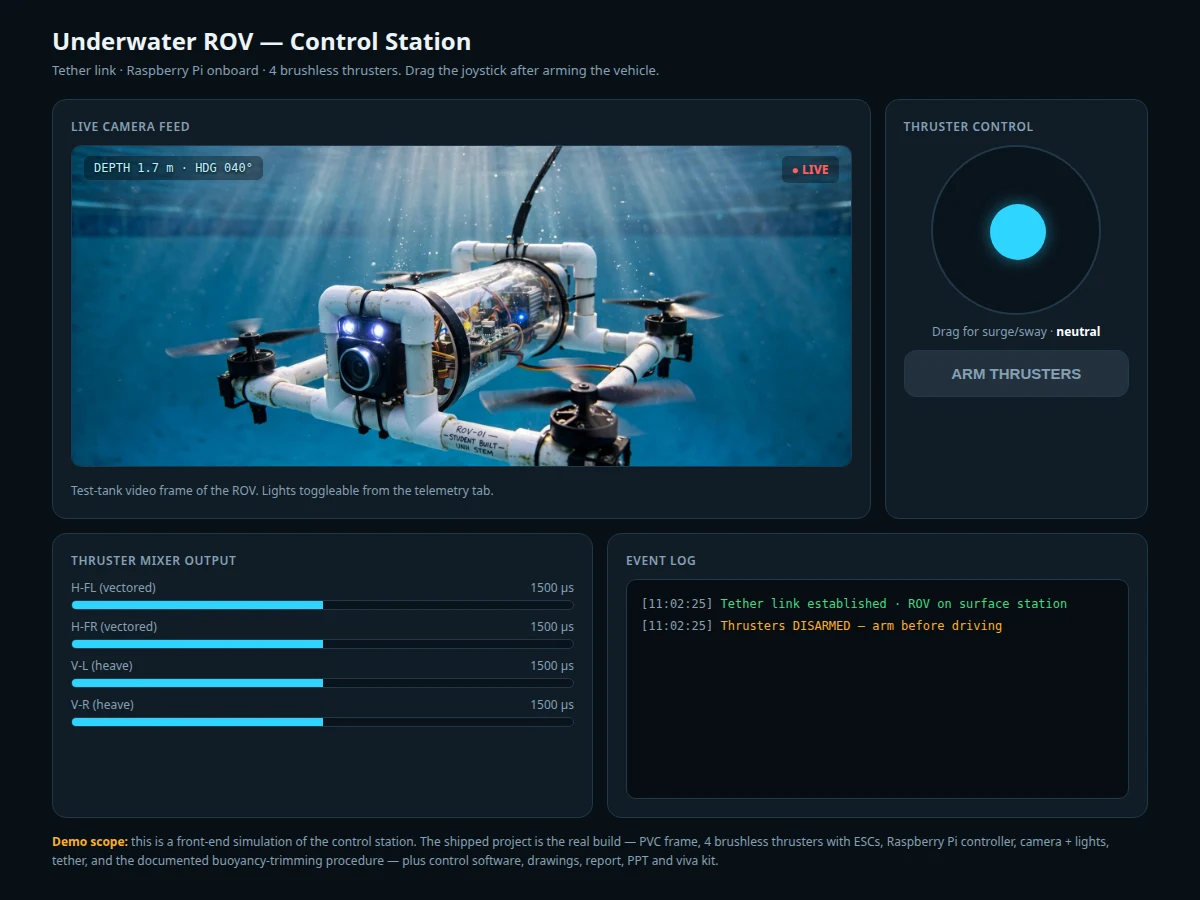
Inspection divers and sonar boats are expensive, and many small underwater jobs — pool inspection, hull checks, pond surveys — don't need industrial ROVs. A student-scale ROV captures the real engineering: watertight electronics, thruster mixing for 6-DOF-style maneuvering, tether communication and video streaming. This project builds the complete vehicle: a PVC frame with four brushless thrusters (two vectored horizontal, two vertical) driven by ESCs, a Raspberry Pi running the control loop, a camera with LED floodlights, and a tether carrying power plus Ethernet for the surface station. The web control station shows the live video feed, depth and heading readouts, individual thruster command bars and an arm/disarm interlock. Brushless outrunner motors are the honest budget choice here — they are not factory-sealed marine thrusters, so the build uses corrosion-protection and limited-depth testing rather than claiming deep-water capability. The deliverable is a pool- and tank-tested vehicle with a documented buoyancy-trimming procedure, not a subsea-rated product.
Arms the vehicle and drives it from the joystick panel.
Follow the working sequence
How it works
- The operator drives the vehicle from the web control station using the joystick panel (surge, sway, heave, yaw) after arming the thrusters.
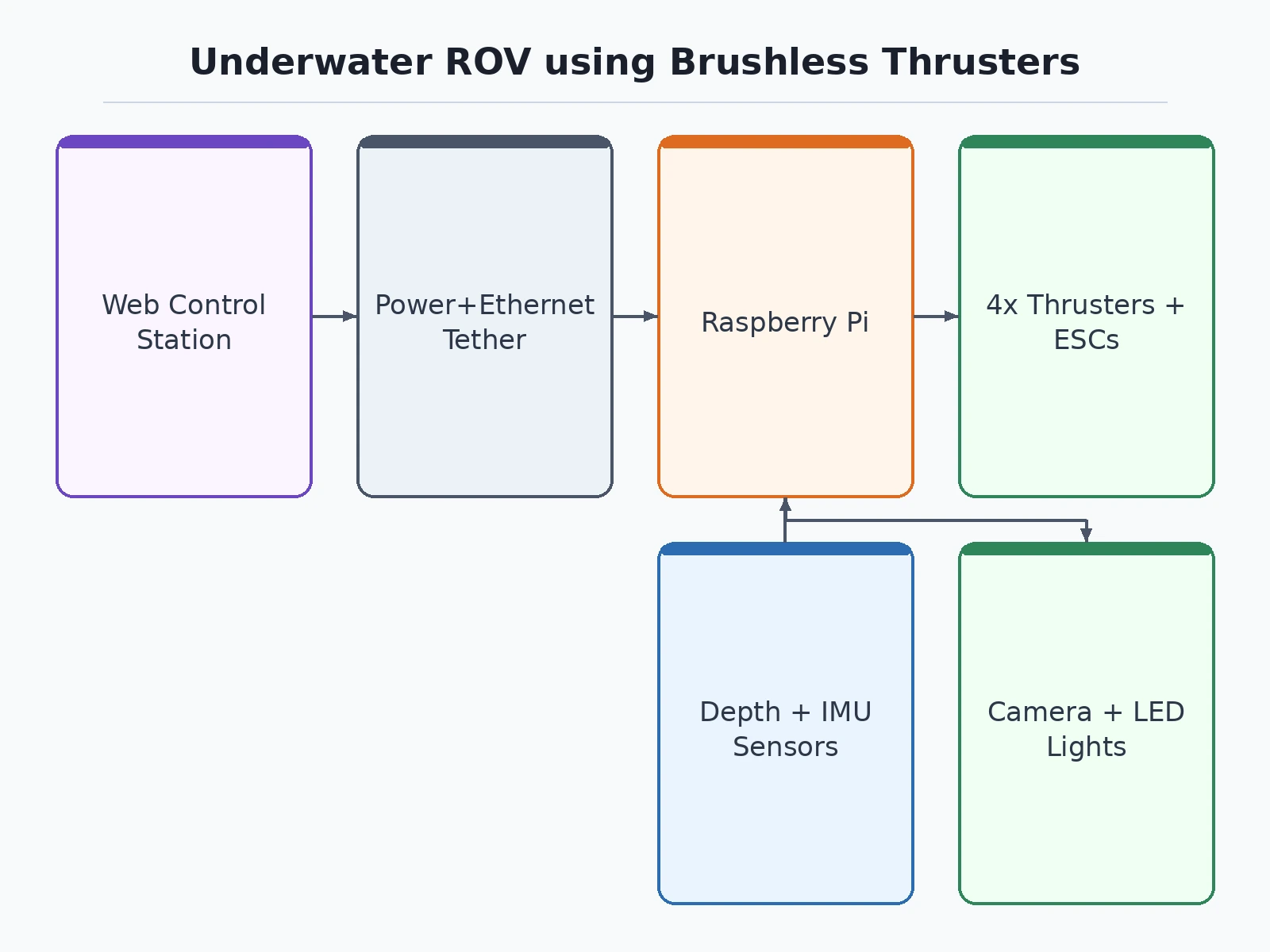
- Commands travel down the tether over Ethernet to the Raspberry Pi, which runs the thruster mixer and outputs PWM to the four ESCs.
- The brushless thrusters generate vectored thrust; the Pi's mixer translates yaw commands into differential thrust on the horizontal pair.
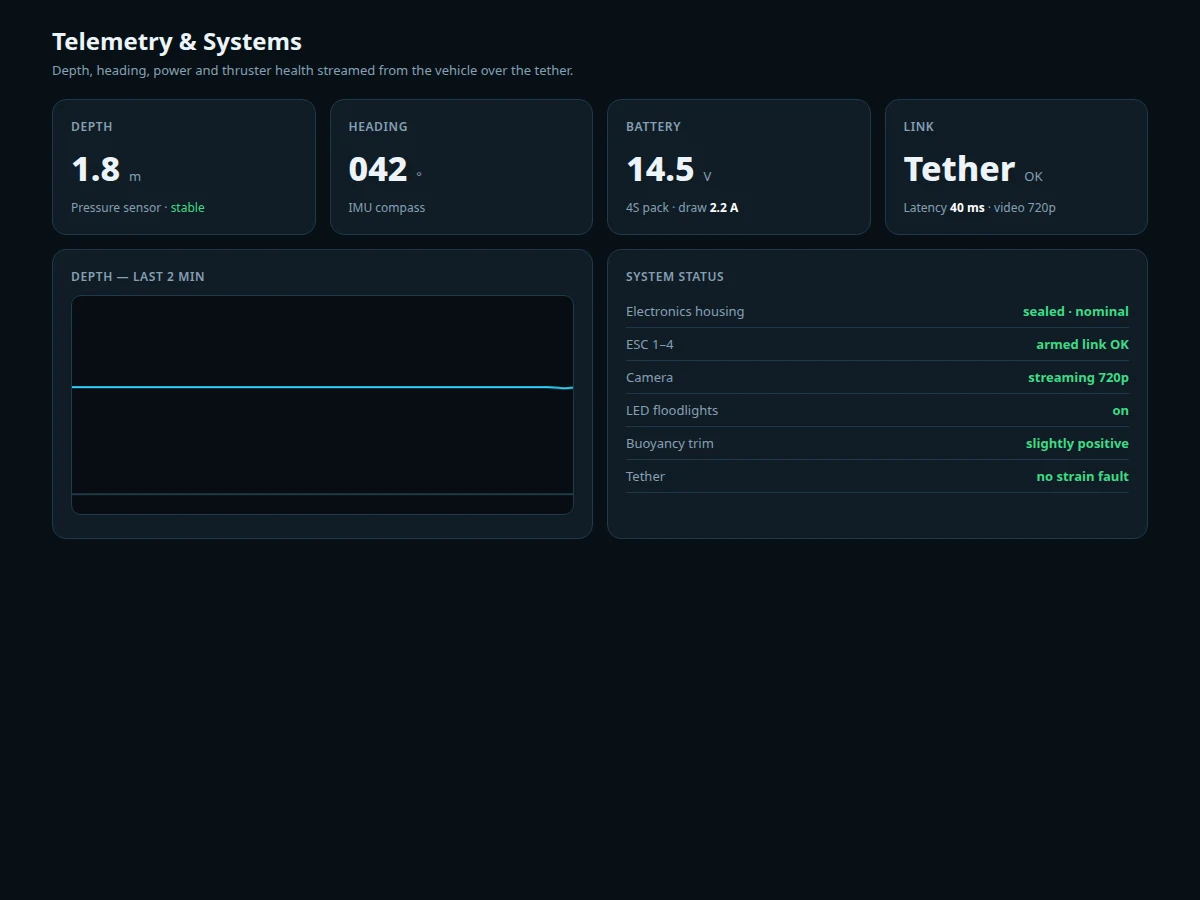
- Depth and IMU sensors stream back up the tether; the control station displays depth, heading, thruster bars and battery voltage in real time.
- The camera video streams over the tether alongside telemetry; the LED lights are switchable from the control station.
- Disarming cuts all thruster outputs instantly; the vehicle floats to the surface on its trimmed positive buoyancy.
Tech stack:
- Raspberry Pi (onboard control + video streaming)
- 4× brushless outrunner motors + ESCs + marine propellers
- PVC/acrylic frame, watertight electronics housing
- Camera module, LED floodlights
- Depth/pressure sensor + IMU (heading)
- Power + Ethernet tether, surface battery
- Web control station (HTML/CSS/JS, joystick panel, telemetry)
| Parameter | Value |
|---|---|
| Thrusters | 4× brushless outrunners (2 vectored horizontal, 2 vertical) |
| Control | Raspberry Pi, thruster mixer, PWM ESC outputs |
| Tether | Power + Ethernet to surface station |
| Sensors | Pressure depth sensor, IMU heading, battery voltage |
| Video | Onboard camera streamed to control station; LED floodlights |
| Buoyancy | Slightly positive, trimmed with foam and ballast (documented procedure) |
| Testing | Pool/tank tested; shallow depth only |
| Safety | Arm/disarm interlock; disarm cuts all thrusters |
Project features
- [Four brushless thrusters] Hobby brushless outrunners with marine propellers, two vectored for surge/sway/yaw and two vertical for heave, each driven by its own ESC.
- [Thruster mixer] Raspberry Pi control loop maps joystick surge/sway/heave/yaw commands to four ESC signals with proper vectored mixing.
- [Live camera + lights] Onboard camera streams video to the surface station; LED floodlights illuminate the scene for the feed.
- [Depth and heading telemetry] Pressure-based depth sensor and IMU compass feed the dashboard's depth and heading readouts.
- [Web control station] Video panel, depth/heading cards, per-thruster command bars, arm/disarm interlock and battery voltage monitor.
- [Buoyancy trimming procedure] Documented foam-and-ballast procedure to achieve slight positive buoyancy, with a trim worksheet.
- [Tether management] Power + Ethernet tether from the surface station; strain relief and tether-float notes in the build guide.
- [Arm/disarm safety interlock] Thrusters stay disarmed until the operator explicitly arms the vehicle from the control station.
What is included
- Complete Raspberry Pi control software (mixer, telemetry, video streaming)
- Web control station app (joystick panel, video, telemetry, arm/disarm)
- Frame fabrication drawings and watertight-housing guide
- Buoyancy trimming worksheet and procedure
- Corrosion-protection and tether-management notes
- Project report PDF (ROV principles, thruster mixing, testing)
- PPT presentation for final review
- Viva Q&A preparation document (brushless motors, ESCs, buoyancy, tethers)
Limitations & prerequisites
- The thrusters are hobby brushless outrunners with corrosion protection, not factory-sealed marine thrusters — the vehicle is rated for shallow pool/tank testing only, and deep-water use is not claimed.
- Brushless motors in water corrode over time; the build guide documents freshwater rinsing and maintenance after every session.
- The tether is a physical constraint: vehicle range is limited by tether length, and tether drag affects maneuverability in current.
- Latency in the video stream depends on the tether and surface-station hardware; it is suitable for slow inspection work, not high-speed maneuvering.
- This is an academic prototype, not a commercial or safety-rated inspection tool — it must not be used where failure would risk property or life.
Frequently Asked Questions
Why brushless motors instead of DC motors?
Brushless outrunners give high thrust per watt and bidirectional control through ESCs, which is what real small ROVs use. DC motors with shafts are harder to keep water out of and are less efficient for this job.
How deep can it go?
Shallow pool/tank depth only. The electronics housing and hobby motors are not rated or tested for deep water, and the build guide states this limit explicitly.
How is it controlled?
Over a tether (power + Ethernet) from a web control station with a joystick panel. Thrusters stay disarmed until the operator explicitly arms them.
How is buoyancy set?
With the documented foam-and-ballast procedure: the vehicle is trimmed to slight positive buoyancy so it floats up when disarmed.
Does it need internet?
No — the control station connects to the ROV over the tether's local Ethernet link. All telemetry and video stay local.
Is this project suitable for a final-year project?
Yes — for Mechanical, Mechatronics and Robotics programs. It demonstrates frame design, thruster vectoring, embedded control, tethers, waterproofing and sensor telemetry, all strong viva material. Suitable for B.E./B.Tech final-year projects in Mechanical, Mechatronics and Robotics.
Components & software requirements
- Raspberry Pi (onboard control + video streaming)
- 4× brushless outrunner motors + ESCs + marine propellers
- PVC/acrylic frame, watertight electronics housing
- Camera module, LED floodlights
- Depth/pressure sensor + IMU (heading)
- Power + Ethernet tether, surface battery
- Web control station (HTML/CSS/JS, joystick panel, telemetry)
Delivery information
Built-to-order project. Delivery timeline is shared after order confirmation based on current queue.
Support terms
Complete documentation, setup guide, and viva preparation included. Support for setup and explanation provided.
Download free synopsis (PDF)
Enter your name and WhatsApp number — the synopsis PDF downloads immediately. We may send occasional project updates on WhatsApp; no spam.