
More project photos (2)
The problem
Swarm robotics is usually taught as simulation — dozens of agents on a screen, no radios, no dropped packets, no dead batteries. The moment you put radios on real robots, the interesting problems appear: who hears whom, what happens when an acknowledgement never arrives, how formations survive a robot that stops responding. Wi-Fi and Bluetooth both drag in access points, pairing and latency that make multi-robot coordination painful. ESP-NOW, Espressif's connectionless peer-to-peer protocol, is the purpose-built answer: short packets, millisecond latency, no infrastructure. This project builds a real three-robot swarm on it — one controller, three ESP32 differential-drive robots, formation broadcasts with acknowledgements and retries, 10 Hz position telemetry, and ultrasonic collision override that works even if the radio link dies. The console makes the invisible visible: arena positions, packet log, delivery rate and round-trip latency. Formations are design targets measured on the buyer's own floor — range and loss depend on the room, antennas and interference, and the report says so.
How it works
- Each robot ESP32 registers the controller's MAC address as an ESP-NOW peer at boot — no Wi-Fi association is ever needed.
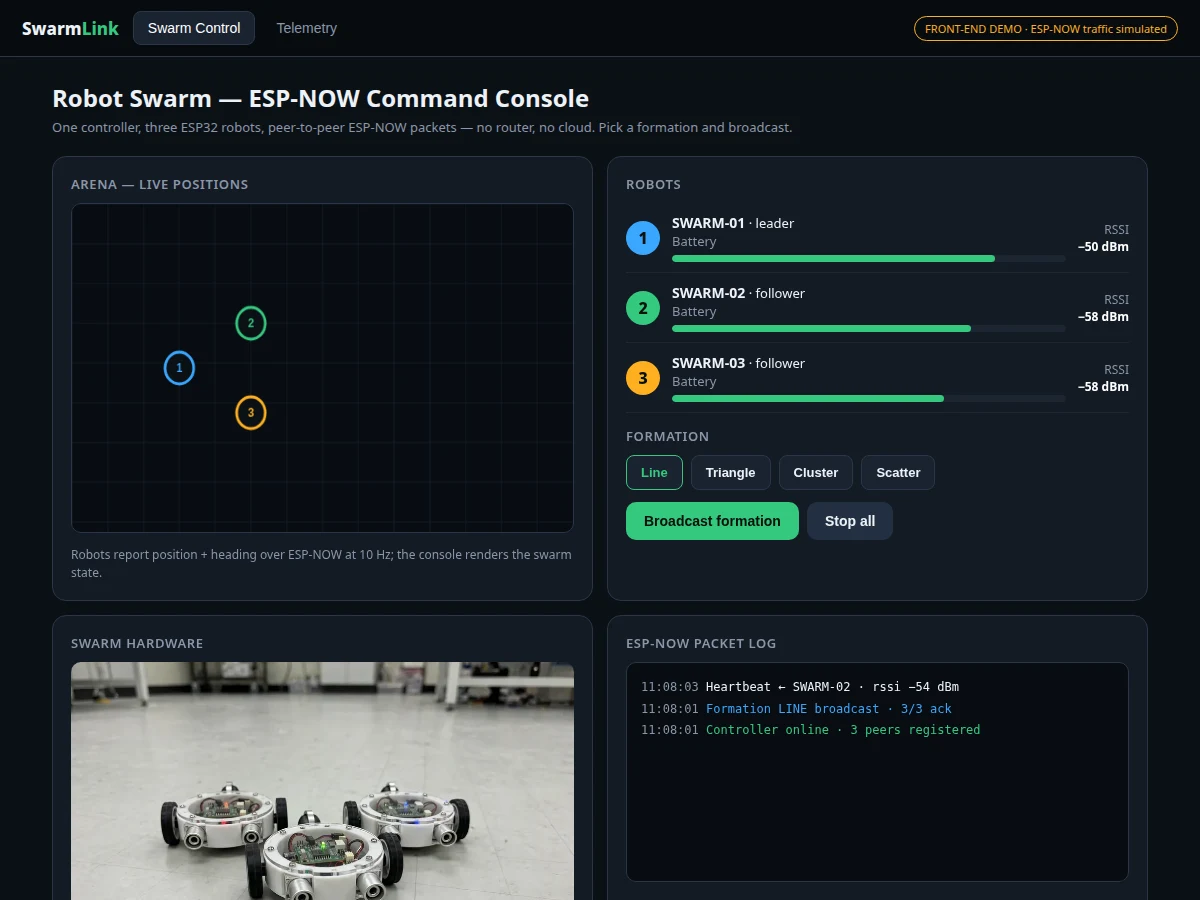
- The operator picks a formation on the console; the controller broadcasts a formation packet with each robot's target x/y slot (up to 250 bytes).
- Robots acknowledge; the controller retries missing acks up to 3 times and the console logs the ack count per broadcast.
- Followers run a proportional controller driving their differential-drive motors toward their assigned slots; the leader follows console joystick commands.
- Every robot streams position, heading, battery and RSSI back at 10 Hz; the console renders the arena map and link statistics live.
- Ultrasonic sensors run a local loop on each robot: an obstacle inside the stop distance halts the motors regardless of what the radio says.
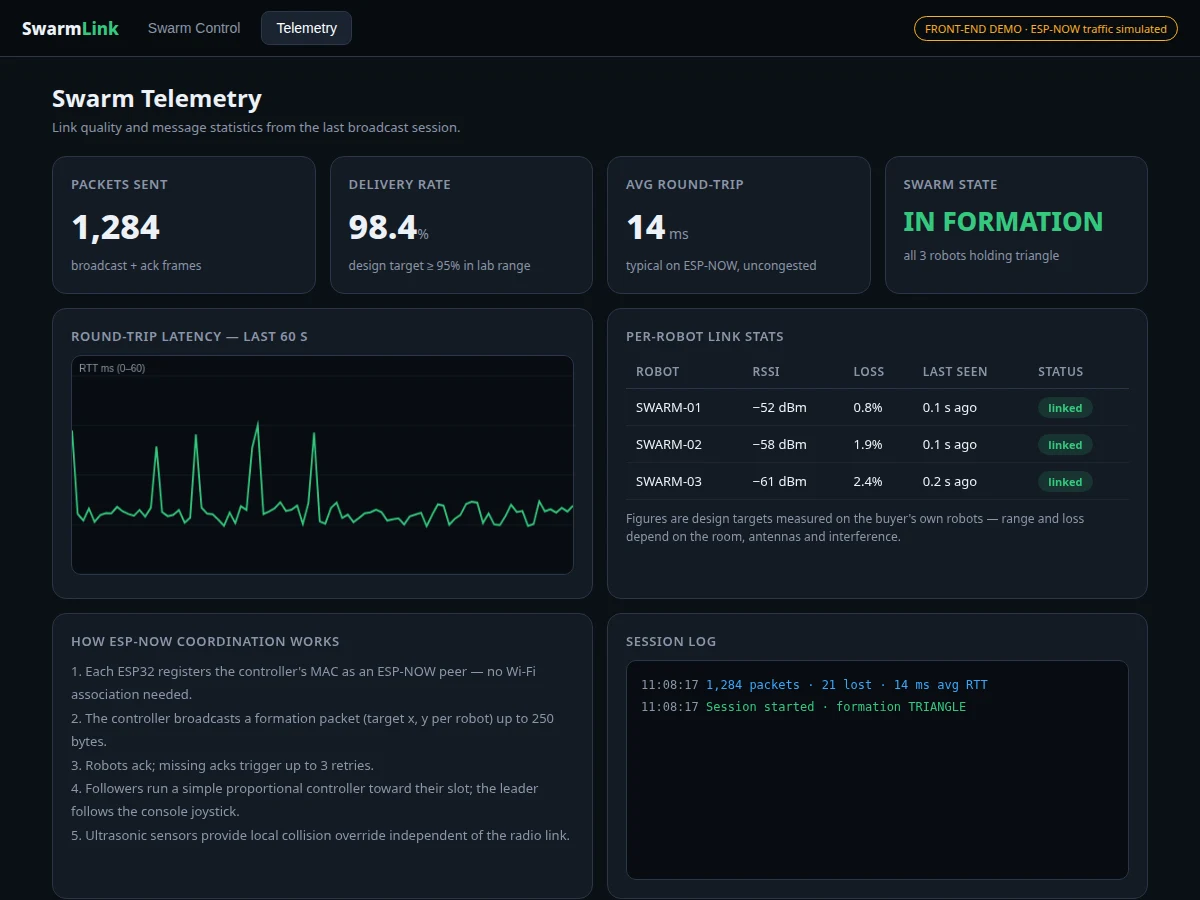
- The telemetry view aggregates delivery rate and round-trip latency; the report's test procedure has the buyer measure range, loss and latency in their own room.
Tech stack:
- 4x ESP32 DevKit (1 controller + 3 robots), Arduino-core firmware
- 3x differential-drive robot chassis kits (motors, wheels, caster)
- ESP-NOW peer-to-peer protocol (connectionless, 250-byte frames)
- Ultrasonic distance sensors (local collision override per robot)
- Proportional formation-follower controller firmware
- Li-ion battery packs with charging guidance
- Single-file HTML/CSS/JS command console (arena, telemetry, packet log)
| Parameter | Value |
|---|---|
| Robots | 3 ESP32 differential-drive robots + 1 controller |
| Radio | ESP-NOW, peer-to-peer, no router/pairing/cloud |
| Packet size | Up to 250 bytes per frame |
| Telemetry rate | 10 Hz per robot (position, heading, battery, RSSI) |
| Delivery target | ≥ 95% in lab range (design target; room-dependent) |
| Round-trip | ~14 ms typical uncongested (design target) |
| Formations | Line, triangle, cluster, scatter (broadcast + ack) |
| Retries | Up to 3 per broadcast on missing ack |
| Safety | Ultrasonic stop-distance override, radio-independent |
| Console | Arena map, battery/RSSI, packet log, latency chart |
Project features
- [ESP-NOW peer-to-peer link] Controller and robots communicate with connectionless ESP-NOW frames — no router, no pairing, no cloud; up to 250-byte packets with millisecond-scale latency.
- [Formation control] Broadcast line, triangle, cluster and scatter formations; each follower runs a proportional controller toward its assigned slot while the leader follows the console joystick.
- [Acknowledged broadcasts] Every formation packet expects per-robot acks; missing acks trigger up to 3 retries, and the console shows exactly who acknowledged and who didn't.
- [Live arena console] The command console renders robot positions and headings in real time from 10 Hz ESP-NOW telemetry, with per-robot battery bars and RSSI.
- [Packet + latency telemetry] Packet log, delivery-rate counter and a 60-second round-trip latency chart make the wireless link itself the observable under test — design target ≥ 95% delivery in lab range.
- [Ultrasonic collision override] Each robot's ultrasonic sensor halts it independently of the radio link — the safety layer that works even during a comms blackout.
- [Leader-follower roles] SWARM-01 leads (console-driven), SWARM-02/03 follow; roles are firmware constants, so the viva can discuss reassignment and failure handling.
- [Complete build docs] Chassis assembly guide, ESP-NOW peer-registration procedure (MAC pairing), tuning guide for the follower gains, and commented firmware.
What is included
- Complete firmware: controller (broadcast, ack/retry, joystick) + robot (peer link, follower control, telemetry, collision override)
- Chassis assembly and wiring guide for all three robots
- ESP-NOW peer-registration (MAC pairing) procedure
- Command console web app (swarm control + telemetry views)
- Follower-gain tuning guide
- Project report PDF (background, protocol design, control design, test procedure)
- PPT presentation for final review
- Viva Q&A preparation document (ESP-NOW vs Wi-Fi/BLE, formation control, proportional control, acks/retries, link budget)
- Setup guide (first power-up, peer registration, first formation)
Limitations & prerequisites
- Delivery rate and latency are design targets measured on the buyer's own robots — walls, Wi-Fi interference and antenna orientation change them, and the report documents the measurement procedure rather than pre-claiming figures.
- Three robots is the tested configuration; larger swarms need broadcast scheduling work the report flags as future scope.
- Position tracking in the console comes from each robot's own odometry/telemetry, not an external motion-capture system — absolute arena accuracy is approximate.
- Ultrasonic sensors see flat obstacles well and soft/angled ones poorly; the collision override is a safety layer, not a mapping system.
- Battery life limits demo sessions; the report's power notes size expectations honestly.
Frequently Asked Questions
What is ESP-NOW and why use it for a swarm?
ESP-NOW is Espressif's connectionless peer-to-peer wireless protocol: devices send short packets directly to registered MAC addresses with no router, no pairing and no cloud. For a swarm that means millisecond latency and no infrastructure — Wi-Fi and Bluetooth both add association overhead that hurts multi-robot coordination.
How do the robots form shapes?
The controller broadcasts each robot's target slot for the chosen formation (line, triangle, cluster, scatter). Followers run a proportional controller driving their motors toward their slots; the leader follows the console joystick. The arena map shows the shape forming live.
What happens if a robot misses a command?
Every broadcast expects per-robot acknowledgements; missing acks trigger up to 3 retries, and the console shows the ack count (e.g. 2/3 ack) so a deaf robot is visible, not silent.
How is collision handled?
Each robot carries an ultrasonic sensor running a local loop: anything inside the stop distance halts the motors immediately, independent of the radio link — so a comms blackout can't cause a crash.
What range and reliability can we expect?
The design target is ≥ 95% packet delivery in lab range with ~14 ms typical round-trip, but these are measured on your own floor: room layout, interference and antennas all matter, and the report documents the measurement procedure.
Is this project suitable for a final-year project?
Yes — for Mechanical, Mechatronics and Robotics programs. It demonstrates wireless protocol design, multi-agent coordination, closed-loop formation control, telemetry and experimental characterization, all strong viva material. Suitable for B.E./B.Tech final-year projects in Mechanical, Mechatronics and Robotics.
Components & software requirements
- 4x ESP32 DevKit (1 controller + 3 robots), Arduino-core firmware
- 3x differential-drive robot chassis kits (motors, wheels, caster)
- ESP-NOW peer-to-peer protocol (connectionless, 250-byte frames)
- Ultrasonic distance sensors (local collision override per robot)
- Proportional formation-follower controller firmware
- Li-ion battery packs with charging guidance
- Single-file HTML/CSS/JS command console (arena, telemetry, packet log)
Delivery information
Built-to-order project. Delivery timeline is shared after order confirmation based on current queue.
Support terms
Complete documentation, setup guide, and viva preparation included. Support for setup and explanation provided.