
More project photos (2)
The problem
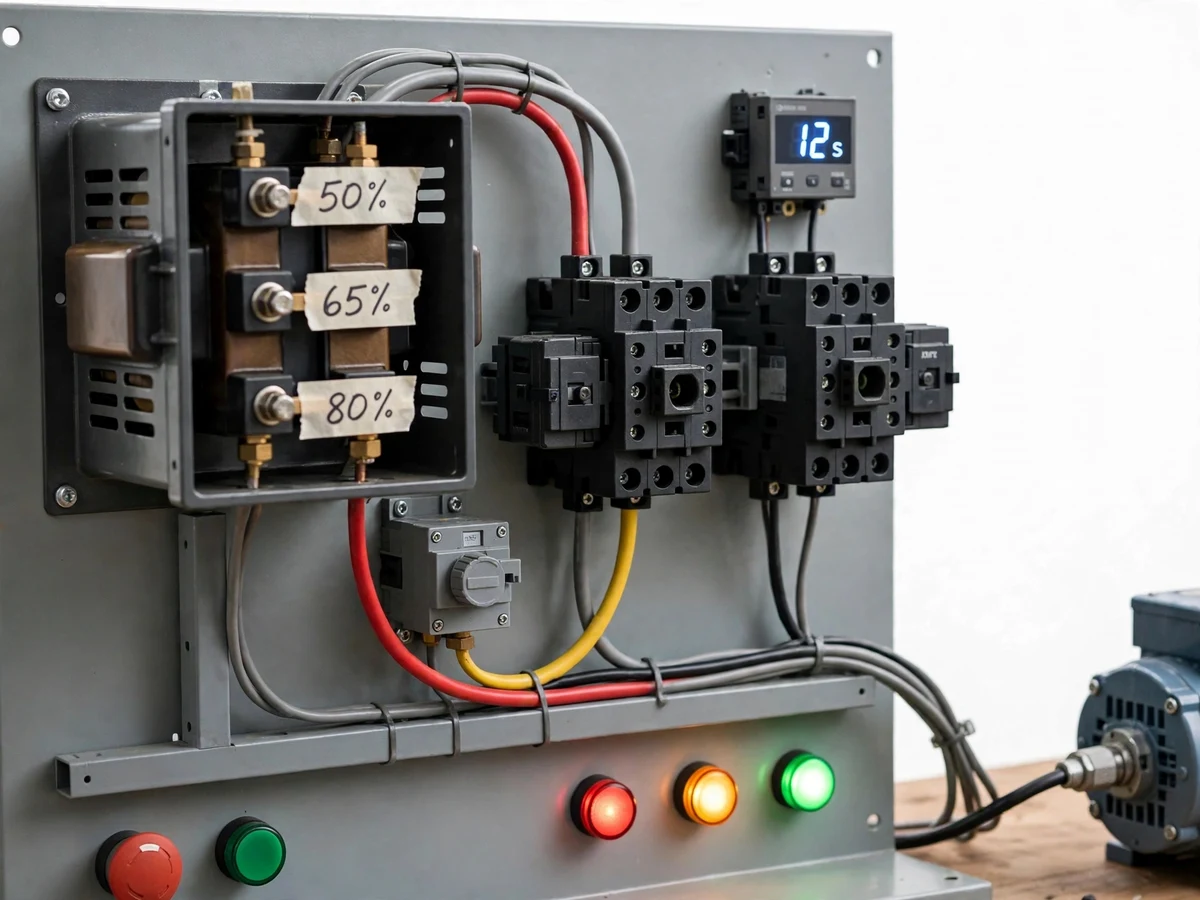
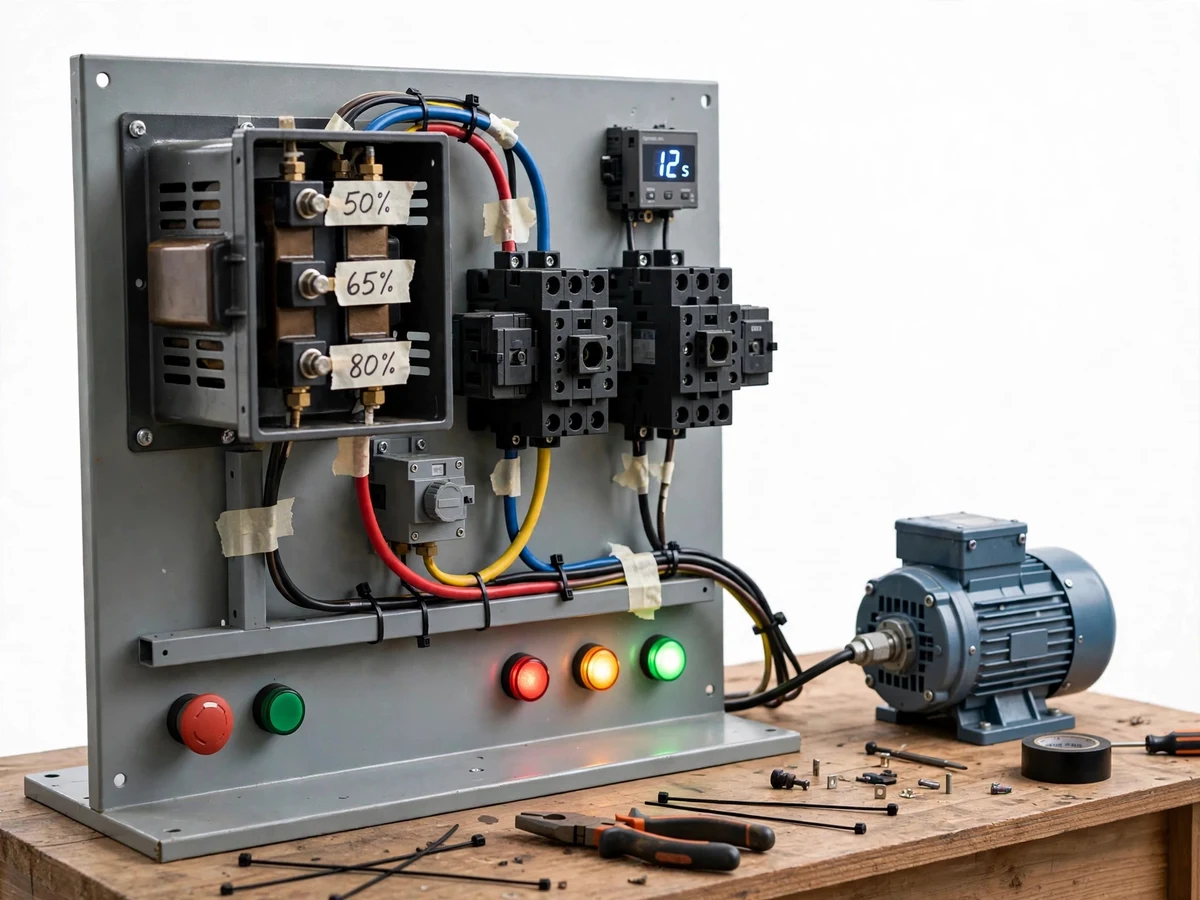
A three-phase motor starter with an auto-transformer and timer is a reduced-voltage starter that starts a three-phase induction motor at a fraction of the line voltage and then switches it to full voltage once it has gathered speed. It solves the inrush problem of direct-on-line starting, where a motor at standstill draws roughly five to seven times its full-load current and can dip the supply voltage and stress the windings. In this build, a tapped auto-transformer supplies the motor at 50%, 65% or 80% of the 415 V line voltage during the start step, and an on-delay timer relay changes over to the run contactor after a set delay. Because the current drawn from the supply falls with the square of the tap ratio, the 50% tap draws only about a quarter of the direct-on-line starting current. Students who build it learn reduced-voltage starting, tap selection, timer changeover sequencing and contactor interlocking on a working panel.
Three-phase 415 V supply enters through the MCCB.
Follow the working sequence
How it works
Three-phase 415 V supply enters through the MCCB and feeds two paths: the control circuit and the power circuit through the auto-transformer. When the green START button is pressed, the start contactor closes and connects the motor to the selected tap of the auto-transformer, so the motor receives only 50%, 65% or 80% of the line voltage and begins to accelerate with a much smaller starting current. The same START press energizes the on-delay timer relay, which starts counting the changeover delay. When the timer reaches its set time, its timed contact drops the start contactor and energizes the run contactor, connecting the motor directly across the full line voltage for normal running. Electrical interlocking through normally-closed auxiliary contacts makes it impossible for the start and run contactors to be closed at the same time. The thermal overload relay sits in series with the motor and trips the contactors if the current stays above its setting.
- Select the starting tap (50%, 65% or 80%) on the auto-transformer terminal links before energizing, matching the tap to the load: lower tap for light loads and the smallest inrush, higher tap when more starting torque is needed.
- Switch on the 3-pole MCCB to energize the panel; the control circuit is live and the red fault lamp stays off while the overload relay is healthy.
- Press the green START push button: the start contactor closes, the motor is connected to the selected auto-transformer tap at reduced voltage, the amber starting lamp lights, and the timer relay starts counting.
- The motor accelerates at reduced voltage while the line current stays near the square of the tap ratio of the direct-on-line value — about 25% at the 50% tap, about 42% at the 65% tap.
- When the timer reaches its set delay (12 s, design setting), its timed contact drops the start contactor and closes the run contactor, switching the motor to full line voltage; the green running lamp lights.
- The electrical interlock blocks any overlap: the normally-closed auxiliary contact of the run contactor opens the start contactor coil circuit the instant the run contactor closes, and vice versa.
- The thermal overload relay continuously monitors motor current; on sustained overload it opens its trip contact, drops both contactors, and lights the red fault lamp until manually reset.
- Press the red STOP push button at any time to drop both contactors and stop the motor; a fresh start requires pressing START again.
Tech stack:
- Three-phase auto-transformer (50% · 65% · 80% taps)
- 3-pole power contactors (AC-3)
- On-delay timer relay
- Thermal overload relay
- 3-pole MCCB
- Start/stop push-button station
- 230 V AC control circuit
- 1.5 kW three-phase induction motor
| Parameter | Value |
|---|---|
| Demonstration motor | 1.5 kW, 3-phase induction motor, 415 V, 50 Hz (design value) |
| Motor full-load current | Approximately 3.1 A (design value) |
| Direct-on-line starting current | Approximately 5–7 times full-load current (typical textbook range) |
| Auto-transformer taps | 50%, 65%, 80% of line voltage (standard tap set) |
| Line current at 50% tap | Approximately 25% of direct-on-line starting current (standard relationship) |
| Line current at 65% tap | Approximately 42% of direct-on-line starting current (standard relationship) |
| Line current at 80% tap | Approximately 64% of direct-on-line starting current (standard relationship) |
| Starting torque at 50% tap | Approximately 25% of direct-on-line starting torque (standard relationship) |
| Timer relay | On-delay, 0–30 s range, set to 12 s (design setting) |
| Start and run contactors | 3-pole, 9 A AC-3 (design value) |
| Thermal overload relay | 2.5–4 A adjustable (design value) |
| MCCB | 3-pole, 10 A (design value) |
| Control supply | 230 V AC single-phase (design value) |
| Push buttons | Green START (NO), red mushroom-head STOP (NC) |
| Indicator lamps | Red (fault/trip), amber (starting), green (running) |
Project features
The starter's core capabilities are the three-tap auto-transformer, the timer-controlled changeover, the interlocked contactor pair, and the overload protection chain. The auto-transformer offers 50%, 65% and 80% voltage taps so the starting step can be matched to the load: the lowest tap gives the smallest inrush, while the highest tap keeps more starting torque for heavier loads. The on-delay timer relay handles the changeover automatically, dropping the start contactor and closing the run contactor after the set delay without any manual switching. The start and run contactors are electrically interlocked with normally-closed auxiliary contacts, so a welded timer contact or a wiring fault cannot close both at once. A thermal overload relay with an adjustable 2.5–4 A range and a 3-pole MCCB protect the motor and the panel against sustained overload and short circuit.
- [Three-tap auto-transformer] A three-phase auto-transformer with 50%, 65% and 80% voltage taps, selected by terminal links before starting, so the reduced-voltage step can be matched to the load and the available supply capacity.
- [Timer-controlled changeover] An on-delay timer relay (0–30 s range, set to 12 s as a design setting) automatically drops the start contactor and closes the run contactor, so the motor moves from reduced voltage to full voltage without manual switching.
- [Interlocked start and run contactors] Two 3-pole contactors with electrical interlocking: the normally-closed auxiliary contact of each contactor is wired in series with the other contactor's coil, so both contactors can never be closed at the same time.
- [Overload relay and MCCB protection] A thermal overload relay (2.5–4 A adjustable, design value) in series with the motor trips the contactors on sustained overload, and a 3-pole MCCB provides short-circuit protection for the panel.
- [Start/stop control with status lamps] Green START and red mushroom-head STOP push buttons with a seal-in (hold-on) auxiliary contact, plus red, amber and green indicator lamps showing fault, starting and running states.
- [Demonstration motor on the bench] A 1.5 kW three-phase induction motor (demonstration motor, design value) connected to the panel, so the full start sequence can be watched and the changeover heard and seen.
- [Complete wiring documentation] The power and control circuit diagrams, terminal schedule and tap-selection table are supplied with the build, so the student can explain every wire in the panel.
What is included
- Working auto-transformer starter panel with demonstration motor
- Power and control circuit diagrams with terminal schedule and tap-selection table
- Timer-setting and overload-setting procedure for the demonstration motor
- Project report PDF (background, reduced-voltage starting theory, tap-ratio calculations, methodology, results)
- PPT presentation for final review
- Viva Q&A preparation document (auto-transformer theory, tap-ratio current and torque relationships, timer changeover, interlocking, protection)
Limitations & prerequisites
- A three-phase 415 V supply is required; the panel must be operated only under qualified supervision in a laboratory, and the auto-transformer terminals are live during starting.
- Reduced-voltage starting gives lower starting torque — about 25% of the direct-on-line torque at the 50% tap — so heavily loaded or high-inertia loads cannot be started on the lowest tap.
- The timer is fixed-delay, not speed-sensed: changeover happens after the set time whether or not the motor has reached speed, so a wrong delay setting can cause a current surge at changeover.
- The prototype is an academic demonstration panel, not a certified industrial starter; no type-test, certification or industrial-duty claims are made.
- The auto-transformer adds size, weight and cost compared with a star-delta starter for the same motor rating.
- The demonstration motor should be started unloaded or lightly loaded; the panel is sized for the 1.5 kW demonstration motor, not for larger motors.
Frequently Asked Questions
Is this project suitable for a final-year project?
Yes — for Electrical Engineering and related diploma and degree programs. It demonstrates reduced-voltage starting, auto-transformer tap selection, timer-based changeover, contactor interlocking and motor protection on a working panel, with standard textbook relationships the student can verify and explain in the viva.
How does the auto-transformer reduce the starting current?
The auto-transformer steps voltage and current down together: the motor draws the tap fraction of its direct-on-line starting current, and the supply sees the tap fraction of that again, so line current is the tap ratio squared. At the 50% tap the motor takes about 50% of its starting current while the supply sees only about 25%, and starting torque also falls with the square of the tap ratio.
How is this different from a star-delta starter?
A star-delta starter gives one fixed reduced voltage — about 58% of line voltage — with line current near 33% of direct-on-line. This starter offers three selectable taps (50%, 65%, 80%), so the starting step can be matched to the load, and the transformer action cuts the line current further than the motor current. Star-delta is cheaper and smaller; the auto-transformer starter suits loads needing more starting torque.
Why is the timer set to 12 seconds?
The 12-second delay is a design setting for the 1.5 kW demonstration motor: long enough for the motor to accelerate near running speed on the selected tap before changeover, and short enough that the auto-transformer is not held in the starting step after the motor has sped up. The delay is adjustable from 0–30 s, and is chosen against the load inertia — a heavier load needs a longer delay.
What happens if both contactors close at the same time?
They cannot, because the contactors are electrically interlocked: the normally-closed auxiliary contact of the run contactor is wired in series with the start contactor coil, and the normally-closed auxiliary contact of the start contactor is wired in series with the run contactor coil. Each coil circuit is broken the instant the other contactor closes, so even a welded timer contact cannot short the auto-transformer through both contactors.
What power supply does the panel need?
A three-phase 415 V, 50 Hz supply for the motor and a 230 V single-phase control supply taken from the same source. The panel is a laboratory demonstration unit and must be run under qualified supervision; it is not a certified industrial starter and is not intended for unsupervised or production use.
Components & software requirements
- Three-phase auto-transformer (50% · 65% · 80% taps)
- 3-pole power contactors (AC-3)
- On-delay timer relay
- Thermal overload relay
- 3-pole MCCB
- Start/stop push-button station
- 230 V AC control circuit
- 1.5 kW three-phase induction motor
Delivery information
Built-to-order project. Delivery timeline is shared after order confirmation based on current queue.
Support terms
Complete documentation, setup guide, and viva preparation included. Support for setup and explanation provided.
Download free synopsis (PDF)
Enter your name and WhatsApp number — the synopsis PDF downloads immediately. We may send occasional project updates on WhatsApp; no spam.