
More project photos (2)
The problem
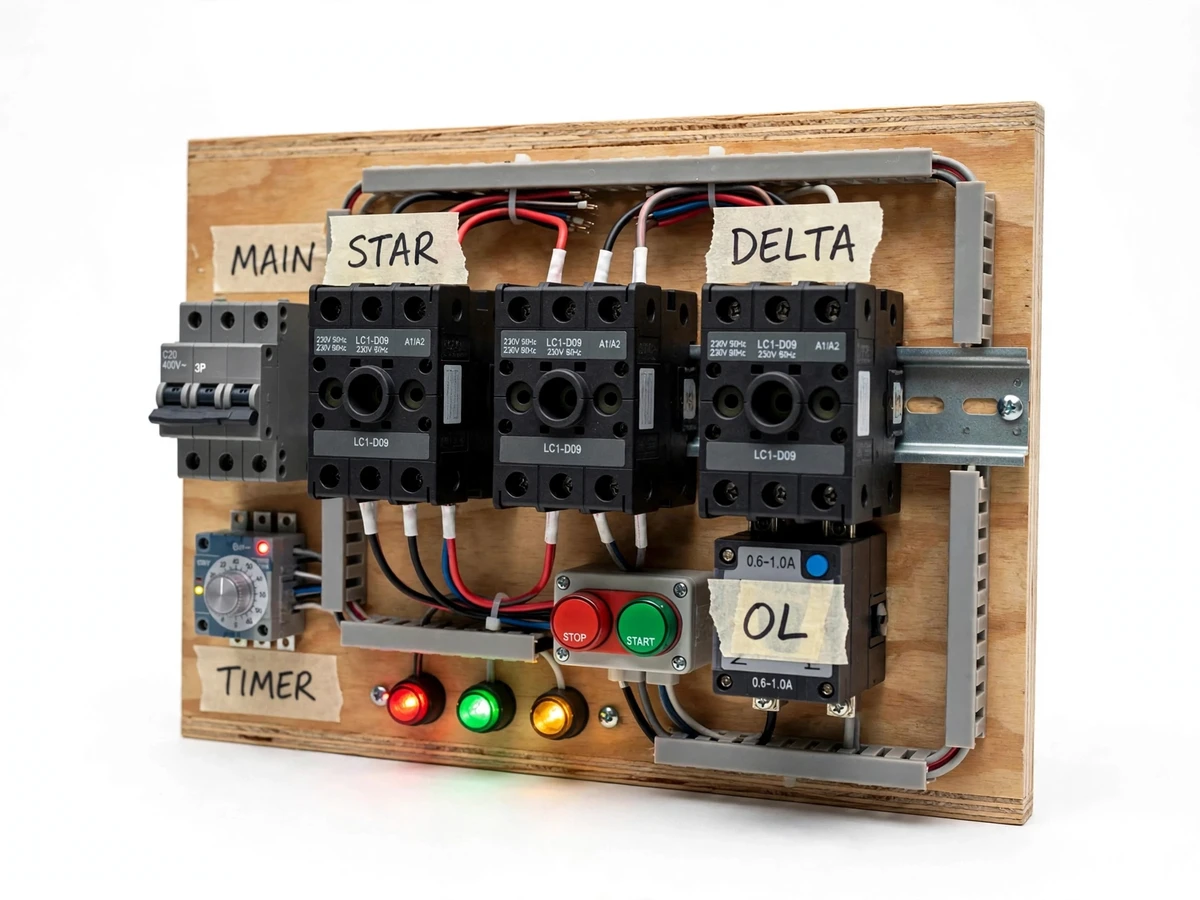
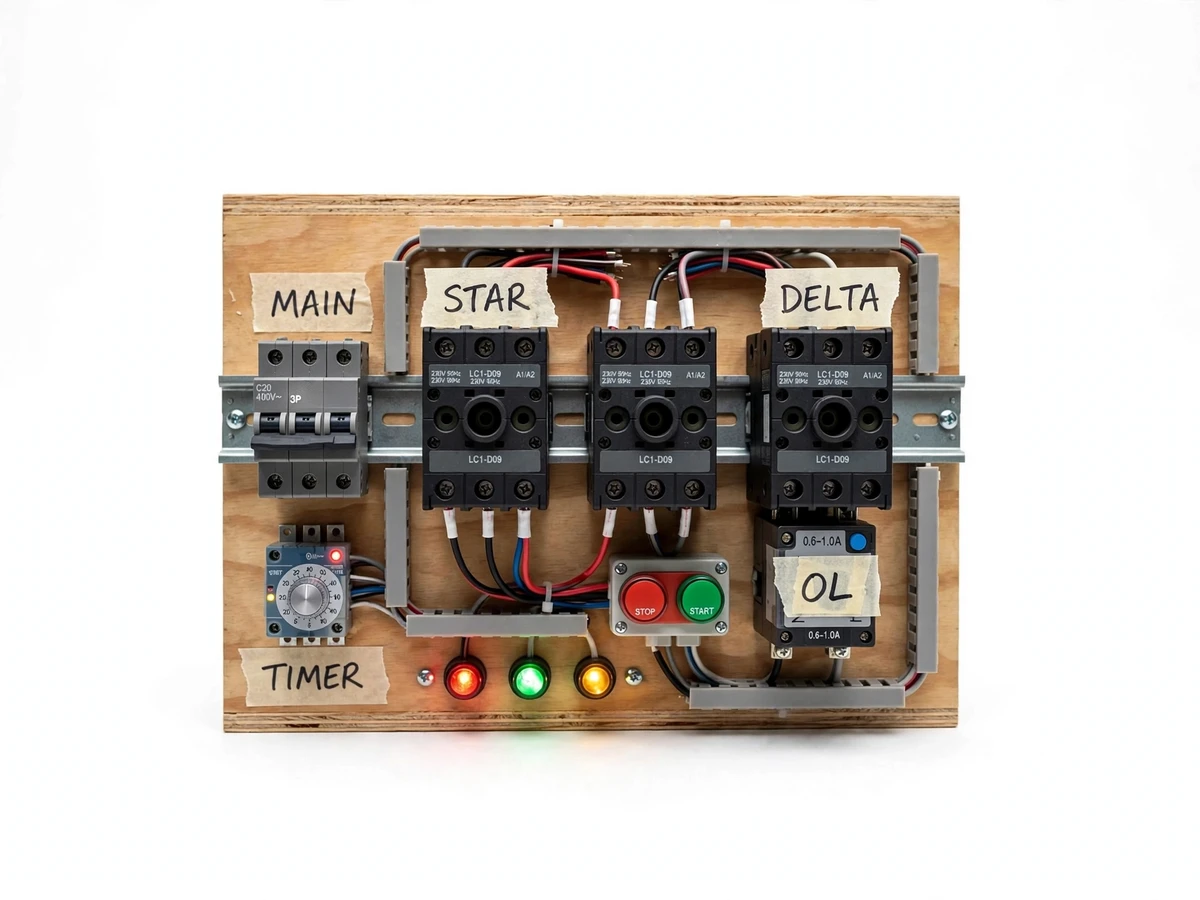
Large three-phase induction motors draw a very high inrush current when started directly across the line — several times the rated full-load current — which sags the supply voltage, heats the windings and stresses the switchgear. Direct-on-line starting is acceptable for small motors, but beyond a few HP the industry standard is reduced-voltage starting, and the star-delta starter is the most widely used method: the motor first starts with its windings in star, then changes over to delta for normal running. This project builds a complete automatic star-delta starter panel — three contactors (main, star, delta), an electronic ON-delay timer for the automatic changeover, a bimetallic overload relay for motor protection, a push-button start/stop station, indicator lamps and MCB protection — mounted on a labeled plywood panel with DIN rail and ferruled wiring. Everything is sized, wired and documented as a real lab-usable panel, so the student can demonstrate the actual starting sequence and answer viva questions from genuine build experience.
Presses START and STOP on the push-button station.
Follow the working sequence
How it works
- Pressing START energizes the main contactor and the star contactor together; the timer coil is energized at the same time. The motor windings connect in star, so each phase sees about 230 V from a 415 V line (415/√3).
- With reduced voltage the motor accelerates smoothly: starting current falls to roughly (1/√3)² ≈ 1/3 of direct-on-line inrush, and starting torque to about one-third.
- After the preset delay (adjustable; 5–10 s is the design setting for the demo motor), the ON-delay timer's changeover contact drops the star contactor and — through the interlocked auxiliary chain — picks up the delta contactor.
- In delta each winding sees the full 415 V line voltage and the motor runs at rated voltage and full torque.
- Pressing STOP drops all contactors instantly. If the overload relay trips on sustained overload, it latches out the start circuit until the relay is reset by hand.
- Indicator lamps track every state — supply healthy, star starting, delta running, overload tripped — so the whole sequence is visible on the panel.
Tech stack:
- Three 3-pole AC contactors, AC-3 duty
- Bimetallic overload relay, adjustable setting
- Electronic ON-delay timer, multi-range
- 3-pole MCB (power) + control-circuit MCB
- Start/stop push-button station
- Indicator lamps (supply, star, delta, trip)
- Control transformer (if needed for control supply)
- DIN rail, ferrules, numbered control wiring, plywood panel
| Parameter | Value |
|---|---|
| Rated supply | 415 V, 3-phase, 50 Hz (design) |
| Motor rating | Up to 5 HP (design target; sized per order) |
| Contactors | 3-pole, AC-3 duty, rating selected per motor full-load current (datasheet) |
| Overload relay | Bimetallic, setting matched to motor FLC (per manufacturer datasheet) |
| Timer range | 0.5–30 s electronic ON-delay (per datasheet) |
| Star start voltage | ~230 V per phase on a 415 V line (physics: 415/√3) |
| Star start current | ~1/3 of direct-on-line starting current (physics: (1/√3)²) |
| Changeover delay | 5–10 s (adjustable design setting) |
| Power protection | 3-pole MCB, short-circuit rated (datasheet) |
| Control supply | 230 V AC with dedicated control MCB (design) |
| Panel | Plywood sheet, DIN-rail mounted components, labeled wiring (design) |
Project features
- [Automatic star–delta changeover] Three AC-3 contactors (main, star, delta) wired in the standard star-delta power sequence, with auxiliary-contact electrical interlocking between star and delta contactors so both can never close together.
- [Electronic ON-delay timer] Multi-range electronic timer with adjustable delay (design range 0.5–30 s) — the star running period (typically set 5–10 s for the demo motor) elapses before the timer switches the panel to delta automatically.
- [Bimetallic overload relay] Overload relay with an adjustable current setting (matched to the motor's full-load current) guards against sustained overload; a trip latches out the control circuit until the relay is manually reset.
- [Push-button start/stop station] Start (NO) and stop (NC) push buttons with hold-on logic through the main contactor's auxiliary contact — the stop button drops the whole control circuit.
- [Indicator lamps] Lamps indicate supply healthy, star starting and delta running, plus an overload-trip indication, so the motor's state is readable at a glance during the demo.
- [MCB protection] A 3-pole MCB on the power circuit provides short-circuit protection; the control circuit is separately protected by its own MCB.
- [Labeled, ferruled control wiring] All wires numbered with ferrules and handwritten masking-tape labels on DIN rail — built like real college-lab panels, easy to trace in the viva.
What is included
- Complete star-delta starter panel — contactors, timer, overload relay, MCBs, push buttons and indicator lamps, wired, labeled and sequence-checked
- Power and control circuit diagrams (star-delta schematic plus wiring layout)
- Component list with ratings and datasheet references
- Step-by-step testing and commissioning procedure (to be run under qualified supervision)
- Project report PDF (star-delta starting theory, design calculations, circuit diagrams, safety notes)
- PPT presentation for final review
- Viva Q&A preparation document (why star-delta, contactor interlocking, timer and overload settings, the √3 physics)
Limitations & prerequisites
- Needs a 415 V, 3-phase, 50 Hz supply — it will not work on a single-phase household supply; the viva demo needs a 3-phase lab point.
- Designed for motors up to 5 HP; motors above the design rating need a larger panel and are out of scope.
- High-voltage wiring and commissioning must be done under qualified supervision — live testing by untrained hands is dangerous and is not part of the student kit.
- Star-delta starting cuts starting torque to about one-third — unsuitable for motors that must start under heavy load (a design limitation, not a defect).
- Open-transition changeover: the motor is briefly disconnected between star and delta, so a small torque dip at changeover is inherent.
- No remote or IoT control — this is a hardwired electrical panel; app-based monitoring is future scope.
Frequently Asked Questions
Why does the motor start in star instead of delta?
In star, each winding sees 415/√3 ≈ 230 V instead of the full 415 V. Starting current follows voltage, so the line current falls to roughly one-third of direct-on-line inrush and starting torque to about one-third as well. Once the motor is near speed, the timer switches it to delta for full-voltage running.
What does the electronic timer actually do?
It is an ON-delay timer wired so the panel holds the star configuration for a preset period after START. When the delay elapses, its contact drops the star contactor and picks up the delta contactor automatically — the changeover needs no manual action and cannot be rushed by the operator.
How is the motor protected?
In two layers: a 3-pole MCB on the power circuit handles short-circuits, and a bimetallic overload relay with an adjustable current setting trips the control circuit on sustained overload. A trip latches out the starter until the relay is manually reset, so a fault cannot restart the motor by itself.
Can this panel run on a single-phase supply?
No. Star-delta starting is inherently a three-phase circuit, and the panel needs a 415 V, 3-phase, 50 Hz supply. For the viva demo you need access to a 3-phase lab point or an approved 3-phase test arrangement at your college.
What safety precautions apply?
The panel carries 415 V power wiring. Wiring, insulation checks and any live testing must be done under qualified supervision, and the commissioning procedure supplied with the build lists the checks in order. Never energize the panel unsupervised or outside an approved lab setup.
Is this project suitable for a final-year project?
Yes — for Electrical and E&TC students. It covers contactor logic and interlocking, timer-based sequencing, motor protection settings and real panel-wiring practice, and the viva questions practically write themselves. Suitable for B.E./B.Tech final-year projects in Electrical and Electronics Engineering.
Components & software requirements
- Three 3-pole AC contactors, AC-3 duty
- Bimetallic overload relay, adjustable setting
- Electronic ON-delay timer, multi-range
- 3-pole MCB (power) + control-circuit MCB
- Start/stop push-button station
- Indicator lamps (supply, star, delta, trip)
- Control transformer (if needed for control supply)
- DIN rail, ferrules, numbered control wiring, plywood panel
Delivery information
Built-to-order project. Delivery timeline is shared after order confirmation based on current queue.
Support terms
Complete documentation, setup guide, and viva preparation included. Support for setup and explanation provided.
Download free synopsis (PDF)
Enter your name and email — the synopsis PDF downloads immediately. We may send occasional project updates; no spam, unsubscribe anytime.