
More project photos (2)
The problem
Moving heavy loads — gas cylinders, water cans, cartons of stock, workshop equipment — up staircases without an elevator is a daily grind in shops, hostels and small factories. A conventional two-wheel hand trolley must be yanked and bounced up each step, which strains the back and risks dropping the load or chipping the stairs. Powered stair-climbers exist but cost far more than a student or small shop can justify for occasional use. The tri-star wheel mechanism sits in the useful middle: three wheels on a rotating carrier plate walk themselves up each riser as the operator pulls, spreading the effort across a rolling motion instead of a dead lift. This project designs and fabricates such a trolley in mild-steel square tube, with a lever-actuated brake lock that pins the carrier — a free-spinning cluster is unsafe on flat floors and can roll backward on stairs, so the lock is what makes the trolley trustworthy. All geometry is sized for standard stair risers, and the design calculations ship with the build.
Pulls the trolley, tilts it onto the cluster and works the brake lever.
Follow the working sequence
How it works
- With the brake lever engaged, the locking pin fixes each carrier plate, and the trolley rolls on one wheel per side like a conventional hand truck on flat floors.
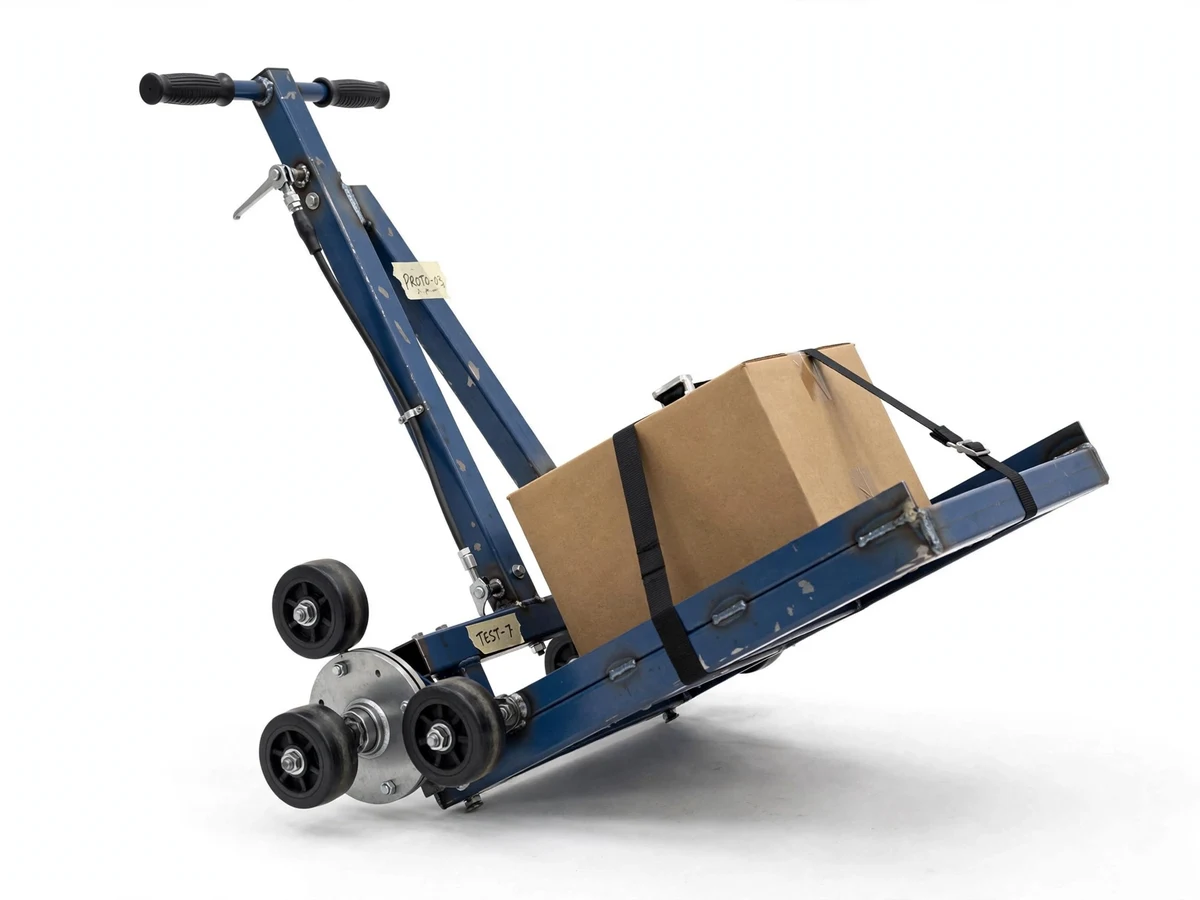
- The load is set on the platform against the retaining lip; straps can be added for tall or top-heavy loads.
- At the staircase the operator tilts the trolley back onto the cluster and begins pulling up.
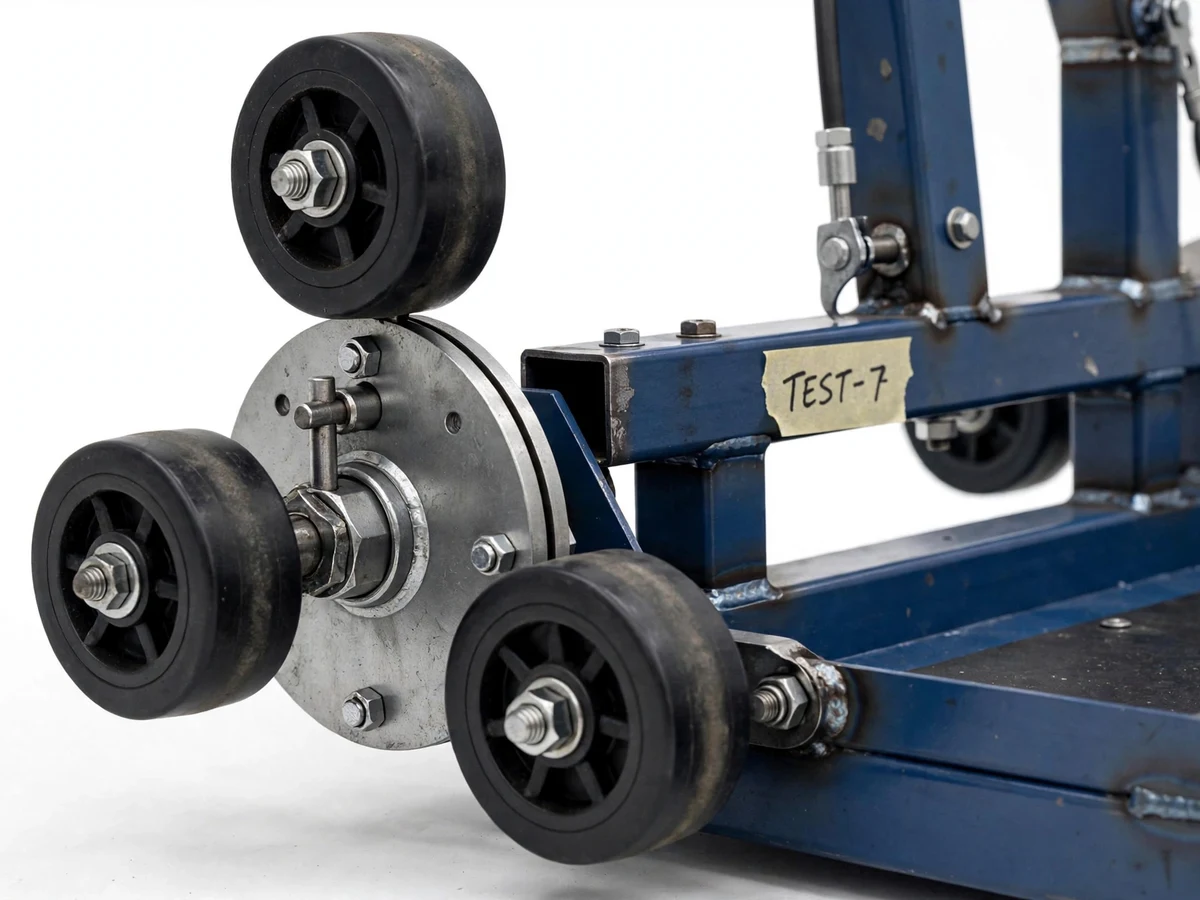
- When the leading wheel meets a riser, the carrier plate rotates about its central 20 mm axle, lifting the leading wheel while the next wheel in the 120° cycle settles onto the tread above.
- Each step repeats the rotation; the load rises one riser per cycle without being lifted clear of the ground.
- If the operator pauses mid-climb, the brake lever is re-engaged to pin the carrier so the trolley holds its position on the step instead of rolling back.
- On the landing the brake is locked again and the trolley rolls away on flat ground.
Tech stack:
- Mild-steel square-tube fabrication
- MIG welding · grinding · drilling
- Tri-star wheel cluster geometry
- Sealed ball bearings · 20 mm axle
- Solid rubber wheels (150 mm)
- Lever-and-cable brake linkage
- 2D CAD drafting
- Design calculations · report
| Parameter | Value |
|---|---|
| Wheel diameter | 150 mm (solid rubber, datasheet value) |
| Wheels per cluster | 3, spaced 120° apart (design) |
| Carrier arm radius (axle centre to wheel centre) | Approximately 110 mm (design value) |
| Stair compatibility | Risers ~17–18 cm, treads ~25–30 cm (design target) |
| Frame section | 25 × 25 mm MS square tube (design) |
| Load platform | Approximately 45 × 40 cm, 10 cm retaining lip |
| Handle height | Approximately 90–110 cm, adjustable (design) |
| Axle | 20 mm MS shaft on sealed ball bearings |
| Brake | Lever-actuated steel locking pin per carrier |
| Payload | 80–100 kg (design target; depends on weld quality and frame section) |
| Trolley weight | Approximately 14–18 kg (expected) |
| Drive | Manual pull; no motor |
Project features
- [Tri-star wheel cluster] One rotating carrier plate per side, each carrying three 150 mm solid-rubber wheels at 120° spacing on sealed ball bearings. On flat ground the cluster rolls on a single wheel per side; on a step the plate rotates and the next wheel lands on the tread, repeating the cycle each riser.
- [Lever-actuated brake lock] A hand lever beside the grip pulls a cable that drives a steel locking pin into the carrier plate. With the pin engaged the carrier cannot rotate, giving a stable two-wheel roll on flat floors and a fixed hold when the trolley is parked mid-climb.
- [MS square-tube frame] Welded 25×25 mm mild-steel square-tube frame with cross bracing under the platform and at the handle uprights, ground smooth and painted for corrosion resistance.
- [Load platform with retaining lip] Approximately 45×40 cm platform with a 10 cm raised lip and an anti-slip rubber mat, so cartons and cylinders sit securely during the tilt and climb.
- [Adjustable pull handle] Handle uprights with rubber grips at approximately 90–110 cm height, letting operators of different heights pull at a comfortable angle on both flat ground and stairs.
- [Stair-geometry design calculations] Carrier arm radius and wheel diameter are selected from standard riser (~17–18 cm) and tread (~25–30 cm) dimensions; the calculation sheet ships with the project for the viva.
- [Optional customization: folding platform] A hinged folding version of the load platform can be added on request for compact storage; it is not part of the base build.
What is included
- Working tri-star stair-climbing trolley prototype
- 2D fabrication drawings of frame, carrier plates and platform
- Design calculation sheet (stair geometry, axle and bearing sizing)
- Project report PDF (design, fabrication, testing procedure)
- PPT presentation for the final review
- Viva Q&A preparation document
- Abstract PDF
Limitations & prerequisites
- The 80–100 kg payload is a design target, not a measured rating; safe load depends on weld quality and must be verified with a static load test before regular use.
- Sized for standard risers of ~17–18 cm; unusually tall, shallow or spiral steps may not climb cleanly.
- The mechanism reduces lifting but the operator still pulls the full load up the slope — near-maximum loads are a two-person job.
- The brake pin must be fully seated before pausing on stairs; a partially engaged pin can wear the plate holes.
- Solid rubber wheels transmit vibration on rough floors; pneumatic wheels are an optional customization.
- Not intended for passengers, unstrapped fragile loads, or staircases with turns narrower than the trolley.
- A student-fabricated prototype, not an industrially certified lifting device.
Frequently Asked Questions
How does the tri-star wheel climb a step?
Each side carries three wheels on a plate that rotates freely about a central axle. When the leading wheel hits a riser, pulling the trolley rotates the plate, lifting that wheel while the next wheel in the 120° cycle lands on the tread. The cycle repeats every step, so the load walks up the stairs instead of being lifted.
What does the brake lock do?
A hand lever drives a steel pin into the carrier plate, stopping it from rotating. Engaged on flat ground it keeps the cluster behaving like ordinary fixed wheels; engaged mid-climb it holds the trolley on a step so it cannot roll back while the operator rests or re-grips.
Which staircases will it climb?
The geometry is designed around standard risers of ~17–18 cm and treads of ~25–30 cm, which covers most residential and institutional staircases. Very tall, very shallow or spiral steps fall outside the design and may not climb cleanly.
Can the trolley be customized?
Yes. Realistic options include pneumatic wheels for rough floors, a folding load platform, a wider platform for cylinders, and a tow eye. Motorized assist is possible as future scope but is not part of the base build.
Is this project suitable for a final-year project?
Yes — for Mechanical and Production Engineering programs. It demonstrates mechanism design, stair-geometry synthesis, welded fabrication, static load analysis and bearing selection, with a full calculation sheet for the viva.
What will I receive with the project?
The working trolley prototype, 2D fabrication drawings, the design calculation sheet, project report PDF, review PPT, viva Q&A document and the abstract PDF.
Components & software requirements
- Mild-steel square-tube fabrication
- MIG welding · grinding · drilling
- Tri-star wheel cluster geometry
- Sealed ball bearings · 20 mm axle
- Solid rubber wheels (150 mm)
- Lever-and-cable brake linkage
- 2D CAD drafting
- Design calculations · report
Delivery information
Built-to-order project. Delivery timeline is shared after order confirmation based on current queue.
Support terms
Complete documentation, setup guide, and viva preparation included. Support for setup and explanation provided.
Download free synopsis (PDF)
Enter your name and email — the synopsis PDF downloads immediately. We may send occasional project updates; no spam, unsubscribe anytime.