
More project photos (3)
The problem
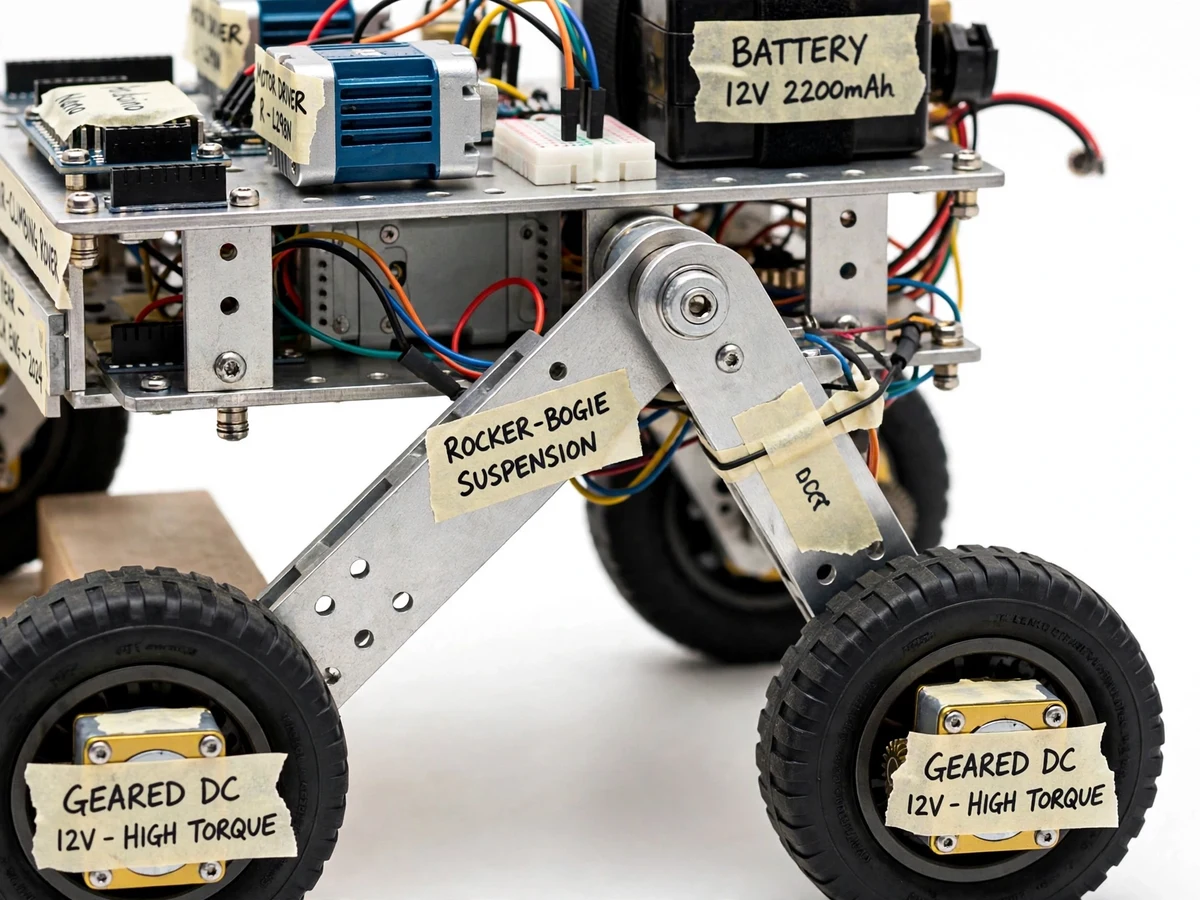
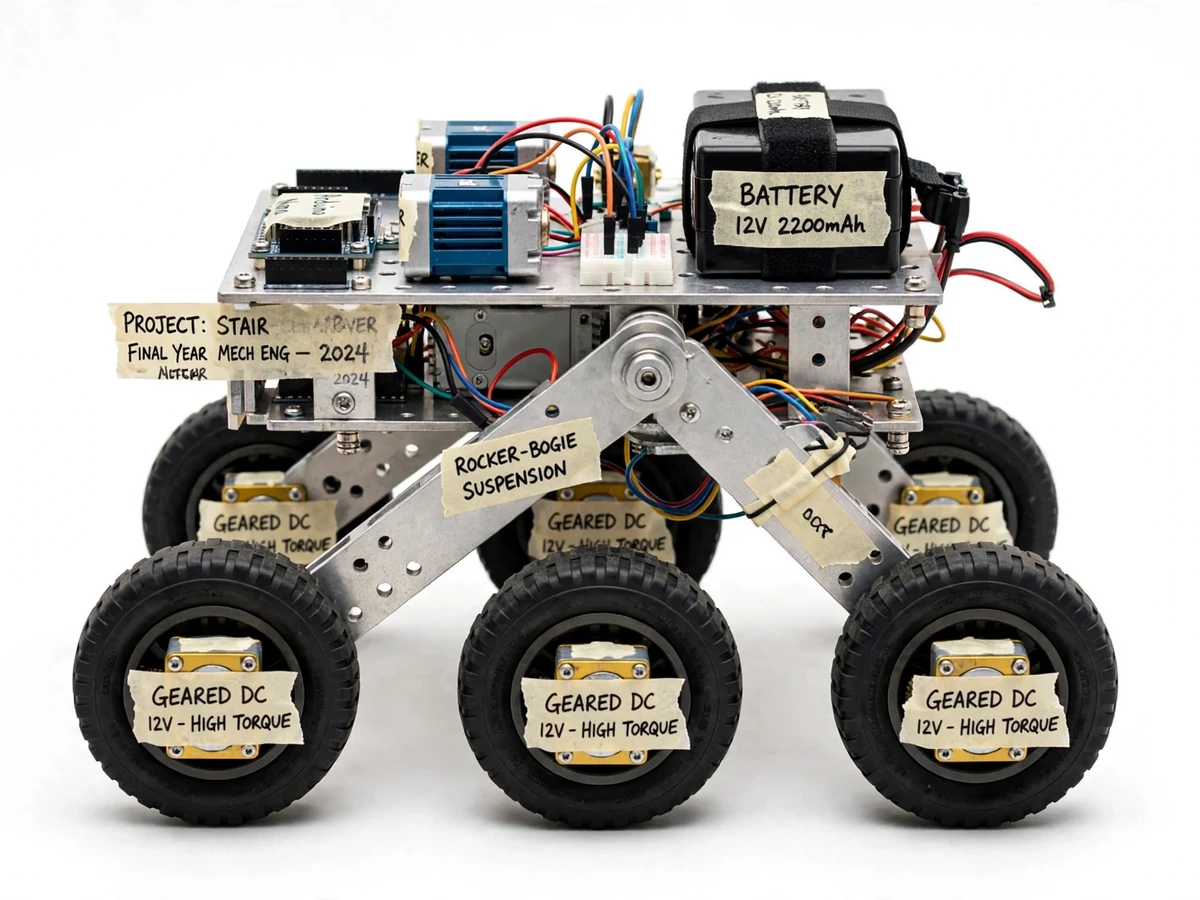
Wheels beat legs on flat ground and lose badly on stairs — the step edge is a wall to a small wheel. The rocker-bogie answer, proven on Mars rovers, keeps all wheels loaded as the body articulates over obstacles instead of high-centering. This project builds a student-scale stair climber: a six-wheel chassis with a pivoted rocker suspension, high-torque geared DC motors, and remote control, sized to climb standard domestic steps (approximately 150–180 mm rise, design target). The report documents the suspension geometry — pivot placement, wheel diameter versus step height — so the climbing ability is explained by design, not luck. Climbing is demonstrated on a test staircase the student builds or borrows, with the honest caveat that real staircases vary.
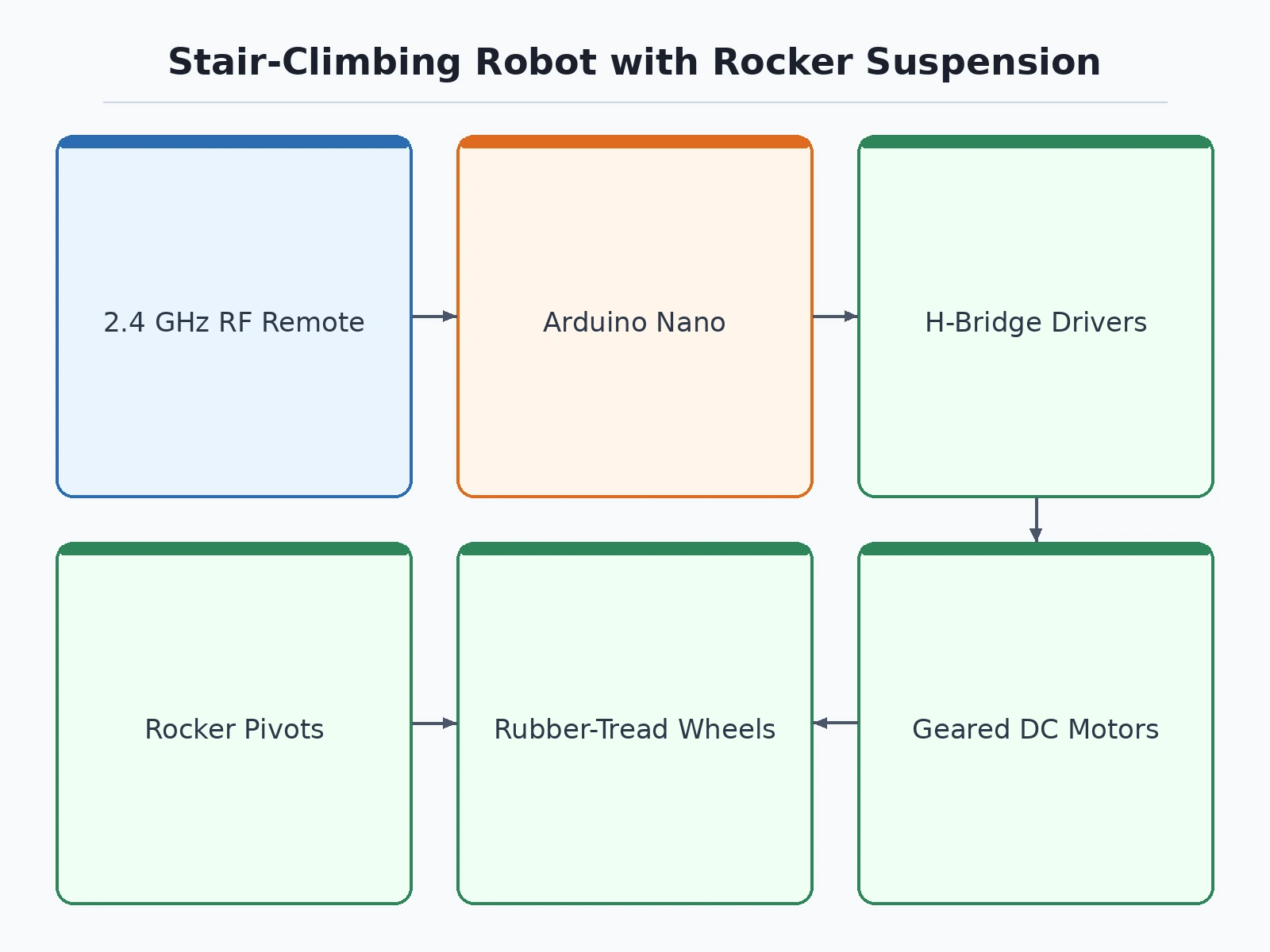
Drives the robot toward the staircase and modulates speed at each riser over the RF link.
Follow the working sequence
How it works
- The operator drives the robot toward the staircase via the remote link.
- The front wheels meet the first riser; rocker articulation lets them ride up while rear wheels stay loaded.
- High-torque motors pull the chassis forward as each wheel pair mounts its step.
- The pivoted suspension keeps the body near-level across the staircase profile.
- The operator modulates speed at each riser to avoid wheel spin on step edges.
- Climb trials on the test staircase are timed and recorded for the report's results section.
Tech stack:
- Arduino Nano (ATmega328P)
- 6 high-torque geared DC motors
- H-bridge motor drivers
- Rocker suspension (fabricated pivots)
- Rubber-tread wheels (large diameter)
- 2.4 GHz RF / Bluetooth remote
- Aluminium/steel chassis (fabricated)
- Arduino IDE (C/C++ firmware)
| Parameter | Value |
|---|---|
| Wheels | 6, large-diameter rubber tread (design) |
| Suspension | Pivoted rocker arms, front + rear |
| Step rise | Approximately 150–180 mm (design target) |
| Motors | 6 high-torque geared DC (design) |
| Control | Remote: 2.4 GHz RF or Bluetooth |
| Chassis | Fabricated aluminium/steel |
| Climb speed | Slow and controlled; trial-timed (buyer-run) |
| Surface | Dry steps; wet edges reduce traction |
Project features
- [Rocker-style suspension] Pivoted rocker arms let the wheels articulate over step edges while keeping the body level and all wheels loaded.
- [Six-wheel drive] High-torque geared DC motors on six wheels give the traction and step-edge leverage a four-wheel chassis lacks.
- [Step-height design] Wheel diameter and rocker geometry are sized against standard step rises of approximately 150–180 mm (design target).
- [Remote control] A 2.4 GHz RF or Bluetooth link gives the operator full drive control during climbs.
- [Articulated body] The chassis pivots let front and rear sections conform to the staircase profile instead of bridging across steps.
- [High-traction wheels] Rubber-tread wheels sized for step edges, documented with the traction reasoning in the report.
- [Test staircase procedure] A guide to building a standard test staircase and running repeatable climb trials for the report.
What is included
- Six-wheel stair-climbing chassis with rocker suspension
- Arduino firmware (motor mixing, remote control)
- Suspension geometry documentation
- Test staircase build guide and trial procedure
- Project report PDF, PPT presentation and viva Q&A document
Limitations & prerequisites
- The approximately 150–180 mm step-rise capability is a design target; real staircases vary and the student verifies on their test staircase.
- Wet or polished step edges reduce traction — climbs are demonstrated on dry steps.
- Climbing is slow by design; torque is traded for speed in the gearing.
- The robot is teleoperated; autonomous stair detection is future scope, not included.
- Battery endurance under climbing load is shorter than on flat ground (buyer-run measurement).
Frequently Asked Questions
How does it climb stairs?
Rocker suspension lets the wheels articulate over each riser while the body stays level and all wheels stay loaded. High-torque geared motors then pull the chassis up step by step — the same principle as rocker-bogie Mars rovers.
What step height can it handle?
The geometry targets standard domestic steps of approximately 150–180 mm rise. The student verifies this on their own test staircase and records the trials.
Is it autonomous?
No — it is teleoperated via remote link. Autonomous stair detection with vision or ranging is listed as future scope.
Why six wheels instead of four?
Six driven wheels with rocker articulation keep traction through the transition when some wheels are on risers and others on treads — a four-wheel chassis tends to high-center or lose grip mid-climb.
What about slippery steps?
Rubber-tread wheels are specified for grip, but wet or highly polished edges still reduce traction. Demonstrations are run on dry steps, stated honestly in the report.
Is this project suitable for a final-year project?
Yes — for Mechanical, Mechatronics and Robotics programs. It combines suspension design, drivetrain sizing, fabrication and documented trial testing. Suitable for B.E./B.Tech final-year projects in Mechanical, Mechatronics and Robotics.
Components & software requirements
- Arduino Nano (ATmega328P)
- 6 high-torque geared DC motors
- H-bridge motor drivers
- Rocker suspension (fabricated pivots)
- Rubber-tread wheels (large diameter)
- 2.4 GHz RF / Bluetooth remote
- Aluminium/steel chassis (fabricated)
- Arduino IDE (C/C++ firmware)
Delivery information
Built-to-order project. Delivery timeline is shared after order confirmation based on current queue.
Support terms
Complete documentation, setup guide, and viva preparation included. Support for setup and explanation provided.
Download free synopsis (PDF)
Enter your name and WhatsApp number — the synopsis PDF downloads immediately. We may send occasional project updates on WhatsApp; no spam.