
More project photos (2)
The problem
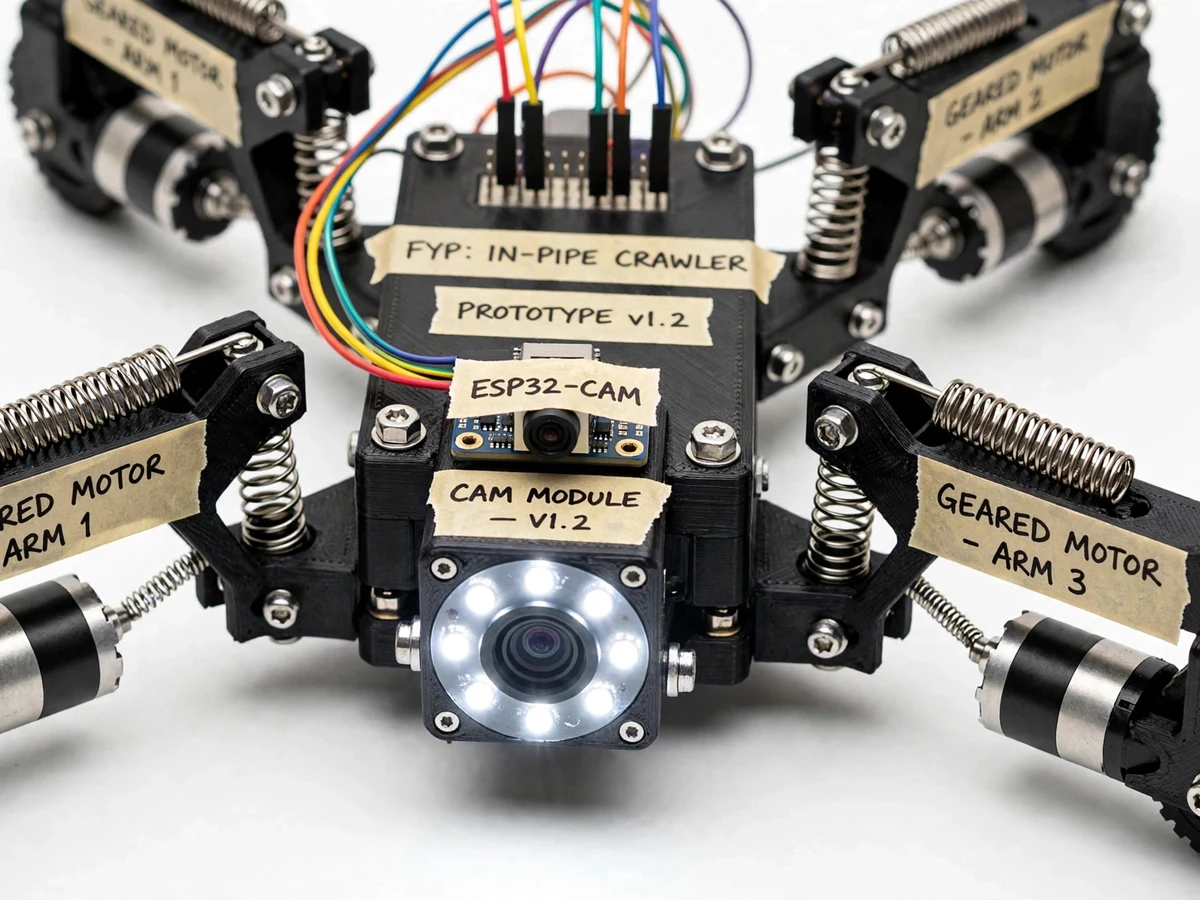
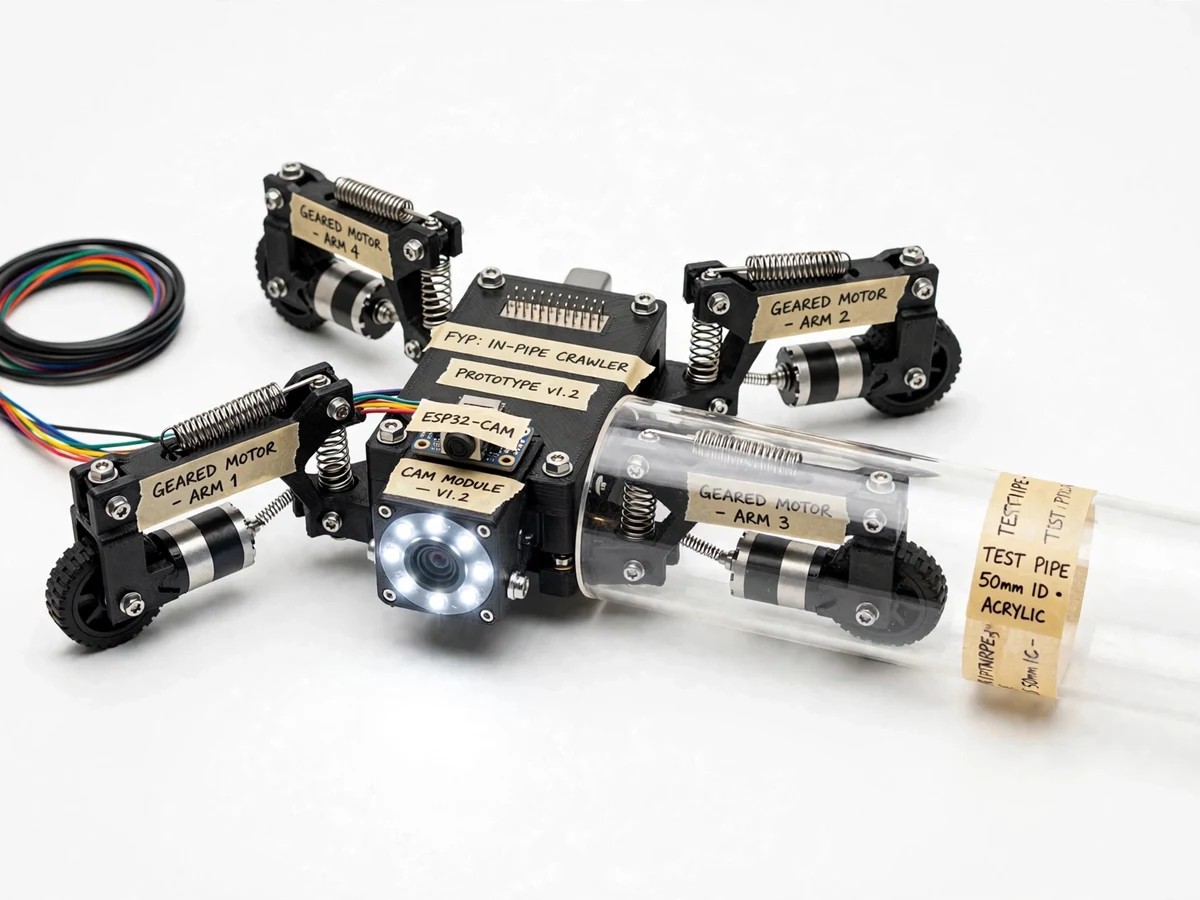
Buried and built-in pipelines fail invisibly: cracks, root intrusion and scale build up where nobody can see, and the failure announces itself as a burst main or a blocked drain. Professional pipe-inspection crawlers cost lakhs, so small municipalities and college labs never get to study one. This project builds a student-scale in-pipe inspection robot: a compact tethered crawler sized for 100–150 mm (4–6 inch) pipes, with spring-loaded traction wheels that press against the pipe wall, an ESP32-CAM streaming live video over Wi-Fi, and LED illumination for the dark interior. The operator drives it through a transparent test-pipe rig (built per the included guide) and watches the inspection feed on a phone or laptop. Traction force, tether management and camera lighting are documented as design analysis — the honest engineering a pipe robot actually needs.
How it works
- The student builds the transparent test pipeline per the guide, including a bend and planted defects (crack tape, intrusion).
- The crawler is inserted at the pipe mouth with its tether managed at the operator station.
- LEDs illuminate the pipe interior; the ESP32-CAM streams live video over Wi-Fi to the operator's screen.
- The operator drives the crawler forward with the remote, spring arms maintaining wall traction through the bend.
- Planted defects are spotted on the live feed and logged with their distance markers.
- The tether retrieves the crawler; the detection log becomes the report's results section.
Tech stack:
- ESP32-CAM module (Wi-Fi video)
- Geared DC motors (compact)
- Spring-loaded traction wheel arms
- High-brightness white LEDs
- Motor driver (compact H-bridge)
- Lightweight tether cable
- Transparent test-pipe rig (acrylic/PVC)
- Arduino IDE (C/C++ firmware)
| Parameter | Value |
|---|---|
| Pipe size | 100–150 mm ID (4–6 inch, design) |
| Camera | ESP32-CAM, Wi-Fi video stream |
| Illumination | White LED array ahead of camera |
| Traction | Spring-loaded drive wheels (design) |
| Control | Tethered drive commands + retrieval |
| Test rig | Transparent pipe with bend (buyer-built) |
| Tether | Lightweight, length per test rig (design) |
| Power | Tether-carried or onboard battery (design option) |
Project features
- [100–150 mm pipe crawler] Compact chassis with spring-loaded traction wheels sized for standard 4–6 inch PVC/drain pipes.
- [ESP32-CAM live video] Live inspection video streamed over Wi-Fi to a phone or laptop browser at the operator station.
- [LED pipe illumination] High-brightness white LEDs light the pipe interior ahead of the camera for clear inspection footage.
- [Spring-loaded wall traction] Spring arms press the drive wheels against the pipe wall, keeping traction through bends and joints (design).
- [Tethered control and retrieval] A lightweight tether carries control signals and guarantees the crawler can always be pulled back — no lost robots.
- [Transparent test-pipe rig guide] Build instructions for a clear acrylic/PVC test pipeline with bends and a planted defect for repeatable inspection trials.
- [Defect-spotting trial procedure] A documented procedure: plant known defects, run the crawler, and record detection results for the report.
What is included
- In-pipe crawler chassis with camera, LEDs and traction wheels
- ESP32-CAM firmware (video stream, drive control, LED control)
- Tether cable and operator-station guide
- Transparent test-pipe rig build instructions
- Defect-spotting trial procedure
- Project report PDF, PPT presentation and viva Q&A document
Limitations & prerequisites
- Sized for 100–150 mm pipes (design); smaller or larger pipes need a rescaled chassis.
- Wi-Fi video range inside real buried pipes is limited — trials run in the transparent test rig, stated honestly.
- The tether limits inspection distance to its length; this is a lab demonstrator, not a municipal crawler.
- Spring traction is a design approach verified in the test rig; heavily scaled or rough pipes are experimental.
- No autonomous defect recognition is included — spotting is done by the operator on the live feed (AI detection is future scope).
Frequently Asked Questions
How does it see inside the pipe?
An ESP32-CAM streams live video over Wi-Fi to the operator's phone or laptop, lit by a white LED array ahead of the camera — the pipe interior is pitch dark without it.
How does it move inside the pipe?
Spring-loaded arms press the drive wheels against the pipe wall, giving traction to climb through straight runs and bends. A tether carries control and guarantees retrieval.
What pipes does it fit?
The design targets 100–150 mm internal diameter (standard 4–6 inch PVC/drain pipes). Other sizes need a rescaled chassis, noted in the guide.
How do I test it without a real pipeline?
The kit includes build instructions for a transparent test-pipe rig with a bend, where you plant known defects (crack tape, intrusions) and run detection trials.
Can it find defects by itself?
No — defect spotting is done by the operator watching the live feed. The trial procedure has you log detections against planted defects; AI-based detection is future scope.
Is this project suitable for a final-year project?
Yes — for Mechanical, Mechatronics and Robotics programs. It combines compact mechanism design, traction analysis, embedded video and a documented test methodology. Suitable for B.E./B.Tech final-year projects in Mechanical, Mechatronics and Robotics.
Components & software requirements
- ESP32-CAM module (Wi-Fi video)
- Geared DC motors (compact)
- Spring-loaded traction wheel arms
- High-brightness white LEDs
- Motor driver (compact H-bridge)
- Lightweight tether cable
- Transparent test-pipe rig (acrylic/PVC)
- Arduino IDE (C/C++ firmware)
Delivery information
Built-to-order project. Delivery timeline is shared after order confirmation based on current queue.
Support terms
Complete documentation, setup guide, and viva preparation included. Support for setup and explanation provided.