
More project photos (2)

The problem
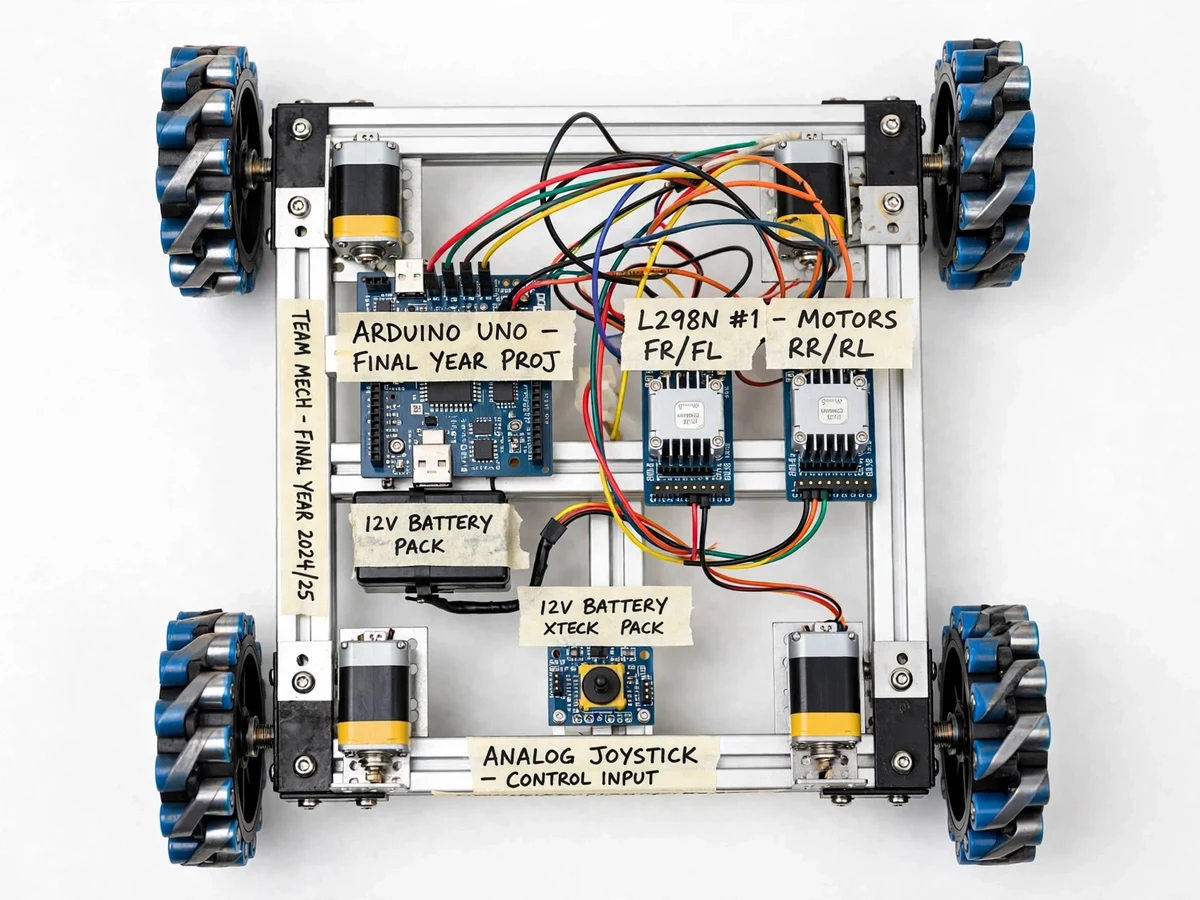
Ordinary wheeled robots can only drive forward and turn — in tight aisles they must perform multi-point maneuvers like a car. Mecanum wheels solve this mechanically: rollers set at 45° around each wheel convert the four wheels' spin into any planar motion, including pure sideways strafing and spot rotation, with no steering mechanism at all. This project builds a complete mecanum platform: a fabricated aluminium chassis, four mecanum wheels on geared DC motors, independent H-bridge drivers, and an Arduino implementing the inverse-kinematics mixer that turns a desired velocity vector (vx, vy, yaw rate) into four wheel speeds. Drive comes from a joystick for proportional control and a Bluetooth phone app for convenience. The report derives the kinematics honestly and documents the measured strafing behavior — the part that makes examiners take the build seriously.
How it works
- The desired motion — forward/back, left/right strafe and rotation — is read from the joystick or Bluetooth app as a velocity vector.
- The Arduino applies the mecanum inverse-kinematics equations to compute each wheel's required speed and direction.
- Four independent H-bridge channels drive the geared DC motors at those speeds via PWM.
- The 45° rollers on the mecanum wheels resolve the four wheel motions into the commanded planar motion of the chassis.
- The student runs the strafing calibration procedure, trimming per-motor PWM so strafe commands track straight.
- Joystick mode demonstrates proportional omnidirectional drive; Bluetooth mode allows remote demonstration.
Tech stack:
- Arduino Uno/Nano (ATmega328P)
- 4 mecanum wheels (100 mm class)
- 4 geared DC motors (TT/BO class)
- Dual H-bridge motor drivers (L298N class)
- Analog joystick module
- HC-05 Bluetooth module
- Aluminium chassis (fabricated)
- Arduino IDE (C/C++ firmware)
| Parameter | Value |
|---|---|
| Wheels | 4 mecanum, 100 mm class, 45° rollers |
| Motors | 4 geared DC, TT/BO class (design) |
| Drive | Independent PWM per wheel via H-bridges |
| Motions | Forward, strafe, diagonal, spot rotation |
| Control | Joystick proportional + Bluetooth |
| Chassis | Fabricated aluminium frame (design) |
| Payload | Approximately 2–3 kg on flat floors (design target) |
| Surface | Flat hard floors; rollers need grip |
Project features
- [True omnidirectional drive] Four mecanum wheels with 45° rollers give forward, strafe, diagonal and spot-rotation motion with zero steering hardware.
- [Inverse-kinematics mixer] Arduino firmware converts the commanded velocity vector (vx, vy, yaw rate) into four independent wheel speeds using the standard mecanum mixing equations.
- [Proportional joystick control] An analog joystick gives speed-proportional drive in any direction, demonstrating the platform's full motion envelope.
- [Bluetooth phone control] An HC-05 link allows drive from a phone app for demonstration convenience.
- [Independent motor drivers] Each geared DC motor has its own H-bridge channel, so wheel speeds are truly independent as the kinematics require.
- [Fabricated aluminium chassis] A rigid laser-cut/drilled aluminium frame keeps wheel geometry true — geometry errors show up immediately as drift.
- [Strafing calibration procedure] A documented procedure trims motor speeds so pure strafe commands produce straight sideways motion on the student's floor.
What is included
- Mecanum robot chassis with 4 wheels, motors and drivers
- Arduino firmware (kinematics mixer, joystick + Bluetooth modes)
- Inverse-kinematics derivation document
- Strafing calibration procedure
- Project report PDF, PPT presentation and viva Q&A document
Limitations & prerequisites
- Mecanum rollers need flat, hard, clean floors — carpet, gravel or wet surfaces defeat the kinematics.
- Payload of approximately 2–3 kg is a design target for the specified motors; overloading stalls the rollers.
- Roller friction means mecanum platforms are less energy-efficient than differential drive; battery life reflects that.
- Pure strafe accuracy depends on the buyer-run calibration on their own floor surface.
- No autonomous navigation is included — this is a teleoperated platform (autonomy is future scope).
Frequently Asked Questions
How do mecanum wheels move sideways?
Each wheel's rollers sit at 45°. Spinning the four wheels in the right pattern makes the roller forces cancel fore-aft and add up sideways — the chassis strafes with no steering mechanism. The report derives the mixing equations.
What motions can it do?
Forward/backward, pure left/right strafe, diagonal translation, and rotation in place — any combination, since the kinematics mixer handles arbitrary (vx, vy, yaw-rate) commands.
What surfaces does it need?
Flat, hard, clean floors. Carpet, gravel or wet surfaces let the rollers slip and the kinematics break down — a documented limitation, not a defect.
How is it controlled?
Two modes: a proportional analog joystick for fine driving, and Bluetooth from a phone app for convenient demonstrations.
Can it carry a load?
Approximately 2–3 kg on flat floors is the design target with the specified motors. Heavier loads need bigger motors and wheels, noted as a scaling step.
Is this project suitable for a final-year project?
Yes — for Mechanical, Mechatronics and Robotics programs. It combines mechanism design, kinematics, motor control and a documented calibration procedure. Suitable for B.E./B.Tech final-year projects in Mechanical, Mechatronics and Robotics.
Components & software requirements
- Arduino Uno/Nano (ATmega328P)
- 4 mecanum wheels (100 mm class)
- 4 geared DC motors (TT/BO class)
- Dual H-bridge motor drivers (L298N class)
- Analog joystick module
- HC-05 Bluetooth module
- Aluminium chassis (fabricated)
- Arduino IDE (C/C++ firmware)
Delivery information
Built-to-order project. Delivery timeline is shared after order confirmation based on current queue.
Support terms
Complete documentation, setup guide, and viva preparation included. Support for setup and explanation provided.