
More project photos (3)
The problem
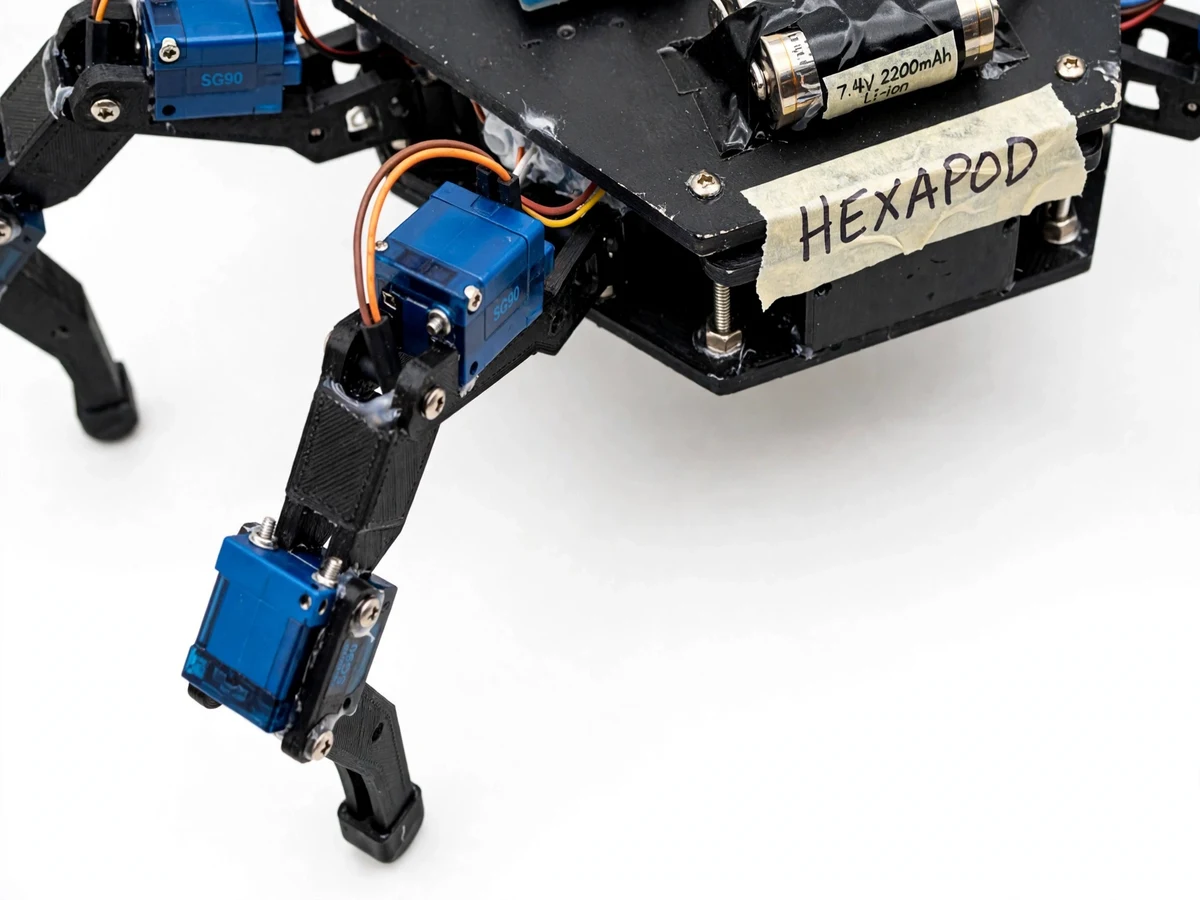
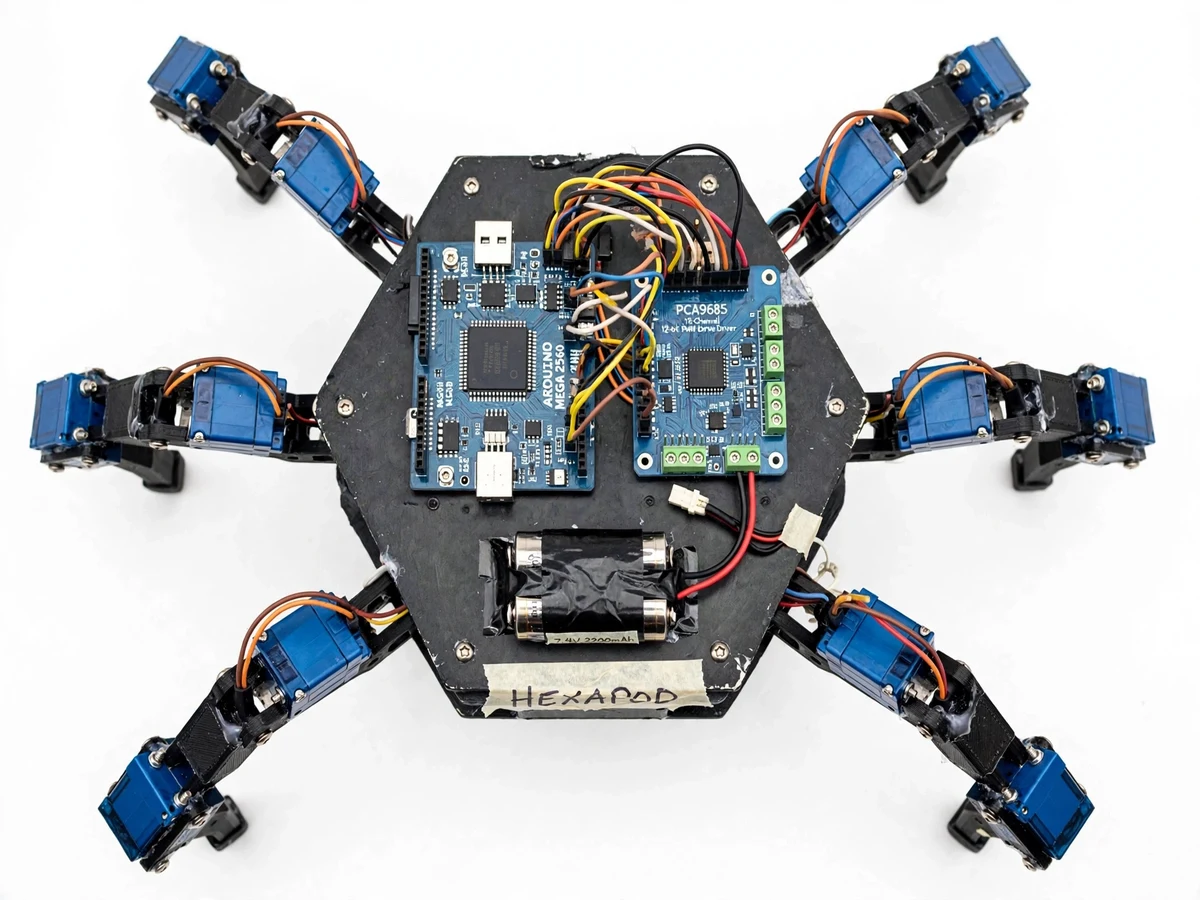
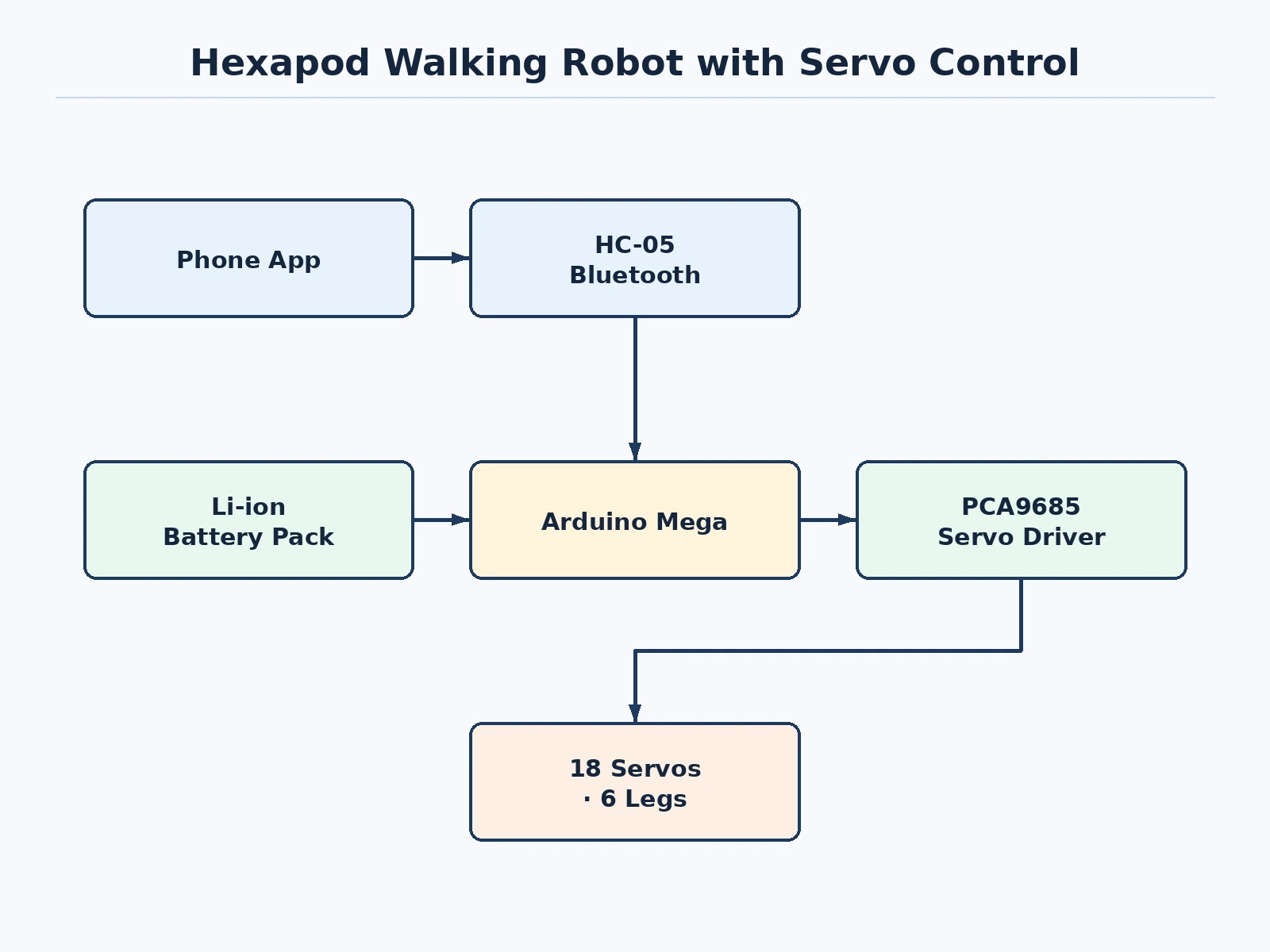
Wheeled robots fail where legs succeed — stairs, rubble, uneven ground — which is why six-legged robots are a staple of locomotion research and a favorite final-year build. A hexapod is statically stable: with six legs it can keep at least three feet on the ground at all times, so it never needs the dynamic balancing of a biped. The engineering content is rich anyway: each leg is a 3-DOF serial arm (coxa, femur, tibia), the tripod gait coordinates all 18 servos in an insect-like stepping pattern, and the kinematics map body motion to joint angles in real time. This project builds the full system: a laser-cut/3D-printed hexapod body, 18 hobby servos, an Arduino Mega with a PCA9685 16-channel servo driver plus a second channel bank, tripod-gait firmware with adjustable stride and speed, and Bluetooth remote control.
The student drives walking, turning and strafing and tunes stride, step height and speed live.
Follow the working sequence
How it works
- The student assembles the body plates and six 3-joint legs from the kit parts, mounting one servo per joint with the supplied brackets and hardware.
- Each servo is plugged into the PCA9685 driver channels per the wiring map, and the per-servo zero trims are set with the calibration procedure so all legs are symmetric.
- The firmware's gait engine computes the tripod stepping pattern: at any moment one tripod of three legs is in stance (pushing the body) while the other tripod swings forward.
- Leg-tip trajectories are converted to coxa/femur/tibia angles with the documented 3-DOF leg inverse kinematics, and the PCA9685 outputs the servo pulses.
- The student connects over Bluetooth and drives the robot — walking, turning, strafing — and tunes stride, step height and speed live.
- The tuning and calibration results are recorded in the report's experiment section, with photos of the gait sequence.
Tech stack:
- Arduino Mega 2560 (ATmega2560)
- PCA9685 16-channel PWM servo driver (+ channel extension)
- 18 x SG90/MG90S-class servo motors (3 per leg)
- 3-DOF leg inverse kinematics (documented derivation)
- Tripod gait engine (C/C++ firmware)
- HC-05 Bluetooth module with documented command protocol
- Laser-cut / 3D-printed body and leg parts
- 2S Li-ion battery pack with protection
| Parameter | Value |
|---|---|
| Legs | 6, each 3-DOF (coxa, femur, tibia) |
| Servos | 18 x SG90 class, approximately 2.5 kg·cm stall (datasheet) |
| Body | Approximately 200 mm hexagonal plate (design) |
| Walking speed | Approximately 5–10 cm/s in tripod gait (expected) |
| Battery | 2S Li-ion, approximately 2200 mAh (design) |
| Expected runtime | Approximately 20–30 min walking per charge (expected) |
| Control range | Approximately 10 m Bluetooth (expected) |
| Overall weight | Approximately 1.2 kg (design) |
Project features
- [18-servo legged platform] Six legs with three joints each (coxa, femur, tibia) give true 3-DOF legs — the robot can walk, turn, strafe and change body height and posture.
- [Tripod gait engine] The firmware implements the insect tripod gait: two alternating tripods of three legs, so the robot is always supported while three legs swing — statically stable walking.
- [PCA9685 servo control] A dedicated 16-channel PWM servo driver (plus extension) generates jitter-free pulses for all servos; the Arduino Mega handles gait sequencing and kinematics.
- [Bluetooth remote control] Walk forward/backward, turn, strafe and change speed and body height from a phone app; commands are parsed in firmware with a documented protocol.
- [Adjustable gait parameters] Stride length, step height, speed and body height are runtime-tuneable, so the student can experiment with gait performance hands-on.
- [Servo calibration procedure] A per-servo zero-trim and leg-levelling procedure ensures all six legs move symmetrically — documented for the student to run on their build.
- [Posture modes] Stand, crouch, and wave-hello demo poses are built in, which makes the review demo memorable.
What is included
- Working hexapod robot (body, 18 servos, electronics, battery)
- Tripod-gait firmware with Bluetooth control and posture modes
- Servo calibration and gait-tuning procedure document
- Mechanical assembly guide with wiring map
- Project report PDF (legged locomotion, gait theory, leg kinematics, tuning)
- PPT presentation for final review
- Viva Q&A preparation document (tripod gait, inverse kinematics, servo control)
Limitations & prerequisites
- Walks on flat, firm surfaces — stairs, sand, deep carpet and wet floors are out of scope.
- Hobby servos limit payload: the robot carries itself and light sensors only, not cargo.
- Continuous walking heats the servos; sessions of about 15–20 minutes with cool-downs are recommended.
- Gait tuning is hands-on — the procedure is documented but the student runs it on their build.
- Bluetooth range is approximately 10 m line-of-sight; it is a demo link, not a long-range control system.
- 3D-printed/laser-cut parts have normal fabrication tolerances; the calibration procedure absorbs them.
Frequently Asked Questions
Why six legs instead of two or four?
Six legs give static stability — three feet stay on the ground at all times in the tripod gait, so the robot never needs dynamic balancing. That makes it a far more forgiving and demonstrable student build than a biped.
What is the tripod gait?
The insect walking pattern: legs are grouped into two tripods (front+rear on one side, middle on the other), and the tripods alternate between stance and swing. The firmware generates it with adjustable stride and step height.
How are 18 servos driven from one Arduino?
Through a PCA9685 16-channel PWM driver (with an extension bank) — a dedicated chip generates all the servo pulses precisely, while the Mega runs the gait math.
What is leg inverse kinematics?
For a desired foot position (from the gait trajectory), the firmware computes the coxa, femur and tibia angles using the leg's geometry. The derivation is documented in the report for the viva.
Can it climb stairs or rough terrain?
Not as shipped — it walks on flat, firm ground. Terrain adaptation with IMU feedback is listed as future scope.
Is this project suitable for a final-year project?
Yes — for Mechanical, Mechatronics and Robotics programs. It combines mechanism design, kinematics, embedded control and experimental gait tuning. Suitable for B.E./B.Tech final-year projects in Mechanical, Mechatronics and Robotics.
Components & software requirements
- Arduino Mega 2560 (ATmega2560)
- PCA9685 16-channel PWM servo driver (+ channel extension)
- 18 x SG90/MG90S-class servo motors (3 per leg)
- 3-DOF leg inverse kinematics (documented derivation)
- Tripod gait engine (C/C++ firmware)
- HC-05 Bluetooth module with documented command protocol
- Laser-cut / 3D-printed body and leg parts
- 2S Li-ion battery pack with protection
Delivery information
Built-to-order project. Delivery timeline is shared after order confirmation based on current queue.
Support terms
Complete documentation, setup guide, and viva preparation included. Support for setup and explanation provided.
Download free synopsis (PDF)
Enter your name and WhatsApp number — the synopsis PDF downloads immediately. We may send occasional project updates on WhatsApp; no spam.