
More project photos (2)
The problem
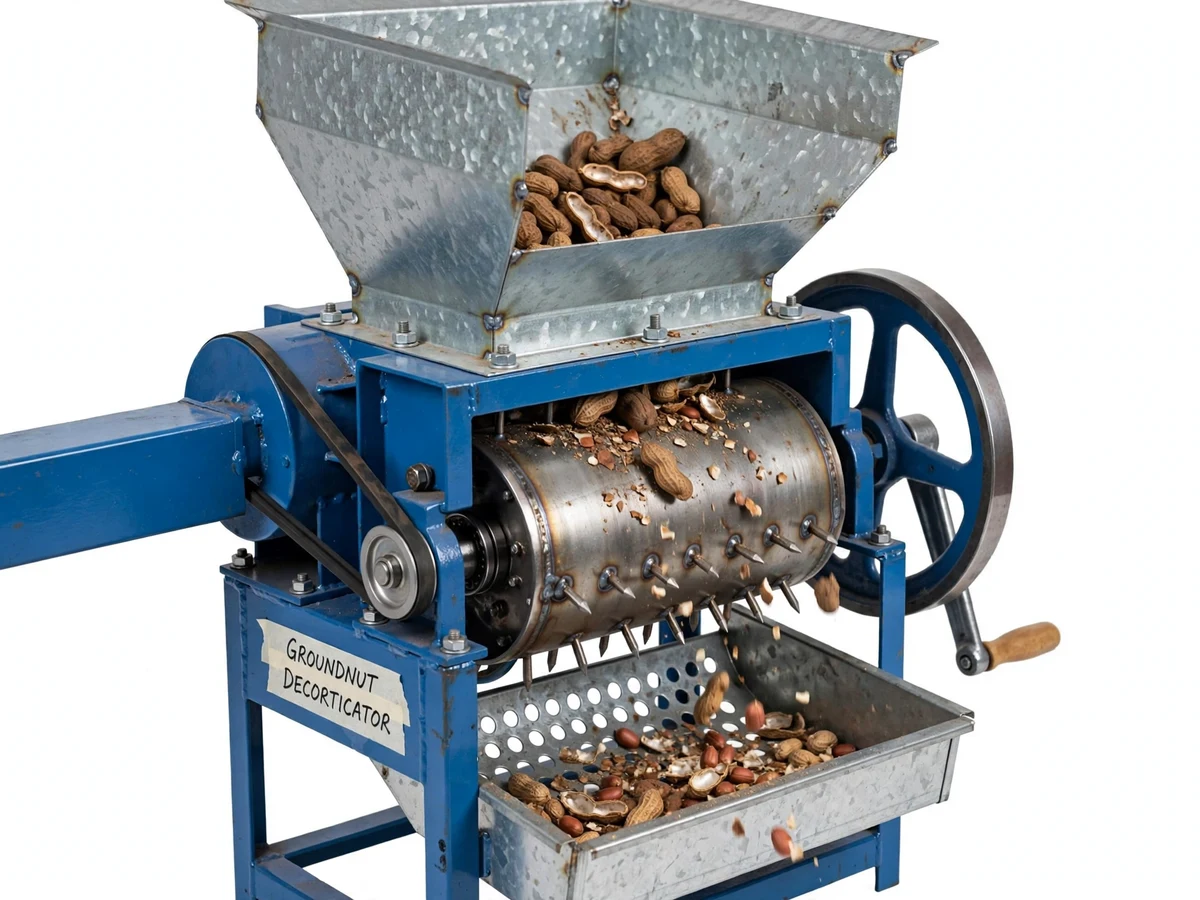
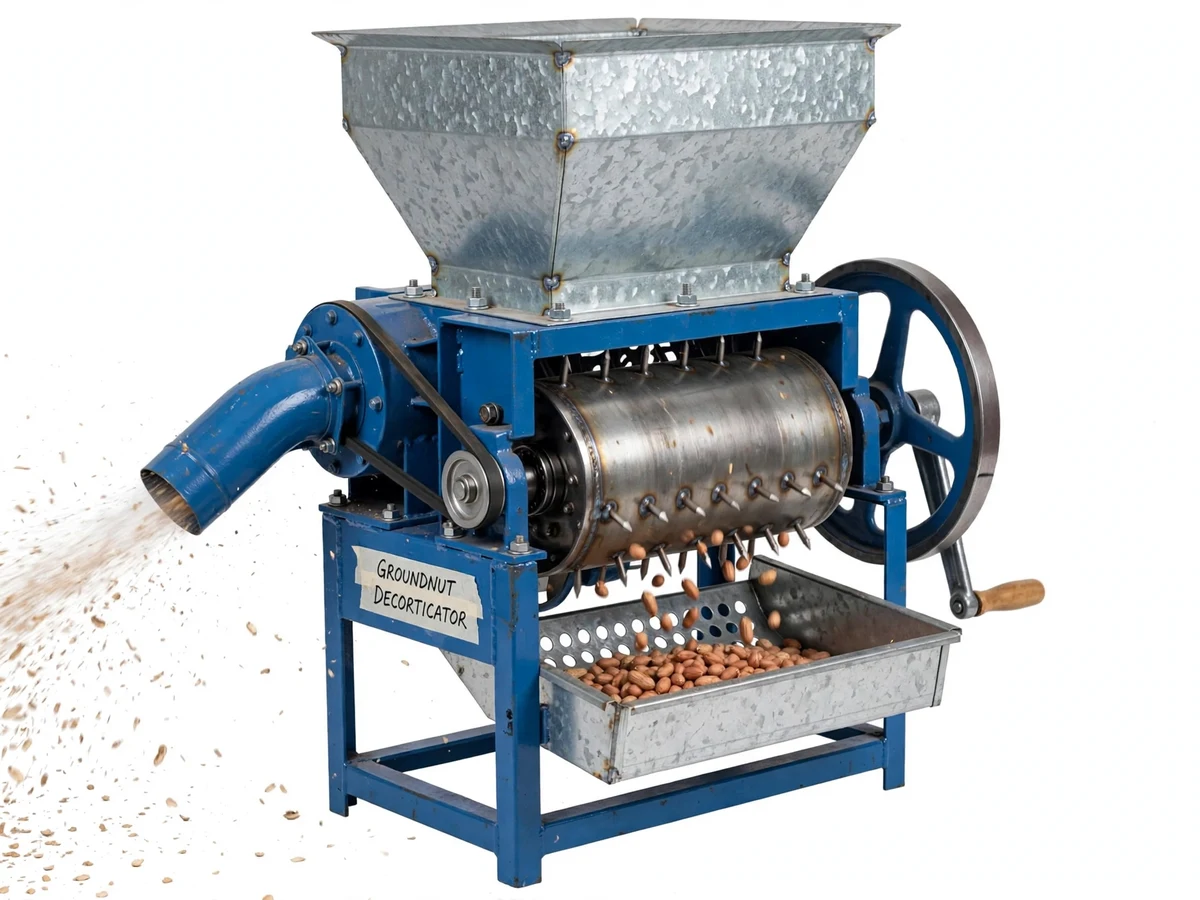
Shelling groundnuts by hand is slow, tedious work, and much of it falls on small and marginal farming families who cannot justify a motorised decorticator that needs electricity, capital and maintenance. The existing options leave a gap in the middle: hand shelling is too slow for even a small harvest, while commercial shellers are built for scale and the grid. A low-cost, human-powered machine that cracks pods and cleans the kernels in a single pass would cut post-harvest drudgery without demanding electricity or a large investment. This project fills that gap with a crank-operated decorticator: a spike-tooth drum does the shelling, and a blower attachment winnows the shells away from the kernels, both driven from the same hand crank through a belt drive.
Operator who cranks the machine, feeds pods and tunes the gates.
Follow the working sequence
How it works
- Dried, size-graded groundnut pods are poured into the galvanized feed hopper; the slide gate meters them into the shelling chamber at a steady rate.
- The operator turns the hand crank; the flywheel smooths the rotation and a V-belt carries power from the crank shaft to the shelling drum and the blower shaft.
- The spike-tooth drum (approximately 300–450 rpm at a normal cranking pace, operator-dependent) drags pods between the spikes and the concave grate, cracking shells open at the set clearance without crushing the kernels.
- The mixture of kernels, shell fragments and dust falls through the concave grate openings into the winnowing zone below.
- The blower's air stream crosses the falling mixture; the lighter shell chaff is blown sideways out of the discharge duct while the heavier kernels fall straight into the perforated collection tray.
- During the first minutes of a run the operator tunes the slide gate and the blower damper until the tray holds clean kernels and only shells exit the duct.
- Unshelled pods picked out of the tray can be re-passed once, and the cleaned kernels are weighed so the run's shelling result can be recorded.
Tech stack:
- Mild steel angle · sheet metal fabrication
- Spike-tooth shelling drum · concave grate
- V-belt · pulley power transmission
- Centrifugal blower · discharge duct
- Sealed ball bearings
- Arc welding · bolted fasteners
- Hand crank · flywheel
- AutoCAD · SolidWorks drawings
| Parameter | Value |
|---|---|
| Operation | Hand crank, flywheel-assisted, no electricity |
| Overall size | Approximately 1100 × 600 × 1200 mm (design target) |
| Weight | Approximately 45–60 kg (expected, fabrication-dependent) |
| Shelling drum | Spike-tooth, approximately 250 mm dia × 450 mm long (design target) |
| Drum speed | Approximately 300–450 rpm at a normal cranking pace (expected, operator-dependent) |
| Throughput | Approximately 25–40 kg of pods per hour (design target, operator-dependent) |
| Concave clearance | Adjustable, approximately 8–15 mm (design) |
| Blower | Centrifugal, belt-driven from the crank shaft |
| Drive | V-belt, pulley ratio approximately 1:3 (design target) |
| Frame | MS angle section, painted; belt and pulley guards included |
Project features
- [Hand-crank drive with flywheel] A large crank with a heavy flywheel smooths out the operator's strokes so the drum and blower hold steady speed, and the whole machine works anywhere — no electricity needed.
- [Spike-tooth shelling drum] A rotating drum fitted with hardened spike bars drags pods across the concave grate, cracking the shells open; kernels and shell fragments fall through the grate openings together.
- [Adjustable concave clearance] The gap between the drum and the concave grate can be set between roughly 8 and 15 mm, so shelling can be tuned for different pod sizes and moisture levels to balance breakage against unshelled pods.
- [Belt-driven blower winnowing] A centrifugal blower on the same crank-driven belt line pushes an air stream across the falling mixture; light shells are carried sideways out of the discharge duct while heavier kernels drop into the collection tray.
- [Adjustable air blast] A damper on the blower outlet lets the operator tune the air velocity during a run, so shells clear cleanly without lifting kernels out of the tray.
- [Feed hopper with slide gate] The galvanized hopper holds a full charge of pods and a sliding gate meters the feed into the shelling chamber, so the drum is never choked and the operator never overfeeds.
- [Sealed ball-bearing shafts] The drum and blower shafts run on sealed ball bearings for smooth rotation and minimal maintenance in dusty farm conditions.
- [Guarded, bolted frame] Belt and pulley guards cover the moving drives, and the whole machine is built on a bolted MS-angle frame that can be transported and demonstrated safely.
What is included
- Working hand-operated decorticator prototype with blower winnowing attachment
- Fabrication drawings (assembly drawing plus part drawings)
- Assembly and alignment guide
- Shelling test procedure the buyer runs to measure their own efficiency
- Project report PDF (background, design calculations, methodology, results)
- PPT presentation for final review
- Viva Q&A preparation document
Limitations & prerequisites
- Throughput is operator-dependent — a tired operator cranks slower, so expect wide variation between runs; the 25–40 kg/h figure is a design target, not a measured claim.
- Shelling quality depends on pod moisture and size grading; mixed-size or damp pods increase both kernel breakage and the unshelled fraction.
- Some kernel breakage is unavoidable in any spike-tooth design; clearance tuning reduces it but never eliminates it.
- The machine is sized for groundnut pods only — other crops need different drum and concave geometry.
- It is a demonstration-scale academic prototype, not a certified farm machine; there is no safety certification.
- Continuous cranking is physically demanding, so the build suits demonstrations and small batches rather than commercial-scale shelling.
Frequently Asked Questions
Is this project suitable for a final-year project?
Yes — for Mechanical Engineering. It demonstrates farm-machinery design, belt-and-pulley power transmission, fabrication practice and aerodynamic separation, with design calculations and a buyer-run test procedure that give strong viva material.
How does the blower run without a motor?
The blower shaft is belt-driven from the same crank line as the shelling drum, so one operator powers both shelling and winnowing. A damper on the blower outlet tunes the air blast to the pod batch.
What decides the shelling quality?
Pod moisture, size grading, drum-to-concave clearance and feed rate. The deliverables include a test procedure the buyer runs on their own build to measure shelled, broken and unshelled fractions honestly.
Can it be motorized or adapted to other crops?
Yes as customizations — a small motor can replace the hand crank, and the drum and concave geometry can be re-sized for crops such as cashew or shea. These are optional extensions developed on request, not part of the base build.
What are the main limitations?
Throughput varies with the operator, pods should be dried and size-graded for best results, some kernel breakage is unavoidable, and it is a demonstration-scale prototype rather than certified farm equipment.
What will I receive with the project?
The working prototype, fabrication drawings, assembly and alignment guide, the shelling test procedure, project report PDF, PPT presentation and viva Q&A document. Suitable for B.E./B.Tech final-year projects in Mechanical Engineering.
Components & software requirements
- Mild steel angle · sheet metal fabrication
- Spike-tooth shelling drum · concave grate
- V-belt · pulley power transmission
- Centrifugal blower · discharge duct
- Sealed ball bearings
- Arc welding · bolted fasteners
- Hand crank · flywheel
- AutoCAD · SolidWorks drawings
Delivery information
Built-to-order project. Delivery timeline is shared after order confirmation based on current queue.
Support terms
Complete documentation, setup guide, and viva preparation included. Support for setup and explanation provided.
Download free synopsis (PDF)
Enter your name and email — the synopsis PDF downloads immediately. We may send occasional project updates; no spam, unsubscribe anytime.