
More project photos (2)
The problem
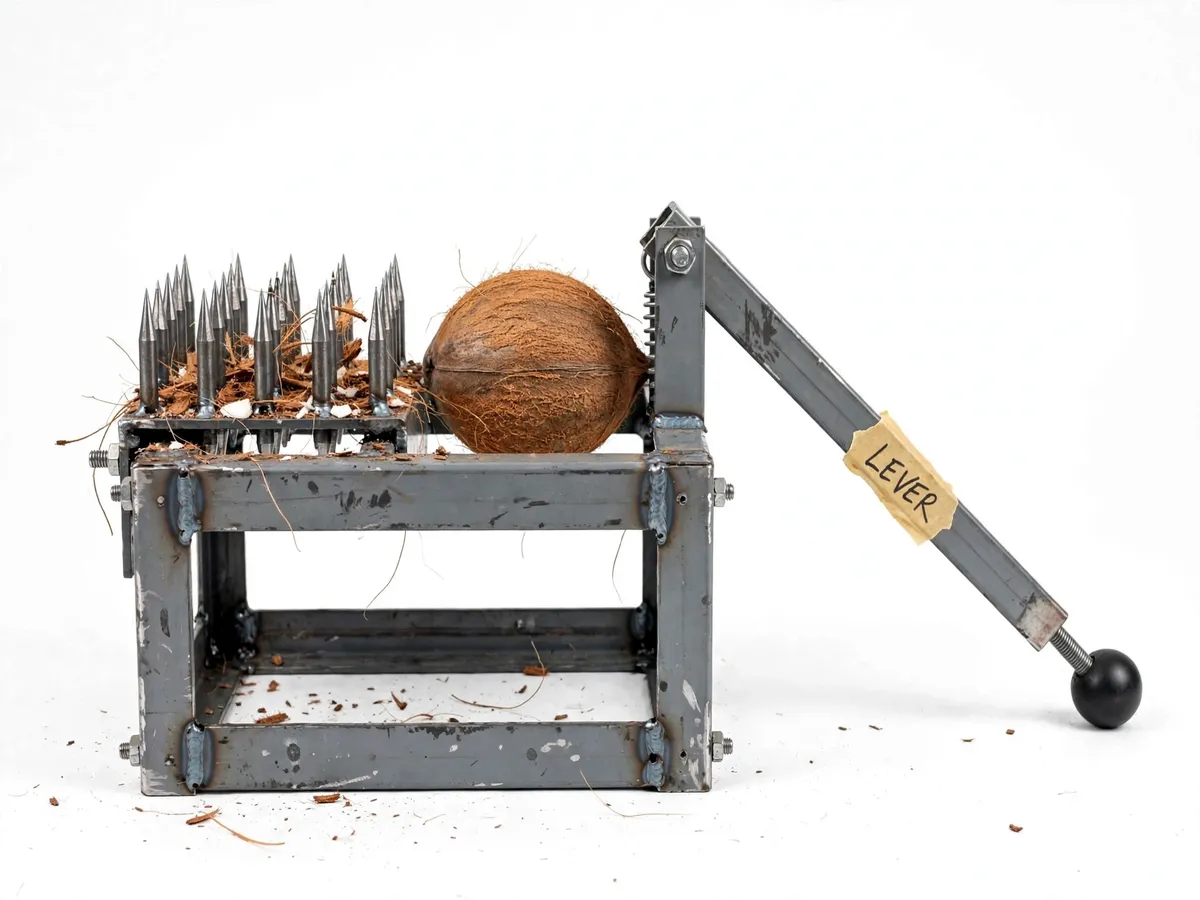
Coconut dehusking is still done by hand with a billhook in most small vendor stalls and farms: the operator stabs the nut onto a fixed spike, twists and pulls the fibrous husk off, and repeats this hundreds of times a day. It is slow, physically punishing, and dangerous — a slipped billhook means a deep cut, and the repeated force wears out wrists and shoulders. Powered dehuskers exist, but they are expensive, need electricity, and are overkill for a roadside vendor or a small farm that processes a few hundred nuts a day. This project builds the middle ground: a fully mechanical, lever-operated dehusking machine. A long lever arm multiplies the operator's effort through a pivot, pressing a coconut held on an adjustable spike plate so the husk tears away with a fraction of the hand force. The spike plate height adjusts to suit small and large coconuts. It is a genuine machine-design fabrication project — frame welding, lever-ratio calculations, spike geometry and spring return — demonstrated live with real coconuts.
Sets spike-plate height per batch, loads coconuts, pulls the lever and clears husk between nuts.
Follow the working sequence
How it works
- Set the spike-plate height: loosen the slot bolts, slide the plate to match the coconut size (low for small nuts, high for large mature ones), and re-tighten — a one-time setup per batch.
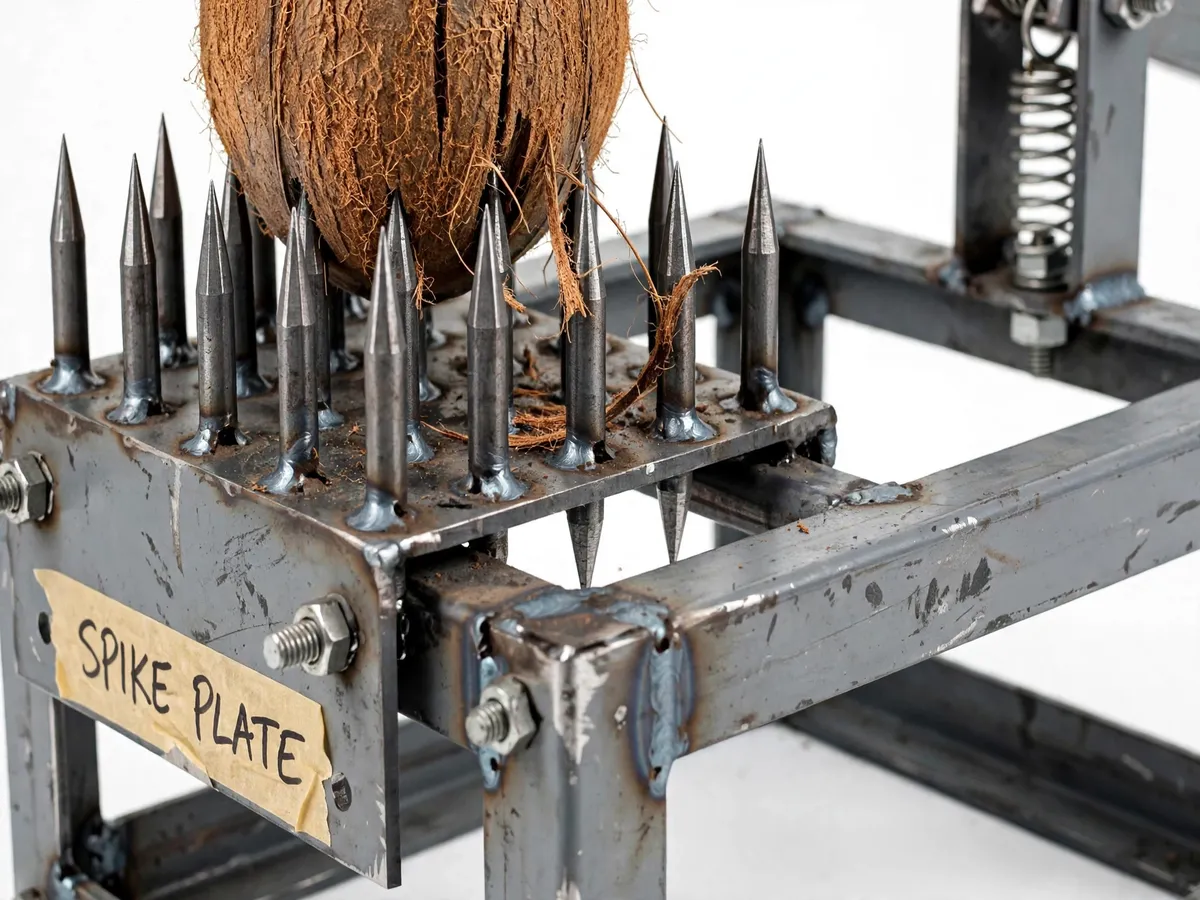
- Place the coconut on the spike plate and push it down so the spikes bite into the husk; the lower anvil spikes grip the underside of the nut.
- Pull the long lever down in a smooth stroke; the pivot multiplies the hand force and the driven plate tears a section of husk away from the shell.
- Rotate the coconut a quarter turn by hand and repeat the stroke — three to four strokes strip the full husk off a mature nut.
- Release the lever; the return spring lifts it back to the rest position while the husked coconut is lifted off the spikes and set aside.
- Strip the torn husk off the plate between nuts — a quick pull clears the spikes — then load the next coconut; a steady rhythm sustains the dehusking rate.
Tech stack:
- MS angle frame (welded)
- Long lever arm with pivot shaft · pillow-block bearings
- Adjustable spike plate with slotted mounts
- Hardened steel spikes
- Coil return spring
- Sheet-metal safety guard
- Arc welding · drilling · grinding (fabrication)
- Red-oxide primer · enamel coating
| Parameter | Value |
|---|---|
| Overall size | Approximately 600 x 450 mm footprint, approximately 1100 mm tall with lever up (design target) |
| Lever length | Approximately 950 mm from pivot (design target) |
| Mechanical advantage | Approximately 4:1–5:1 at the plate (design target, depends on pivot position) |
| Spike plate adjustment | Approximately 50 mm vertical travel in slotted bolt mounts (design target) |
| Spikes | Hardened steel, pointed, approximately 100–120 mm long (design target) |
| Coconut size | Mature nuts, approximately 150–250 mm diameter (design target) |
| Throughput | Approximately 25–40 coconuts per hour per operator (design target, operator- and nut-dependent) |
| Operating effort | Hand pull, approximately 15–25 kgf at the handle grip (design target, varies with nut maturity) |
| Lever return | Coil tension spring; lever self-resets after each stroke |
| Finish | Red-oxide primer with enamel top coat |
Project features
- [Lever arm with mechanical advantage] A long steel lever arm pivots on the frame and multiplies the operator's hand force by approximately 4:1–5:1 (design target), so the husk-tearing force at the plate needs far less effort than a direct billhook pull.
- [Adjustable spike plate] The plate carrying the dehusking spikes slides vertically in slotted mounts and locks with bolts, giving approximately 50 mm of height adjustment (design target) so small and mature coconuts can both be seated with the spikes biting at the right depth.
- [Welded MS angle frame] A rigid base frame in welded, primer-coated MS angle keeps the pivot and plate aligned under the levering load; bolted feet allow the machine to be anchored to the floor for steady operation.
- [Coil return spring] A tension spring at the pivot returns the lever to its rest position after every stroke, so the operator only drives the working stroke and the machine resets itself.
- [Fixed anvil spike row] A second row of spikes on the lower anvil plate grips the coconut from below while the lever-driven plate tears the husk, keeping the nut from slipping during the pull.
- [Husk-tearing spike geometry] Hardened pointed spikes, approximately 100–120 mm long (design target), are spaced to catch and split the fibrous husk without puncturing the shell; spikes are replaceable if bent or dulled.
- [Safety guard and hand clearance] A sheet-metal guard covers the spike tips and a handle stop keeps the operator's hand path clear of the plate during the stroke; the lever parks away from the plate at rest.
What is included
- Working coconut dehusking machine prototype (frame, lever, adjustable spike plate, spikes, return spring, safety guard)
- Fabrication drawings (frame layout, lever, plate, spike pattern) with dimensions
- Lever-ratio and force calculation notes for the report
- Complete bill of materials with specifications
- Spike-height setup procedure and dehusking operating procedure
- Project report PDF (design, fabrication methodology, calculations)
- PPT presentation for final review
- Viva Q&A preparation document (mechanisms, lever mechanics, manufacturing processes)
Limitations & prerequisites
- Throughput and effort depend on the operator and the nut — dry, small nuts dehusk slower than fresh mature ones; the 25–40/hour figure is a design target, not a measured guarantee.
- Tender (young, green) coconuts are NOT suitable — their soft shells deform on the spikes; the machine is built for mature nuts with a full fibrous husk.
- Husk removal completeness varies: over-dry, brittle husk can leave fibre strands that need a final hand clean.
- Spikes dull and bend with use; they must be inspected and straightened or replaced — a replacement spike set and procedure are part of the kit, but maintenance is on the owner.
- The all-steel machine is heavy and needs a level floor; floor anchoring is recommended for aggressive use.
- Hand-placement discipline matters: the safety guard covers the spike tips, but the operator must follow the hand-clearance procedure — it is a student prototype, not a certified industrial machine.
Frequently Asked Questions
How much effort does it take to dehusk a coconut?
The lever's approximately 4:1–5:1 mechanical advantage (design target) means the hand pull needed at the grip is a fraction of the force a direct billhook pull requires. Typical effort at the handle is in the 15–25 kgf range depending on husk tightness and coconut maturity — noticeably lighter than stabbing and twisting by hand, and repeatable stroke after stroke during the demonstration.
Can it handle different coconut sizes?
Yes. The spike plate slides vertically in slotted mounts and locks with bolts, giving approximately 50 mm of height adjustment (design target). Set it low for small nuts and high for large mature ones — a one-time setup per batch of coconuts. Very small tender nuts are not suitable regardless of setting, since their soft shells deform on the spikes.
Is it safer than using a billhook?
It removes the highest-risk motion — stabbing a heavy blade toward your own hand. The spikes are static, the lever keeps the working hand on a grip away from the plate, and a sheet-metal guard covers the spike tips. That said, it is still a student-built prototype with real sharp spikes; the included hand-clearance procedure must be followed every time.
Does it need electricity?
No. The machine is fully mechanical — lever, pivot, spikes and a return spring. There is nothing to plug in and no motor to maintain, which is exactly why it suits roadside vendors and farms. Power-driven dehusking can be developed as an optional extension if the college wants a comparative study.
What maintenance do the spikes need?
Spikes dull and occasionally bend under hard husks. Inspect them regularly, straighten bent spikes, and replace worn ones — the bill of materials lists the spike specification and the kit includes a replacement procedure. The pivot bearings need occasional greasing and the spring tension is adjustable with the anchor bolt.
Is this project suitable for a final-year project?
Yes — for Mechanical Engineering programs. It demonstrates machine design (lever-ratio and force calculations), fabrication (welding, drilling, grinding), mechanisms (pivot, spring return) and ergonomics, all in a genuinely buildable prototype that can be demonstrated live with real coconuts during the demonstration. Suitable for B.E./B.Tech final-year projects in Mechanical Engineering.
Components & software requirements
- MS angle frame (welded)
- Long lever arm with pivot shaft · pillow-block bearings
- Adjustable spike plate with slotted mounts
- Hardened steel spikes
- Coil return spring
- Sheet-metal safety guard
- Arc welding · drilling · grinding (fabrication)
- Red-oxide primer · enamel coating
Delivery information
Built-to-order project. Delivery timeline is shared after order confirmation based on current queue.
Support terms
Complete documentation, setup guide, and viva preparation included. Support for setup and explanation provided.
Download free synopsis (PDF)
Enter your name and email — the synopsis PDF downloads immediately. We may send occasional project updates; no spam, unsubscribe anytime.