
More project photos (2)
The problem
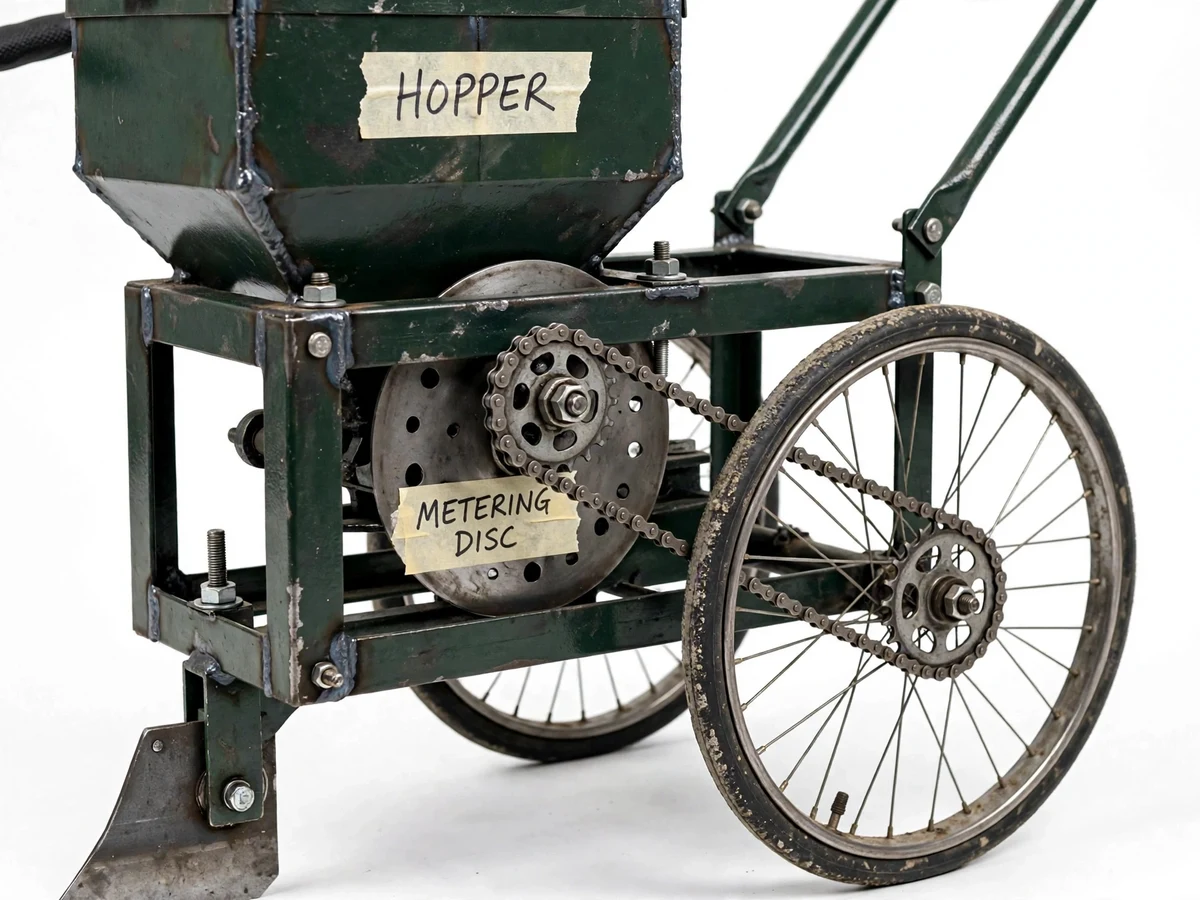
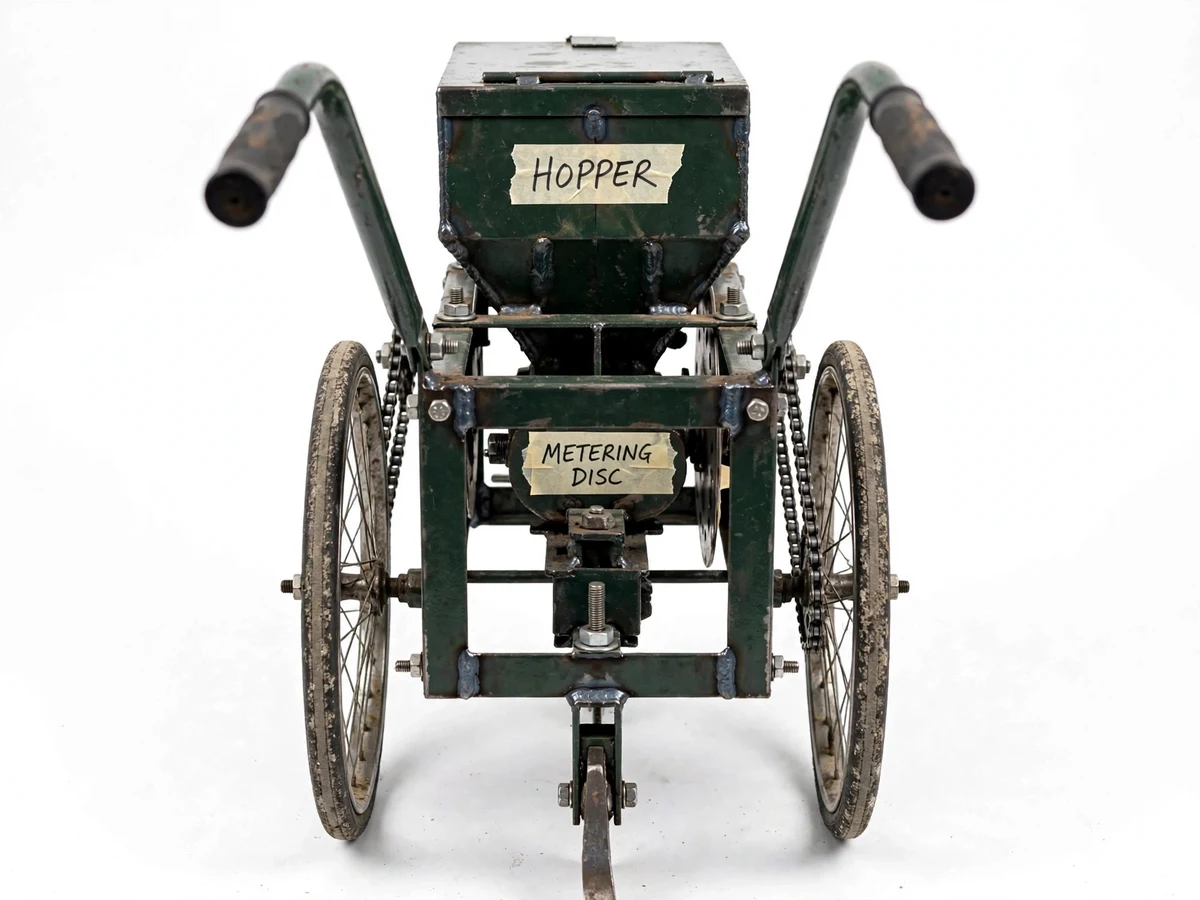
Manual sowing — broadcasting seed by hand or dropping it behind a plough — is slow, exhausting work, and it leaves seeds at uneven depth and spacing. Uneven stands waste expensive seed, force extra thinning, and leave gaps where weeds take over. Tractor-drawn seed drills solve this but are far beyond the reach of small and marginal farmers, and they are overkill for small plots, kitchen gardens and college demonstration fields. This project builds the middle ground: a single-row, hand-pushed mechanical seed sowing machine. The operator pushes the machine over a prepared bed; a furrow opener cuts the row, a ground-wheel-driven chain turns a metering disc that drops one seed at a time from the hopper into a seed tube, and a soil-cover plate closes the furrow. Seed spacing is adjustable through interchangeable sprockets and metering discs (design range approximately 10–30 cm), and planting depth is set with a pinned height adjustment. The whole machine is human-powered — no fuel, no battery, no electronics.
Loads seed, sets the slide gate and pushes the machine by its twin handles.
Follow the working sequence
How it works
- Graded, dry seed is loaded into the sheet-metal hopper; a slide gate at the hopper throat is opened so seed feeds by gravity into the metering-disc housing.
- The operator pushes the machine by its twin handles; the V-share furrow opener at the front cuts a furrow whose depth (design 2–6 cm) is fixed beforehand through the pinned height slots on the opener bracket.
- As the machine moves, the spoked ground wheel rotates; a bicycle roller chain carries this rotation to the metering-disc shaft — the drive ratio is set by the chosen sprocket pair, so spacing does not depend on walking speed.
- Each cell in the rotating metering disc picks up a single seed from the hopper throat and carries it around; at the drop point a knockout scraper pushes the seed out and it falls down the seed tube into the furrow.
- Seed spacing follows from geometry: wheel circumference divided by (sprocket ratio times disc cells). The report includes the worked calculation and a table mapping each supplied sprocket/cell combination to its design spacing (approximately 10–30 cm).
- A trailing soil-cover plate behind the seed tube scrapes loose soil back over the furrow. At the row end the operator closes the slide gate so no seed is lost during the turn.
Tech stack:
- Mild-steel angle/box section frame
- Bicycle roller chain and sprockets
- Sheet-metal seed hopper
- Interchangeable seed metering discs
- Steel furrow-opener share
- Ball bearings and shafts
- Arc welding and grinding (fabrication)
- Fasteners and rubber grips
| Parameter | Value |
|---|---|
| Rows | 1 (single row) |
| Drive | Ground wheel → roller chain → metering disc (human powered) |
| Ground wheel | Spoked bicycle-type wheel, approximately 450–550 mm diameter (design target) |
| Seed spacing | Approximately 10–30 cm, set by sprocket pair + disc cells (design target) |
| Planting depth | Approximately 2–6 cm via pinned height slots (design target) |
| Hopper capacity | Approximately 2–3 kg of seed (design target) |
| Metering | Rotating cell disc, interchangeable plates for seed grades |
| Frame | Welded mild-steel angle/box section, total weight approximately 18–25 kg (design target) |
| Furrow opener | Adjustable steel V-share |
| Power | Manual push — no fuel, battery or electronics |
| Spacing adjustment | Interchangeable bicycle sprockets on disc shaft |
Project features
- [Ground-wheel chain drive] As you push, the spoked ground wheel turns a bicycle roller chain geared to the metering-disc shaft. Metering is locked to distance travelled, not to time or walking speed — walking faster does not change the seed spacing. No motor, battery or fuel is needed.
- [Adjustable seed spacing] Interchangeable sprockets on the disc shaft change the wheel-to-disc ratio, and interchangeable metering discs change the cell count. Together they set intra-row spacing across a design range of approximately 10–30 cm; the report shows the exact calculation for each combination.
- [Depth-adjustable furrow opener] A steel V-share opener cuts the planting furrow; its height is set through pinned slots on the mounting bracket for a design depth range of approximately 2–6 cm.
- [Interchangeable metering discs] Disc plates with different cell sizes suit different seed grades (for example maize-type, groundnut-type or cotton-type). Cells are sized so each carries one seed, and discs are swapped with two bolts.
- [Seed hopper with slide gate] A sheet-metal hopper holds approximately 2–3 kg of seed (design target); a sliding gate at the throat starts and stops seed flow — closed for turns and transport.
- [Soil covering plate] A trailing plate behind the seed tube scrapes loose soil back over the dropped seed, completing the sowing pass in one operation.
- [Twin push handles] Tubular steel handles with rubber grips give a comfortable pushing posture; tipping the machine back onto the handles lets one person wheel it to the field.
What is included
- Working hand-pushed single-row seed sowing machine prototype
- Set of interchangeable metering discs (2–3 cell sizes) and spacing sprockets
- Fabrication drawings: frame, hopper, metering disc, axle and full assembly
- Spacing-calculation sheet mapping each sprocket/disc combination to its design spacing
- Field calibration guide: the buyer-run procedure to measure and verify spacing in a trial plot
- Project report PDF (background, design calculations, fabrication steps, calibration procedure)
- PPT presentation for final review
- Viva Q&A preparation document (transmission ratios, metering, fabrication processes)
Limitations & prerequisites
- Single-row operation — covering a plot needs repeated passes; this is a small-plot and demonstration machine, not a tractor replacement.
- Spacing figures are design targets computed from wheel circumference, sprocket ratio and cell count — not lab-measured accuracy claims. Real placement depends on seed-size uniformity, ground-wheel slip and walking steadiness; the calibration guide tells the buyer how to measure actual spacing in their own trial.
- Best with graded, dry, uniformly sized seeds (maize, groundnut, cotton-type). Tiny seeds (mustard, sesame) or ungraded lumpy seed will meter unevenly and need a different disc cell design (listed as customization).
- Push effort rises on loose, wet or cloddy soil — the machine is designed for a prepared seedbed, not untilled hard ground.
- Furrow depth varies with soil hardness and operator pressure — check depth with a ruler every few rows during the trial.
- The chain needs periodic tensioning and lubrication, and metal-on-metal pivots need grease; basic maintenance is part of the operation guide.
- A college prototype, not certified agricultural machinery — no claim of yield improvement is made; the buyer verifies germination and spacing in their own trial plot.
Frequently Asked Questions
How is the seed spacing adjusted?
Two ways, used together: interchangeable sprockets on the metering-disc shaft change the wheel-to-disc ratio, and interchangeable metering discs change the number of cells per revolution. The report includes the worked formula — spacing equals wheel circumference divided by (sprocket ratio times cell count) — plus a table mapping each supplied combination to its design spacing, approximately 10–30 cm.
Does it need a motor or battery?
No. The metering disc is driven by a roller chain from the ground wheel, so metering is locked to distance travelled rather than time — pushing faster does not change the spacing. The trade-off is that wheel slip on very loose soil or an unsteady walking pace can still shift real placement slightly, which is why the buyer-run calibration procedure is included.
Which seeds can it sow?
Graded, dry, uniformly sized medium seeds such as maize, groundnut, cotton or sunflower-type. The metering-disc cell must match the seed: discs with different cell sizes are supplied and swapped with two bolts. Very small seeds like mustard or sesame need a purpose-made disc, listed under customization.
How is the planting depth set?
The V-share furrow opener is mounted on a bracket with pinned height slots; the operator sets the depth before starting, with a design range of approximately 2–6 cm. Because depth also depends on soil hardness and downward pressure on the handles, the guide asks the buyer to verify with a ruler every few rows during the trial.
How do I verify it in the field?
The calibration guide gives a buyer-run procedure: prepare a flat bed, push the machine over a marked 10-metre run, then measure the gaps between dropped seeds with a tape. The measured average is compared with the design spacing from the calculation sheet — this becomes the student's own field data for the viva.
Is this project suitable for a final-year project?
Yes, for Mechanical Engineering (and allied programs such as Production or Agricultural Engineering). It demonstrates machine design, chain-drive transmission calculations, sheet-metal and welded fabrication, and a genuine design-of-experiments style calibration — all strong viva material. The fabrication drawings, spacing-calculation sheet and calibration guide give the student real engineering documentation to defend in the final review. Suitable for B.E./B.Tech final-year projects in Mechanical Engineering.
Components & software requirements
- Mild-steel angle/box section frame
- Bicycle roller chain and sprockets
- Sheet-metal seed hopper
- Interchangeable seed metering discs
- Steel furrow-opener share
- Ball bearings and shafts
- Arc welding and grinding (fabrication)
- Fasteners and rubber grips
Delivery information
Built-to-order project. Delivery timeline is shared after order confirmation based on current queue.
Support terms
Complete documentation, setup guide, and viva preparation included. Support for setup and explanation provided.
Download free synopsis (PDF)
Enter your name and email — the synopsis PDF downloads immediately. We may send occasional project updates; no spam, unsubscribe anytime.