
More project photos (2)
The problem
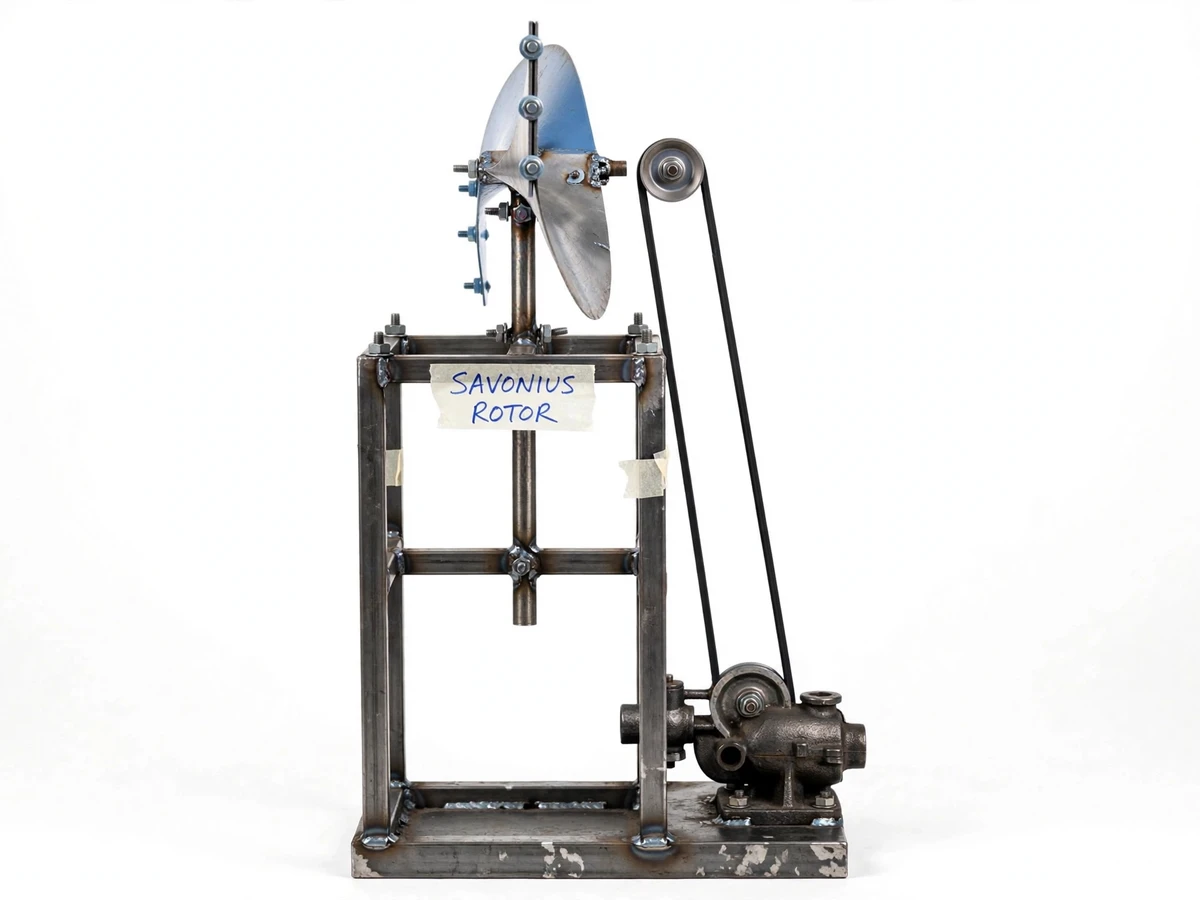
Many small farms still depend on electric or diesel pumps for irrigation, and power cuts or fuel costs can leave crops dry at critical stages. A wind-powered pump is an old idea, but the Savonius rotor makes it a genuinely buildable final-year project: it is drag-based, self-starting, and accepts wind from any direction, so it needs no yaw mechanism, no gearbox and no electronics. The build couples the vertical-axis rotor through a V-belt reduction to a single-cylinder reciprocating piston pump, which lifts water from a well or sump into a field channel. Everything is fabricated with ordinary workshop tools — sheet-metal rolling and bending, arc welding and lathe work — so the project demonstrates renewable-energy conversion, positive-displacement pump theory and machine fabrication in one working machine. The report carries the full design calculation set: swept area, estimated torque, belt-ratio selection and pump sizing against an assumed head.
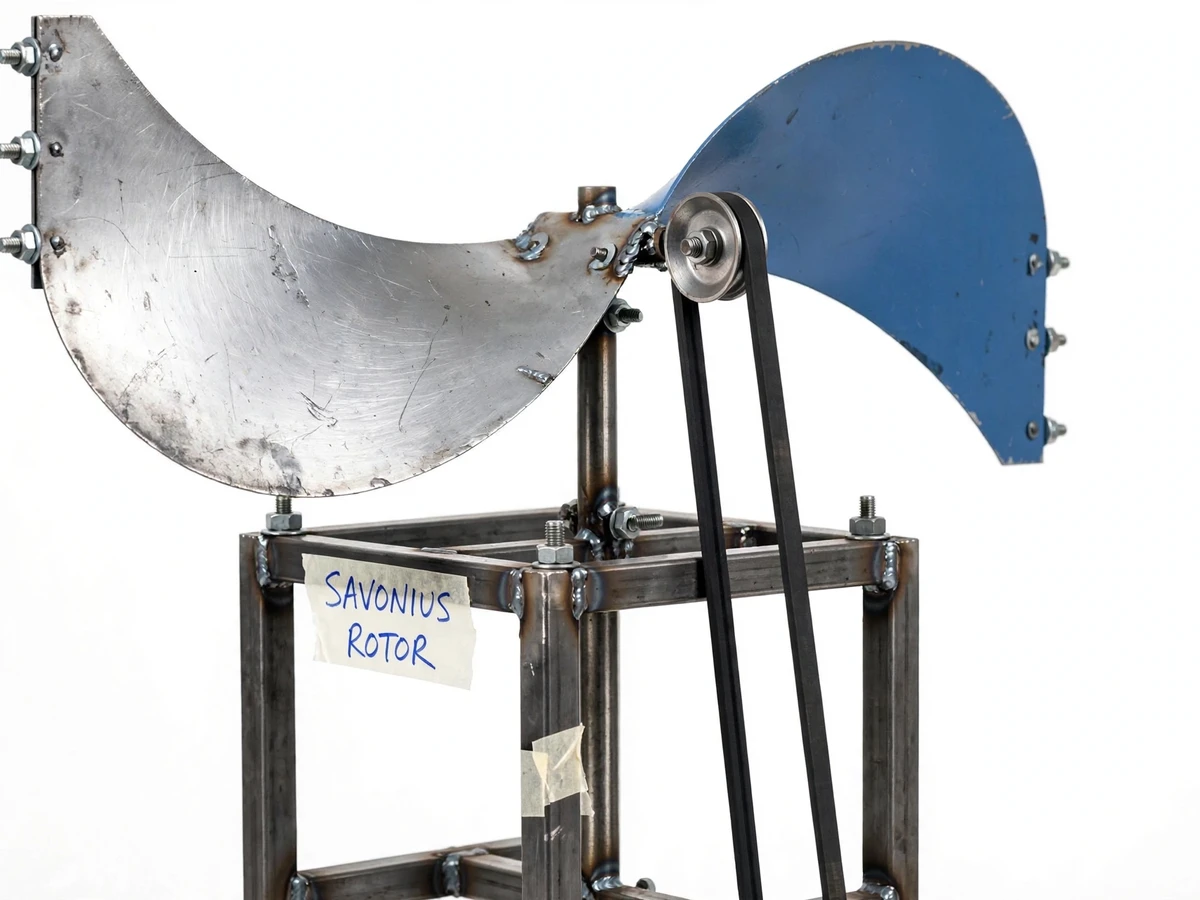
Two-blade S-profile drag rotor catching wind from any direction.
Follow the working sequence
How it works
- Wind strikes the S-shaped blades: the concave scoop catches more drag than the convex back of the opposite blade, producing net torque on the vertical shaft. Being vertical-axis, the rotor starts and runs in wind from any direction with no yaw mechanism.
- A small pulley on the rotor shaft drives a larger pulley on the pump crankshaft through a V-belt (approximately 3:1 reduction), converting the rotor's slow, high-torque rotation into the crank speed a reciprocating pump needs.
- The crank and connecting rod drive the piston: on the suction stroke the cylinder draws water up through the foot valve from the well or sump; on the delivery stroke it pushes water past the delivery valve into the outlet pipe.
- The foot valve at the suction pipe's submerged end stops water draining back between strokes, so the pump holds its prime.
- Delivered water flows into the field channel or an overhead collection tank, ready for irrigation.
- Output follows the wind: stronger wind means faster rotor rpm, more strokes per minute and higher flow — so delivery is naturally variable and matched to windy hours.
Tech stack:
- Savonius rotor theory (drag-based vertical-axis wind conversion)
- Reciprocating pump selection and sizing
- V-belt drive design (pulley ratio, belt length, tensioning)
- MS fabrication: sheet-metal bending, arc welding, lathe work
- Foot valve and suction/delivery piping
- Bearing selection (pillow-block bearings)
- Anemometer and tachometer (testing)
- 2D fabrication drawings (SolidWorks / AutoCAD)
| Parameter | Value |
|---|---|
| Rotor type | Two-blade Savonius, S-profile sheet-metal scoops |
| Rotor diameter | Approximately 450–500 mm (design) |
| Rotor height | Approximately 700–800 mm (design) |
| Swept area | Approximately 0.35 m² (from design dimensions) |
| Start-up wind speed | Approximately 3 m/s (typical for Savonius rotors) |
| Design wind range | Approximately 5–7 m/s (design target) |
| Belt reduction | Approximately 3:1 (design) |
| Pump | Single-cylinder reciprocating piston pump, bore approx 40 mm, stroke approx 50 mm (design) |
| Suction head | Up to approximately 5–6 m (typical for small reciprocating pumps) |
| Delivery head | Up to approximately 8–10 m total (design target) |
| Flow rate | Design target approximately 5–12 L/min, wind-dependent |
| Frame | Welded 25 × 25 mm MS square tube on MS base plate |
Project features
- [Drag-based Savonius rotor] Two S-shaped sheet-metal scoops on a vertical shaft start rotating in light wind and need no yaw control, since the rotor catches wind from any direction.
- [V-belt reduction drive] A stepped pulley pair reduces the rotor's low rpm to the crank speed the pump needs, and the belt absorbs shock loads from gusts that would strain a rigid coupling.
- [Reciprocating piston pump] A single-cylinder positive-displacement pump lifts water against real head, which suits the rotor's low-speed, high-torque character far better than a centrifugal pump would.
- [Welded MS frame stand] A square-tube mild-steel frame carries rotor bearings, the countershaft and the pump in one rigid unit that anchors to a concrete plinth on site.
- [No electricity, no fuel] The machine converts wind to pumped water entirely mechanically, so it runs anywhere with adequate wind and zero running cost.
- [Adjustable belt tensioning] A slotted motor-plate style tension mount lets the belt be re-tensioned as it wears, and different pulley steps let the drive ratio be changed for testing.
- [Instrumentation-ready test plan] The build includes a procedure to log wind speed, rotor rpm and delivered flow with a handheld anemometer and tachometer, giving the viva real data to discuss.
What is included
- Working windmill-pump prototype (rotor, frame, belt drive, pump, piping)
- 2D fabrication drawings (rotor blades, shaft, frame, pump mounting)
- Design calculation sheet (swept area, torque estimate, belt ratio, pump sizing)
- Assembly and installation guide (plinth, anchoring, alignment)
- Wind-speed/rpm/flow test procedure with a sample log sheet
- Project report PDF (background, theory, design, fabrication, testing)
- PPT presentation for final review
- Viva Q&A preparation document (Savonius theory, pump curves, belt design, limitations)
- Downloadable project abstract PDF
Advantages
- Drag-based Savonius rotor: two S-profile sheet-metal scoops on a vertical shaft start turning at roughly 3 m/s, accept wind from any direction with no yaw mechanism, and need no gearbox or electronics.
- Positive-displacement pump matched to the rotor's character: a single-cylinder reciprocating piston pump lifts water against real head (suction up to ~5–6 m, total delivery ~8–10 m design) — the right pump for a slow, high-torque rotor — with a foot valve holding prime between strokes.
- V-belt reduction (approximately 3:1) converts rotor rpm to pump-crank speed while absorbing gust shock loads that would strain a rigid coupling; stepped pulleys and a slotted tension mount let the ratio and belt tension be changed for testing.
- Zero running cost: wind converts to pumped water entirely mechanically — no electricity, no fuel — in a welded MS square-tube frame anchored to a concrete plinth.
- Honest, measurable validation: the build ships with a wind-speed/rpm/flow test procedure (handheld anemometer and tachometer with a log sheet) and a full design-calculation set — swept area, estimated torque, belt-ratio selection, pump sizing — so the viva works from real data.
Disadvantages
- Savonius rotors are aerodynamically inefficient (power coefficient typically 0.15–0.25 in published literature) — this is a low-flow, low-head machine (design target ~5–12 L/min) that will not replace a mains-powered pump.
- Delivery stops when the wind stops: the base build has no water storage or flywheel, so pumping is intermittent by design.
- Flow varies with wind speed and cannot be regulated to a constant rate in the base build; suction head is capped at about 5–6 m and the pump must be reprimed if the suction line empties.
- It needs an open, reasonably windy site — nearby walls and trees create turbulence that hurts starting — and as an academic prototype it is not rated for continuous farm duty; the belt, crank and piston need periodic inspection, re-tensioning and lubrication.
Limitations & prerequisites
- Savonius rotors have low aerodynamic efficiency (power coefficient typically 0.15–0.25 in published literature), so this is a low-flow, low-head machine — it will not replace a mains-powered pump.
- Pumping happens only when the wind blows; the base build has no water storage or flywheel, so delivery is intermittent.
- Suction head is limited to about 5–6 m and the pump must be primed if the suction line empties.
- Flow varies with wind speed and cannot be regulated to a constant rate in the base build.
- The rotor needs an open, reasonably windy site; nearby walls and trees create turbulence that hurts starting.
- This is an academic prototype, not a certified pumping system — not rated for continuous farm duty or harsh weather without added anchoring and maintenance.
- Moving parts (belt, crank, piston) need periodic inspection, belt re-tensioning and lubrication.
Frequently Asked Questions
Is this project suitable for a final-year project?
Yes — for Mechanical, Production and Industrial Engineering programs. It demonstrates renewable-energy conversion, positive-displacement pump theory, belt-drive and bearing design, and genuine workshop fabrication, with a design-calculation set and a test plan that give the viva solid technical ground.
Does it need electricity or fuel?
No. The machine is entirely mechanical: wind turns the rotor, the belt drives the pump, and water is lifted with zero running cost. It is meant for sites where grid power is unreliable or unavailable during irrigation hours.
Why a reciprocating pump and not a centrifugal pump?
A centrifugal pump needs high rpm to build head, while a Savonius rotor turns slowly with high torque. A reciprocating piston pump is positive displacement — it lifts water against real head at low speed, which matches the rotor's character exactly.
What wind speeds does it need?
Savonius rotors typically start turning at about 3 m/s and the design targets a 5–7 m/s working range. Output rises with wind speed, so sites with steady breezes pump noticeably more than gusty, sheltered ones.
Can it pump water without wind?
Not in the base build — delivery stops when the wind stops. Storing water in an overhead tank or adding a flywheel are listed as optional customizations, not part of the standard build.
What will I receive with the project?
The working prototype with rotor, frame, belt drive, pump and piping; 2D fabrication drawings; the design calculation sheet; assembly and installation guide; the test procedure; plus the report PDF, PPT and viva Q&A document. Suitable for B.E./B.Tech final-year projects in Mechanical, Production and Industrial Engineering.
Components & software requirements
- Savonius rotor theory (drag-based vertical-axis wind conversion)
- Reciprocating pump selection and sizing
- V-belt drive design (pulley ratio, belt length, tensioning)
- MS fabrication: sheet-metal bending, arc welding, lathe work
- Foot valve and suction/delivery piping
- Bearing selection (pillow-block bearings)
- Anemometer and tachometer (testing)
- 2D fabrication drawings (SolidWorks / AutoCAD)
Delivery information
Built-to-order project. Delivery timeline is shared after order confirmation based on current queue.
Support terms
Complete documentation, setup guide, and viva preparation included. Support for setup and explanation provided.
Download free synopsis (PDF)
Enter your name and email — the synopsis PDF downloads immediately. We may send occasional project updates; no spam, unsubscribe anytime.