
More project photos (2)
The problem
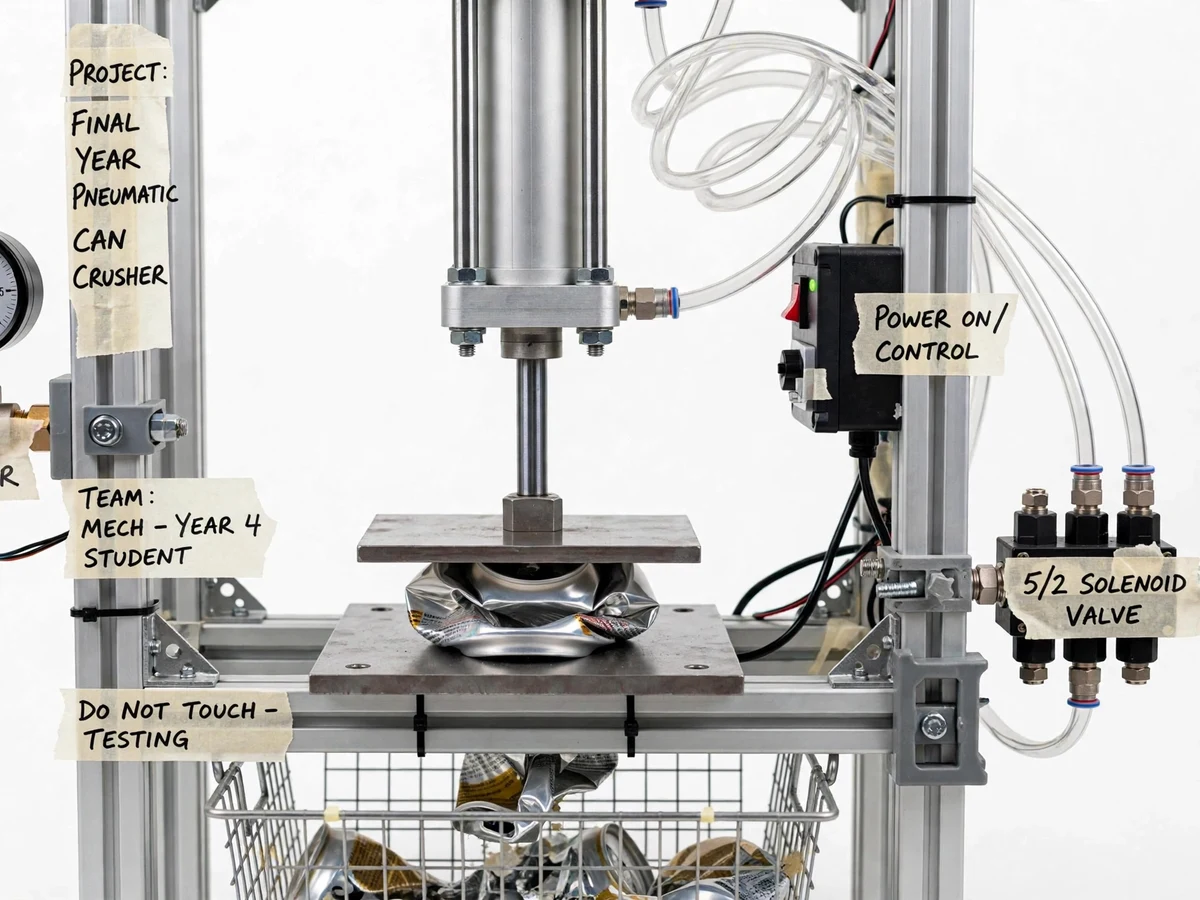
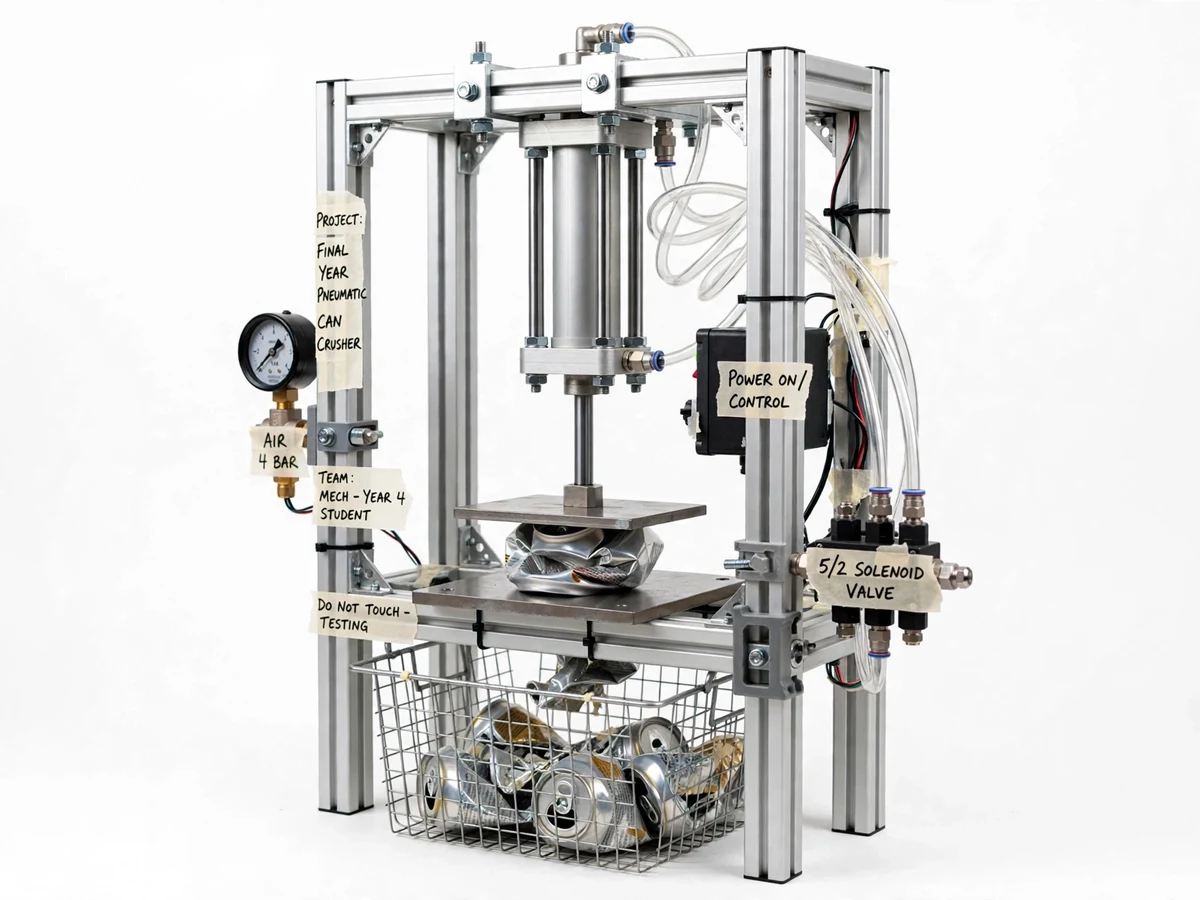
Aluminium cans are infinitely recyclable, but loose cans are bulky to store and transport — crushing them to a fraction of their volume is the first step of any collection chain. This project builds a working pneumatic crusher at demonstration scale: a vertical double-acting cylinder mounted on an aluminium extrusion frame drives a crush plate down onto the can, a 5/2 solenoid valve controls extend and retract, and the flattened can drops through into a wire-mesh collection bin. An Arduino sequences the cycle with push-button start, and a filter-regulator-lubricator (FRL) unit with pressure gauge conditions the shop air. The report carries real pneumatics: cylinder force from bore and pressure, air consumption per cycle, and valve timing — the same calculations behind industrial press design.
How it works
- The operator places one aluminium can on the crush plate and presses start.
- The Arduino energises the 5/2 solenoid valve; air drives the cylinder down.
- The crush plate flattens the can against the base plate at the set air pressure.
- After a short dwell, the valve shifts and the cylinder retracts.
- The flattened can tips off the plate and falls into the collection bin below.
- The cycle counter increments; the bin is emptied when full and the pressure gauge is checked each session.
Tech stack:
- Double-acting pneumatic cylinder
- 5/2 solenoid valve with relay drive
- FRL unit: filter, regulator, gauge
- Aluminium extrusion frame
- Arduino cycle controller
- Push-button and e-stop panel
- Wire-mesh collection bin
- Polyurethane air tubing and fittings
| Parameter | Value |
|---|---|
| Cylinder bore | Approximately 32–50 mm (design target, per selected unit) |
| Operating pressure | Approximately 4–6 bar, regulator-set (design target) |
| Crushing force | Approximately 300–1000 N depending on bore and pressure (calculated) |
| Cycle time | Approximately 5–8 s per can, extend–dwell–retract (expected) |
| Can size | Standard 330 ml aluminium beverage cans (design target) |
| Control | Arduino-timed cycle, push-button start |
| Bin capacity | Approximately 40–60 crushed cans (expected) |
| Frame | 20×20 aluminium extrusion (design target) |
Project features
- [Double-acting pneumatic cylinder] A vertical air cylinder provides the crushing stroke and powered retract, sized from a bore-versus-pressure force calculation.
- [5/2 solenoid valve control] A 5/2-way solenoid valve directs air to extend and retract sides; the Arduino drives it through a relay.
- [Aluminium extrusion frame] A rigid 20×20 extrusion frame holds cylinder, crush plate and bin in alignment with T-slot adjustability.
- [FRL unit with pressure gauge] Filter-regulator-lubricator conditions the supply air and the gauge displays the set crushing pressure.
- [Push-button cycle control] Start and emergency-stop buttons run a timed extend–dwell–retract cycle with status indication.
- [Wire-mesh collection bin] Crushed cans fall directly into a wire bin sized to hold a full demonstration batch.
- [Pneumatic circuit diagram] The report includes the standard symbolic circuit diagram (ISO 1219 style) for the build.
What is included
- Fully assembled pneumatic can crusher with bin
- Arduino controller with programmed cycle firmware
- Pneumatic circuit diagram (symbolic) and tubing layout
- FRL setup and pressure-setting procedure
- Project report PDF (background, pneumatics theory, cylinder sizing, air-consumption calculation, test procedure)
- PPT presentation for final review
- Viva Q&A preparation document (pneumatic circuits, solenoid valves, force calculations)
Limitations & prerequisites
- Only standard aluminium beverage cans are in scope; steel cans and plastic bottles need far higher force and are excluded.
- A shop air compressor or lab air line at 4–6 bar is required — it is not included with the prototype.
- Throughput is approximately one can every 5–8 seconds; it is a demonstration unit, not an industrial baler.
- Crushing force varies with supply pressure; the procedure requires checking the gauge each session.
- The cylinder and valve need periodic seal and tubing inspection; the maintenance schedule covers this.
- Noise from exhaust air is inherent to pneumatics; the circuit includes a silencer on the valve exhaust.
Frequently Asked Questions
How much force does the cylinder produce?
Force equals pressure times piston area — at 5 bar a 40 mm bore gives roughly 600 N, and the report works this calculation through for the selected cylinder. That is far more than the ~150 N needed to crush an aluminium can.
What does the 5/2 solenoid valve do?
It is a 5-port, 2-position valve that routes supply air to the extend side or the retract side of the cylinder, giving powered motion in both directions under Arduino control.
Is a compressor included?
No — the crusher needs a 4–6 bar shop air supply, which college pneumatic labs already have. The FRL unit that conditions that air is part of the build.
Can it crush steel cans?
No. Steel food cans need several kilonewtons; this machine is sized for aluminium beverage cans only, and the documentation states the limit.
How is the cycle controlled?
An Arduino runs an extend–dwell–retract sequence on a push-button start, driving the solenoid through a relay, with an emergency stop wired in hardware.
Is this project suitable for a final-year project?
Yes — for Mechanical Engineering and Mechatronics. Industrial pneumatics, solenoid control and force sizing in one demonstrable recycling machine. Suitable for B.E./B.Tech final-year projects in Mechanical Engineering and Mechatronics.
Components & software requirements
- Double-acting pneumatic cylinder
- 5/2 solenoid valve with relay drive
- FRL unit: filter, regulator, gauge
- Aluminium extrusion frame
- Arduino cycle controller
- Push-button and e-stop panel
- Wire-mesh collection bin
- Polyurethane air tubing and fittings
Delivery information
Built-to-order project. Delivery timeline is shared after order confirmation based on current queue.
Support terms
Complete documentation, setup guide, and viva preparation included. Support for setup and explanation provided.