
More project photos (3)
The problem
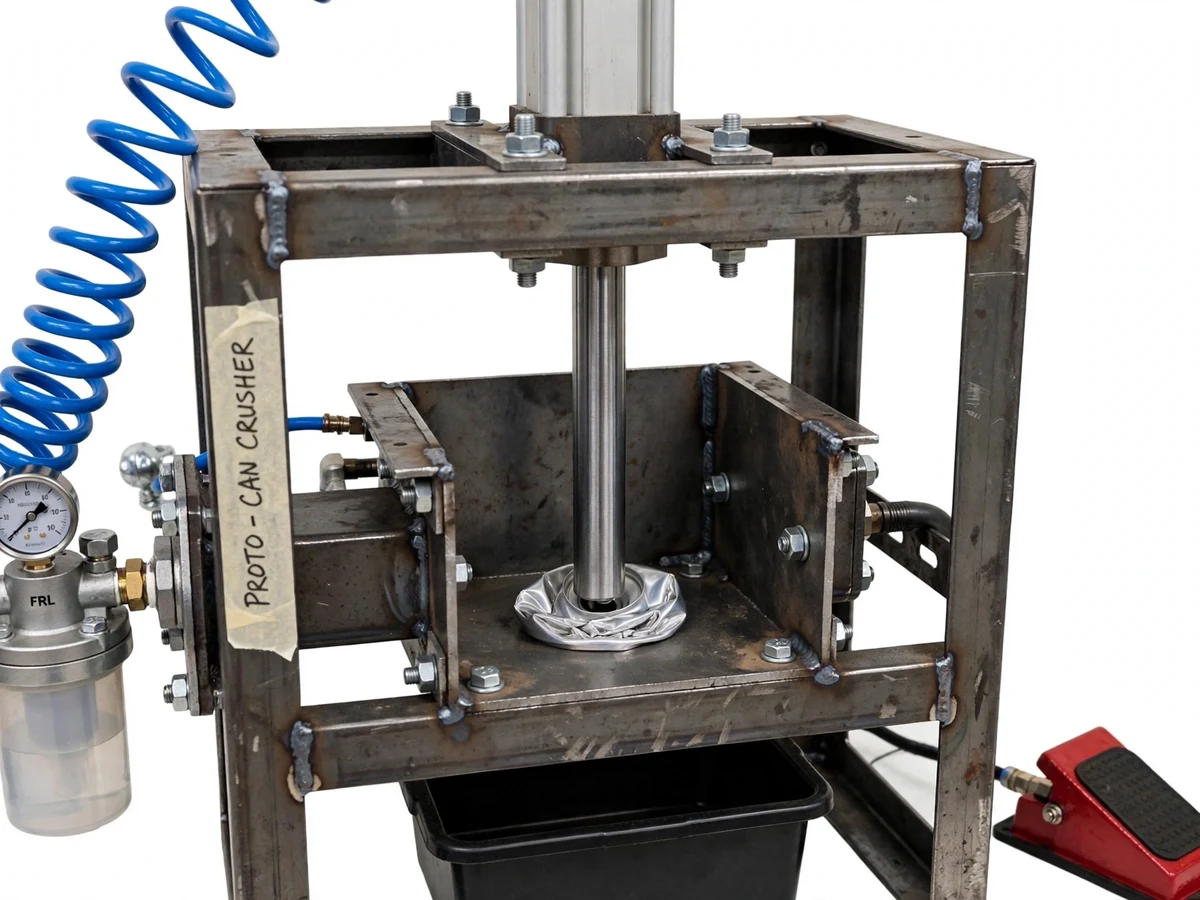
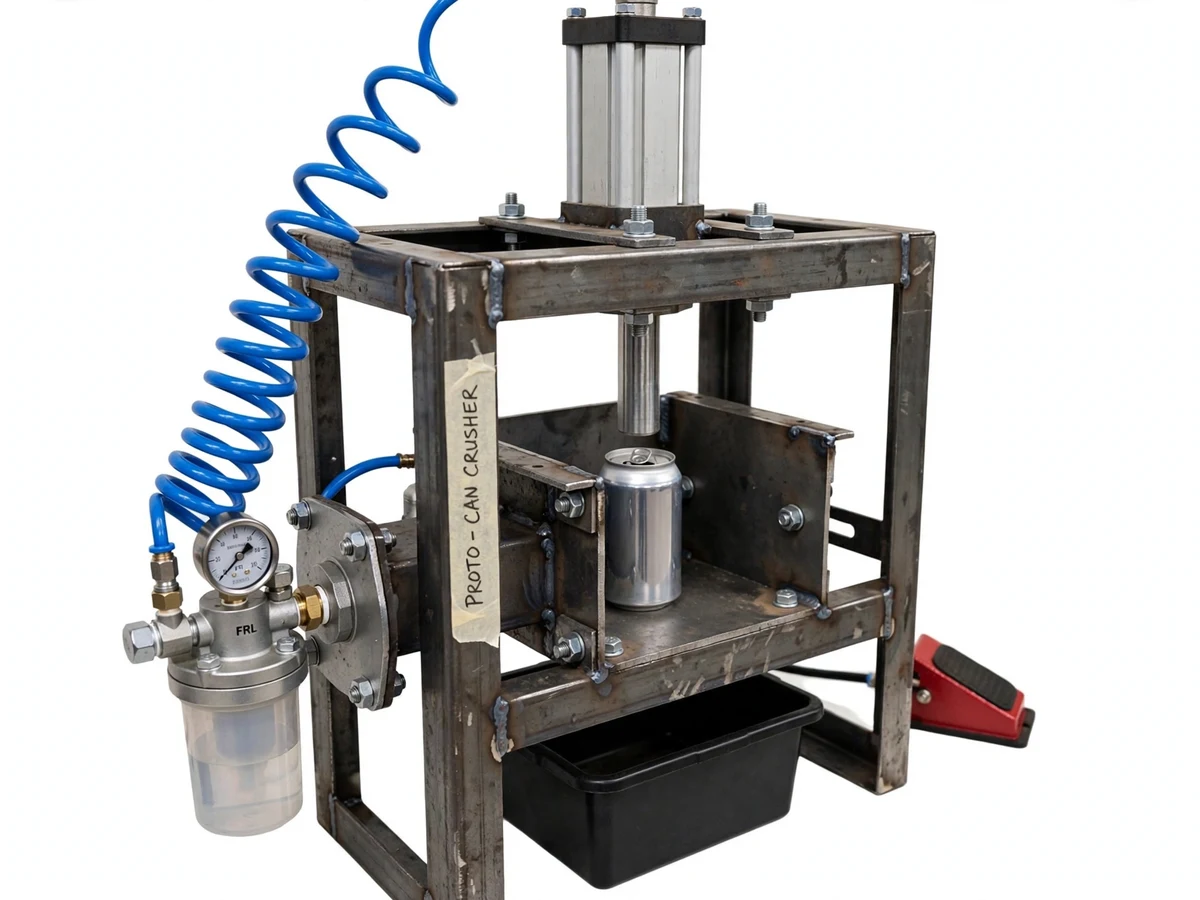
Aluminum beverage cans are among the most recycled packaging in the world, yet at the collection point they are bulky: a bag of empty cans holds far more air than metal, wasting storage space and making transport to recyclers uneconomical in small lots. Hand-crushing is slow, inconsistent, and risks cuts from sharp torn edges. This project builds a small footswitch-operated pneumatic can crusher for canteens, hostels and scrap-collection points. A double-acting pneumatic cylinder drives a steel platen down onto one can at a time inside a guarded steel chamber, flattening each can so a collection bin holds several times more crushed cans than loose ones. Along the way the build teaches real pneumatic practice — sizing a cylinder for a required force, selecting a 5/2 directional control valve, preparing air with an FRL unit, and regulating working pressure — plus welded mild-steel fabrication and basic machine guarding with an interlocked door and emergency stop.
Loads a can in the chamber, closes the guard door and presses the footswitch.
Follow the working sequence
How it works
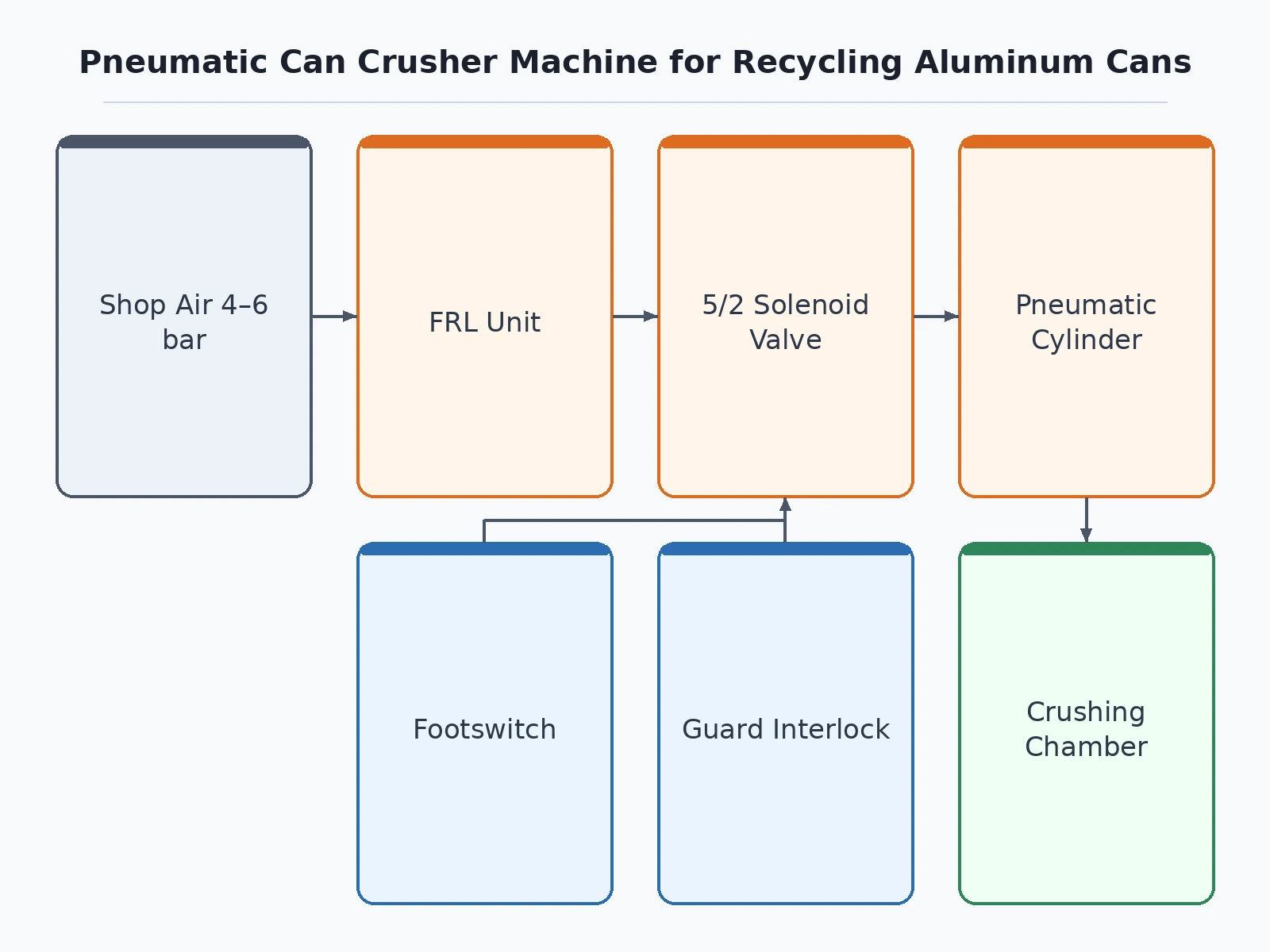
- Connect shop air to the FRL unit and set the regulator to the working pressure (4–6 bar); the gauge confirms the line pressure before each session.
- Open the guard door, place one empty 330 ml aluminum can upright on the chamber's anvil plate, and close the guard — the door switch enables the solenoid circuit only when closed.
- Press the footswitch: the 5/2 solenoid valve shifts and directs compressed air to the cap end of the 50 mm bore cylinder.
- The piston rod extends its 150 mm stroke, driving the steel platen onto the can; at 6 bar the cylinder develops approximately 1.2 kN of theoretical crushing force (calculated from the bore).
- The can collapses against the anvil plate to a design-target height of roughly 25–35 mm; exhaust air from the rod end vents through the valve's mufflers.
- Release the footswitch to de-energize the solenoid; the valve spring returns it and the cylinder retracts, ready for the next can.
- Sweep the crushed can into the collection bin and repeat. The emergency stop cuts solenoid power at any point if anything goes wrong.
Tech stack:
- Double-acting pneumatic cylinder (50 mm bore × 150 mm stroke)
- 5/2-way solenoid valve, 24 V DC coil
- FRL unit (filter · regulator · lubricator)
- Pneumatic footswitch
- Mild-steel fabrication (welding · drilling · grinding)
- Guard-door limit-switch interlock
- PU air tubing · push-in fittings (6 mm OD)
- Shop compressed-air supply
| Parameter | Value |
|---|---|
| Pneumatic cylinder | 50 mm bore × 150 mm stroke, double-acting (Datasheet value) |
| Directional control valve | 5/2-way solenoid valve, 24 V DC coil (Datasheet value) |
| Operating pressure | Approximately 4–6 bar (regulator setting) |
| Theoretical crushing force | Approximately 1.2 kN at 6 bar (calculated from cylinder bore) |
| Can size handled | Standard 330 ml aluminum cans, approximately 115 mm tall × 66 mm diameter (standard can size) |
| Crushed can height | Design target: approximately 25–35 mm |
| Frame | Welded mild-steel angle frame, bolted cylinder mounting |
| Air supply | External shop air or portable compressor through FRL unit (Approximate 4–8 bar supply) |
| Crushing stroke time | Design target: under 1 s at 6 bar (full cycle depends on manual loading) |
| Actuation & safety | Footswitch with guard-door interlock and emergency stop |
Project features
- [Footswitch-actuated crushing stroke] The operator places a can in the chamber and presses the red footswitch, which energizes the 5/2 solenoid valve and sends compressed air to the cylinder — hands stay completely clear of the moving platen during the stroke.
- [Steel crushing chamber] The chamber guides each can upright under the platen and absorbs the crushing load, so cans collapse straight down instead of skidding sideways mid-stroke.
- [FRL air-preparation unit] The filter-regulator-lubricator cleans incoming shop air, lets the operator set the working pressure between 4 and 6 bar, and displays the set point on the gauge before every run.
- [Guard-door interlock] A guard covers the crushing zone and its door switch enables the solenoid circuit only when the guard is closed; an emergency stop on the panel cuts valve power instantly at any point.
- [Adjustable crushing pressure] The regulator setting can be tuned across the 4–6 bar range to match available shop air and can condition, with the gauge showing the exact set pressure.
- [Collection bin] Crushed cans drop or are swept into the removable bin under the chamber, keeping the work area tidy and making transfer to recycling bags trivial.
- [Welded mild-steel frame] The rigid MS angle frame is sized for the cylinder's theoretical thrust of approximately 1.2 kN at 6 bar, with bolted cylinder mounting for easy maintenance.
- [Exhaust mufflers] Silencers on the solenoid valve exhaust ports keep the machine quiet enough for a college workshop during repeated cycles.
What is included
- Working pneumatic can crusher prototype (MS frame, cylinder, valve, chamber, guard, collection bin)
- Pneumatic circuit diagram and full bill of materials
- Fabrication drawings for the frame and crushing chamber
- Operating and safety procedure sheet
- Project report PDF (background, force calculations, methodology)
- PPT presentation for the final review
- Viva Q&A preparation document (pneumatics, force calculation, safety)
Limitations & prerequisites
- Handles standard 330 ml aluminum beverage cans only; steel tins, PET bottles and larger cans are out of scope.
- Needs an external compressed-air source — the machine ships with the FRL unit and hose couplings, but not the compressor itself.
- Crushed-height and stroke-time figures are design targets; the report documents the theoretical force calculation, not measured test results.
- Manual loading, one can per cycle — there is no automatic can feeder.
- The prototype is not an industrially certified machine; the guard and interlock suit a college workshop, not a production line.
- Valve exhaust makes pneumatic noise on every cycle; mufflers reduce it but cannot eliminate it.
- Steel cans need far more force than this cylinder develops at 6 bar and must never be attempted in this machine.
Frequently Asked Questions
How does the pneumatic crushing actually work?
Pressing the footswitch energizes a 5/2 solenoid valve that sends 4–6 bar shop air to a 50 mm bore double-acting cylinder. The piston rod drives a steel platen down its 150 mm stroke onto the can inside the guarded chamber, collapsing it against the anvil plate. Releasing the footswitch retracts the cylinder for the next can.
Is this project suitable for a final-year project?
Yes — for Mechanical Engineering and related programs. It demonstrates pneumatic circuit design, crushing-force calculation from cylinder bore and pressure, welded steel fabrication and machine guarding, with real working hardware the student can operate and explain during the viva. The report documents the full design calculation and pneumatic circuit.
What air supply does the machine need?
An external shop-air connection or a portable compressor able to hold 4–6 bar at the FRL regulator inlet. The machine ships with the FRL unit, hose and push-in couplings, but the compressor itself is not part of the build — it must be available in the college workshop or arranged separately.
Can it crush steel cans or plastic bottles?
No. It is sized for thin-wall aluminum beverage cans: steel cans need far more force than the 50 mm bore cylinder develops at 6 bar, and PET bottles spring back instead of staying crushed. Feeding anything other than aluminum cans into the chamber is unsafe and out of scope for this build.
What safety features are built in?
The crushing zone sits behind a guard whose door switch enables the solenoid only when closed, so the cylinder cannot fire with the guard open. A red emergency stop on the panel cuts valve power instantly at any point, the footswitch keeps both hands free and clear, and exhaust mufflers keep cycle noise down.
Can the crushing pressure be adjusted?
Yes. The FRL regulator sets the working pressure anywhere in the 4–6 bar range, and the panel gauge shows the exact set point before each run. The operator can dial pressure down for very thin cans or run at the full 6 bar for the maximum theoretical crushing force.
Components & software requirements
- Double-acting pneumatic cylinder (50 mm bore × 150 mm stroke)
- 5/2-way solenoid valve, 24 V DC coil
- FRL unit (filter · regulator · lubricator)
- Pneumatic footswitch
- Mild-steel fabrication (welding · drilling · grinding)
- Guard-door limit-switch interlock
- PU air tubing · push-in fittings (6 mm OD)
- Shop compressed-air supply
Delivery information
Built-to-order project. Delivery timeline is shared after order confirmation based on current queue.
Support terms
Complete documentation, setup guide, and viva preparation included. Support for setup and explanation provided.
Download free synopsis (PDF)
Enter your name and email — the synopsis PDF downloads immediately. We may send occasional project updates; no spam, unsubscribe anytime.