
More project photos (2)
The problem
Plastic recycling only works once waste is reduced to flakes: shredding is the unavoidable first step before washing and pelletizing. Small recycling units and scrap dealers rely on this size reduction daily, but industrial granulators cost several lakhs of rupees and are sized for factory floors, leaving college workshops and community collection centres with no hands-on way to demonstrate the process. This project fills that gap with a buildable, motorized plastic shredder prototype: a fabricated mild-steel frame, a single-shaft cutter with hardened EN-8 steel blades, a 0.5 HP single-phase induction motor driving through a belt and gearbox, a safety feed hopper and a collection bin. The build forces real mechanical engineering work — torque estimation, shaft and bearing sizing, blade clearance setting, guard design — and ends with a machine that genuinely shreds PET bottles and containers into flakes of a pelletizer-ready size. Every claimed number is stated as a design target, datasheet value or material grade, never as a measured result.
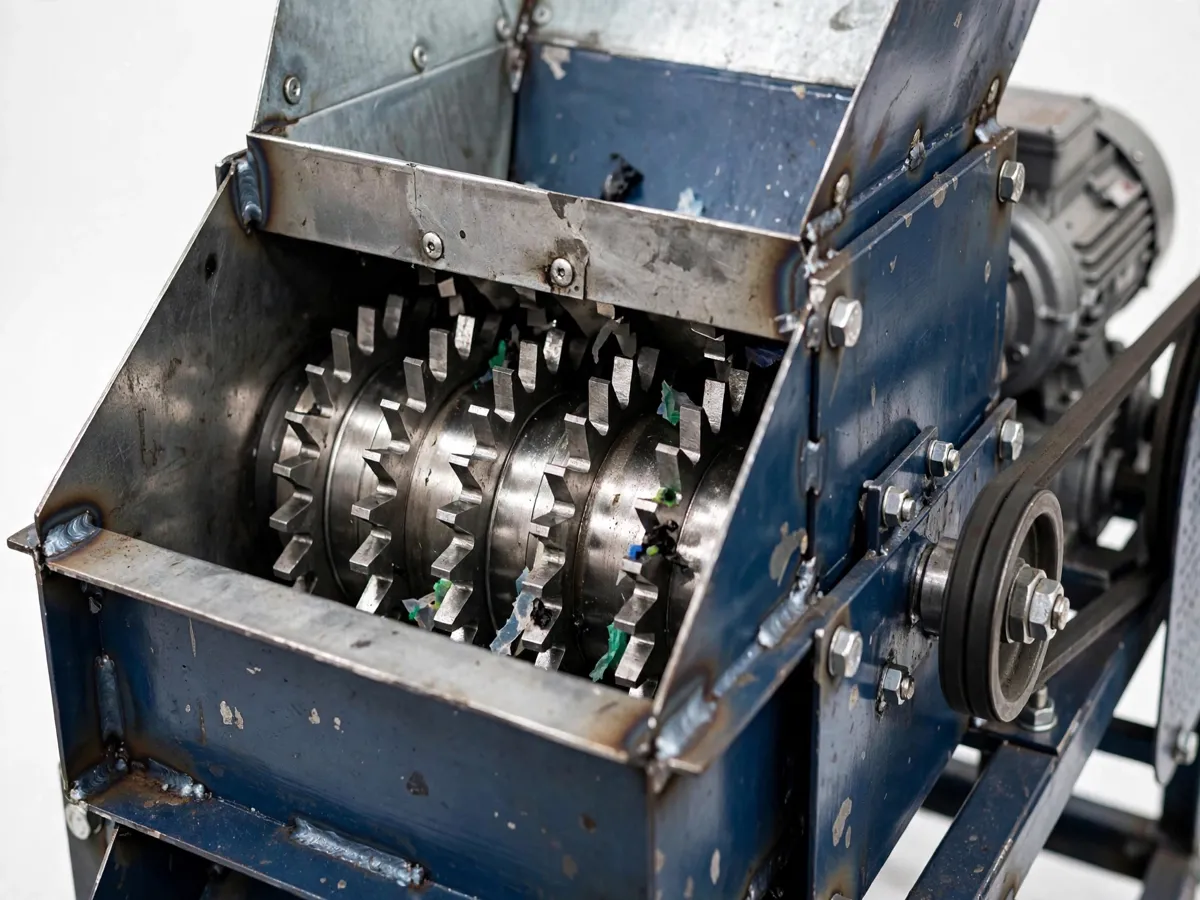
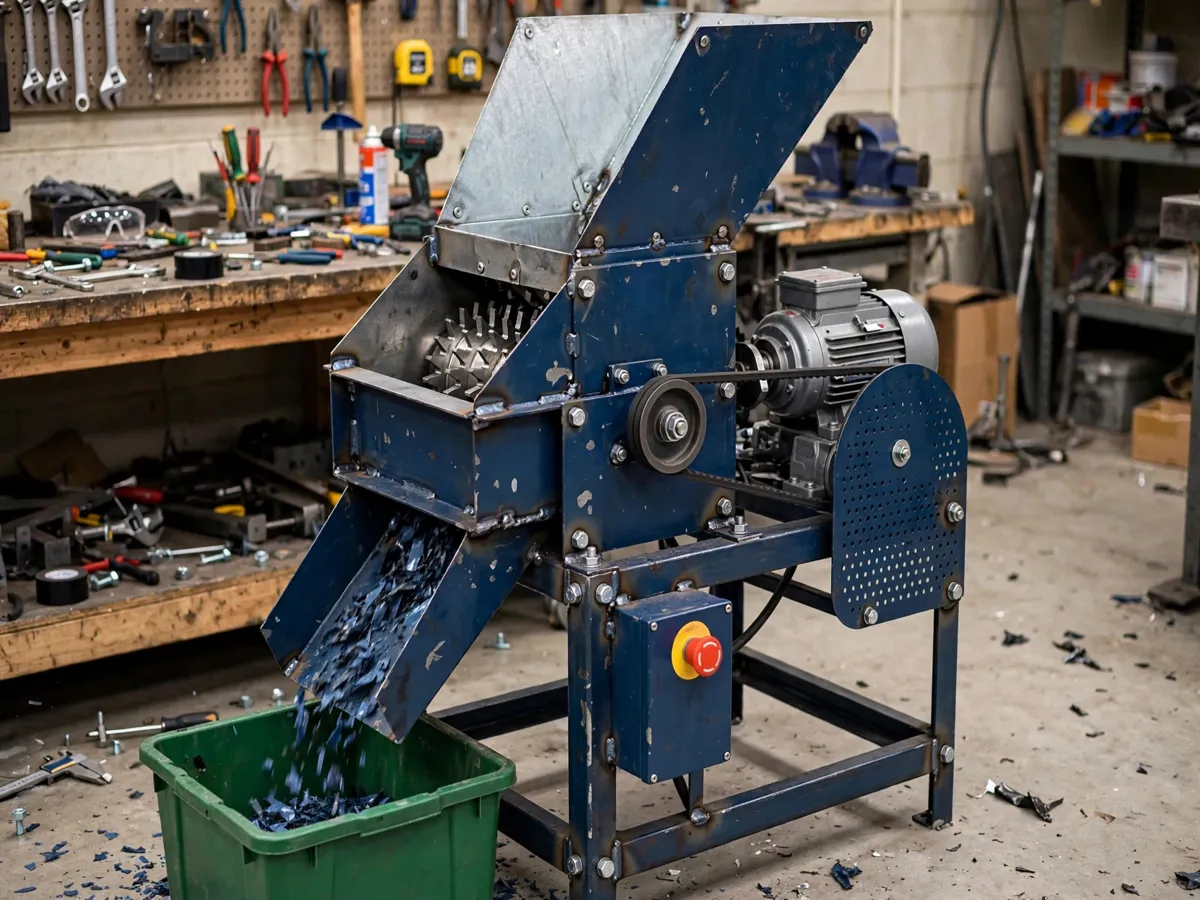
Loads PET bottles and rigid plastic waste into the safety hopper.
Follow the working sequence
How it works
- Plastic waste — PET bottles, HDPE containers, wall thickness up to about 2 mm (design target) — is loaded into the safety hopper.
- The 0.5 HP single-phase motor (1440 rpm, datasheet) drives the V-belt and worm gearbox; the cutter shaft turns at about 40 rpm (design target).
- Blade discs grip and shear the plastic against fixed comb plates; the combs also strip stuck material off the shaft.
- Flakes fall through the discharge chute into the collection bin; flake size is a design target of 10–15 mm.
- If material jams the shaft, the thermal overload relay trips the motor contactor; the emergency stop halts everything instantly.
- The operator weighs the flakes over a timed run and logs flake size, noise and power draw for the report's test procedure.
Tech stack:
- Mild steel (IS 2062) fabrication
- Arc welding (SMAW)
- Hardened EN-8 steel blades
- 0.5 HP single-phase induction motor
- Worm gearbox · V-belt drive
- Deep-groove ball bearings (UC/6200 series)
- Thermal overload relay · contactor
- CAD fabrication drawings
| Parameter | Value |
|---|---|
| Input material | PET bottles, HDPE containers, rigid plastic waste |
| Max plastic wall thickness | Approximately 2 mm (design target) |
| Throughput | 8–12 kg/hr on PET bottles (design target, not measured) |
| Cutter shaft speed | Approximately 40 rpm (design target) |
| Motor | 0.5 HP single-phase induction, 1440 rpm (datasheet value) |
| Blade material | EN-8 alloy steel, approximately 50 HRC after heat treatment (material grade) |
| Cutter assembly | 12 blade discs + fixed comb plates (build specification) |
| Flake size | 10–15 mm (design target) |
| Frame | MS angle 40 × 40 × 5 mm, arc-welded (nominal) |
| Power supply | 230 V AC, single phase |
| Noise at 1 m | Approximately 85 dBA (expected) |
| Machine weight | Approximately 65 kg |
| Footprint (L × W × H) | Approximately 900 × 600 × 1200 mm |
Project features
- [Single-shaft shredder cutter] Intermeshing hardened EN-8 steel blade discs on a hexagonal shaft shear plastic against fixed comb plates; flake size is a design target of 10–15 mm, a size that feeds a pelletizer without a second grinding stage.
- [0.5 HP motor drive with belt and gearbox] A single-phase induction motor (1440 rpm, datasheet value) drives the cutter shaft at about 40 rpm through a V-belt reduction and a worm gearbox, trading speed for the torque needed to tear plastic.
- [Safety feed hopper] A tapered sheet-metal hopper keeps the operator's hands well clear of the blade zone; the throat is sized for cut-down bottles and small containers.
- [Emergency stop and guarded drive] A red mushroom-head emergency stop cuts motor power instantly, and the belt drive runs fully enclosed under a perforated sheet-metal guard.
- [Thermal overload protection] A thermal overload relay on the motor contactor trips on stall current, protecting the motor when a jam stops the shaft.
- [Discharge chute and collection bin] Shredded flakes drop through an angled chute into a removable collection bin, so output can be weighed and sampled for the report's test log.
- [Rigid fabricated frame] The cutter box, motor and gearbox sit on an arc-welded MS angle frame with bolted feet that can be anchored to the floor.
- [Reversible drive (optional)] A reverse jog switch for backing blades out of a jam is available as an optional add-on; the base build ships with forward-only operation.
What is included
- Fabricated and assembled shredder machine with safety hopper and collection bin
- Fabrication CAD drawings (frame, cutter box, blade and shaft details)
- Wiring diagram of motor control panel (contactor, overload relay, emergency stop)
- Motor and gearbox datasheets
- Timed test procedure with log sheets (throughput, flake size, noise, power draw)
- Project report PDF (design calculations, fabrication method, working, test procedure)
- PPT presentation for final review
- Viva Q&A preparation document (cutting forces, torque, blade materials, safety)
Limitations & prerequisites
- Throughput of 8–12 kg/hr is a design target, not a measured value — it depends on operator feed rate and plastic type; the report explains how to measure it honestly.
- Noise is about 85 dBA at 1 m (expected) — ear protection is mandatory during operation and the machine suits a workshop, not a residential room.
- Blades are a real hazard: the machine must be operated only with guards fitted and under supervision; never feed by hand into the throat.
- Not for metal, rubber, PVC with fillers, or fibre-reinforced plastic — these damage the blades or release harmful fumes.
- Blade edges wear with use; expect resharpening or re-clearancing after sustained batches, documented in the maintenance section.
- Requires a 230 V single-phase supply; needs a shaded, ventilated, anchored installation point.
Frequently Asked Questions
What plastic can this machine actually shred?
PET bottles, HDPE containers and rigid plastic waste with wall thickness up to about 2 mm (design target) — the typical waste a small recycling unit collects. It is not designed for metal, rubber or fibre-reinforced composites, which would damage the blades. The report also covers blade clearance setting and the re-sharpening maintenance procedure after sustained use.
Is 8–12 kg/hr a tested figure?
No, and it is stated honestly as a design target derived from cutter speed and throat size, not as a measured result. The included test procedure walks you through measuring your own build's throughput with a weighing scale and stopwatch.
Why EN-8 steel for the blades?
EN-8 is a medium-carbon alloy steel that is easy to machine and, after heat treatment, hardens to about 50 HRC — hard enough to keep an edge through plastic while being affordable and available for a small student fabrication budget.
What happens if plastic jams the cutter?
If a jam stalls the shaft, the thermal overload relay trips the motor contactor automatically, and the emergency stop can halt everything instantly. Jams are cleared only with the machine switched off and the hopper clear — the report documents the safe procedure.
What will I actually learn from this project?
Cutting-force and torque estimation, shaft and bearing sizing, blade material selection and heat treatment, fabrication drawing reading, welding assembly, motor control wiring, and how to write an honest test procedure with measured numbers you can defend — the core of mechanical design and manufacturing practice.
Is this project suitable for a final-year project?
Yes — for Mechanical, Manufacturing and Industrial Production programs. It combines machine design, fabrication, drive sizing and documented testing, and delivers a physical working machine you can demonstrate — with an honest test procedure behind every number quoted in the viva.
Components & software requirements
- Mild steel (IS 2062) fabrication
- Arc welding (SMAW)
- Hardened EN-8 steel blades
- 0.5 HP single-phase induction motor
- Worm gearbox · V-belt drive
- Deep-groove ball bearings (UC/6200 series)
- Thermal overload relay · contactor
- CAD fabrication drawings
Delivery information
Built-to-order project. Delivery timeline is shared after order confirmation based on current queue.
Support terms
Complete documentation, setup guide, and viva preparation included. Support for setup and explanation provided.
Download free synopsis (PDF)
Enter your name and email — the synopsis PDF downloads immediately. We may send occasional project updates; no spam, unsubscribe anytime.