
More project photos (3)

The problem
An online courier booking system with price comparison and live tracking is a web application that lets a sender compare parcel delivery prices across several courier partners, book the cheapest or fastest option, and follow the parcel to delivery on one booking ID. The customer enters the pickup and delivery pincodes, parcel weight and service speed, and the system prices the same parcel with every partner from one rate card, so the choice is a number, not a guess. Standard takes 3–5 days, Express takes 1–2 days, and Same-Day is available within the city before the cut-off, with the cheapest option highlighted in the comparison table. Once booked, the system issues a booking ID, CB- followed by 6 digits, and every scan — pickup, hub departure, out for delivery, handover — appears on a five-stage timeline under that ID. The build is a full-stack PHP and MySQL web application with a working browser demo running on sample rates.
| Service tier | Delivery time | Tracking | Sample base price (up to 1 kg) | Best for |
|---|---|---|---|---|
| Standard | 3–5 days | Five-stage scan timeline | Rs. 69–89 | Cheapest delivery when there is no rush |
| Express | 1–2 days | Five-stage scan timeline | Rs. 139–169 | Documents and parcels needed this week |
| Same-Day | Today, before the cut-off | Five-stage scan timeline | Rs. 229–259 | Urgent parcels within the same city |
Related built-to-order projects on this site: the Android courier management system with pickup scheduling and live tracking (https://projectech.in/projects/courier-management-system-project-android-pickup-scheduling-live-tracking/), the car rental system with online booking and fleet management (https://projectech.in/projects/car-rental-system-online-booking-fleet-management/), the salon booking app with stylist selection and slot management (https://projectech.in/projects/salon-booking-app-stylist-selection-slot-management/) and the home services booking platform (https://projectech.in/projects/home-services-booking-platform/).
Booking a courier by phone or chat leaves the sender with no written price, no agreed pickup slot and no way to see where the parcel is until someone calls back — the parcel is effectively invisible between handover and delivery. Comparing partners means opening three apps or making three calls, and the cheapest option is usually discovered only after paying. This project replaces that with one web page: the sender enters two pincodes and a weight, sees every partner's price for the same parcel side by side, books a pickup slot, and follows the parcel through five scan stages under one booking ID. It is deliberately different from the related listings on this site: the Android courier project books pickups from a phone app with an AWB number, while this project is a browser-based booking system whose core is the multi-partner price comparison, and the car rental and salon projects book vehicles and appointments, not parcels. In the demo build, one 2.4 kg parcel priced across 3 partners and 3 service tiers produces 8 priced options, with a Rs. 34 spread between the cheapest and dearest Standard price (Rs. 119 against Rs. 153) — a measured result from the demo's own rate card, not a market claim.
How it works
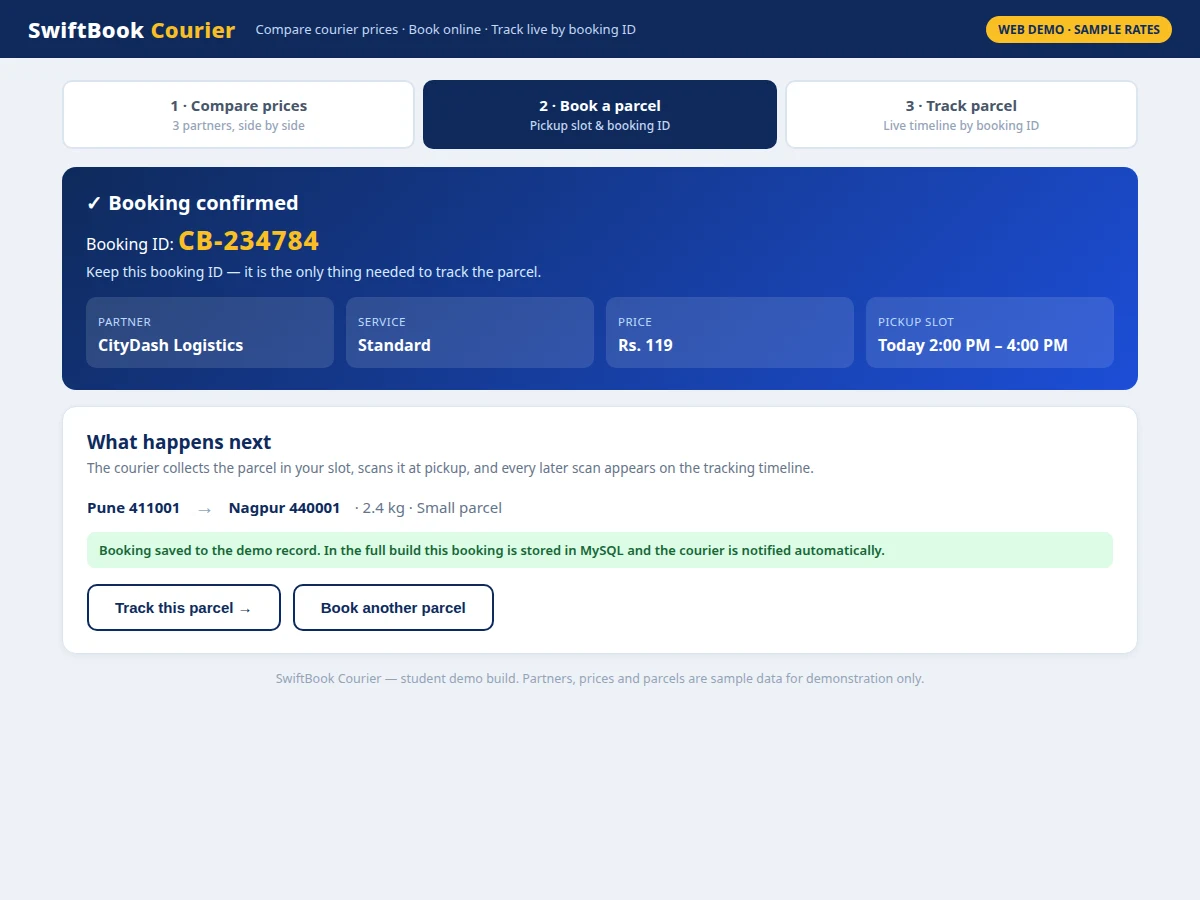
A booking starts with a price comparison and ends with a handover recorded against the booking ID, and every step between them is a scan that both sides can see. The customer enters the two pincodes and the parcel weight, and the system prices the parcel with all three partners from the same rate card, applying the base charge up to 1 kg plus a per-kg charge for each started kilogram above it. The customer picks a partner and a service tier, chooses one of four two-hour pickup slots, and confirms; the booking is stored in MySQL with a generated booking ID, and the courier is assigned the pickup. At the door the courier scans the parcel, and each later scan — hub departure, out for delivery, handover — is appended to the five-stage timeline, so the customer watches progress by booking ID instead of calling the courier to ask where the parcel is.
- The customer enters the pickup pincode, delivery pincode, parcel weight and parcel type, and selects a service tier: Standard, Express or Same-Day.
- The system prices the parcel with all three partners from the same rate card — base charge up to 1 kg plus a per-kg charge for each started kilogram above 1 kg — and shows the results side by side with the cheapest highlighted.
- The customer picks a partner and tier, fills in sender and receiver details, and chooses one of four two-hour pickup slots; slots that have already passed are disabled.
- On confirmation the booking is stored in MySQL with a generated booking ID (CB- followed by 6 digits), and the pickup is assigned to the chosen partner's courier.
- The courier scans the parcel at pickup, which starts the tracking timeline; each hub scan appends a stage with its time and place.
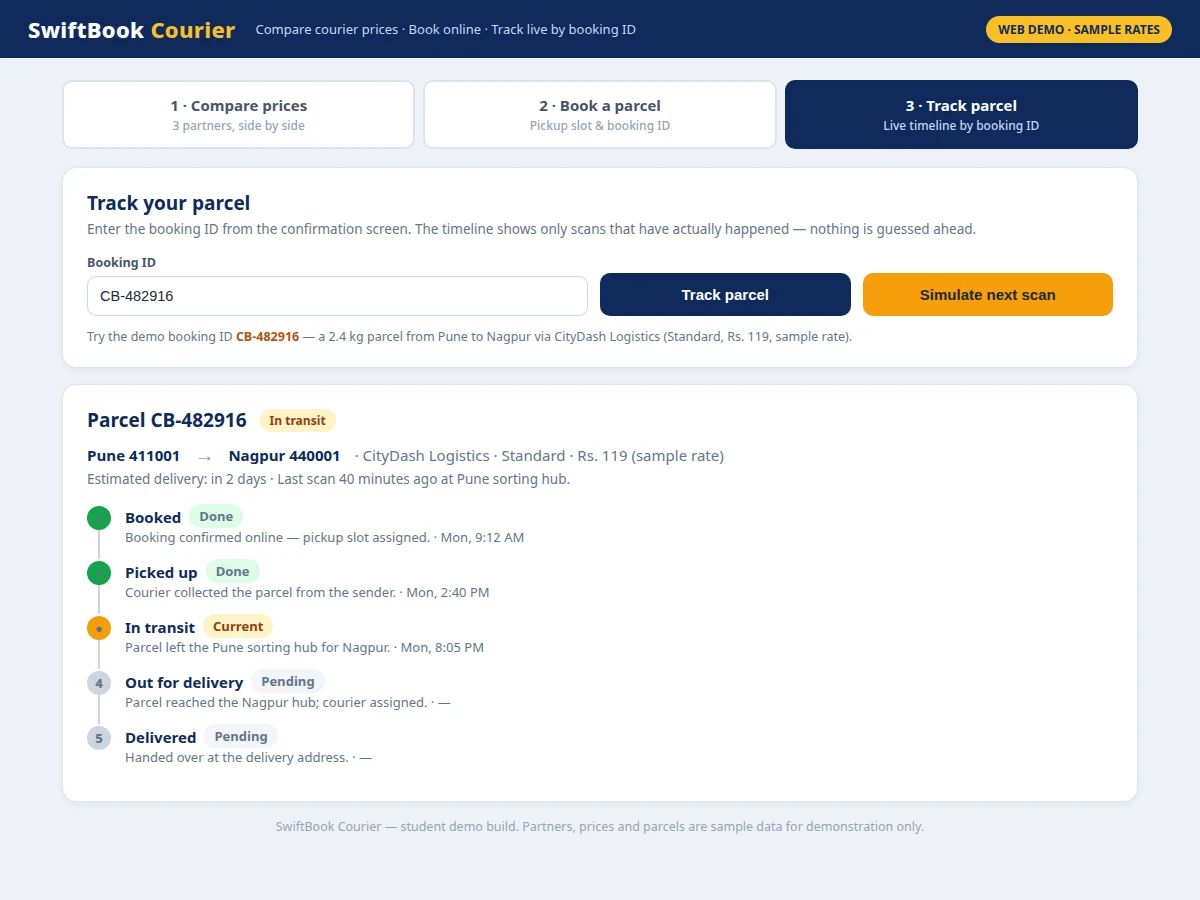
- The customer and receiver follow the five stages by booking ID until the handover is recorded and the parcel shows as Delivered.
Tech stack:
- PHP 8 · Laravel
- MySQL 8
- HTML5 · CSS3 · JavaScript
- Bootstrap 5
- REST API design
- Git
- XAMPP · Apache
| Parameter | Value |
|---|---|
| Platform | Web application, runs in any modern browser (design) |
| Partners compared | 3 demo partners — SwiftKart Courier, ExpressParcel, CityDash Logistics (demo build) |
| Service tiers | 3 — Standard, Express, Same-Day (design) |
| Price formula | Base charge up to 1 kg + per-kg charge for each started kg above 1 kg (design) |
| Sample Standard prices, 2.4 kg | Rs. 119 (CityDash) · Rs. 135 (SwiftKart) · Rs. 153 (ExpressParcel) (sample rates, demo build) |
| Sample Express base prices | Rs. 139–169 up to 1 kg (sample rates, demo build) |
| Sample Same-Day base prices | Rs. 229–259 up to 1 kg; not offered by CityDash (sample rates, demo build) |
| Maximum parcel weight | 10 kg per booking (design limit) |
| Pickup slots | 4 two-hour slots per day (design) |
| Tracking stages | 5 — Booked, Picked up, In transit, Out for delivery, Delivered (design) |
| Booking ID format | CB- followed by 6 digits (design) |
| Database | MySQL — users, partners, rate card, bookings, scans (design) |
| Demo rate combinations | 9 partner-tier combinations, 8 priced (demo build) |
| Price comparison | Renders in the browser with no page reload (demo build) |
Project features
The system's strongest capabilities are its multi-partner price comparison, its booking flow with a booking ID, its five-stage live tracking timeline, and its transparent rate card. The comparison prices one parcel with three courier partners — SwiftKart Courier, ExpressParcel and CityDash Logistics — across Standard, Express and Same-Day tiers, and highlights the cheapest option, so a 2.4 kg Pune–Nagpur parcel shows Rs. 119, Rs. 135 and Rs. 153 side by side in the demo. The booking form turns that choice into a confirmed pickup with a slot and a booking ID, and the tracking screen turns the ID into a timeline that only advances when a scan exists. Around those four sit the pickup slot picker, the rate card that makes every price traceable to its formula, and an admin dashboard that lists every booking with its status and partner.
- [Multi-partner price comparison] One parcel is priced with three courier partners at once from a single rate card, and the cheapest option is highlighted in the table. The demo's 2.4 kg Pune–Nagpur parcel prices at Rs. 119, Rs. 135 and Rs. 153 for Standard delivery, so the saving is visible before anything is booked.
- [Booking form with booking ID] The sender enters name, phone, pickup and delivery addresses, weight, partner, service tier and pickup slot, and the booking is confirmed instantly with a booking ID in the form CB- followed by 6 digits.
- [Live tracking timeline] Entering a booking ID shows the parcel's five-stage scan history — Booked, Picked up, In transit, Out for delivery, Delivered — with the time and place of each scan. A stage can only advance when a scan exists, so the timeline can never jump ahead of reality.
- [Standard, Express and Same-Day tiers] Three service speeds cover the real choice a sender makes: Standard in 3–5 days, Express in 1–2 days, and Same-Day within the city before the cut-off. Same-Day is not offered by every partner, and the table says so plainly.
- [Transparent rate card] Every price is traceable to one published formula: a base charge up to 1 kg plus a per-kg charge for each started kilogram above 1 kg. The rate card lists the base and per-kg charge for every partner and tier.
- [Pickup slot picker] The booking form offers four two-hour pickup slots per day, and slots whose start time has already passed are disabled, so a pickup can never be booked in the past.
- [Admin bookings dashboard] Staff see every booking in one list with its booking ID, partner, service tier, price, pickup slot and current tracking stage, so no booking needs a phone call to locate.
What is included
- Complete full-stack source code (PHP/Laravel backend, MySQL database, Bootstrap frontend)
- Working browser demo with price comparison, booking form and tracking timeline
- Rate-card configuration with the base and per-kg charge for every partner and tier
- Project report PDF (background, design, methodology, architecture, results)
- Project abstract PDF
- PPT presentation for final review
- Viva Q&A preparation document (rate-card pricing, booking flow, scan-based tracking, MySQL schema)
- Setup and demonstration guide
- To get this courier booking system built for you with your college's requirements and delivery timeline, message Projectech on WhatsApp for a quotation — the build covers the full web application (price comparison across 3 partners, online booking with booking ID, and live tracking timeline) as a built-to-order project, with the scope, price and delivery date confirmed before the build starts.
Limitations & prerequisites
- All prices in the demo are sample rates from a demo rate card, not any real courier's tariff; a live build must replace them with each partner's real rate API or tariff table.
- Tracking is scan-based, not continuous GPS: the timeline shows hub and handover scans, not the courier's live position on a map.
- Same-Day delivery is within-city only, needs booking before the cut-off, and is not offered by every partner in the demo.
- No payment gateway is integrated in the base build, so online payment collection is an optional customisation; the base build records the price and settles payment outside the system.
- The single-file demo holds bookings in the page, so demo bookings reset on reload; the full PHP and MySQL build stores every booking in the database.
- Live partner rates, courier assignment and SMS notifications need real partner accounts and credentials, which are not part of the student build.
Frequently Asked Questions
Is this project suitable for a final-year project?
Yes — for Computer Science, IT and Web Development students, because it combines full-stack web development, relational database design, a pricing engine with a transparent formula, and a complete user journey from comparison to booking to tracking. It demonstrates PHP and Laravel backend logic, MySQL schema design, and a working demo the student can walk through end to end in a viva.
How is this different from the courier management app on this site?
The courier management project on this site is an Android app that books doorstep pickups from a phone and tracks parcels by AWB number with offline-first storage. This project is a browser-based web application whose core is the multi-partner price comparison: the same parcel is priced with three partners side by side before anything is booked, and tracking runs on a booking ID, with no app install needed.
Where do the prices come from — are they real courier rates?
No, the demo prices are sample rates from a demo rate card built for this project, and every price in the demo and on this page is labelled as a sample rate. The pricing logic is real: each partner has a base charge up to 1 kg and a per-kg charge above it, and the demo's 2.4 kg parcel prices at Rs. 119, Rs. 135 and Rs. 153. A live deployment would swap the table for real partner tariffs.
How does live tracking work without GPS?
It tracks scans, not the courier. Each time the parcel is scanned — at pickup, at a hub departure, and out for delivery — the scan is recorded with its time and place, and the timeline shows those five stages. This is how real courier tracking works: the parcel's location is the location of its last scan, which is honest and needs no tracking hardware in the student build.
Can more courier partners or service tiers be added?
Yes — partners, tiers, base charges and per-kg charges all live in one rate-card table, and the comparison reads that same table, so adding a partner means adding rows, not changing the pricing code. The comparison table, the booking form and the admin dashboard all read that one table, so a new partner appears everywhere at once. The admin dashboard lists the partners and their rates, and a new city pair or weight slab is the same kind of table change.
What will I receive with the project?
The order includes the complete full-stack source code with the MySQL database, the working browser demo, the rate-card configuration, the project report and abstract PDF, the PPT presentation, the viva Q&A document and the setup guide. The price is confirmed by quotation, and the project is built to order rather than shipped from stock.
Components & software requirements
- PHP 8 · Laravel
- MySQL 8
- HTML5 · CSS3 · JavaScript
- Bootstrap 5
- REST API design
- Git
- XAMPP · Apache
Delivery information
Built-to-order project. Delivery timeline is shared after order confirmation based on current queue.
Support terms
Complete documentation, setup guide, and viva preparation included. Support for setup and explanation provided.
Download free synopsis (PDF)
Enter your name and WhatsApp number — the synopsis PDF downloads immediately. We may send occasional project updates on WhatsApp; no spam.