
More project photos (2)
The problem
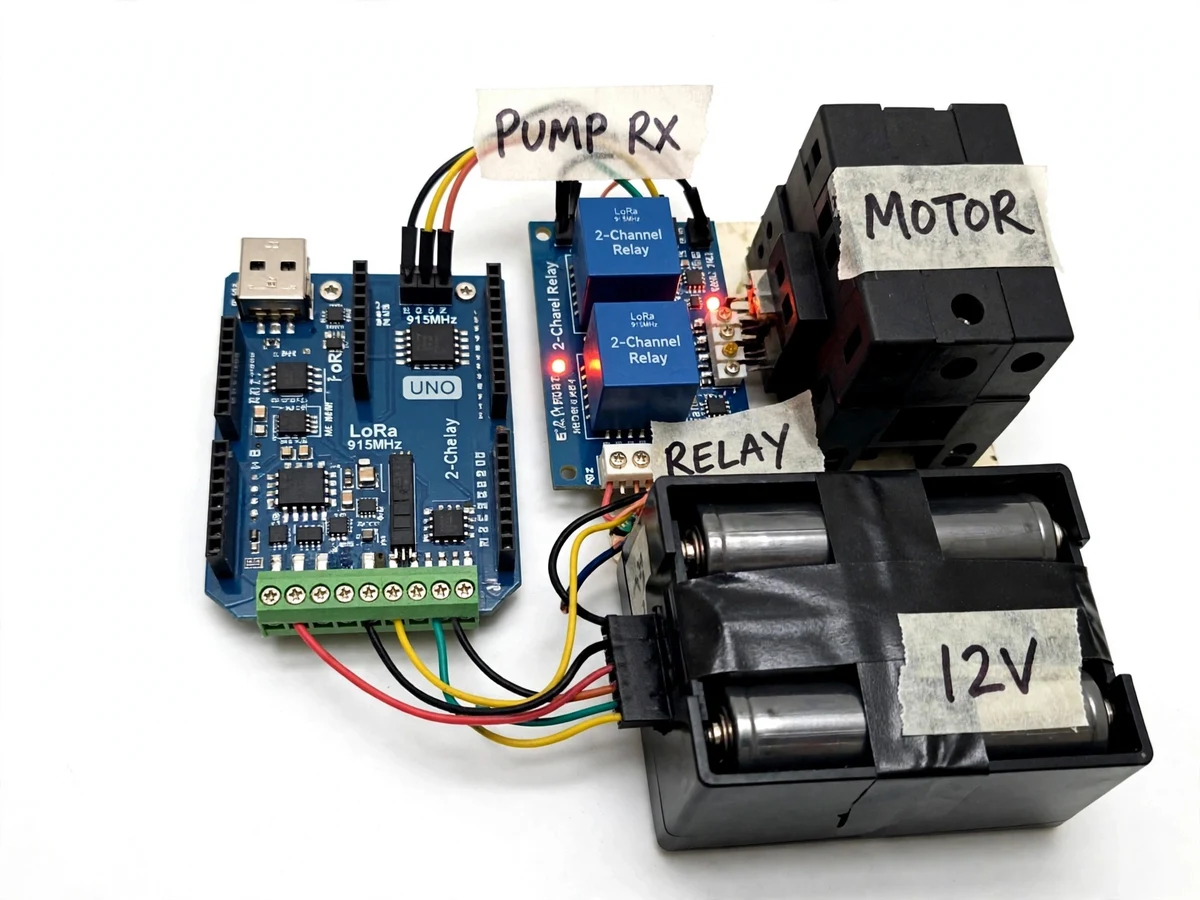
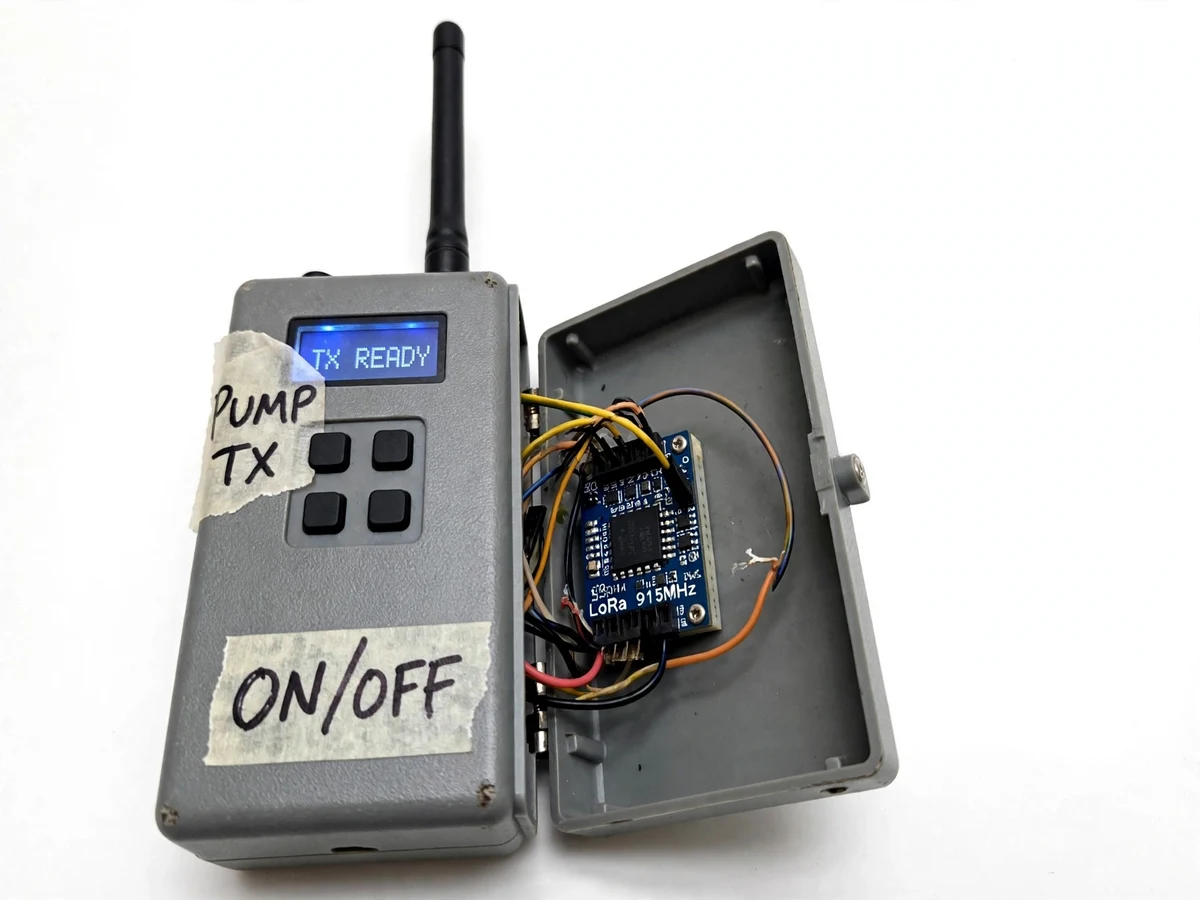
Farmers often have to walk long distances to the field to switch an irrigation pump on or off, and the trips are unavoidable because a stuck or dry-running pump wastes electricity and can burn out the motor. Mobile-network-based remote switches fail where coverage is poor, and most hobby remote switches are one-way — the farmer presses a button and hopes the pump obeyed. This project solves both gaps: a long-range LoRa radio link connects a handheld remote to the pump-side controller, and a two-way acknowledgement protocol reports the real pump state back to the remote's LCD. The system is split into two Arduino Nano units. The transmitter is a battery-powered handheld with a 4-key keypad and 16x2 LCD; pressing ON or OFF sends an addressed command over the SX1276 LoRa module and waits for acknowledgement. The receiver at the pump decodes the command, switches the motor through a relay-driven power contactor sized for the pump, then replies with the confirmed pump state, which the remote displays. If no acknowledgement arrives, the remote retries and clearly reports the failure instead of pretending the command went through. Everything works offline — LoRa is a direct radio link, so there is no cloud, no SIM card and no internet dependency.
Presses ON or OFF on the handheld transmitter.
Follow the working sequence
How it works
- The farmer presses ON or OFF on the handheld transmitter; the Arduino Nano builds an addressed command packet and sends it through the SX1276 LoRa module on 865–867 MHz.
- The receiver's LoRa module picks up the packet; the receiver Nano verifies the address and command checksum before acting on it.
- On a valid command, the receiver energizes the relay module, which pulls in the power contactor's coil and switches the pump motor circuit.
- The receiver reads back the relay/contactor drive state and transmits an acknowledgement packet containing the confirmed pump state.
- The transmitter's LCD displays the acknowledged state ("PUMP ON ✓" / "PUMP OFF ✓"); if no acknowledgement arrives within the timeout, it retries up to 3 times and then reports "NO ACK".
- A watchdog timer in the receiver firmware monitors link activity; if the pump is running and the configured quiet window expires, it drops the contactor as a fail-safe.
Tech stack:
- Arduino Nano (ATmega328P) × 2
- SX1276 LoRa module · 865–867 MHz
- Arduino IDE · embedded C++ firmware
- 16x2 LCD · 4-key keypad
- 2-channel relay module
- Power contactor (AC-3 duty)
- 12V SMPS supply
- Hand-wired prototype assembly
| Parameter | Value |
|---|---|
| Radio module | SX1276 LoRa, 865–867 MHz (India license-free band; firmware-configurable) |
| Link range | Design target ~2–5 km line-of-sight in open fields (per datasheet link budget — not a measured claim; field range-test procedure included) |
| Transmitter supply | 2× 18650 battery pack, expected ~8–10 hours of intermittent use |
| Receiver supply | 12 V DC, 2 A SMPS adapter |
| Relay contacts | 10 A, 250 V AC (module datasheet rating) |
| Contactor | 9 A AC-3 rated, 230 V coil (design target; contactor sized per the ordered pump rating) |
| Pump compatibility | Single-phase up to ~1.5–2 HP, or 3-phase via contactor sizing (design target; pump rating confirmed at order time) |
| Command round-trip | Design target under 2 seconds in normal conditions |
| Acknowledgement | Up to 3 retries, 1 s timeout per attempt (configurable in firmware) |
| Remote display | 16x2 character LCD with backlight |
| Operating mode | Fully offline — no internet, cloud or SIM required |
Project features
- [Bidirectional acknowledgement protocol] Every command expects a reply from the pump-side unit; the remote shows "PUMP ON ✓"/"PUMP OFF ✓" on its LCD, retries up to 3 times on timeout, and explicitly reports failure — no silent hope-the-command-landed behaviour.
- [True long-range LoRa link] SX1276 modules on the India license-free 865–867 MHz band give a design-target range of ~2–5 km line-of-sight in open fields (datasheet link budget; a field range-test procedure is included so the buyer measures the actual site range).
- [Contactor-based motor switching] The receiver drives a relay module that energizes an industrial-style power contactor, so the prototype demonstrates proper motor-control practice rather than overloading a small relay with motor current.
- [Handheld remote with LCD status] Battery-powered transmitter with keypad and 16x2 LCD showing link status, last command, and the acknowledged pump state — usable from the farmhouse or road.
- [Fail-safe on link loss] Configurable watchdog: if the pump is running and no valid link activity occurs within the configured window, the receiver drops the contactor to protect against a runaway pump (implemented in firmware, timeout adjustable).
- [Fully offline operation] No Wi-Fi, cloud or mobile network anywhere in the design — the point of LoRa is direct unit-to-unit radio, which also makes field demonstrations immune to network outages.
- [Addressed commands] Transmitter and receiver pair on a configurable address byte, so neighbouring units (or a future second pump) do not act on each other's commands.
What is included
- Working two-unit prototype: handheld transmitter + pump-side receiver, both wired and tested for the command/acknowledgement loop
- Firmware source code for both units (transmitter + receiver), with the acknowledgement protocol documented in comments
- Wiring diagrams for the transmitter and the receiver/contactor panel
- Component list with exact part numbers used in the build
- Range-test and installation procedure the buyer runs at their own site
- Project report PDF (background, LoRa theory, protocol design, methodology, results)
- PPT presentation for final review
- Viva Q&A preparation document (LoRa modulation, link budget, contactor vs relay, fail-safe design, electrical safety)
Limitations & prerequisites
- The ~2–5 km range is a design target derived from the SX1276 datasheet link budget, not a measured field result — the kit includes a range-test procedure the buyer runs at their own site to find the real figure.
- LoRa needs reasonable line-of-sight; dense trees, buildings and hills cut range significantly, and results vary with antenna height and placement.
- The acknowledgement confirms the receiver acted and the contactor drive state — the base build does not measure actual motor current, so it cannot detect a dry-running or stalled pump (current sensing is an optional customization).
- The prototype is a demonstration build, not a certified electrical panel or an IP-rated outdoor unit; weatherproofing the pump-side enclosure is an optional customization.
- Mains and motor wiring must be installed by a qualified electrician and comply with local wiring codes; the buyer performs installation following the supplied wiring diagram.
- Transmitter battery runtime is an expected value for intermittent use; continuous back-to-back commanding drains it faster.
- Only the 865–867 MHz band is configured for India; operating on other bands requires firmware and legal verification for the region of use.
Frequently Asked Questions
How far does it actually work?
The design target is ~2–5 km line-of-sight in open fields, derived from the SX1276 datasheet link budget — it is honestly stated as a target, not a measured claim. The kit includes a step-by-step range-test procedure so you can measure the real figure at your own site and report it in the viva.
Which frequency band does it use, and is it legal?
The firmware is configured for 865–867 MHz, the license-free band for short-range devices in India. The module is capable of other sub-GHz bands, but switching bands requires checking local regulations.
Can it switch a 3-phase agricultural pump?
Yes — the receiver drives a power contactor rather than switching motor current through a small relay, and the contactor is sized for the pump (single-phase ~1.5–2 HP or 3-phase) at order time. Final motor wiring is done by a qualified electrician.
What exactly does the feedback acknowledgement show?
The remote's LCD displays the pump state confirmed by the receiver ("PUMP ON ✓" / "PUMP OFF ✓"). If no acknowledgement arrives after 3 retries, it reports "NO ACK" so the farmer knows the command did not go through.
Does it need internet or a mobile network?
No — and that is the whole point. LoRa is a direct radio link between the two units, so it works in fields with zero mobile coverage and keeps working during network outages.
Is this project suitable for a final-year project?
Yes — for Electrical, Electronics and E&TC programs. It demonstrates wireless communication, link-budget thinking, relay/contactor motor control, protocol design with acknowledgements, and electrical safety practice. Suitable for B.E./B.Tech final-year projects in Electrical, Electronics and E&TC.
Components & software requirements
- Arduino Nano (ATmega328P) × 2
- SX1276 LoRa module · 865–867 MHz
- Arduino IDE · embedded C++ firmware
- 16x2 LCD · 4-key keypad
- 2-channel relay module
- Power contactor (AC-3 duty)
- 12V SMPS supply
- Hand-wired prototype assembly
Delivery information
Built-to-order project. Delivery timeline is shared after order confirmation based on current queue.
Support terms
Complete documentation, setup guide, and viva preparation included. Support for setup and explanation provided.
Download free synopsis (PDF)
Enter your name and email — the synopsis PDF downloads immediately. We may send occasional project updates; no spam, unsubscribe anytime.