
More project photos (3)
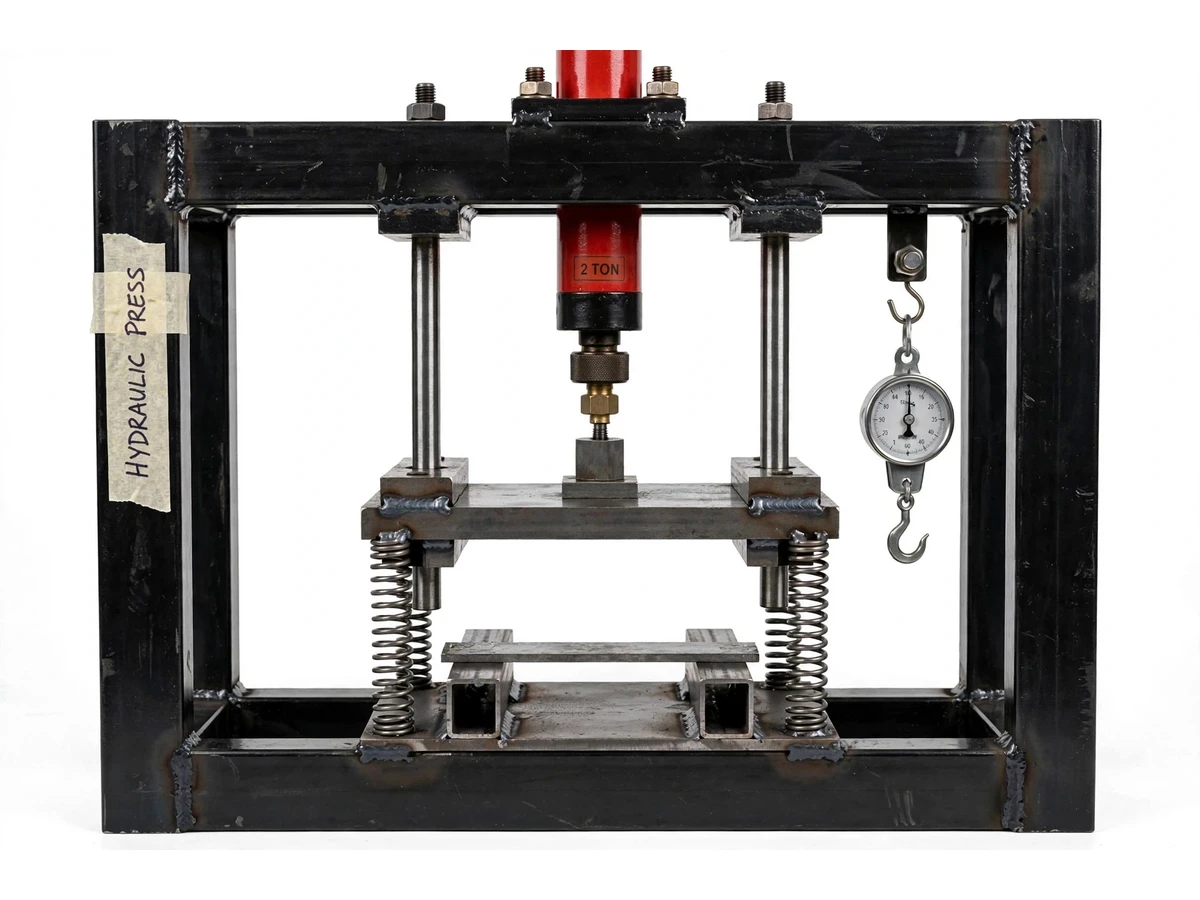
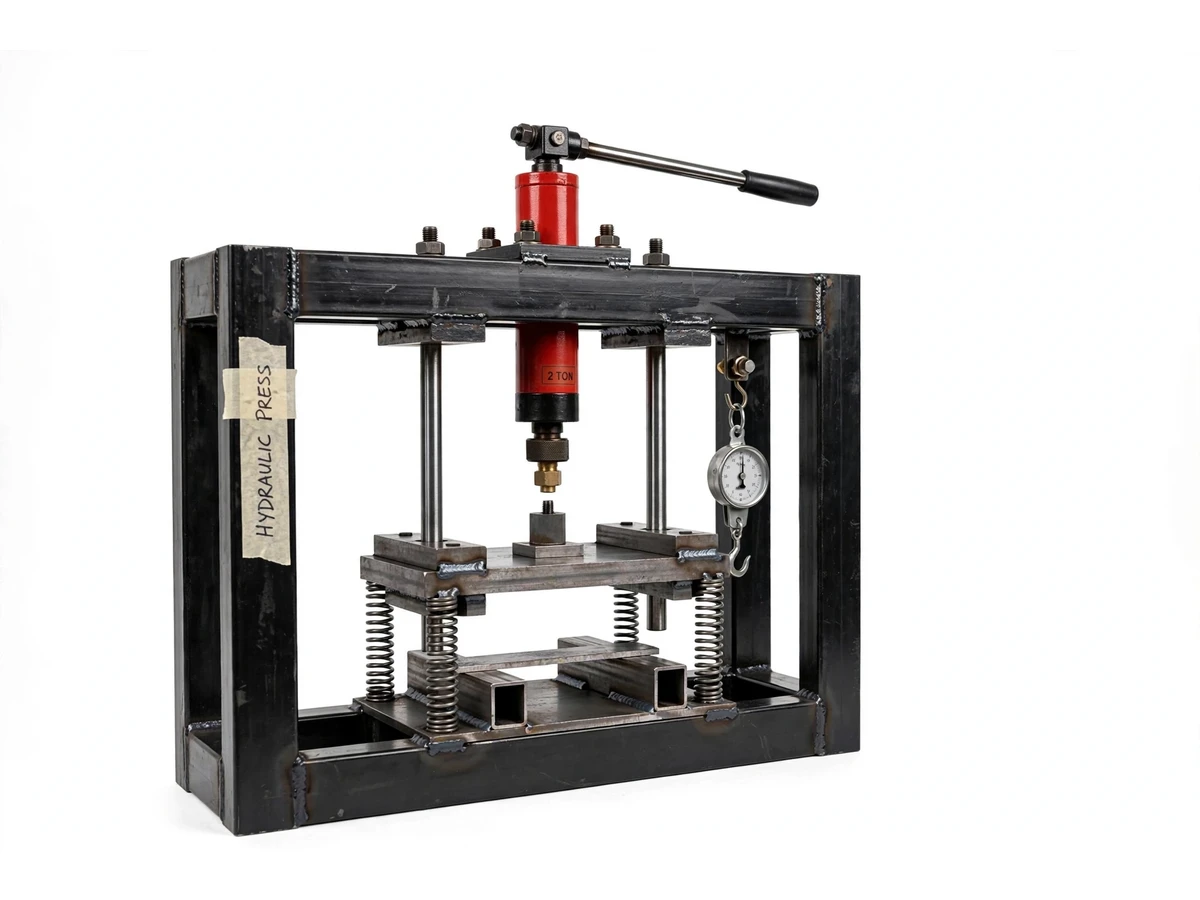
The problem
Pascal's law — pressure applied to a confined fluid transmits equally in all directions — is easy to state and hard to feel, until a student pumps a small handle and watches a bottle jack lift or crush with tonnes of force. This project turns that experience into a complete final-year build: a 2-ton bottle jack mounted inverted or upright in a welded MS H-frame, driving a moving platen against a work bed fitted with V-blocks and pressing fixtures. With it the student demonstrates bending a small strip, pressing a bearing onto a shaft, and straightening a bent rod — real workshop operations at demonstration scale. The engineering content is the force analysis: from the jack's pump-piston and ram diameters the student computes the theoretical force multiplication, measures their own handle effort with a spring balance, and reconciles the two through the jack's lever ratio — Pascal's law verified with the student's own hands on the handle.
Places the workpiece, pumps the handle, and measures effort for the Pascal check.
Follow the working sequence
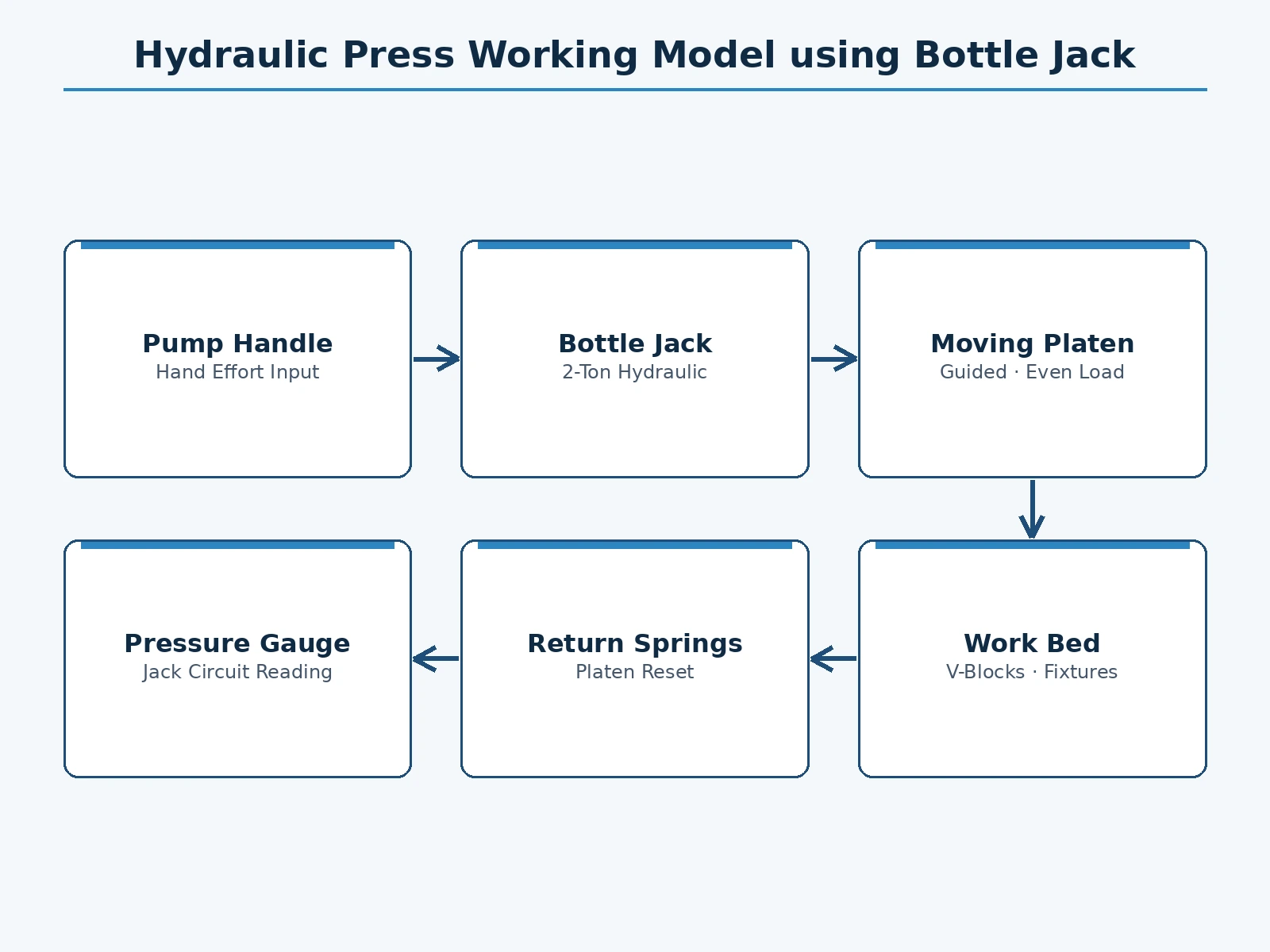
How it works
- Place the workpiece on the bed fixtures (V-blocks for bending, mandrel for bearing pressing) and lower the platen near it.
- Close the jack's release valve and pump the handle — each stroke drives a small volume of oil from the pump piston to the ram cylinder.
- Pressure builds equally throughout the confined oil (Pascal's law); acting on the large ram area it produces the pressing force on the platen.
- Continue pumping until the operation completes — the strip bends, the bearing seats, or the gauge (if fitted) reaches the target pressure.
- Open the release valve — oil returns to the reservoir and the return springs lift the platen back to rest.
- For the Pascal's-law check: measure handle effort with a spring balance, multiply through the handle lever ratio and the piston-area ratio, and compare the theoretical ram force with the jack's rated capacity.
- Repeat the demo operations and record handle strokes, effort and results in the observation sheet.
Tech stack:
- 2-ton hydraulic bottle jack
- Welded MS channel H-frame
- Guided moving platen
- Work bed with V-blocks and fixtures
- Return springs
- Spring balance (effort measurement)
- Optional hydraulic pressure gauge
- Front safety guard
| Parameter | Value |
|---|---|
| Jack capacity | 2 ton (manufacturer rating) |
| Theoretical force multiplication | Pump-piston to ram area ratio (computed from jack dimensions — design calculation) |
| Frame | Welded MS channel H-frame (design target factor of safety on yield) |
| Daylight (max opening) | Approximately 250 mm (design target) |
| Bed size | Approximately 300 × 250 mm (approximate) |
| Overall size | Approximately 500 × 400 × 900 mm (approximate) |
| Demo operations | Strip bending, bearing pressing, rod straightening |
| Handle effort | Student-measured with spring balance (procedure included) |
Project features
- [2-ton bottle jack as the power unit] A standard, off-the-shelf 2-ton hydraulic bottle jack — cheap, serviceable and familiar to every workshop — is the heart of the press.
- [Welded steel H-frame] A rigid MS channel H-frame carries the jack and resists the full pressing load with a calculated factor of safety.
- [Moving platen and work bed] A guided platen transmits the ram force evenly, and the bed accepts V-blocks and pressing fixtures for different demo operations.
- [Pascal's law verification] The student computes theoretical force multiplication from pump-piston and ram diameters and checks it against spring-balance handle-effort measurements.
- [Demo operations] Bending a strip, pressing a bearing, straightening a rod — three real operations the student performs and documents.
- [Spring-return assist] Return springs retract the platen when the jack's release valve is opened, resetting the press for the next cycle.
- [Pressure gauge port] A gauge tapping on the jack circuit (optional fitment) lets the student read hydraulic pressure during a press.
- [Safety stops and guarding] Mechanical stops limit platen travel and a front guard keeps hands clear of the pressing zone.
What is included
- Fabricated H-frame press with platen, bed and fixtures
- 2-ton bottle jack
- V-blocks, bending and pressing fixtures
- Return springs and safety stops
- Front safety guard
- Spring balance for effort measurement
- Pascal's-law calculation sheets (blank, for your measurements)
- Project report PDF (hydraulics theory, frame design, procedure)
- PPT presentation for final review
- Viva Q&A preparation document
Limitations & prerequisites
- The 2-ton figure is the jack manufacturer's rating; the force the student actually applies is whatever their pumping produces, measured via handle effort — no measured tonnage is claimed.
- Theoretical force multiplication is a design calculation from piston diameters; seal friction and lever losses make the real figure lower, and the report states this.
- Demo stock is limited to small, soft workpieces — this is a demonstration press, not a workshop production press.
- The frame is sized for the 2-ton jack only; fitting a larger jack would need a re-rated frame.
- Hydraulic oil level and release-valve condition must be checked per the maintenance notes; a leaking jack loses pressure mid-stroke.
Frequently Asked Questions
How does the student verify Pascal's law?
By measurement and calculation: handle effort from a spring balance, times the handle lever ratio, times the ram-area ÷ pump-piston-area ratio, gives the theoretical ram force. Comparing that chain with the jack's rated capacity shows where the multiplication comes from — all from the student's own numbers.
What can the press actually do?
Demonstration-scale operations: bend a small MS strip, press a small bearing onto a shaft, straighten a bent rod. Each is performed live and photographed for the report.
Why a bottle jack instead of a custom cylinder?
It is the honest engineering choice: a mass-produced, rated, serviceable hydraulic unit cheaper than any custom cylinder the student could build, and its published dimensions make the force-multiplication calculation possible.
Is it safe for a student to operate?
Yes with the procedure followed: safety stops limit travel, the guard keeps hands out of the pressing zone, the release valve gives instant pressure dump, and the manual lists the checks before every use.
What hydraulic theory does the viva cover?
Pascal's law, pressure–force–area relations, why the pump piston must displace many strokes to move the ram, volumetric vs mechanical efficiency of the jack, and frame stress basics.
Is this project suitable for a final-year project?
Yes — for Mechanical Engineering. It combines fabrication (welded frame), hydraulic theory verified by the student's own measurements, and live workshop demonstrations. Suitable for B.E./B.Tech final-year projects in Mechanical Engineering.
Components & software requirements
- 2-ton hydraulic bottle jack
- Welded MS channel H-frame
- Guided moving platen
- Work bed with V-blocks and fixtures
- Return springs
- Spring balance (effort measurement)
- Optional hydraulic pressure gauge
- Front safety guard
Delivery information
Built-to-order project. Delivery timeline is shared after order confirmation based on current queue.
Support terms
Complete documentation, setup guide, and viva preparation included. Support for setup and explanation provided.
Download free synopsis (PDF)
Enter your name and WhatsApp number — the synopsis PDF downloads immediately. We may send occasional project updates on WhatsApp; no spam.