
More project photos (3)

The problem
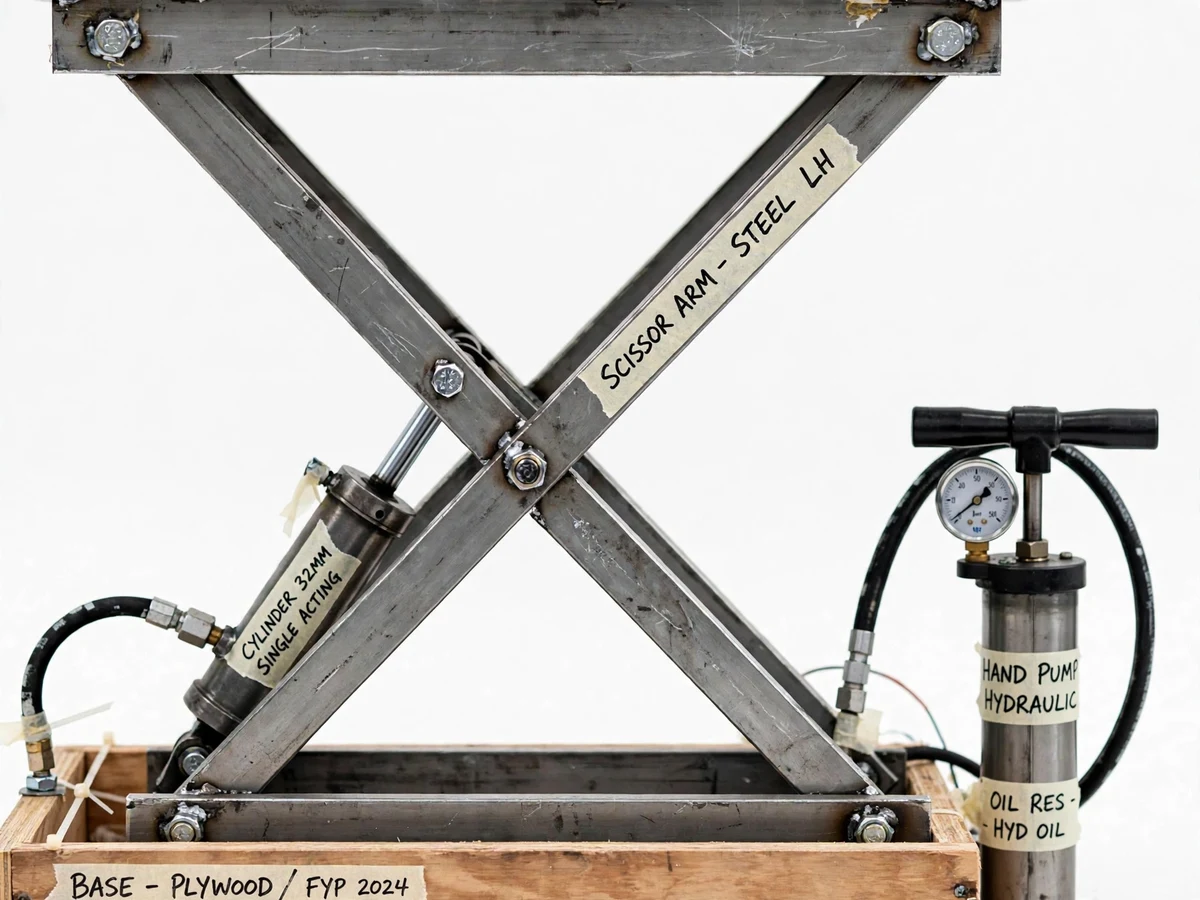
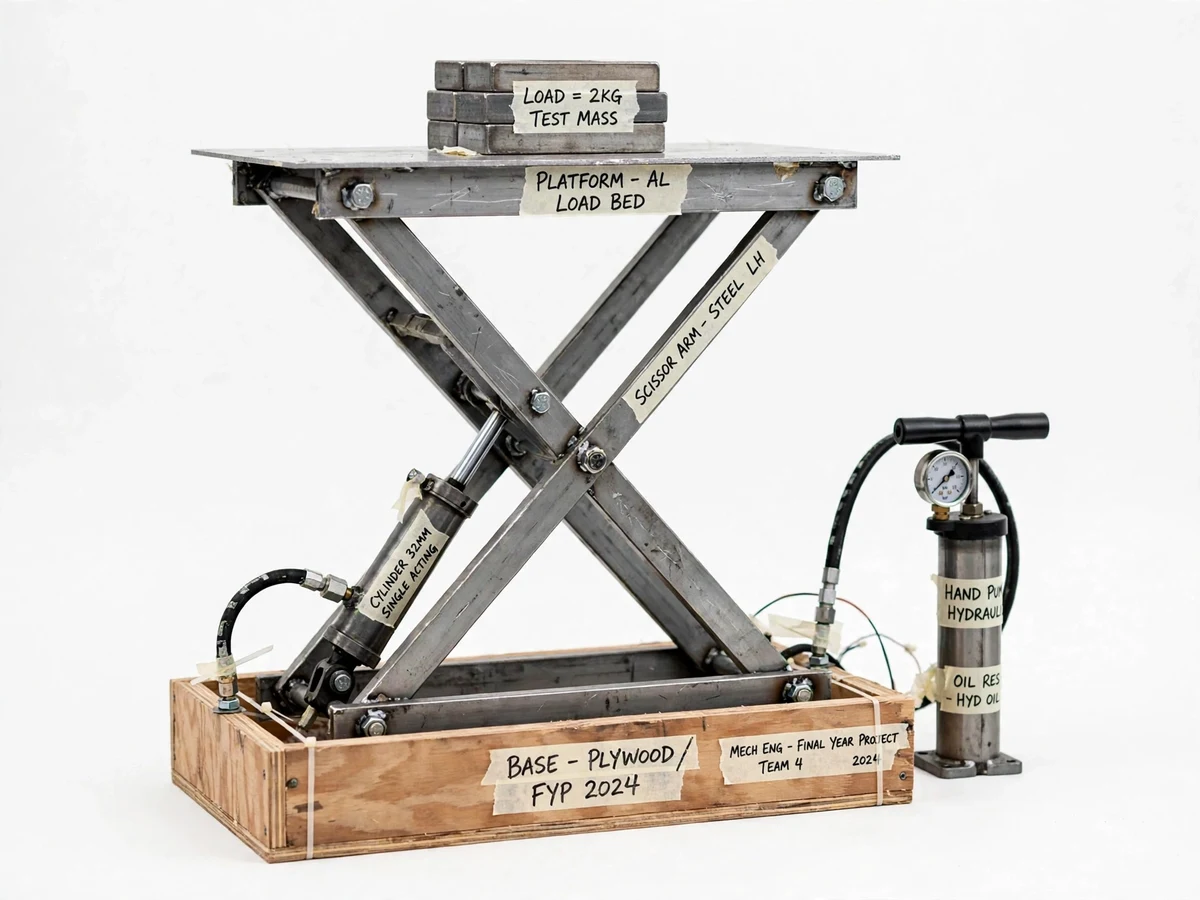
Scissor lifts are everywhere — in warehouses, workshops and construction — but their hydraulics are hidden inside sealed units. This project opens the mechanism up at working-model scale: a hand-operated hydraulic pump drives oil into a single-acting 32 mm cylinder, the cylinder pushes the scissor linkage, and the crossed steel arms convert a short piston stroke into a tall platform lift. A pressure gauge on the pump line lets the student read the actual hydraulic pressure for a known 2 kg test mass and check it against the theoretical value from piston area — Pascal's law as a measurement, not a slogan. The linkage geometry (arm length, pivot positions, lift height versus cylinder stroke) is designed and documented, making the kinematics as examinable as the hydraulics.
Places the test mass and works the pump lever.
Follow the working sequence
How it works
- The 2 kg test mass is placed on the aluminium platform and the release valve is closed.
- The operator works the hand-pump lever; each stroke forces oil into the cylinder.
- Rising oil pressure extends the cylinder piston against the scissor linkage.
- The scissor arms rotate about their centre pivots, raising the platform vertically.
- The pressure gauge reading is noted against the known load for the theory check.
- Opening the release valve lets oil return to the reservoir and the platform lowers under its own weight.
Tech stack:
- Single-acting hydraulic cylinder, 32 mm bore
- Hand-operated hydraulic pump with reservoir
- Hydraulic pressure gauge
- Steel scissor-linkage arms with pivot pins
- Aluminium platform (load bed)
- Hydraulic hoses and fittings
- Hydraulic oil (ISO 32 grade)
- Plywood base frame
| Parameter | Value |
|---|---|
| Cylinder bore | 32 mm, single-acting (nameplate/design value) |
| Test load | 2 kg marked test mass (design value) |
| Theoretical pressure | Approximately 2.5 bar for 2 kg on a 32 mm bore (calculated, g = 9.81) |
| Lift height | Approximately 250–350 mm platform travel (design target) |
| Platform | Aluminium load bed, approximately 300 × 300 mm (expected) |
| Pump | Hand lever pump with integrated reservoir (design target) |
| Oil | ISO 32 hydraulic oil (specified grade) |
| Base | Plywood frame, approximately 450 × 350 mm (expected) |
Project features
- [Scissor linkage mechanism] Crossed steel arms on pivot pins convert the cylinder's short stroke into vertical platform travel with documented kinematics.
- [Single-acting hydraulic cylinder] A 32 mm bore cylinder extends under oil pressure and retracts under the platform's weight through a release valve.
- [Hand-operated hydraulic pump] A lever pump with an oil reservoir pressurises the circuit — no electricity needed, and every stroke is felt by the operator.
- [Pressure gauge] A glycerine-filled gauge on the pressure line displays the working pressure for each lift, the key experimental reading.
- [2 kg test mass] A marked test mass provides the known load for pressure-versus-theory comparison.
- [Aluminium platform] A rigid aluminium load bed carries the test mass on the linkage top pivots.
- [Plywood base frame] A stable wooden base anchors the linkage bottom pivots and the pump.
What is included
- Fully assembled hydraulic scissor lift working model
- 2 kg marked test mass
- Pressure-versus-theory worksheet
- Hydraulic circuit sketch and hose routing diagram
- Project report PDF (background, Pascal's law, linkage kinematics, cylinder sizing, experiment procedure)
- PPT presentation for final review
- Viva Q&A preparation document (hydraulics, scissor kinematics, pressure-force relationship)
Limitations & prerequisites
- The 2 kg test load is a model scale — the rig demonstrates principles and is not a load-rated lifting device.
- Lift height of roughly 250–350 mm follows from the model linkage geometry; it does not scale to industrial lifts.
- Lowering speed depends on the release valve opening and platform weight; it is not a controlled descent rate.
- Hydraulic fittings must be checked for leaks before each demonstration session, per the operating procedure.
- The model is for indoor laboratory demonstration; seals and the plywood base are not weatherproof.
- Pressure readings include gauge least-count uncertainty, discussed in the error analysis section.
Frequently Asked Questions
How does the pressure gauge reading relate to the load?
Pressure equals force over piston area: a 2 kg mass (~19.6 N) on a 32 mm bore (~804 mm²) predicts about 2.5 bar, and the student compares the gauge reading against this — the core experiment.
Why a scissor linkage instead of lifting directly with the cylinder?
The crossed arms multiply a short cylinder stroke into a much taller lift and keep the platform level, which is the whole engineering point of the mechanism.
How does the platform come back down?
Opening the release valve lets pressurised oil flow back to the reservoir; the platform's own weight pushes the piston in. No power needed for descent.
What hydraulic oil is used?
ISO 32 grade hydraulic oil, filled to the reservoir mark. The procedure covers filling, bleeding air and leak checks.
Can it lift heavier loads?
The model is designed around the 2 kg test mass; heavier loads raise pressures beyond the model's design intent and are excluded in the operating limits.
Is this project suitable for a final-year project?
Yes — for Mechanical Engineering. It unites fluid power, mechanism kinematics and experimental verification in one visible, working model. Suitable for B.E./B.Tech final-year projects in Mechanical Engineering.
Components & software requirements
- Single-acting hydraulic cylinder, 32 mm bore
- Hand-operated hydraulic pump with reservoir
- Hydraulic pressure gauge
- Steel scissor-linkage arms with pivot pins
- Aluminium platform (load bed)
- Hydraulic hoses and fittings
- Hydraulic oil (ISO 32 grade)
- Plywood base frame
Delivery information
Built-to-order project. Delivery timeline is shared after order confirmation based on current queue.
Support terms
Complete documentation, setup guide, and viva preparation included. Support for setup and explanation provided.
Download free synopsis (PDF)
Enter your name and WhatsApp number — the synopsis PDF downloads immediately. We may send occasional project updates on WhatsApp; no spam.