
More project photos (2)
The problem
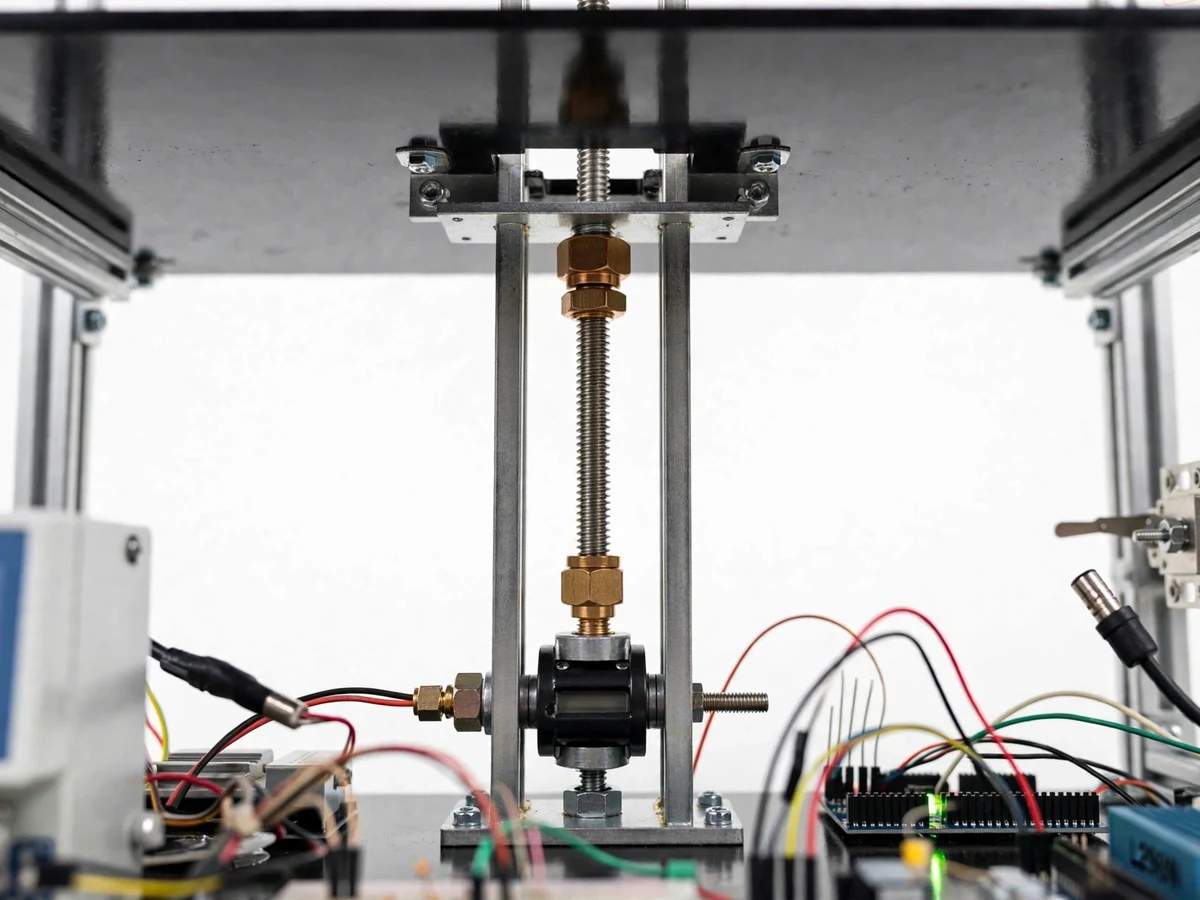
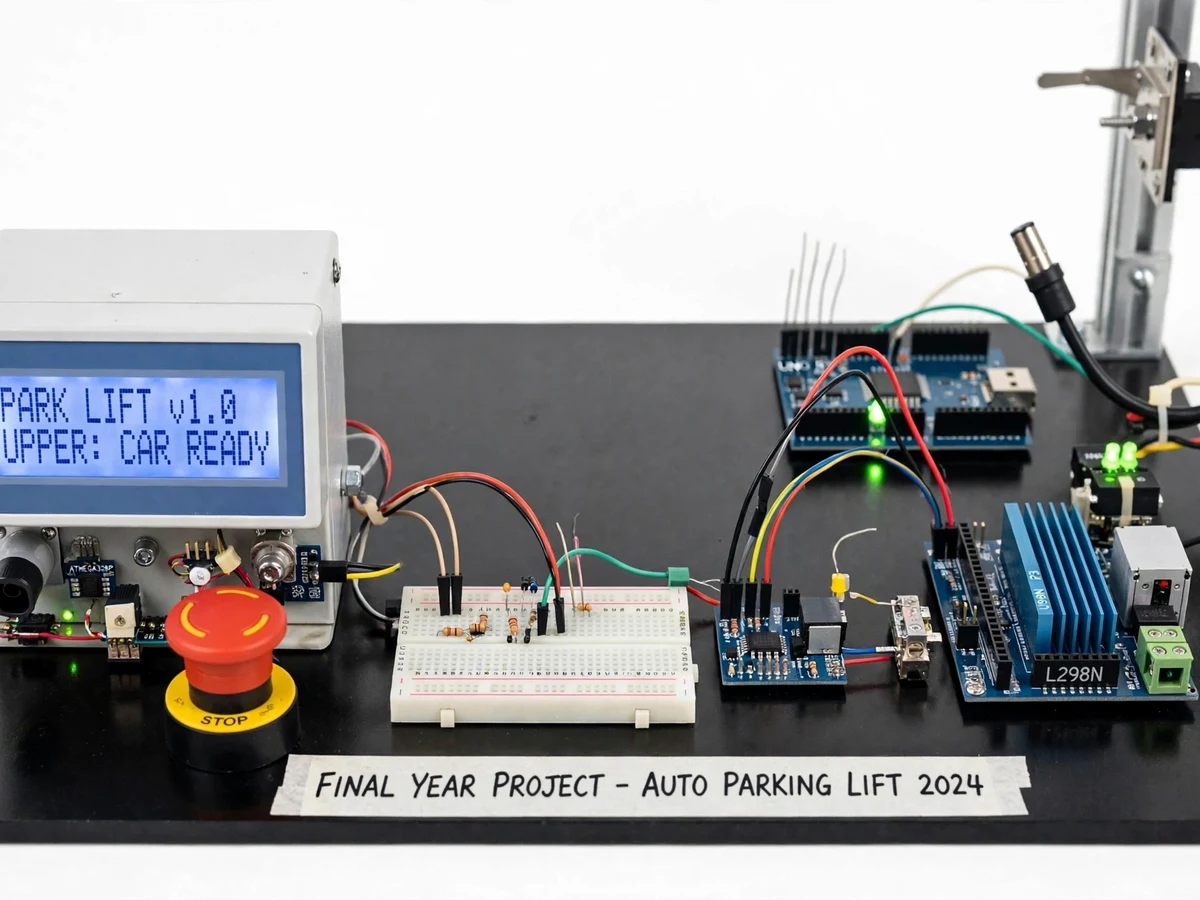
Urban parking is a geometry problem: land is scarce and cars are not getting smaller, so cities increasingly stack vehicles with automated parking lifts. The engineering behind those systems — a lift mechanism that carries a tonne safely, sensors that know a car is correctly positioned, and a controller that sequences the whole cycle without human error — is excellent final-year material, but students rarely get to build it because the real machines are industrial-scale. The gap is a bench-scale model that demonstrates the complete loop honestly: presence sensing, lift actuation, end-of-travel safety, and automatic sequencing. This project builds it: a two-level steel/wood frame, a platform driven by a lead-screw or rack-and-pinion lift mechanism with a DC gear motor, IR sensors confirming the car is on the platform and in position, limit switches at both travel ends, and an Arduino running the park/retrieve state machine with LCD status.
How it works
- The model car is driven onto the platform; the IR presence sensors confirm it is fully and centrally positioned.
- The student presses PARK; the Arduino verifies the sensors, then drives the gear motor to raise the platform.
- The platform travels until the top limit switch trips; the motor stops and the state latches as PARKED on the LCD.
- The car sits on the upper deck, freeing the ground position — the demo shows a second car using the lower bay.
- On RETRIEVE, the Arduino re-verifies the bay is clear, lowers the platform to the bottom limit switch, and releases.
- The E-stop, if pressed at any point, halts the motor instantly; the cycle resumes only after a manual reset and state re-check.
Tech stack:
- Arduino-class microcontroller
- DC gear motor with lead-screw / rack-and-pinion lift mechanism
- IR proximity sensors (car presence and position)
- Limit switches (top and bottom of travel)
- Latching emergency-stop button
- 16x2 LCD status display
- Motor driver module with current-limited supply
- Steel/wood two-level frame, model cars
- Arduino IDE (C/C++ firmware)
| Parameter | Value |
|---|---|
| Mechanism | Lead-screw or rack-and-pinion platform lift, DC gear-motor driven |
| Capacity | Design target: 2–3 kg model-car payload (student verifies on their build) |
| Sensing | IR car-presence sensors; top/bottom limit switches; software travel timeout |
| Control | Arduino state machine: IDLE → DETECTED → LIFTING → PARKED → RETRIEVING |
| Display | 16x2 LCD with live cycle state |
| Safety | Latching E-stop cuts motor drive; manual reset required |
| Frame | Two-level steel/wood structure; adjustable upper-deck height at build |
| Power | 12 V DC motor supply with current-limited driver |
Project features
- [Motorized platform lift] DC gear-motor driven lead-screw/rack lift raises the platform between ground and upper deck with smooth, controlled travel.
- [IR car-presence sensing] IR sensors confirm a car is fully on the platform before the lift moves — the lift never travels with a half-positioned car.
- [Limit-switch travel safety] Top and bottom limit switches stop the motor at the travel ends; the firmware also enforces a software travel timeout as a second layer.
- [Automatic park/retrieve cycle] One button starts the park sequence (detect → lift → confirm parked); another retrieves — a full state machine, not just up/down buttons.
- [LCD status display] Shows the current state (IDLE / CAR DETECTED / LIFTING / PARKED / RETRIEVING) so the examiner can follow the logic live.
- [Emergency stop] A mushroom/latching E-stop cuts motor drive immediately and requires a deliberate reset — real machine-safety practice at model scale.
- [Adjustable deck spacing] The frame allows the upper-deck height to be set at build, so the student can discuss the geometry trade-off (clearance vs lift time).
What is included
- Working parking-lift model (frame, platform, lift mechanism, sensors, electronics)
- Complete firmware source code (state machine, safety interlocks, LCD)
- Fabrication and assembly documentation with frame drawings
- Wiring and motor-driver documentation
- Test procedure (cycle timing, load check within design envelope)
- Component list with ratings
- Project report PDF (mechanism design, sensor logic, methodology, test results)
- PPT presentation for final review
- Viva Q&A preparation document (lead-screw mechanics, state machines, machine safety)
- Setup and demonstration guide
Limitations & prerequisites
- This is a scale demonstration model, not a vehicle lift: the design payload is a few kilograms of model car, and it must never be presented as capable of lifting real vehicles.
- Lift speed and cycle time are design outcomes of the motor and screw pitch chosen — measured by the student, not claimed at build.
- The IR sensors work in indoor lighting; strong direct sunlight can affect readings, which the demo setup notes acknowledge.
- The frame is a light student build; stability depends on correct assembly and the specified base/anchoring in the documentation.
- Real automated parking adds payment, access control and multi-bay management — this model demonstrates the single-bay lift cycle, and the report scopes it as such.
Frequently Asked Questions
How does the lift know a car is on it?
IR presence sensors under/around the platform confirm the car is fully positioned before the Arduino allows any travel — a half-on car blocks the cycle.
What stops the platform at the right height?
Top and bottom limit switches cut the motor at the travel ends, with a software travel-timeout as a backup layer.
What does the emergency stop do?
The latching E-stop cuts motor drive immediately at any point in the cycle; the system only resumes after a manual reset and a fresh state check.
How heavy a car can it lift?
The design target is 2–3 kg of model car. The actual figure is verified on your build with the included load-check procedure — it is a scale model, never a real-vehicle lift.
Can it park more than one car?
The model demonstrates a single-bay two-level cycle (one car up, one bay free below). Multi-bay management is discussed as future scope.
Is this project suitable for a final-year project?
Yes — for Mechanical and Mechatronics programs. It demonstrates mechanisms, sensor integration, state-machine control and machine-safety practice in one build. Suitable for B.E./B.Tech final-year projects in Mechanical and Mechatronics engineering.
Components & software requirements
- Arduino-class microcontroller
- DC gear motor with lead-screw / rack-and-pinion lift mechanism
- IR proximity sensors (car presence and position)
- Limit switches (top and bottom of travel)
- Latching emergency-stop button
- 16x2 LCD status display
- Motor driver module with current-limited supply
- Steel/wood two-level frame, model cars
- Arduino IDE (C/C++ firmware)
Delivery information
Built-to-order project. Delivery timeline is shared after order confirmation based on current queue.
Support terms
Complete documentation, setup guide, and viva preparation included. Support for setup and explanation provided.