
More project photos (2)
The problem
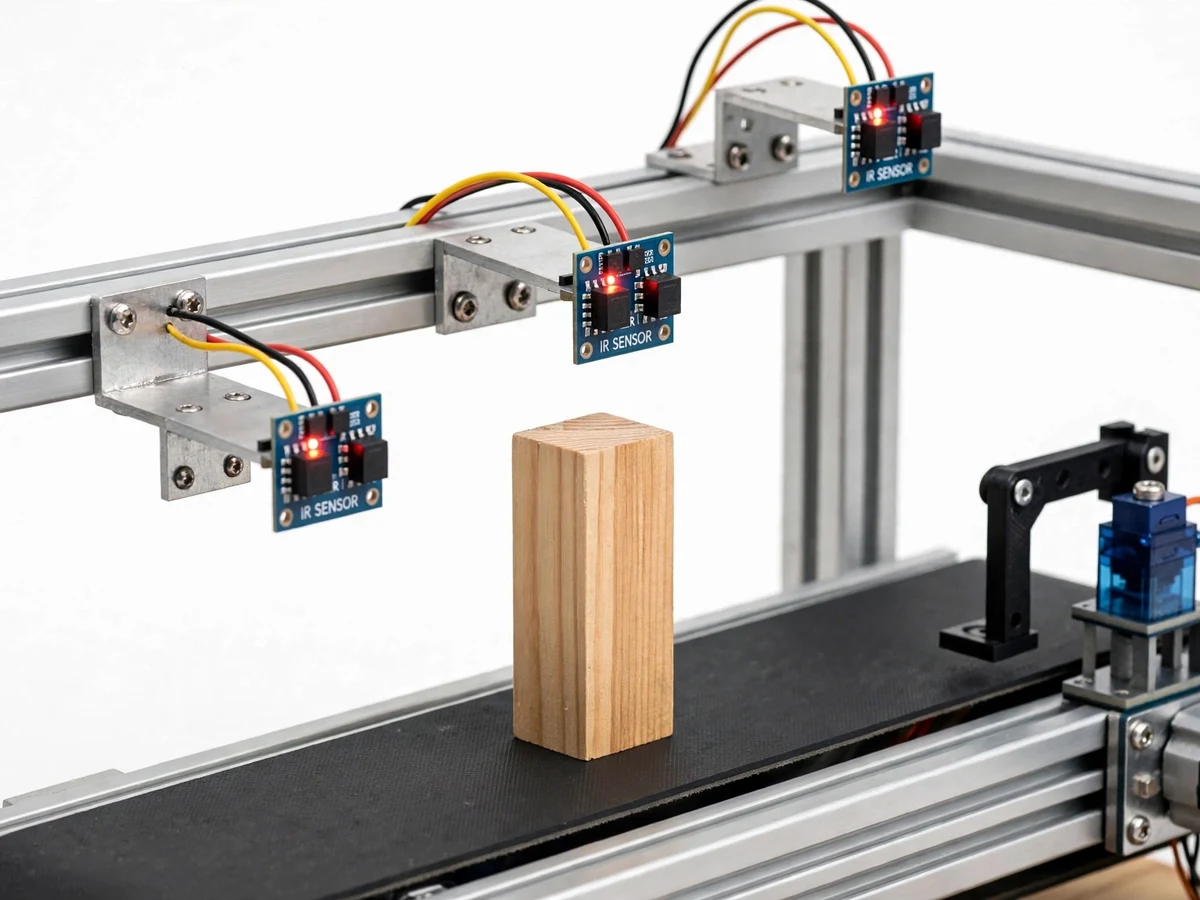
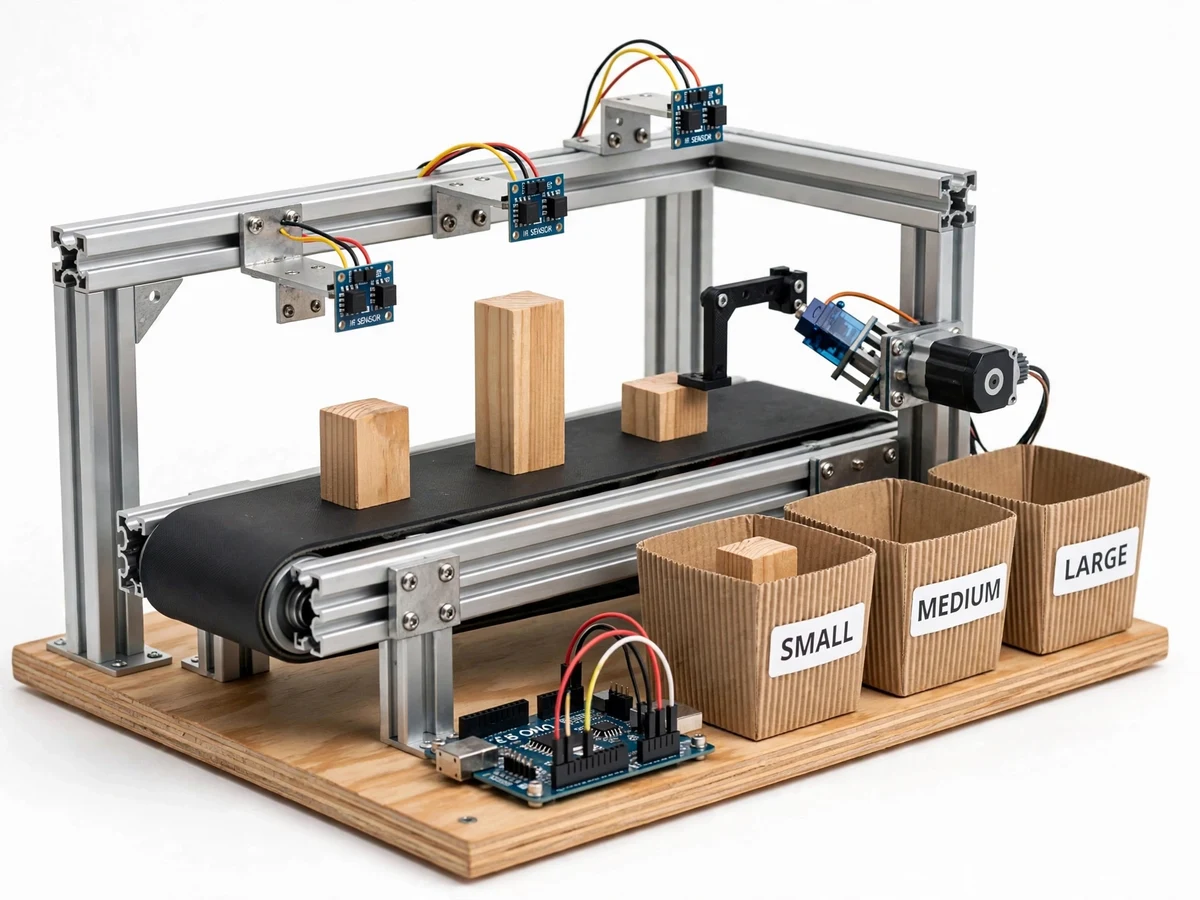
Sorting is one of the oldest jobs in factory automation — by size, by height, by color — and the modern answer is always the same architecture: a conveyor, a sensing gate, a decision, and a diverter. Students study PLCs and sensors in theory but rarely build the complete cell, so the timing relationships (how fast the belt can run before the diverter misses) stay abstract. The gap is a bench-scale line that makes those relationships physical and measurable. This project builds it: a belt conveyor on an aluminium/wood frame driven by a DC gear motor with speed control, a sensing gate of IR break-beam/reflective sensors at staggered heights, an Arduino that classifies each passing object into height bands, and servo pusher arms that sweep each object into its bin. Bin counters on the LCD and a jam-detection timeout complete the industrial feel.
How it works
- The DC gear motor drives the belt; the student sets a belt speed with the PWM control.
- An object enters the sensing gate and breaks a subset of the staggered IR beams.
- The Arduino reads the beam pattern and classifies the object into a height band (short / medium / tall).
- Using the known belt speed, the firmware times the object's arrival at the diverter station.
- The matching servo pusher arm sweeps at the computed moment, diverting the object into its bin; the LCD counter increments.
- If the gate stays blocked past the jam timeout, the belt halts and the LCD shows the jam state until the student clears and resets.
Tech stack:
- Arduino-class microcontroller
- Belt conveyor (DC gear motor, PWM speed control)
- IR break-beam / reflective sensors at staggered heights
- Servo-driven pusher diverter arms (one per bin)
- 16x2 LCD with bin counters
- Collection bins (3 height bands)
- Aluminium/wood conveyor frame
- Arduino IDE (C/C++ firmware)
| Parameter | Value |
|---|---|
| Conveyor | Belt on frame; DC gear motor with PWM speed control |
| Sensing | Staggered IR sensor gate; beam-break pattern encodes height band |
| Sorting bands | 3 height bands (adjustable sensor heights on slotted rails) |
| Diversion | Servo pusher arms, timing computed from belt speed |
| Display | 16x2 LCD: bin counts + state (RUN / JAM / IDLE) |
| Safety/faults | Jam timeout halts belt; manual clear-and-reset |
| Throughput | No claimed rate at build — the student measures max reliable speed in their trials |
| Objects | Demo blocks of 3 distinct heights supplied; bands re-definable |
Project features
- [IR height-sensing gate] Multiple IR sensors at staggered heights detect which beams an object breaks — the pattern directly encodes its height band with no camera or vision processing.
- [Servo diverter arms] One pusher arm per bin sweeps the object off the belt at the right moment; the timing is computed from the measured belt speed.
- [Belt-speed control] A PWM speed control lets the student find the maximum reliable sorting rate — the core experiment of the report.
- [Bin counters on LCD] Each successful diversion increments its bin count on the 16x2 LCD, giving a live production tally for the demo.
- [Jam detection] If an object blocks the gate beyond the timeout, the belt stops and the LCD flags a jam — the same fault handling real lines implement.
- [Adjustable sensor heights] The gate sensors mount on slotted rails so the student can redefine the height bands and re-run their calibration.
- [Student-set thresholds] Beam patterns, timing delays and speed limits are all firmware constants set during the buyer's calibration runs — no claimed sorting figures at build.
What is included
- Working conveyor sorting cell (frame, belt, gate, diverters, bins, electronics)
- Complete firmware source code (classification, timing, jam handling, LCD)
- Fabrication and assembly documentation with frame drawings
- Sensor-gate calibration procedure (set bands, verify timing at speeds)
- Component list with ratings
- Project report PDF (automation theory, sensor logic, methodology, student's trial data)
- PPT presentation for final review
- Viva Q&A preparation document (IR sensing, timing analysis, industrial automation basics)
- Setup and demonstration guide
Limitations & prerequisites
- Sorting accuracy and throughput are design targets measured by the student — belt slip, sensor response time and servo speed all limit the real rate, and the report must present measured, not claimed, figures.
- The gate classifies by height band only; color, weight and material are not sensed — the report scopes the system honestly as a single-feature sorter.
- IR sensors need reasonably consistent ambient light; strong direct sunlight on the gate can affect readings in outdoor demos.
- Objects must be placed with spacing; overlapping objects defeat any gate-type sorter, and the procedure specifies the minimum gap.
- The frame and belt are a student build; continuous multi-hour production running is outside its design envelope.
Frequently Asked Questions
How does it measure height without a camera?
Staggered IR beams at different heights: a short object breaks only the low beam, a tall one breaks all three — the break pattern is the height measurement.
How does the pusher know when to fire?
The Arduino knows the belt speed and the gate-to-diverter distance, so it computes the arrival time and fires the servo at that moment.
What happens if two objects touch?
They read as one tall object — like any gate sorter, it needs spaced objects, and the procedure specifies the minimum gap.
How fast can it sort?
That is your experiment: the PWM speed control lets you raise belt speed until misses start, and you report the maximum reliable rate from your own trials.
Can the height bands be changed?
Yes — the sensors mount on slotted rails and the bands are firmware constants, so you redefine and recalibrate for different object sets.
Is this project suitable for a final-year project?
Yes — for Mechanical and Mechatronics programs. It demonstrates the sense-decide-actuate automation cell with real timing analysis. Suitable for B.E./B.Tech final-year projects in Mechanical and Mechatronics engineering.
Components & software requirements
- Arduino-class microcontroller
- Belt conveyor (DC gear motor, PWM speed control)
- IR break-beam / reflective sensors at staggered heights
- Servo-driven pusher diverter arms (one per bin)
- 16x2 LCD with bin counters
- Collection bins (3 height bands)
- Aluminium/wood conveyor frame
- Arduino IDE (C/C++ firmware)
Delivery information
Built-to-order project. Delivery timeline is shared after order confirmation based on current queue.
Support terms
Complete documentation, setup guide, and viva preparation included. Support for setup and explanation provided.